
Médoc Wine Map: Free Download
Eight appellations on the left bank of the Gironde, from Saint-Estèphe to Margaux.
This free Médoc wine map shows all eight appellations of the Médoc: the communal appellations of Saint-Estèphe, Pauillac, Saint-Julien, Listrac-Médoc, Moulis-en-Médoc and Margaux, plus Haut-Médoc and Médoc, with the 1855 classified growths marked along the Gironde. Download it as a high-resolution image or a letter-size PDF. No signup is required, and the map is free for personal and non-commercial use.
- Location: Left bank of the Gironde estuary, north of the city of Bordeaux
- Grapes: Cabernet Sauvignon and Merlot lead, with Cabernet Franc, Petit Verdot and Malbec
- Appellations: Eight: Médoc, Haut-Médoc and six communal appellations
- 1855 Classification: 60 of the 61 classified red wines are in the Médoc; the other is Haut-Brion in Pessac-Léognan
- First Growths: Lafite Rothschild, Latour and Mouton Rothschild in Pauillac, and Château Margaux
- Soils: Gravel ridges near the estuary, the classic sites for Cabernet Sauvignon
The Médoc is the long tongue of land between the Gironde estuary and the Atlantic forests, north of Bordeaux. Its most famous vineyards sit on gravel ridges close to the estuary, where the communal appellations line up from south to north: Margaux, Saint-Julien, Pauillac and Saint-Estèphe, with Listrac-Médoc and Moulis inland. The Haut-Médoc appellation covers the rest of the southern half, and the Médoc appellation, sometimes called the Bas-Médoc, covers the north.
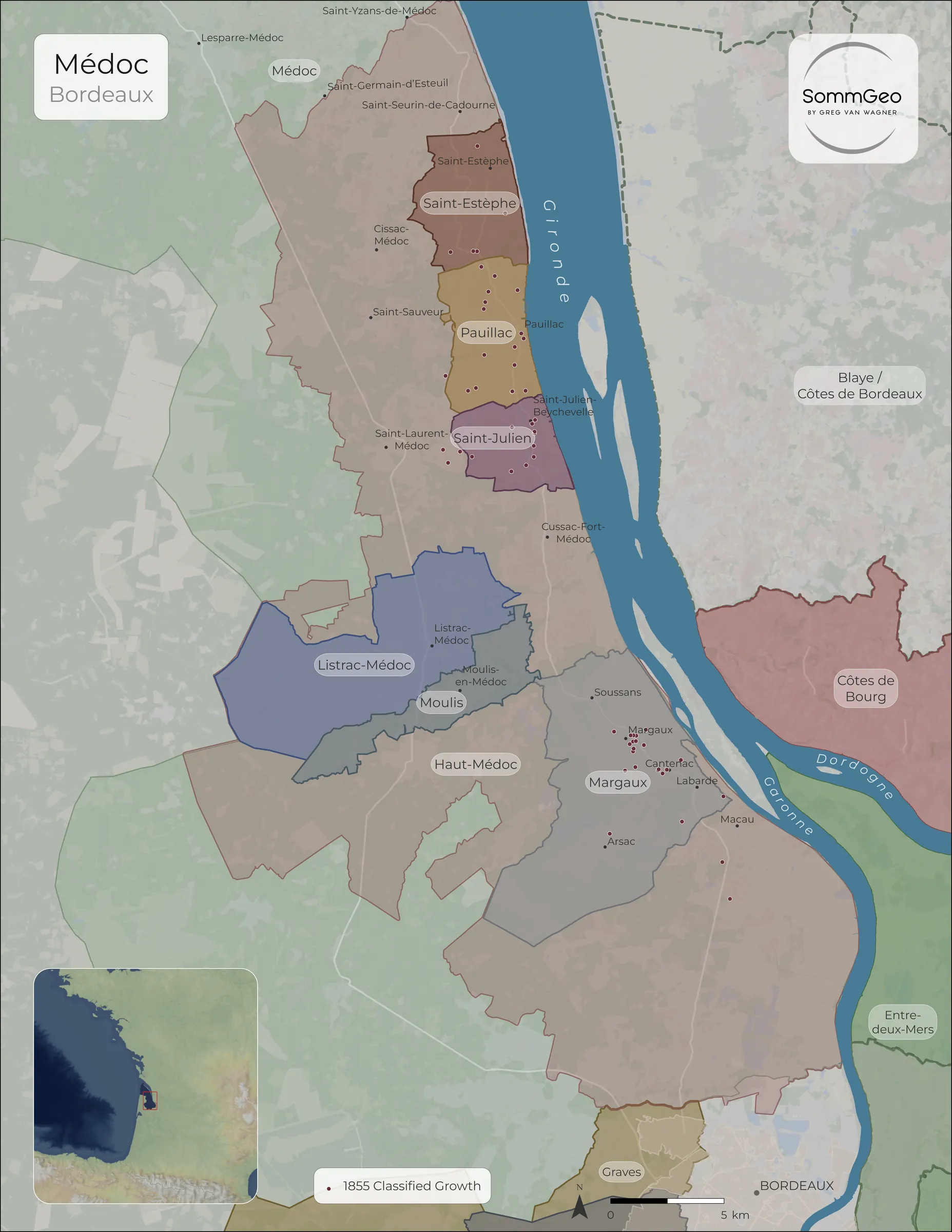
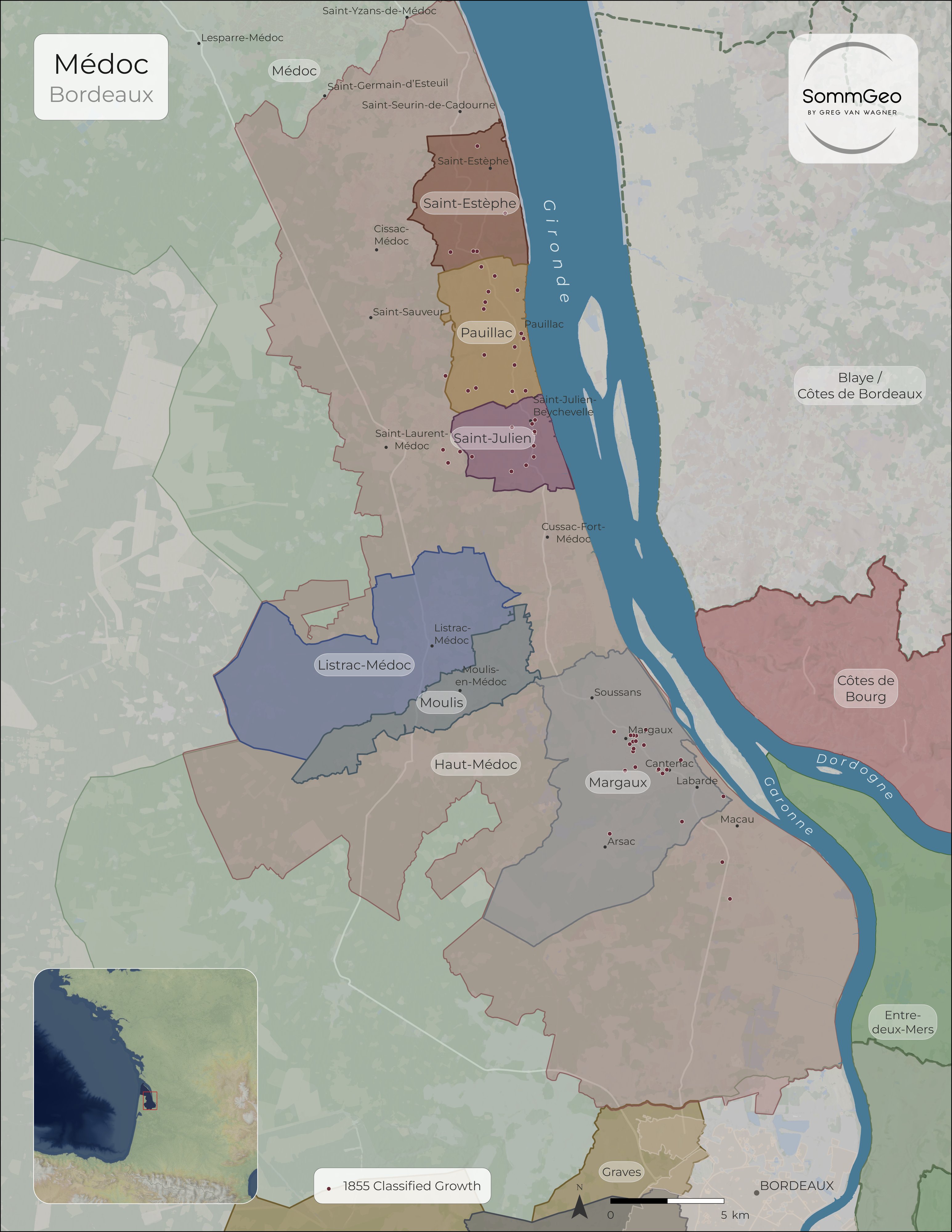
SommGeo Classic Map Series: free for personal and non-commercial use.
What This Map Covers
This classic map shows every Médoc appellation boundary, with the 1855 classified growths marked as dots and the main villages labeled. Graves, the Côtes de Bourg, Blaye and Entre-Deux-Mers are shown at the edges for context, along with the Gironde, Garonne and Dordogne.
- The six communal appellations: Saint-Estèphe, Pauillac, Saint-Julien, Listrac-Médoc, Moulis-en-Médoc and Margaux
- Haut-Médoc and Médoc, the two regional appellations around them
- The 1855 classified growths marked across the communes
- The five villages of the Margaux appellation: Margaux, Cantenac, Soussans, Labarde and Arsac
- The Gironde estuary and the meeting of the Garonne and Dordogne, with Bordeaux at the southern edge
The Communal Appellations
Pauillac holds three of the five First Growths, Lafite Rothschild, Latour and Mouton Rothschild, and is known for the most structured, Cabernet-led wines. Saint-Julien, just to the south, is small but dense with classified growths. Margaux, the southernmost, has more classified growths than any other commune, spread across five villages. Saint-Estèphe, in the north, has more clay and gives firmer wines. Listrac-Médoc and Moulis, inland, have no classified growths but are a good source of value.
The 1855 Classification
The 1855 classification ranked the leading red wines of Bordeaux in five tiers, from First to Fifth Growths. Today it lists 61 wines, and all but Château Haut-Brion are in the Médoc. The best-known change since 1855 was the promotion of Château Mouton Rothschild to First Growth in 1973. The dots on this map show where the classified estates sit.
Gravel and the Estuary
The best Médoc vineyards sit on gravel ridges deposited by the ancient Garonne, close enough to the Gironde to benefit from its moderating influence. The deep, free-draining gravel suits Cabernet Sauvignon. Further inland and to the north, clay and limestone increase and Merlot plays a bigger role.
Key Producers
Beyond the First Growths, names to know include Léoville Las Cases, Ducru-Beaucaillou and Léoville Barton in Saint-Julien, Pichon Baron and Pichon Comtesse in Pauillac, Cos d’Estournel and Montrose in Saint-Estèphe, Palmer and Rauzan-Ségla in Margaux, and Chasse-Spleen and Poujeaux in Moulis.
Médoc Wine Map: Frequently Asked Questions
What are the appellations of the Médoc?
Eight: the communal appellations of Saint-Estèphe, Pauillac, Saint-Julien, Listrac-Médoc, Moulis-en-Médoc and Margaux, and the two regional appellations, Haut-Médoc and Médoc. All eight are outlined on this map.
What is the difference between Médoc and Haut-Médoc?
Haut-Médoc covers the southern half of the peninsula, closer to Bordeaux, and surrounds the six communal appellations. Médoc covers the northern part. “Haut” refers to its position upstream on the estuary, not to altitude.
Where are the First Growths?
Lafite Rothschild, Latour and Mouton Rothschild are in Pauillac, and Château Margaux is in Margaux. The fifth, Haut-Brion, is in Pessac-Léognan, south of Bordeaux and off this map.
Which grapes are grown in the Médoc?
Cabernet Sauvignon and Merlot lead, with smaller amounts of Cabernet Franc, Petit Verdot and Malbec. Cabernet Sauvignon dominates on the gravel near the estuary, while Merlot is more important on the heavier soils inland and to the north.
Is this Médoc map free to download?
Yes. Download the high-resolution image or the letter-size PDF for personal and non-commercial use, with no signup. If you share or teach with it, credit it visibly as Map: SommGeo (sommgeo.com). Commercial use, including embedding or printing for sale, requires a SommGeo commercial license.
Want to explore the Médoc and all of Bordeaux in 3D with interactive layers, elevation data and appellation boundaries? Join 200+ wine organizations already using SommGeo.
Start Your 15-Day Free Trial $5/month billed annually after trial · Cancel anytimeMap Usage
Free for your own study and tastings. If you share or teach with a map, credit it visibly as Map: SommGeo (sommgeo.com). Commercial use requires a Commercial Embed License. See Map Usage, Credit and Licensing.
Map by Greg Van Wagner, SommGeo