
Argentina Wine Regions Map: Interactive Guide
From Mendoza’s high-altitude Malbec vineyards to the extreme elevations of Salta and the cool-climate frontier of Patagonia. Exploring the country that redefined New World wine.
Argentina’s wine regions map tells the story of a country that spent centuries making wine for itself before the rest of the world caught on. The fifth-largest wine producer on the planet, Argentina stretches its vineyards across a staggering 2,400 kilometers (1,491 miles) from the subtropical north to the wind-battered south of Patagonia, nearly all of it in the rain shadow of the Andes. What makes Argentina singular isn’t just Malbec (though that alone would be enough). It’s the combination of extreme altitude, desert-dry growing conditions, and an indigenous grape pool (Torrontés, Bonarda, Criolla) that you simply won’t find anywhere else. With over 100 Geographical Indications (IGs) now recognized by the INV and a classification system that’s rapidly evolving, Argentina’s appellation landscape is far more complex than most wine professionals realize. This interactive Fast Map lets you search and explore every classified wine region across the country, and every single mapped region includes detailed popup information covering grape varieties, climate and elevation data, soil profiles, viticulture, and wine law, essentially putting a sommelier-level reference guide directly inside the map.
Unlock the Full SommGeo Toolkit
Gain exclusive access to our entire suite of premium features, including interactive Map Makers, immersive 3D Tours, high-resolution classic Maps, and advanced analytical tools.
Start Free TrialWhat You’ll Explore
This interactive Fast Map is a fully searchable 2D atlas of every classified wine appellation in Argentina, but the real depth is in the detail. Click on any mapped region and a comprehensive info panel opens with the kind of content you’d find in an advanced sommelier study guide: vineyard hectarage, elevation ranges, climate profiles with diurnal temperature data, soil composition, dominant grape varieties with planting percentages, key producers, sub-region breakdowns, and relevant wine law. For example, clicking the Uco Valley reveals everything from its 28,500 hectares (70,425 acres) and 900–1,500m (2,953–4,921 ft) altitude range to the fact that Malbec accounts for over 55% of plantings and that GIs like Gualtallary and Paraje Altamira are producing some of South America’s most sought-after wines. Every single region on the map has this level of built-in intelligence.
- Every Argentine IG, DOC, and IP designation mapped with searchable boundaries
- In-depth region profiles for every mapped area: grape varieties, climate data, elevation, soils, and producers
- Mendoza sub-regions including Luján de Cuyo, Maipú, Uco Valley, and San Rafael with full breakdowns
- Northern regions from Salta’s Calchaquí Valleys to Jujuy and Catamarca
- Patagonian appellations including Río Negro, Neuquén, and Chubut
- Emerging regions like San Juan’s Pedernal, Córdoba, and Buenos Aires province


A Brief History of Argentine Wine
Viticulture arrived in Argentina with Spanish missionaries and conquistadors in the mid-16th century, with the first recorded commercial vineyard likely established at Santiago del Estero in or around 1557. Plantings expanded to Mendoza by the early 1560s and San Juan shortly after. For three centuries, the industry was local and modest: missionaries making sacramental wine, settlers growing the pink-skinned Criolla grapes brought from the Canary Islands. In 1853, Domingo Faustino Sarmiento, then a leading provincial politician (and later president), pushed to bring French agronomist Michel Aimé Pouget to Mendoza to introduce European grape varieties and establish a model training vineyard. Among those cuttings was Malbec, and April 17, 1853, the date Sarmiento initiated his research center, is now celebrated worldwide as Malbec Day.
The arrival of the Buenos Aires–Mendoza railway in 1885 was the real spark. What had been a month-long mule journey became a single day by train, and the Argentine wine industry exploded. Massive immigration from southern Europe (particularly Italy and Spain) brought both labor and know-how. By 1910, roughly 80% of Mendoza’s vineyards were planted with French stock, mainly Malbec. Argentina became one of the world’s largest wine producers, but for most of the 20th century, production focused almost entirely on volume for domestic consumption (Argentines were drinking 90 liters (23.8 gallons) per capita at the peak). The economic crises of the 1970s and 1980s devastated the industry. Between the 1960s and mid‑1990s, the vast majority of Argentina’s Malbec was uprooted and replaced with higher‑yielding Criolla and Cereza for bulk wine.
The modern era began in the 1990s. Nicolás Catena Zapata, widely credited as the father of modern Argentine wine, began experimenting with high-altitude plantings and brought in American winemaker Paul Hobbs to consult. Catena planted the Adrianna Vineyard in Gualtallary at nearly 1,500 meters (4,921 ft) in 1994, at the time, an act most considered reckless. It turned out to be visionary. Foreign investment poured in, stainless steel tanks replaced concrete, and Argentina shifted from bulk production to export-quality wines. Malbec plantings tripled from under 10,000 hectares (24,710 acres) in the mid-1990s to over 44,000 today, and in 2010, the Argentine government declared wine the country’s “National Beverage.”
Wine Law & Classification
Argentina’s wine classification system is regulated by the Instituto Nacional de Vitivinicultura (INV) under Law No. 25.163, which established three tiers of geographic designation. At the broadest level, Indicación de Procedencia (IP) covers table wines with at least 80% of grapes from the named area, but is rarely seen on exported wines. Indicación Geográfica (IG) is the more specific designation, verifying that the wine originates from a defined region, province, department, district, or non-political zone, and that its qualities reflect that origin. Argentina also has Denominación de Origen Controlada (DOC), which functions similarly to European appellations, specifying not just geography but also permitted varieties, yields, and production methods, with wines subject to a tasting panel for typicity.
In practice, the DOC tier has seen minimal uptake. Only two DOCs have been approved in over 30 years: Luján de Cuyo DOC (1989), which requires predominantly Malbec, and San Rafael DOC (2007). Fewer than a dozen wineries actively use either designation on their labels. The real action is in the IG system, which has expanded rapidly; the INV has certified over 100 Geographical Indications as of recent count. The breakthrough moment came in 2013 with the approval of Paraje Altamira IG in the Uco Valley, the first Argentine GI delimited by actual soil and climate research rather than political boundaries. That required five years of study, 200 soil pits, and collaboration between producers and the Universidad de Cuyo. Since then, several more research-driven GIs have followed in Mendoza, including Los Chacayes, San Pablo, Agrelo, and Las Compuertas.
Climate & Geography
Nearly all of Argentina’s wine production sits in the Andes’ rain shadow, a long, narrow strip of desert and semi-arid land running from roughly 22°S latitude in Jujuy to 45°S in Chubut. The Andes block Pacific moisture, creating conditions so dry that irrigation isn’t just helpful, it’s essential for survival. Historically, vineyards were flood-irrigated via canal systems channeling Andean snowmelt, infrastructure the region’s indigenous peoples and later Spanish settlers developed centuries ago. Modern operations increasingly use drip irrigation for precision water management.
Altitude is Argentina’s defining viticultural advantage. Vineyards range from around 300 meters (984 ft) in Patagonia’s Río Negro up to 3,000 meters (9,843 ft) in Salta’s Colomé estate, among the highest commercial vineyards on the planet. This elevation delivers intense solar radiation, which concentrates color and flavor in the grapes, combined with dramatic diurnal temperature swings (daytime highs exceeding 35°C (95°F) dropping to 12°C (54°F) or lower at night) that preserve acidity and build aromatic complexity. The result is wines with a signature combination of power and freshness that’s difficult to replicate at lower elevations.
Grape Varieties
Malbec is the undisputed flagship: one in five vines in Argentina is Malbec, with around 44,000 hectares (108,726 acres) planted. Argentine Malbec has evolved into something genuinely distinct from its French ancestor in Cahors: the berries are smaller, the clusters tighter (suggesting a unique clone that may have gone extinct in France), and the wines tend toward richer fruit, softer tannins, and a velvety texture rather than the more austere, tannic profile of Cahors. The best expressions come from high-altitude sites in Luján de Cuyo and the Uco Valley, where the concentration of color and structure is extraordinary.
Torrontés is Argentina’s white wine calling card, a grape you genuinely won’t find making serious wine anywhere else. It’s actually a family of three distinct varieties (Torrontés Riojano, Sanjuanino, and Mendocino). Torrontés Riojano, by far the most important, produces intensely aromatic wines with floral and stone fruit character
Beyond the headliners, Bonarda (actually Douce Noir from Savoie, not the Italian Bonarda) is Argentina’s second most-planted red and a value play. Cabernet Sauvignon, Syrah, Tempranillo, and Cabernet Franc all perform well, particularly at altitude. In Patagonia’s cooler south, Pinot Noir and Merlot are producing increasingly compelling results, and the old-vine Semillon in Río Negro is a genuine discovery. And then there are the Criollas, the pink-skinned grapes (Criolla Grande, Cereza) that once dominated Argentine production. While largely used for bulk wine and grape concentrate, a handful of producers are now championing old-vine Criolla plantings as a link to Argentina’s viticultural heritage.
Key Wine Regions
Mendoza
Mendoza accounts for roughly two-thirds of Argentina’s entire wine production and is the country’s viticultural heart. The three sub-regions to know are Luján de Cuyo, Argentina’s first DOC and home to some of its most historic Malbec vineyards in districts like Perdriel, Agrelo, and Vistalba; Maipú, directly east, with its older vineyards and increasingly interesting Cabernet Sauvignon; and the Uco Valley, the high-altitude frontier where districts like Gualtallary, Paraje Altamira, and Los Chacayes are producing some of South America’s most exciting wines. Producers like Catena Zapata, Zuccardi, Achaval-Ferrer, and Cobos have put Mendoza on the global fine wine map, but there are hundreds of smaller operations doing remarkable work.
Salta & the Northwest
The Calchaquí Valleys of Salta (centered on Cafayate) are home to some of the world’s highest vineyards. At elevations between 1,600 and 3,000 meters (5,249–9,843 ft), the combination of extreme UV radiation, massive diurnal temperature shifts, and virtually zero rainfall produces wines of exceptional concentration and aromatic intensity. This is the heartland of Torrontés, but Malbec, Cabernet Sauvignon, and Tannat also grow.
San Juan
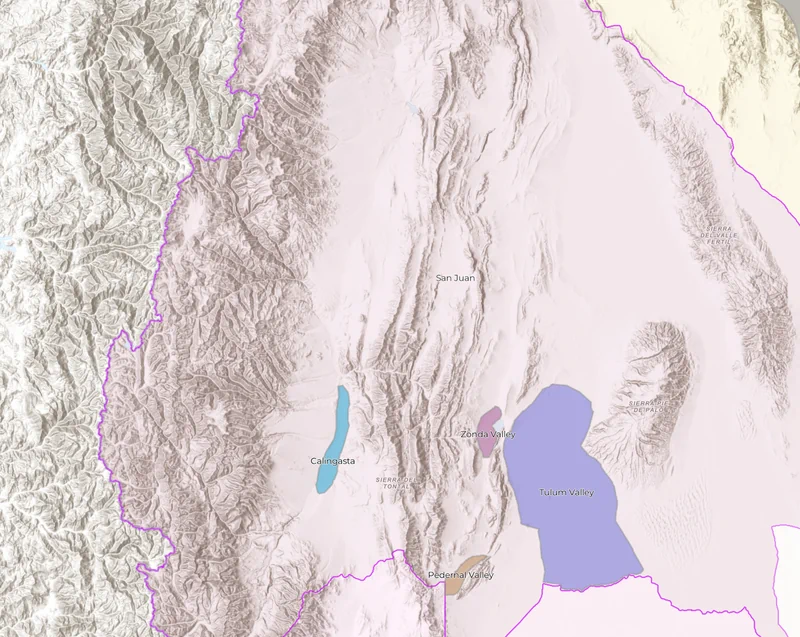
Argentina’s second-largest wine region by vineyard area has historically been dismissed as bulk production territory, and much of it still is. The high-altitude sites of Pedernal and La Ciénaga, in the western foothills, are producing reds (particularly Syrah and Malbec) that rival quality from the Uco Valley. San Juan also holds old-vine Criolla plantings in Calingasta that are being rediscovered.
Patagonia
The southern frontier. Río Negro and Neuquén represent Argentina’s cool-climate answer to the Malbec-dominated warmth of Mendoza. Vineyards sit at much lower elevations (around 300 meters (984 ft)) but benefit from a long, cool growing season, persistent winds, and chalky soils that produce wines of notable elegance and restraint. Humberto Canale, established in 1909, has been making wine here for over a century, and Bodega Chacra’s old-vine Pinot Noir has become one of Argentina’s most sought-after bottles. Further south, Chubut is pushing the frontier to some of the southernmost commercial vineyards in the world.
New to the Fast Maps? Learn how to search regions, navigate layers, and get the most from your interactive map.
Fast Map Guide →Ready to explore Argentina’s wine regions in full detail? Join 200+ wine organizations already using SommGeo.
Start Your 15-Day Free Trial $5/month billed annually after trial · Cancel anytime