
Argentina Wine Tour: Uco Valley, Mendoza & Beyond in 3D
From the limestone-laced heights of Gualtallary to the desert vineyards of Cafayate. Argentina’s wine revolution is being written in altitude and subregion.
Argentina’s wine story has shifted dramatically in the past two decades. What was once a conversation dominated by big, oak-heavy Malbec from the Mendoza flatlands is now a granular discussion about subregional identity, limestone soils, and picking dates that have moved a full month earlier. The Uco Valley (and Gualtallary in particular) sits at the center of this transformation, but the story extends well beyond Mendoza. Cafayate’s high-desert Torrontés, San Juan’s bulk-to-quality evolution, and La Rioja’s quiet Famatina Valley all play roles. This Tour takes you through the regions, the subzones that matter, and the producers driving the change.
Unlock the Full SommGeo Toolkit
Gain exclusive access to our entire suite of premium features, including interactive Map Makers, immersive 3D Tours, high-resolution classic Maps, and advanced analytical tools.
Start Free TrialInside This Tour
This Tour moves through Argentina’s major wine provinces: Mendoza, Salta, San Juan, La Rioja, and the Uco Valley subregion that is redefining Argentine wine. Every map frame is fully interactive. Don’t just watch the flythrough. Click, drag, zoom, and rotate the 3D terrain to explore from any angle, then click every pin for the full content.
- Uco Valley subregions: Gualtallary, Altamira, La Consulta, and more
- Mendoza zone flavor profiles: how Luján de Cuyo, Maipú, and Uco express Malbec differently
- Producer profiles on Catena Zapata, SuperUco, Cheval des Andes, and notable others
- Cafayate Valley and Calchaquí Valley: Torrontés, high-altitude reds, and desert viticulture
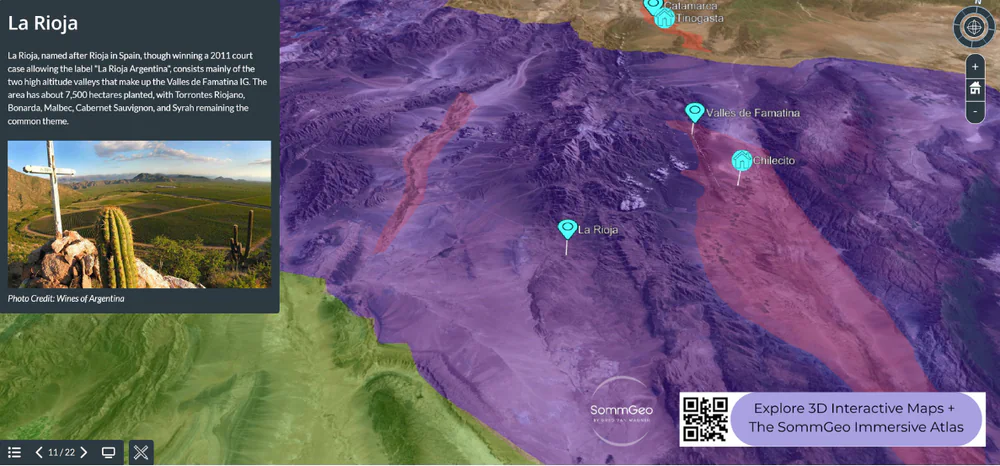
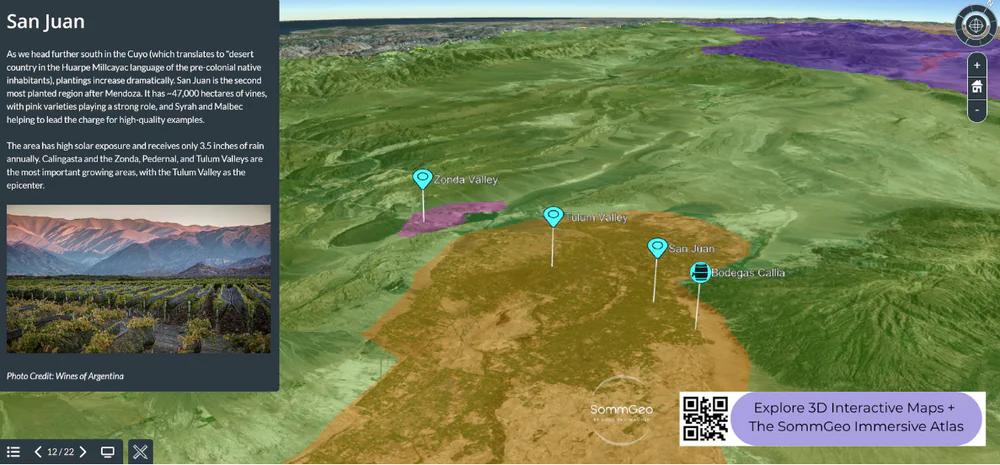
- San Juan and La Rioja: emerging quality zones including Tulum, Zonda, and Famatina
- Current trends: earlier picking, less oak, limestone focus
Argentina’s Subregional Revolution
For a geographic overview of Argentina’s wine regions, see the Argentina Fast Map. Here, we focus on what’s driving quality and identity.
The Uco Valley is where the conversation starts. Three primary departments (Tupungato, Tunuyán, and San Carlos) break down into ~29 subregions, and the differences between them are not academic. Gualtallary, at the northern end of Tupungato, sits up to 1,600 meters (5,249 feet) elevation on alluvial soils laced with calcium carbonate. The wines are chalky and fresher, a different animal entirely from the ripe, plush Malbec of Luján de Cuyo. Paraje Altamira (in San Carlos) shares the calcareous thread but with heavier silt soils and bigger rocks, producing wines with more body and darker fruit.
Beyond the Uco Valley, Cafayate in Salta’s Calchaquí Valley is the spiritual home of Torrontés and increasingly quality high-altitude reds at elevations above 1,700 meters (5,577 feet). San Juan, Argentina’s second-largest wine province, has long been bulk country but Syrah from the Pedernal Valley and structured reds from Tulum are starting to earn attention. And La Rioja’s Famatina Valley, remote and sparsely planted, produces Torrontés and Bonarda at elevations that rival anything in Salta.
Key Producers
Catena Zapata
Nicolás Catena planted his Adrianna Vineyard in Gualtallary in 1992 when the conventional wisdom said vines couldn’t ripen at 1,500 meters (4,921 feet). He proved everyone wrong. The Adrianna vineyard is now one of the most studied and acclaimed single sites in South America, producing Malbecs and Chardonnays of extraordinary precision.
SuperUco
The Michelini brothers were among the earliest champions of Gualtallary and helped define what high-altitude Argentine wine could be. SuperUco is the family’s own project, and their Cabernet Franc from Alto Gualtallary is a reference point: mint chocolate, black pepper, stony minerality, and the kind of energy you don’t expect from Argentine reds. They work with minimal intervention and an intuitive understanding of the soils they’ve been farming since the early 2000s.
Cheval des Andes
The joint venture between Château Cheval Blanc (Saint-Émilion) and Terrazas de los Andes represents one of Bordeaux’s most serious investments in Argentina. Drawing from two estate vineyards (old-vine Las Compuertas in Luján de Cuyo and younger plantings in the Uco Valley’s Paraje Altamira) the blend has historically been Malbec-led but has shifted significantly in recent vintages toward Cabernet Sauvignon co-dominance or outright Cabernet leadership, with Petit Verdot playing a supporting role.
Notable Vintages: Argentina (Mendoza)
Among the standout vintages of the past two decades, 2010 is considered by many producers to be the vintage of the decade: a mild winter, dry spring, warm summer with strong diurnal shifts, and pristine fruit at harvest. 2017 was cool and concentrated, with lower yields producing wines of exceptional structure and aging potential. 2018 delivered near-perfect conditions with warm days, cool nights, and excellent results across all varieties. 2019 continued the streak with modest alcohol, fresh acidity, and long, even ripening. 2022, despite spring frosts cutting yields, produced concentrated fruit that some winemakers are calling their best of the decade.
On the difficult side, 2016 was marked by rain and humidity during harvest, bringing rot risk and requiring meticulous sorting; lesser producers struggled. 2014 saw frost and January rains that diluted whites and made for lighter, shorter-lived reds. 2023 was tricky in Mendoza, with frost devastating yields by up to 70% in some areas and rain complicating harvest conditions, though the small volumes that survived were of very high quality.
New to the Tours? Learn how to navigate frames, click pins for detailed producer and region profiles, and get the most from your 3D experience.
Tours Guide →Ready to go deeper into Argentina? Join 200+ wine organizations already using SommGeo.
Start Your 15-Day Free Trial $5/month billed annually after trial · Cancel anytime