
Valtellina Wine Map — Free Download
Nebbiolo on near-vertical Alpine terraces — dry-stone walls, five historic subzones, and some of Italy’s most dramatically sited vineyards.
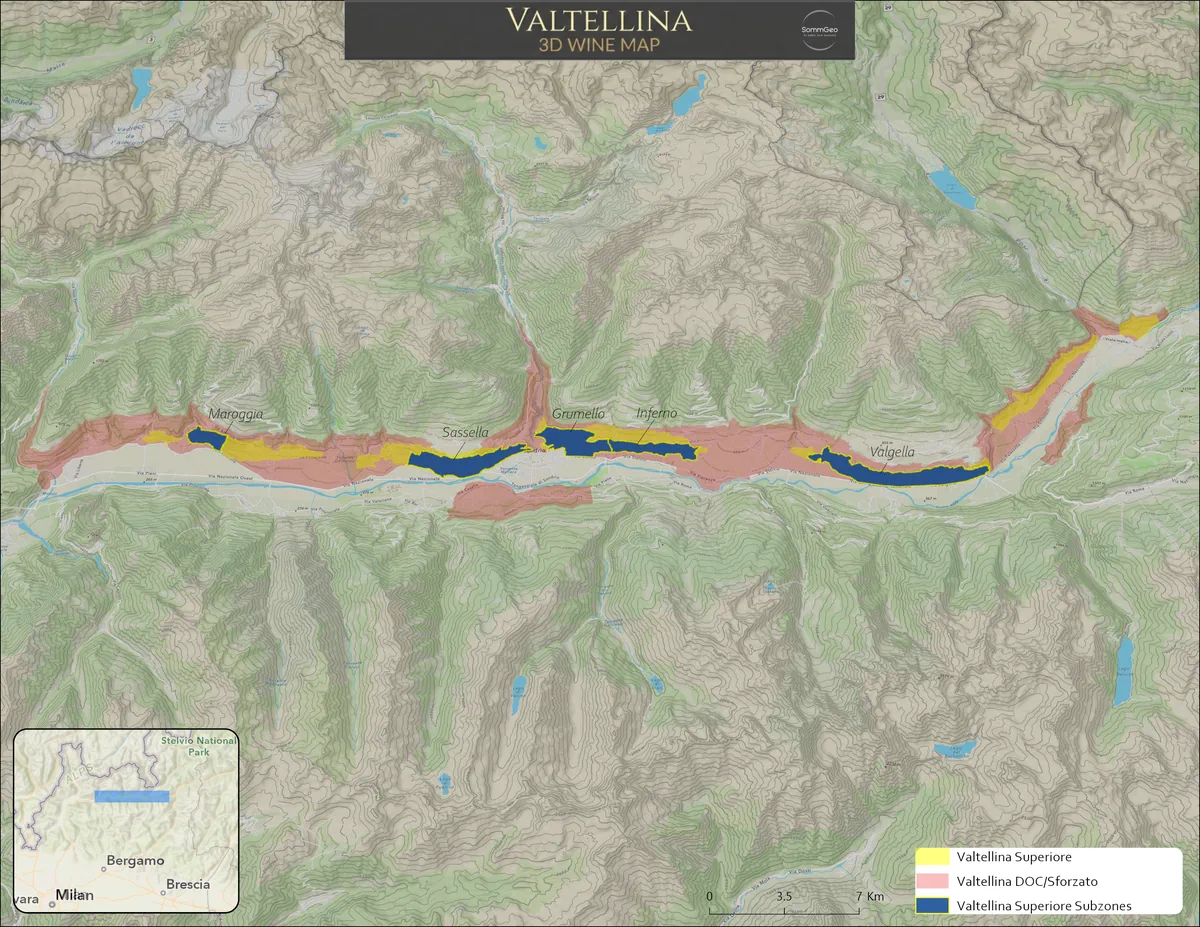
This Valtellina wine map covers one of the most visually stunning and physically demanding wine regions on earth. Tucked into a narrow Alpine valley in Lombardy where the Adda River carves east-to-west through the Rhaetian Alps, Valtellina grows Nebbiolo (known locally as Chiavennasca) on south-facing terraced slopes so steep that mechanization is essentially impossible — every vine is tended entirely by hand. The region holds two DOCG designations: Valtellina Superiore, subdivided into five named subzones (Sassella, Grumello, Inferno, Valgella, and Maroggia), and Sforzato di Valtellina, a dried-grape wine made in the style of Amarone but from pure Nebbiolo. If you know Barolo and Barbaresco but haven’t explored Valtellina, you’re missing what may be the most site-expressive and undervalued expression of Nebbiolo in Italy. Download the free map below to see where these subzones sit along the valley.
What This Map Covers
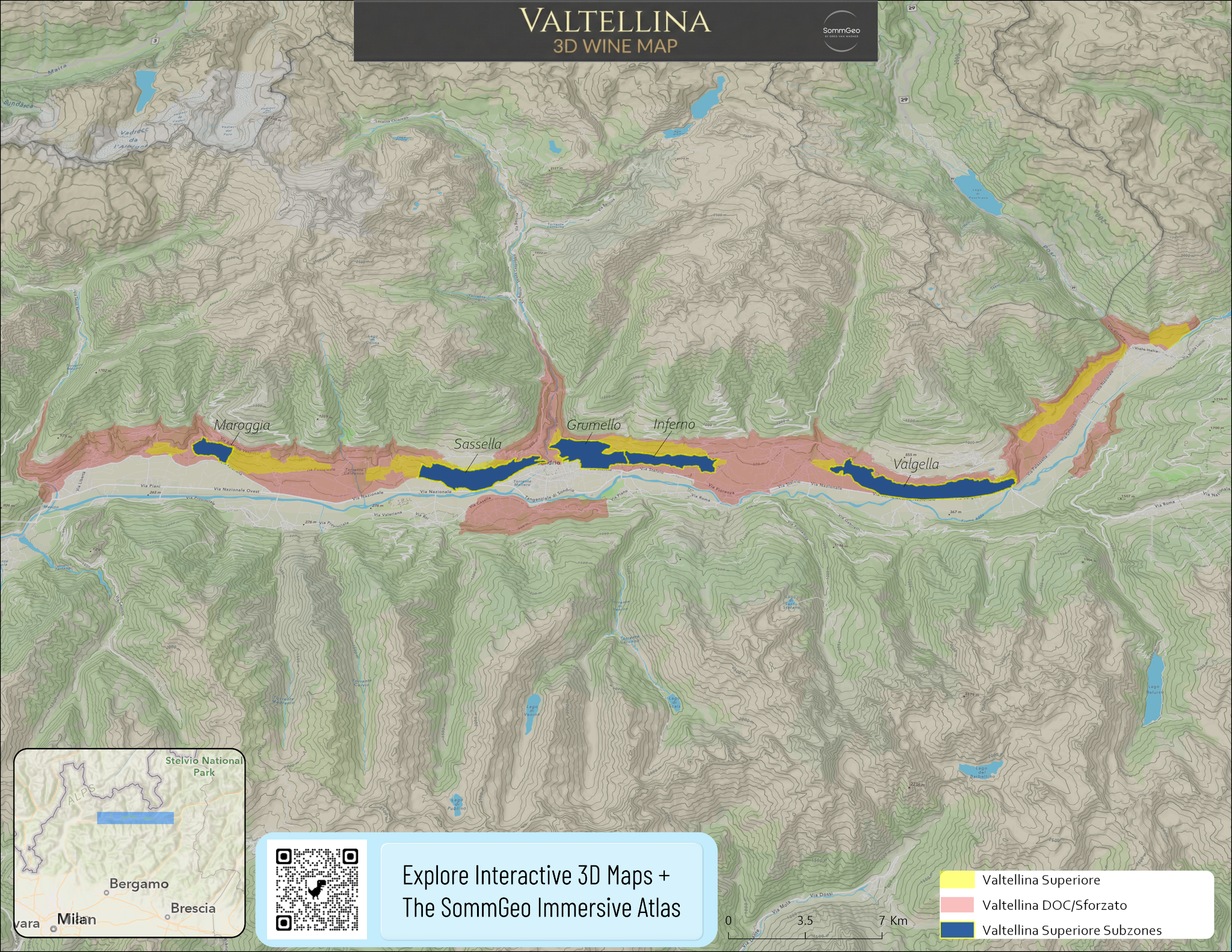
This classic map provides a detailed overview of Valtellina’s wine geography with all five Valtellina Superiore DOCG subzones clearly delineated. You’ll see how the terraced vineyards line the south-facing slopes of the Rhaetian Alps above the Adda River, and how each subzone occupies a distinct section of this narrow Alpine corridor.
- All five Valtellina Superiore DOCG subzones: Sassella, Grumello, Inferno, Valgella, and Maroggia
- The east-west orientation of the valley and the south-facing exposure that makes Nebbiolo viticulture possible at this latitude
- The Rhaetian Alps to the north and the Orobie Alps to the south framing the viticultural corridor
- Elevation context showing the steep terraced slopes between 300 and 800 meters
Geography and Site Character
Valtellina’s viticultural identity comes down to one extraordinary geographic accident: the valley runs east-to-west. In the Alps, most valleys run north-to-south, which means vineyard slopes face either east or west and get limited sun exposure. But the Adda River valley cuts laterally through the mountains, creating a continuous south-facing slope on the northern wall that receives sunlight from dawn until dusk. Despite sitting at a latitude comparable to Montreal, Valtellina’s south‑facing Alpine terraces capture far more sunlight than you’d expect — enough to ripen late‑harvest Nebbiolo reliably.
The Rhaetian Alps rise to over 4,000 meters above the valley, and their south-facing flank is where all the serious viticulture happens. The opposite, north-facing side (the Orobie Alps) is a wall of dense chestnut forest — too shaded for grapes. The valley is narrow enough that it concentrates and retains heat, while the mountains block cold northern weather systems. A regular drying breeze called la Breva blows up the valley from Lake Como, reducing humidity and keeping fungal pressure low. Cold air drains to the valley floor at night, leaving the elevated terraces warmer than the towns below — a classic thermal inversion that protects vines from damaging frost.
The soils are predominantly shallow, acidic, and granitic — broken-down gneiss and schist scraped by millennia of glacial activity, with pockets of sandy material and some silt deposits. These poor, free-draining soils force vines to root deeply and naturally restrict vigor, which is exactly what Nebbiolo needs to produce concentrated fruit. The dry-stone terrace walls that hold the vineyards in place aren’t just structural — they absorb solar radiation during the day and radiate heat back at night, extending the effective growing season for a late-ripening variety that often isn’t harvested until mid-to-late October.
Wine Classifications & Subzones
Heroic Viticulture — What It Actually Means
Valtellina is the textbook example of what Italians call viticoltura eroica — heroic viticulture. This isn’t marketing language. The CERVIM (Centre for Research, Studies, and Promotion of Heroic Viticulture) defines it by measurable criteria: extreme slope steepness, altitude, and the impossibility of mechanization. Valtellina meets all of them. Vineyard slopes regularly exceed 30 degrees, with some pitches approaching 70 degrees. The labor math is staggering — often quoted as requiring on the order of five to six times more manual labor per hectare than a typical Italian vineyard — well over a thousand hours per hectare versus a few hundred. Everything is done by hand: pruning, canopy management, harvest, and the constant maintenance of the dry-stone walls that hold the terraces together. At its peak in the mid-19th century, Valtellina had over 6,000 hectares under vine. Today, roughly 850 hectares remain in active production — the economics of hand-farming near-vertical slopes have pushed all but the most dedicated (or stubborn) growers out.
Valtellina Superiore DOCG
Valtellina Superiore, elevated to DOCG in 1998, represents the best vineyard sites in the valley. The wines must be at least 90% Chiavennasca (Nebbiolo), aged a minimum of 24 months with at least 12 in wood, and the Riserva designation requires 36 months total. Compared to Barolo, these are lighter-bodied, more vertical wines — expect dried cherry, tar, rose petal, and a granitic minerality that’s distinctly Alpine. They’re built on acidity and fine-grained tannins rather than raw power, and the best examples develop beautifully with age, adding gamey, leathery complexity. The five subzones each occupy a distinct stretch of the valley:
Sassella — The largest and most celebrated subzone, stretching west from Sondrio. Around 100–150 hectares of terraced vineyards sit at elevations from 270 to 600 meters, with the subzone occupying a wider section of the valley where peaks don’t obscure afternoon sunlight as early. Sassella is generally considered the most complete and balanced expression of Valtellina — the wines combine structure, freshness, and aromatic complexity. Producers like Ar.Pe.Pe. (whose Rocce Rosse Riserva is one of Italy’s great ageworthy reds) and Rainoldi have made Sassella their flagship.
Grumello — Named after a 13th-century castle overlooking Sondrio, Grumello occupies roughly 80 hectares directly northeast of the city. It’s a compact, sheltered subzone that produces wines often described as the most elegant of the five — subtle aromatics, velvety texture, and a refined tannic structure. Nino Negri, the valley’s largest producer, sources heavily from Grumello.
Inferno — The name says it all. This 55-hectare subzone sits just east of Grumello and earns its reputation from the intense heat trapped by its vertiginous, fully south-facing slopes between 300 and 500 meters. The thermal accumulation here matches Sassella as the warmest in the valley. Inferno wines tend to be a touch more fruit-forward and approachable than their neighbors, though the best examples still carry serious structure. The historic heart of the subzone features some of the steepest pitches in all of Valtellina.
Valgella — The largest subzone by area at roughly 140 hectares, Valgella stretches between Chiuro and Teglio with vineyards ranging from 350 to 650 meters in elevation. It is often described as slightly drier and more sheltered than some of the other subzones, and tends to produce Nebbiolo of particular softness and floral delicacy — more approachable in youth, though the best Riservas show real depth and longevity.
Maroggia — The smallest and most obscure subzone at just 25 hectares, Maroggia was the last to receive official recognition (2002). Old vines and steep pitches define the area, and the wines are rarely seen outside the valley — which makes them a genuine treasure for anyone who visits.
Sforzato di Valtellina DOCG
Sforzato (or Sfursat in local dialect) is Valtellina’s answer to Amarone — though the comparison only goes so far. Elevated to DOCG in 2003, it’s made from Chiavennasca grapes dried on wooden racks for up to three months after harvest, concentrating sugars, flavors, and phenolics before a slow fermentation. The result is a dry, full-bodied red with considerable power (typically 14–16% alcohol), deep color, and complex aromatics ranging from dried cherry and rose to licorice, tar, and spice. Unlike Amarone’s Corvina-based richness, Sforzato retains Nebbiolo’s signature acidity and tannic grip, giving it a nervous energy that keeps the wine from feeling heavy. Ar.Pe.Pe., Nino Negri, and Sandro Fay all produce benchmark examples. It’s a wine that demands serious food — think bresaola, aged Bitto cheese, and the hearty buckwheat pasta dishes the valley is known for.
Rosso di Valtellina DOC
The entry point to the valley’s wines, Rosso di Valtellina DOC covers the broader production zone and requires shorter aging. These are lighter, more fruit-driven expressions of Chiavennasca — good everyday drinking wines that can offer excellent value. For producers like Dirupi and Barbacàn, the Rosso bottlings often come from younger vines or less-favored terraces, but they still carry the unmistakable stamp of Alpine Nebbiolo: lifted aromatics, bright acidity, and a mineral backbone that sets them apart from simple table wine.
Want to explore Valtellina and Northern Italy with interactive layers, 3D elevation tools, and detailed appellation data? Join 200+ wine organizations already using SommGeo.
Start Your 15-Day Free Trial $5/month billed annually after trial · Cancel anytimeMap Usage
Free for your own study and tastings. If you share or teach with a map, credit it visibly as Map: SommGeo (sommgeo.com). Commercial use requires a Commercial Embed License. See Map Usage, Credit and Licensing.