
Chile Wine Regions Map: Interactive Guide
From the Atacama Desert to Patagonia. Mapping the geographic forces that make Chile one of the New World’s most dynamic wine countries.
Chile’s wine regions map reads like a lesson in extremes. Stretched across 1,300 kilometers (808 miles) of Pacific coastline and hemmed in by the Andes to the east, the Atacama Desert to the north, and Antarctic waters to the south, this narrow strip of land packs an almost absurd diversity of growing conditions into a country that’s never more than 180 kilometers (112 miles) wide. With roughly 130,000 hectares (321,236 acres) under vine, Chile is the world’s seventh-largest wine producer and fifth-largest exporter, but the real story is how dramatically the industry has evolved since the 1990s. What was once synonymous with reliable, inexpensive Cabernet has become a hotbed of cool-climate exploration, old-vine rediscovery, and a grape variety, Carmenère, that the rest of the world thought was extinct. This interactive Chile wine regions map lets you explore every DO, valley, and geographic influence shaping these wines, and every single mapped region includes detailed popup content covering grape varieties, climate profiles, soil types, viticulture, and wine law, putting a complete reference guide directly inside the map.
Unlock the Full SommGeo Toolkit
Gain exclusive access to our entire suite of premium features, including interactive Map Makers, immersive 3D Tours, high-resolution classic Maps, and advanced analytical tools.
Start Free TrialWhat You’ll Explore
This interactive Fast Map covers every major Chilean wine region and DO designation, from the desert vineyards of Atacama in the north to the frontier plantings of Austral in the south. But the real depth is in the detail. Click on any mapped region and a comprehensive info panel opens with sommelier-level content: dominant grape varieties with planting context, climate profiles including coastal versus Andean influence, soil composition, vineyard hectarage, key producers, and how the Andes, the Coastal Range, and the Humboldt Current interact to shape each valley’s wines. Every single region on the map carries this level of built-in intelligence, making it a complete study tool as much as a map.
- All six wine regions and their sub-regions: Atacama, Coquimbo, Aconcagua, Central Valley, Sur, and Austral
- In-depth region profiles for every mapped area: grape varieties, climate, soils, viticulture, and producers
- Central Valley detail: Maipo, Rapel (Cachapoal & Colchagua), Curicó, and Maule DOs
- Cool-climate coastal zones including Casablanca, San Antonio, Leyda, and Limarí
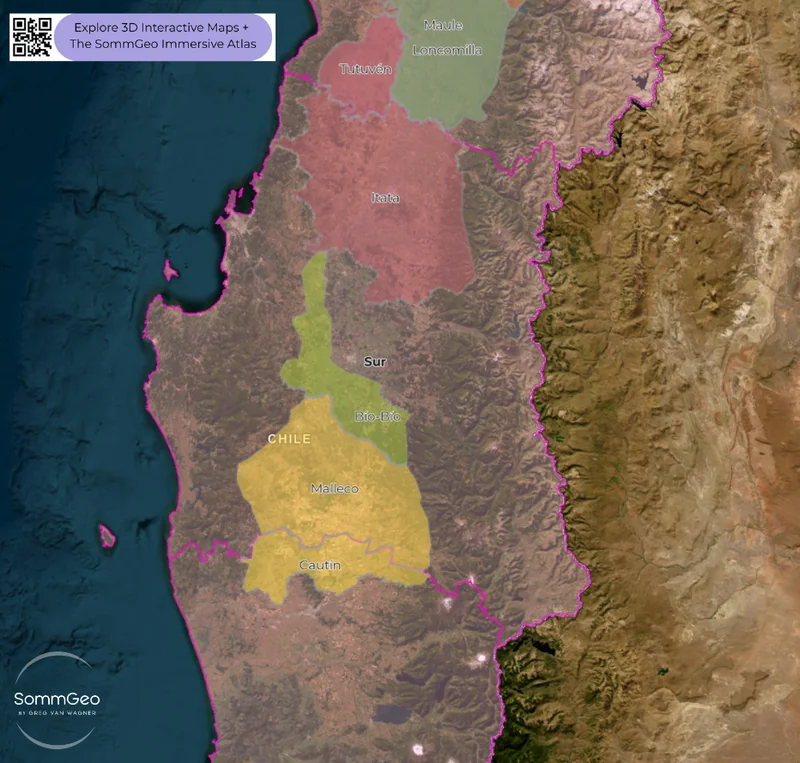
- Southern heritage regions: Itata, Bío Bío, and Malleco with their old-vine País and Cinsault


History and Wine Law
Chilean viticulture dates to 1554, when Spanish missionaries planted the first Vitis vinifera vines, most likely the “common black grape” that became País (known elsewhere as Listán Prieto or Mission). For three centuries, País was the backbone of Chilean wine, grown by Jesuit priests and later by hacienda owners across the Central Valley and the south. The transformation began in the mid-1800s, when wealthy Chilean landowners returned from France and started importing Bordeaux varieties. Don Silvestre Ochagavía founded one of the country’s first modern wineries in 1851, bringing Cabernet Sauvignon, Merlot, Cabernet Franc, Malbec, and, crucially, Carmenère. These vines arrived before phylloxera devastated Europe, and Chile’s natural barriers (the Andes, the Pacific, the Atacama Desert, and Antarctic ice) kept the pest out entirely. To this day, Chile remains one of the only major wine-producing countries with no phylloxera; vines grow on their own rootstock.
The modern regulatory framework came with Decree 464 in 1994, which established Chile’s DO (Denominación de Origen) system. Unlike European appellations, there are no restrictions on grape varieties, yields, or viticultural practices; the law simply defines geographic boundaries and labeling requirements. Varietal wines must contain at least 85% of the named grape for export (75% for domestic sale), and the same 85% rule applies to vintage and origin. The decree was updated significantly in 2011 with the introduction of three transversal climate designations: Costa (coastal), Entre Cordilleras (between the mountain ranges), and Andes (Andean foothills), overlaid on top of the existing north-south valley system. In 2018, four new DOs were added (Apalta, Lo Abarca, Los Lingues, and Licantén), and in 2024, the decree was expanded again to allow 51 additional grape varieties on labels, more than doubling the previously approved list of 47.
The Three Forces: Andes, Humboldt Current, and Downsloping Winds
Understanding Chilean wine comes down to three geographic forces that interact to create the country’s extraordinary range of mesoclimates. Get these three right and the rest of the map makes sense.
The Andes
The Andes form a wall of rock and ice along Chile’s eastern border, rising to nearly 7,000 meters (22,966 ft) at Aconcagua. For viticulture, the mountains serve a dual purpose. First, they’re the primary water source; snowmelt from Andean glaciers feeds the river systems (Maipo, Rapel, Maule, and others) that make irrigation possible in a country where much of the vineyard land receives less than 300mm (11.8 in) of annual rainfall. Second, and more critically for wine quality, the Andes generate dramatic diurnal temperature shifts. As the sun drops behind the peaks each evening, cold air slides down the mountainsides into the valleys. These downsloping winds can drop nighttime temperatures by 15–20°C (59–68°F), slowing sugar accumulation in the grapes and preserving the natural acidity that gives Chile’s best wines their structure and freshness. Vineyards planted in the Andean foothills (classified as “Andes” under the 2011 transversal system) tend to produce wines with more pronounced tannin, elevated acidity, and a distinctive mineral signature. This is where you’ll find some of Chile’s most compelling Syrah, Cabernet Franc, and high-altitude Malbec.
The Humboldt Current
The Humboldt Current is a massive river of frigid Antarctic water (roughly 600 miles wide) that flows north along Chile’s entire Pacific coastline. Its effect on viticulture is profound. Despite sitting at a latitude equivalent to North Africa (around 33°S for Santiago), Chile’s coastal vineyards experience growing conditions closer to Burgundy or Champagne. The current chills the ocean surface, which in turn generates a dense morning fog the Chileans call Camanchaca. This fog blankets coastal vineyards from dawn until early afternoon, keeping temperatures low, extending the ripening period, and delivering the high acidity and low pH that define Chile’s coastal whites and Pinot Noirs. Without the Humboldt Current, cool-climate viticulture at this latitude would be impossible. Casablanca, San Antonio, Leyda, and the coastal zones of Limarí all owe their existence to this Antarctic current. The “Costa” designation under the 2011 transversal system identifies these vineyards specifically.
Downsloping Winds and the Coastal Range
Running parallel to the Pacific between the coast and the Central Valley is Chile’s Coastal Range (Cordillera de la Costa), a lower chain of mountains that acts as a buffer between maritime and continental influences. This is what creates the “Entre Cordilleras” zone: the warm, sheltered valleys between the two mountain chains where the vast majority of Chile’s Cabernet Sauvignon, Merlot, and Carmenère is grown. Crucially, the Coastal Range isn’t continuous; east-west river valleys punch through it at regular intervals, creating corridors through which cool Pacific air (driven by the Humboldt Current) can penetrate inland. The degree to which a valley opens to the ocean dictates its climate personality. Maule, which has no direct maritime access, is warmer and more continental. Colchagua’s horseshoe-shaped Apalta sub-valley is sheltered on three sides but receives enough coastal influence to balance its warm growing season. Together, these forces create a country where vineyards planted 30 kilometers (19 miles) apart can experience radically different conditions, which is exactly what makes Chile’s wine map so rewarding to explore interactively.
Key Regions and Grape Varieties
Coquimbo: The Northern Frontier
The Elqui and Limarí Valleys represent Chile’s viticultural frontier: arid, sun-drenched landscapes where annual rainfall can dip below 70mm (2.8 in) and vineyards depend entirely on Andean snowmelt for irrigation. Elqui, best known for Pisco production, has emerged as a source of compelling Syrah from high-altitude sites cooled by funneled Andean winds. But Limarí is the bigger story for wine professionals. Its calcareous soils (rare in Chile) are producing Chardonnay with a mineral intensity and saline edge. The morning Camanchaca fog penetrates through gaps in the Coastal Range created by the Limarí River, enabling cool-climate viticulture just ~12 kilometers (7 miles) from the Atacama Desert’s edge.
Aconcagua: Cool-Climate Pioneers
The Aconcagua region is where Chile’s modern cool-climate revolution began. Casablanca Valley, first planted in the mid-1980s, proved that Chile could produce quality Sauvignon Blanc, Chardonnay, and Pinot Noir, not just bulk Cabernet. San Antonio and its sub-valley Leyda pushed even closer to the Pacific, with some vineyards sitting just 6 kilometers (4 miles) from the ocean. These are among Chile’s coldest growing sites, and the Pinot Noir and Chardonnay coming from Leyda’s granite slopes is prized. The Aconcagua Valley proper, developed extensively by the Errázuriz family since the 19th century, remains a benchmark for structured reds; the 2004 Berlin Tasting, where Errázuriz’s Seña and Viñedo Chadwick outscored Château Lafite and Château Margaux in a blind tasting, put Chilean premium wine on the global map permanently.
Central Valley: The Heartland
The Central Valley is the engine room of Chilean wine, with roughly 118,000 hectares (291,584 acres) spanning four major sub-regions. Maipo, closest to Santiago, is Chile’s Bordeaux, the spiritual home of Cabernet Sauvignon, with alluvial soils in the Alto Maipo foothills producing structured, age-worthy reds from producers like Concha y Toro (Viñedo Chadwick, Don Melchor), Santa Rita, and Cousiño Macul. Rapel encompasses Cachapoal (fast becoming the top region for Carmenère, particularly around Peumo) and Colchagua (home to the flagship Apalta DO, where Lapostolle, Montes, and Neyen farm the horseshoe-shaped valley’s granite and clay soils). Curicó gained international attention in the 1970s when Miguel Torres arrived from Spain and produced Chile’s first internationally acclaimed Cabernet. Maule, the largest DO in Chile at roughly 50,000 hectares (123,552 acres), is the most exciting story right now; its old dry-farmed bush vines of País, Carignan, Cinsault, and Moscatel de Alejandría are being rediscovered by a new generation of producers. The VIGNO project has championed old-vine Carignan specifically, setting minimum vine-age requirements for wines that carry the designation.
Carmenère: Chile’s Signature Grape
The Carmenère story is one of the great plot twists in wine history. One of the original six red grapes of Bordeaux, it was brought to Chile in the 1850s and thrived, but was misidentified as Merlot for over a century. Chilean winemakers knew something was different (they called it “Merlot Chileno”), but it wasn’t until November 24, 1994, that French ampelographer Jean-Michel Boursiquot, visiting Viña Carmen’s vineyard in the Maipo Valley, noticed the twisted stamens on certain vines and confirmed they were Carmenère, not Merlot. What was initially a scandal became Chile’s defining opportunity. Today, Chile holds roughly 10,000 hectares (24,710 acres) of Carmenère, the world’s largest planting of a variety that’s virtually extinct in its native Bordeaux. The best examples, particularly from Peumo, Apalta, and the Maipo Andes, offer spicy red fruit, green peppercorn, and a structure that’s distinctly neither Merlot nor Cabernet.
The Sur and Austral: Old Roots and New Frontiers
Chile’s southern regions represent both its deepest history and its newest frontier. Itata, where vines were first planted in the 16th century, is the oldest wine-growing zone in the country. For decades it was dismissed as bulk-wine territory, but its old bush vines of País (some over 200 years old) and Moscatel de Alejandría are now producing characterful, site-expressive wines under producers committed to organic practices and minimal intervention. Bío Bío and Malleco offer cooler, wetter conditions that suit Pinot Noir, Chardonnay, and Riesling. At the extreme south, the newly established Austral region (Cautín and Osorno) represents uncharted territory: volcanic soils, high rainfall, and growing conditions unlike anything else in Chile. The first DO wines from Austral date only to the 2013 vintage, making this one of the youngest commercial wine regions on the planet.
New to the Fast Maps? Learn how to search regions, navigate layers, and get the most from your interactive map.
Fast Map Guide →Ready to explore Chile’s wine regions in full detail? Join 200+ wine organizations already using SommGeo.
Start Your 15-Day Free Trial $5/month billed annually after trial · Cancel anytime