
Eastern EU Wine Regions Map: Interactive Guide
Seven countries, centuries of indigenous grape heritage, and a viticultural identity that predates Rome, from Tokaj’s volcanic cellars to the Dalmatian coast.
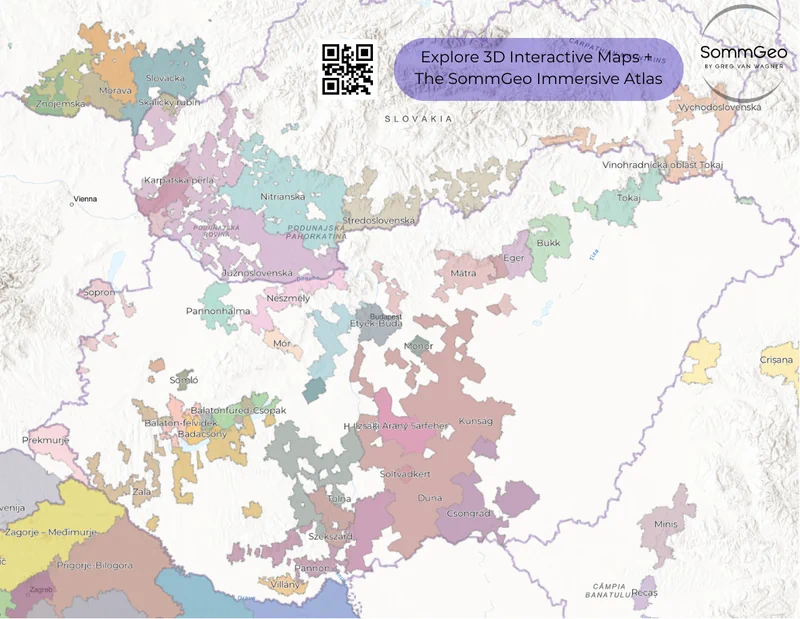
If you want to find the most undervalued wine regions on the planet, look east. Hungary, Slovenia, Croatia, Romania, and Bulgaria collectively represent over 350,000 hectares (864,868 acres) of vineyard, hundreds of indigenous grape varieties found nowhere else on earth, and winemaking traditions stretching back to the Thracians and Illyrians, centuries before large‑scale Roman viticulture reached Gaul.. Yet outside of specialist circles, this corner of Europe remains overlooked. That’s changing fast. This interactive Eastern EU wine regions map lets you explore the appellations, indigenous varieties, and geographic forces shaping these wines across seven countries, and every single mapped region includes detailed popup content covering key grape varieties, climate and geographic profiles, soil types, classification systems, and viticultural context, putting sommelier-level reference material directly inside the map.
Unlock the Full SommGeo Toolkit
Gain exclusive access to our entire suite of premium features, including interactive Map Makers, immersive 3D Tours, high-resolution classic Maps, and advanced analytical tools.
Start Free TrialWhat You’ll Explore
This interactive Fast Map is a fully searchable 2D atlas spanning seven Eastern EU wine-producing nations, and for a region this complex and poorly documented in most wine education resources, the built-in content is where the real value lives. Click on any mapped appellation and a comprehensive info panel opens with sommelier-level detail: indigenous grape varieties, climate and geographic profiles, soil composition, classification systems, vineyard data, and what makes each region distinct. Whether you’re reading about Tokaj’s volcanic tuff and Furmint clones, the terra rossa soils driving Istrian Teran, or the specific DOC requirements of Romania’s Dealu Mare, every single region on the map carries this depth of built-in intelligence.
- Hungary’s wine regions including Tokaj, Eger, Villány, and Somló with PDO boundaries
- In-depth region profiles for every mapped area: indigenous varieties, soils, climate, and classification rules
- Slovenia’s PDO Regions from the Adriatic to inland
- Croatia’s wine regions from Istria and Dalmatia to Slavonia and the Croatian Uplands
- Romania’s DOC/DOCC appellations across Moldavia, Muntenia, Transylvania, and Oltenia
- Bulgaria’s PDO viticultural zones from border to border


Geography & the Eastern EU Wine Belt
The seven countries on this map share a fundamental geographic fact: they sit at the crossroads of three major climate systems. Atlantic maritime influence from the west, warm Pannonian continental conditions from the Hungarian basin, and Mediterranean heat pushing north through the Adriatic and the Balkans. The result is a great diversity of growing conditions packed into a relatively compact area. You can drive from the cool, fog-shrouded slopes of Slovenia’s Goriška Brda to the sun-hammered Dalmatian islands in four hours, passing through climate zones that would take thousands of kilometers to replicate in the New World.
Mountain ranges are the dominant geographic feature shaping viticulture here. The Carpathians arc through the center of Romania like a 1,500-kilometer spine, creating rain shadows, temperature inversions, and altitude-driven mesoclimates on both flanks. The Balkan Mountains bisect Bulgaria east to west, blocking cold northern winds and allowing the Thracian Valley to the south to develop its warm, Mediterranean-leaning character. The Dinaric Alps run along Croatia’s coast, creating the dramatic elevation changes that give Dalmatian vineyards their extraordinary sun exposure on steep limestone slopes facing the Adriatic. And the Julian Alps that Slovenia shares with Italy are responsible for the altitude gradients and the bora wind patterns that keep Primorska’s wines so vibrant.
Soil diversity is equally remarkable. Volcanic substrates (from the rhyolite and andesite of Tokaj to the extinct volcanic cones of Bulgaria’s Struma Valley and Hungary’s Somló) produce some of the region’s most mineral-driven wines. Loess deposits blanket vast areas of the Hungarian plain and Romania’s southern slopes. Limestone dominates Croatia’s coastal vineyards. Iron-rich red soils (terra rossa) define Istria. And the flysch marls of Slovenia’s Goriška Brda connect directly to the geological story of neighboring Friuli-Collio across the Italian border. Understanding these geological patterns is the key to understanding why wines from villages only kilometers apart can taste so radically different.
Hungary
Tokaj
Tokaj is, without question, one of the most historically important wine regions on earth. The volcanic hills of northeast Hungary (where rhyolite and andesite bedrock sits under a topsoil of clay and loess) produced what was arguably the world’s first classified wine region, formalized by royal decree in 1737 and now a UNESCO World Heritage Site. For centuries, Tokaji Aszú was the ultimate prestige sweet wine, collected by Louis XIV (“the wine of kings, the king of wines”) and Catherine the Great, who stationed a permanent guard detachment in the region to secure royal shipments. The six permitted grape varieties (Furmint (about 60% of plantings), Hárslevelű, Sárgamuskotály (Yellow Muscat), Kabar, Kövérszőlő, and Zéta) are grown across roughly 5,500 planted hectares in 27 villages, with the botrytis-friendly humidity provided by the convergence of the Bodrog and Tisza rivers.
Nowadays, the bigger story for wine professionals is dry Furmint. Since the “Tokaj Renaissance” that began after the fall of communism in 1990, a wave of investment and new thinking has produced single-vineyard dry whites of extraordinary mineral complexity: bone-dry, high-acid, waxy-textured wines from volcanic soils that legitimate comparisons to Riesling or Chablis. The best come from villages like Mád, Tarcal, and Tállya, where the volcanic geology shifts significantly between neighboring parcels. It’s one of Europe’s most exciting white wine stories right now.
Eger, Villány & Beyond
Hungary has 22 wine regions (PDOs) organized into six broad zones, and while Tokaj dominates international attention, the rest of the country is increasingly worth knowing. Eger, in the north, is home to Egri Bikavér (“Bull’s Blood”), a red blend built around Kékfrankos (Blaufränkisch) with Kadarka, Cabernet Franc, and other varieties that’s been dramatically upgraded from its bulk-wine past into a serious, age-worthy style on volcanic soils. Villány, in the warm south near the Croatian border, produces Hungary’s best reds: structured Cabernet Franc, Merlot, and Kékfrankos with a Pannonian richness that surprises anyone who associates Hungary only with whites. Somló, a tiny extinct volcano rising from the plains near Lake Balaton, makes intensely mineral, smoky whites from Juhfark and Olaszrizling that rank among the most distinctive wines in Central Europe. And the vast Kunság PDO (over 23,000 hectares (56,834 acres) in the sandy plains between the Danube and Tisza) is Hungary’s bulk production engine, though quality-focused producers are beginning to find interesting things to do there.
Slovenia
Slovenia punches far above its weight class. With roughly 16,000–22,000 hectares (54,363 acres) of vineyard (sources vary depending on what’s actively cultivated), 28,000 small vineyard holdings, and almost no export to speak of; Slovenians drink virtually everything they produce. This is a country that the international wine world is only now discovering. Three principal regions tell the story: Primorska (the coastal/western zone bordering Italy), Podravje (the northeastern zone bordering Austria and Hungary), and Posavje (the smallest, in the southeast bordering Croatia).
Primorska
Primorska is where the excitement is. Goriška Brda (often called “Slovenia’s Tuscany,” though honestly it has more in common with neighboring Friuli-Collio, with which it shares identical geology) produces Rebula (Ribolla Gialla), Chardonnay, Sauvignonasse, and increasingly serious Merlot and Cabernet Franc from terraced hillside vineyards on flysch marl soils. This is ground zero for the natural and orange wine movements in the region; producers like Movia, Marjan Simčič, Kabaj, and Ščurek are making skin-contact whites and unfined, unfiltered wines that have earned cult followings. The Vipava Valley, just to the south, is larger (over 2,000 hectares (4,942 acres)) and known for the indigenous whites Zelen and Pinela alongside excellent Malvazija and Sauvignon Blanc; the bora wind that tears through the valley keeps acidity sharp and mildew at bay. The Karst plateau produces Teran (Refosco) from iron-rich terra rossa soils, and Slovenian Istria rounds out the coastal offerings with Refošk and Malvazija.
Podravje & Posavje
Podravje, in the northeast, is Slovenia’s largest wine region, nearly 10,000 hectares (24,710 acres) bordering Austrian Styria. Štajerska Slovenija (Slovenian Styria) is the heartland, producing Laški Rizling (Welschriesling), Renski Rizling (Riesling), Šipon (Furmint), Traminec (Gewürztraminer), and Sauvignon from rolling hillside vineyards that feel very much like a southern extension of Austria’s Südsteiermark. The style leans Germanic: single-varietal, precision-driven, with late-harvest Beerenauslese-style wines at the top end. Posavje, in the southeast, is the smallest region and home to Cviček, a local specialty: a light, slightly tart, low-alcohol blend of red and white grapes that’s been the everyday drink of the Dolenjska region for over 200 years. Charming, unapologetically simple, and basically impossible to find outside Slovenia.
Croatia
Istria & Dalmatia
Croatia’s viticultural DNA starts with one astonishing fact: Zinfandel is Croatian. DNA testing confirmed in 1994 that California’s Zinfandel is genetically identical to Croatia’s Tribidrag (also called Crljenak Kaštelanski), and Tribidrag is one of the parent grapes of Plavac Mali, Croatia’s most important red variety. That genetic heritage runs through the entire Dalmatian coast.
Istria, the large northwestern peninsula, is Croatia’s most exciting wine region right now. Around 4,000 hectares (9,884 acres) of vineyard sit on a mix of red terra rossa soils along the coast and white limestone-clay inland, a geological split that producers exploit deliberately. Malvazija Istarska dominates the whites (it’s genetically distinct from Italian Malvasia, despite the shared name), producing everything from crisp, stainless-steel expressions to ambitious skin-contact orange wines. Teran (Terrano), grown on the iron-rich coastal soils, delivers bold, tannic reds with a mineral, almost saline quality. The Italian, Austrian, and Yugoslav influences on this peninsula’s history are apparent in every aspect of its wine culture.
Dalmatia is Mediterranean red wine country. Plavac Mali (“small blue”) is the star, producing powerful, high-alcohol, tannic reds on the steep limestone slopes of the Pelješac peninsula (home to Croatia’s first appellations, Dingač and Postup, established in 1961) and the islands of Hvar, Brač, and Korčula. The indigenous white varieties are equally compelling: Pošip (crisp, citrusy, from Korčula), Bogdanuša (Hvar’s aromatic curiosity), and Grk, grown only in sandy soils near Lumbarda on Korčula, where you literally pronounce the name as three consonants in a row. Over 130 indigenous grape varieties have been identified across Croatia, making it one of Europe’s richest repositories of viticultural genetic diversity.
Slavonia & the Continental Interior
Slavonia and the Croatian Uplands represent the continental side of Croatian wine, and the gap with the coastal regions is dramatic. Slavonia, in the northeast, is flat, fertile, and dominated by Graševina (Welschriesling), Croatia’s most planted variety, producing light, fresh, mildly aromatic whites from the valley of Kutjevo, which houses one of the oldest wine cellars in the region (dating to 1232). The region also provides the famous Slavonian oak used in large barrels by winemakers across Italy and beyond. The Croatian Uplands, north of Zagreb, are cooler still, with steep vineyards producing Pušipel, Škrlet, and some increasingly serious Pinot Noir and Riesling. Producers like Krauthaker, Kutjevo, and Enjingi are pushing quality, but Slavonia remains far better known for its oak than its wine; that’s starting to change.
Romania
Romania is generally Europe’s fifth-largest wine-producing country by vineyard area, roughly 185,000 hectares (457,144 acres), a figure that catches most people off guard. The country sits on the same latitude as France, the Carpathian arc creates a staggering range of mesoclimates, and there’s a portfolio of indigenous grape varieties that’s genuinely world-class. So why isn’t Romanian wine better known? Decades of communist-era quantity-over-quality production, followed by chaotic post-1989 privatization, meant that the modern industry is effectively only about 20 years old. EU membership in 2007 was the turning point, bringing investment, expertise, and the 33 DOC/DOCC designations that now structure the quality hierarchy.
Dealu Mare & Muntenia
Dealu Mare (“the big hill”) is Romania’s most prestigious red wine appellation, stretching 65 kilometers (40 miles) through the Carpathian foothills of Prahova and Buzău counties at the 45th parallel (the same latitude as Bordeaux and Piedmont). Around 3,200 hectares (7,907 acres) of vineyard on south-facing slopes produce structured reds from both Fetească Neagră (the “black maiden,” Romania’s flagship indigenous red) and international varieties: Cabernet Sauvignon, Merlot, and Pinot Noir. Piero Antinori founded Viile Metamorfosis here in 2008, which tells you something about the region’s potential. SERVE, founded by Corsican nobleman Count Guy Tyrel de Poix in 1994, was among the first modern private wineries. Davino, Budureasca, and Aurelia Vișinescu (who pioneered dry Fetească Neagră vinification) are among the current leaders.
Moldavia, Transylvania & Beyond
Moldavia, in the east, is Romania’s largest wine region, some 70,000 hectares (172,974 acres) of terraced slopes producing whites and reds in a moderate continental climate. The historic Cotnari appellation, Romania’s answer to Tokaj, produces botrytized sweet wines from the indigenous Grasă de Cotnari that were famous across European courts for centuries. Transylvania, the high plateau ringed by the Carpathians, produces fresh, aromatic whites: Fetească Regală, Fetească Albă, and Tămâioasă Românească (a Muscat-like aromatic variety whose name translates as “Romanian frankincense”), with a crisp, altitude-driven acidity. And in the southeast, Dobrogea, along the Black Sea coast, benefits from maritime influence and produces both dry wines and the historically important Murfatlar sweet wines. The indigenous variety roster is deep: Fetească Neagră, Fetească Albă, Fetească Regală, Băbească Neagră, Grasă de Cotnari, Tămâioasă Românească, and Negru de Drăgășani, among others. Each carries genuine site character when handled well.
Bulgaria
Bulgaria’s wine story is one of ancient pedigree and modern rebuilding. The Thracians were cultivating vines and worshipping Dionysus here over 5,000 years ago; archaeological evidence includes vine seeds in Thracian tombs, and Homer praised Thracian wines in the Iliad. Under communist rule in the 1970s and 80s, Bulgaria became the world’s fourth-largest wine exporter, shipping oceans of inexpensive Cabernet Sauvignon and Merlot to the Soviet Union and Western Europe. The collapse of communism in 1989, followed by chaotic privatization, cratered the industry. EU accession in 2007 catalyzed the modern era.
Thracian Valley & Key Regions
Today, Bulgaria has roughly 60,000 hectares (148,263 acres) of vineyard organized into two official PGI zones (the Thracian Lowlands and the Danubian Plain) plus 52 PDO designations, though only a fraction are actively used. The Thracian Valley, in the south, accounts for about 35% of production and is the country’s red wine heartland. The Balkan Mountains block cold northern air, giving the Maritsa River valley a semi-Mediterranean warmth ideal for Mavrud, Bulgaria’s most important indigenous red, producing deeply colored, tannic wines with dark fruit, leather, and spice that need time but reward patience. Rubin (a Bulgarian crossing of Syrah and Nebbiolo) adds another indigenous dimension.
The Danubian Plain, in the north, handles about 30% of production with a more continental climate suited to Gamza (the local name for Kadarka, Hungary’s old red standby), Cabernet Sauvignon, and increasingly serious Pinot Noir on limestone soils that show real potential. The Black Sea coast produces fresh whites: Dimyat and Misket alongside international varieties. And the Struma Valley, in the extreme southwest near the Greek border, is Bulgaria’s most distinctive sub-region: a warm, sheltered corridor where the indigenous Shiroka Melnishka Loza (Broad-Leafed Melnik) produces bold, spicy, age-worthy reds. International varieties still dominate overall plantings (a legacy of the communist export strategy) but the return to indigenous grapes is where the real excitement lies.
New to the Fast Maps? Learn how to search regions, navigate layers, and get the most from your interactive map.
Fast Map Guide →Ready to explore Eastern Europe’s wine regions in full detail? Join 200+ wine organizations already using SommGeo.
Start Your 15-Day Free Trial $5/month billed annually after trial · Cancel anytime