France Wine Map Maker: Build Custom AOP Maps in 2D and 3D
Over 360 appellations, a dozen distinct wine regions, and the birthplace of terroir, mapped, layered, and ready to explore.
The France Map Maker is an interactive GIS workspace built on SommGeo’s France AOP layer: 363 appellations, loadable all at once, by region (Bordeaux, Burgundy, Loire, Alsace and Champagne, the two Rhônes, Languedoc-Roussillon, Provence and Corsica), or split into the overarching appellations and the nested ones inside them, each with its boundary and profile. Load a region from the legend, choose a basemap, switch between 2D and 3D, run elevation profiles and the solar aspect tool, sketch and label on top, then save the view as an image. The interactive map is part of SommGeo membership, which starts with a free 15-day trial.
- Appellations on the map: 363 AOPs across nine regional groups, from the 106 of Burgundy, Beaujolais, Jura and Savoie to the single Cognac appellation of the Charentes
- Layers: All AOPs, eight regional layers, an overarching layer and a nested layer, plus bright and dark outline and black and white label versions for clean exports
- Tools: 2D and 3D views, basemap gallery, measure and elevation profile, daylight simulator, sketch and label (2D only), save as image
- Export: Save captures the current view as a downloadable image; untick “Include Legend” for a clean map
- Profiles: Every AOP opens a popup with its grapes, rules, soils and climate; where appellations stack, like Pauillac inside Médoc inside Bordeaux, arrows in the popup header step through them
- Spread: Vineyards from Champagne near 49°N to Corsica and Roussillon at about 42°N, with the Atlantic, the Mediterranean, the Pyrenees, the Alps and the Massif Central setting the climates between

France is where the conversation about terroir begins. With over 360 AOP appellations governed by the world’s most rigorous classification system, the country’s wine geography is both extraordinary and genuinely complex. From the gravel banks of Bordeaux’s Left Bank to the limestone slopes of Burgundy, from the granite hills of the Northern Rhône to the chalk cellars of Champagne, every region tells a different geographic story. This interactive France wine map lets you build your own study maps with toggleable AOP layers, elevation profiles, satellite imagery, and a solar aspect tool that simulates sunlight and shadow at any time of year. Whether you’re preparing for a certification exam or planning vineyard visits, this is the most detailed interactive map of French wine regions available. Every mapped appellation includes detailed popup content covering grape varieties, classification rules, climate and soil profiles, a sommelier-level reference built directly into the map.
Unlock the Full SommGeo Toolkit
Gain exclusive access to our entire suite of premium features, including interactive Map Makers, immersive 3D Tours, high-resolution classic Maps, and advanced analytical tools.
Start Free TrialFree to study. Credit when you share it.
Use the map for your own study and tastings. If you share or teach with it, credit it visibly as Map: SommGeo (sommgeo.com). Commercial use requires a license.
See Map Usage, Credit and Licensing for the full terms and the Commercial Embed License.
What You’ll Explore
The France Map Maker gives you full control over how you view and study the country’s appellation system, but the real depth is in what each region reveals. Click on any mapped AOP and a comprehensive info panel opens with sommelier-level content: permitted grape varieties, classification hierarchy, climate and soil profiles, and the geographic specifics that define each appellation. Whether you’re reading about the Kimmeridgean limestone driving Chablis’s mineral character, the gravel banks of the Haut-Médoc, or the granite of Hermitage’s hillside, every mapped appellation carries this level of built-in intelligence. Beyond the content, every AOP boundary is mapped in toggleable layers, and you can combine them with topographic data, satellite imagery, and analytical tools.
- All French AOP/AOC boundaries as toggleable layers. Load individual regions or the full national view
- In-depth appellation profiles for every mapped area: varieties, classification, soils, climate
- “Nested” vs. “Overarching” region options: view Burgundy’s commune-level AOPs without regional overlays, or Southern Rhône appellations without the Côtes du Rhône layer
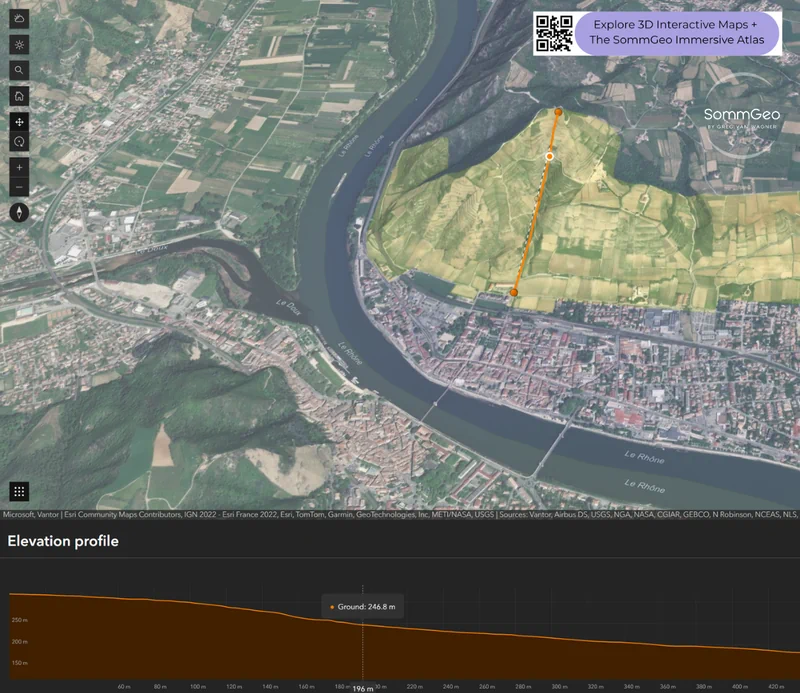
- Elevation profiles showing vineyard slope, aspect, and altitude across any cross-section
- Solar aspect tool: simulate sunlight and shadow patterns for any day of the year and time of day
- Sketch tools for adding study notes, pins, and annotations directly on the map
Performance tip: Showing all French AOPs at once can slow down older devices or slower connections. For the best experience, choose individual regional layers rather than loading everything simultaneously.
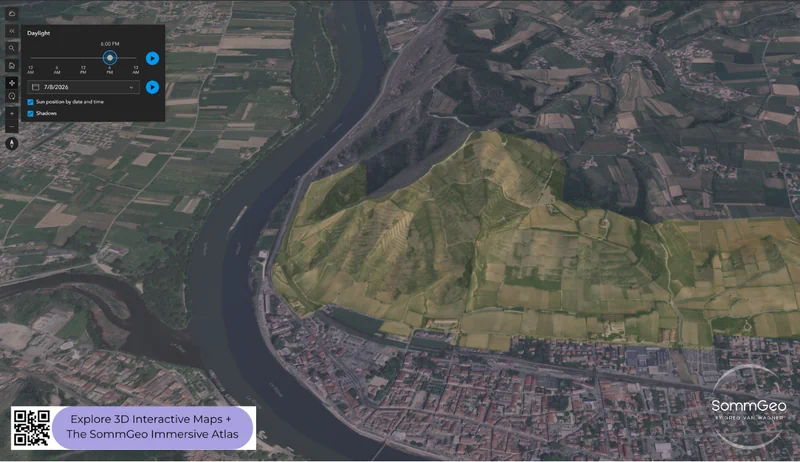
Geography and Terroir of France
What makes France’s wine geography exceptional isn’t just diversity; it’s the precision with which the French have catalogued it. The AOP system, born out of the establishment of INAO in 1935 (with Châteauneuf-du-Pape as the original template), doesn’t just draw lines on a map. It codifies the relationship between specific places and specific grapes, yields, and winemaking methods. Over 360 appellations later, no country on earth has mapped the connection between geography and wine with this level of detail.
The country’s wine regions span an enormous climatic range. The country’s wine regions span an enormous climatic range. Champagne pushes the northern limits of viable viticulture, where marginal ripening conditions are precisely the point; that struggle to reach full phenolic ripeness is what gives the base wines their nerve and acidity, the essential raw material for the region’s sparkling wines. Alsace sits at a similar latitude but operates in an entirely different register: sheltered behind the Vosges Mountains, it enjoys one of the driest, sunniest climates in France. Bordeaux and the Loire benefit from Atlantic moderation, while Burgundy sits in a continental climate where vintage variation is part of the story. The Rhône Valley transitions from continental north to Mediterranean south over just 200 kilometers (124 miles). And Languedoc-Roussillon and Provence bake under full Mediterranean sun, producing some of France’s most powerful (and increasingly refined) reds and rosés.
Geologically, the soil map reads like a textbook. Kimmeridgian limestone in Chablis, chalk in Champagne, gravel in the Médoc, granite in Beaujolais and the Northern Rhône, schist in Banyuls, galets roulés (round stones) in Châteauneuf-du-Pape, and the famously complex patchwork of marl, clay, and limestone that gives Burgundy’s Côte d’Or its vineyard-by-vineyard variation. The Map Maker’s elevation profile tool is particularly useful here. You can draw a cross-section through any hill to see exactly how slope, altitude, and aspect change across a single appellation.
Key Wine Regions
Bordeaux
One of the world’s most commercially important fine wine regions, with over 60 appellations organized around the Gironde estuary. The Left Bank (Médoc, Graves, Pessac-Léognan, Sauternes) sits on deep gravel beds that favor Cabernet Sauvignon, while the Right Bank (Saint-Émilion, Pomerol, Fronsac) features clay and limestone soils that produce Merlot-dominant blends. The 1855 Classification still drives the conversation here, though the Saint-Émilion classification (last revised in 2022) has generated its share of controversy. Producers to know: Château Latour, Château Cheval Blanc, Château Lafleur, Château Palmer.
Burgundy
If Bordeaux is classified by estate, Burgundy is classified by dirt. The Côte d’Or (that roughly 50-kilometer golden slope running from Dijon to Santenay) contains 33 Grand Cru vineyards and hundreds of Premier Cru plots, all mapped with specificity. Pinot Noir and Chardonnay reign here, and the difference between a village wine and a Grand Cru from the same commune can be a matter of meters and a completely different soil profile. The Map Maker’s nested layer option lets you view commune-level AOPs without the regional Bourgogne overlay cluttering the picture, essential for studying the hierarchy. Producers to know: Domaine de la Romanée-Conti, Domaine Leroy, Coche-Dury, Domaine Roulot.
Champagne
The northernmost major wine region in France, where chalk subsoils and a cool, marginal climate create the conditions for the world’s most celebrated sparkling wine. The region’s classification system is village-based (Grand Cru, Premier Cru), and the three primary grape varieties (Chardonnay, Pinot Noir, and Pinot Meunier) are distributed across three main sub-regions: the Côte des Blancs for Chardonnay, the Montagne de Reims and Aube for Pinot Noir, and the Vallée de la Marne for Meunier (generally speaking). The grower Champagne movement has transformed how professionals think about the region’s terroir over the past two decades.
The Rhône Valley
Two regions in one. The Northern Rhône is a narrow granite corridor producing some of France’s most singular Syrah (Hermitage, Côte-Rôtie, Cornas) and exceptional Viognier from Condrieu. The Southern Rhône is broader and Mediterranean, dominated by Grenache-based blends across vast appellations like Châteauneuf-du-Pape and Gigondas. The Map Maker’s “overarching vs. nested” view is particularly useful here. You can strip away the regional Côtes du Rhône layer to focus on the individual crus without the visual noise.
Loire Valley
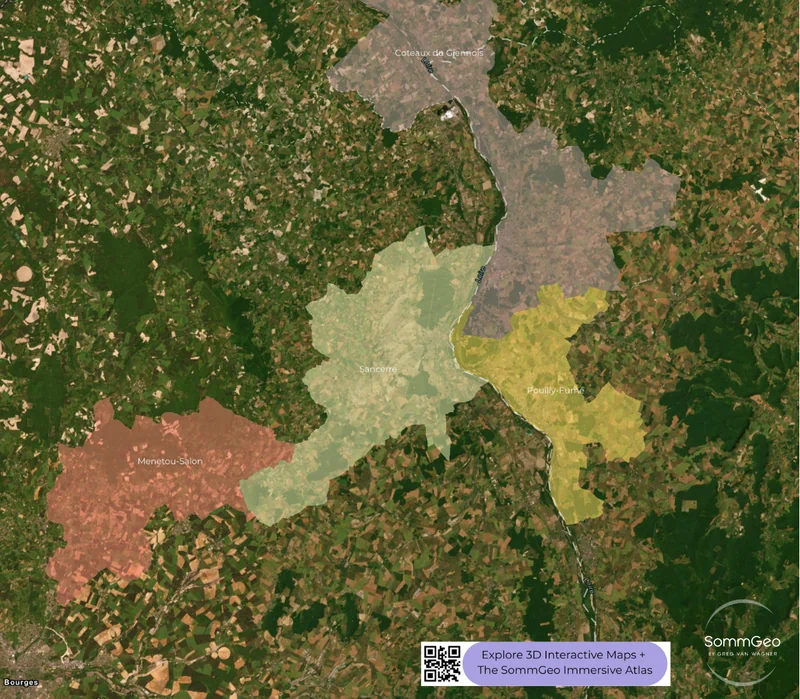
France’s longest wine river, stretching from the volcanic soils of the Auvergne to the Atlantic coast near Nantes. The Loire produces everything from bone-dry Muscadet sur Lie to the botrytized sweet wines of Quarts de Chaume, with world-class Sauvignon Blanc from Sancerre and Pouilly-Fumé and increasingly serious Cabernet Franc from Chinon, Bourgueil, and Saumur-Champigny in between. The Central Vineyards around Sancerre (visible in the satellite view screenshot) sit on the same Kimmeridgian limestone found in Chablis, which is no coincidence.
Alsace
Tucked between the Vosges mountains and the Rhine, Alsace is France’s driest major wine region; the mountains create a pronounced rain shadow. The region is unique in France for labeling by grape variety (Riesling, Gewurztraminer, Pinot Gris, Muscat), and its 51 Grand Cru vineyards are defined by an extraordinary geological mosaic: granite, limestone, sandstone, volcanic, and clay soils can shift within a single hillside. This is one of the most rewarding regions to study with the elevation and solar aspect tools.
Languedoc-Roussillon & Provence
The south of France has undergone a quality revolution. Languedoc remains France’s largest wine-producing area by volume, but the best producers in appellations like Pic Saint-Loup, La Clape, Faugères, and Minervois are making structured, terroir-driven wines that punch well above their price point. Roussillon adds the dry schist-based wines of Maury and Collioure, plus some of France’s finest Vins Doux Naturels. Provence, meanwhile, has become a global standard-bearer for rosé while its red appellations (Bandol, above all) produce some of the most serious wines in the Mediterranean south.
New to the Map Makers? Explore all the tools, tips, and features in our complete walkthrough.
Map Maker Guide →Appellations you can build with (363 AOPs)
Every AOP on the Map Maker, grouped by the regional layers in the web map. Load a region from the legend and click any appellation for its profile.
| Region | AOPs | Names on the map |
|---|---|---|
| Alsace, Lorraine and Champagne | 58 | Alsace, Alsace grand cru Altenberg de Bergbieten, Alsace grand cru Altenberg de Bergheim, Alsace grand cru Altenberg de Wolxheim, Alsace grand cru Brand, Alsace grand cru Bruderthal, Alsace grand cru Eichberg, Alsace grand cru Engelberg, Alsace grand cru Florimont, Alsace grand cru Frankstein, Alsace grand cru Froehn, Alsace grand cru Furstentum, Alsace grand cru Geisberg, Alsace grand cru Gloeckelberg, Alsace grand cru Goldert, Alsace grand cru Hatschbourg, Alsace grand cru Hengst, Alsace grand cru Kaefferkopf, Alsace grand cru Kanzlerberg, Alsace grand cru Kastelberg, Alsace grand cru Kessler, Alsace grand cru Kirchberg de Barr, Alsace grand cru Kirchberg de Ribeauvillé, Alsace grand cru Kitterlé, Alsace grand cru Mambourg, Alsace grand cru Mandelberg, Alsace grand cru Marckrain, Alsace grand cru Moenchberg, Alsace grand cru Muenchberg, Alsace grand cru Ollwiller, Alsace grand cru Osterberg, Alsace grand cru Pfersigberg, Alsace grand cru Pfingstberg, Alsace grand cru Praelatenberg, Alsace grand cru Rangen, Alsace grand cru Rosacker, Alsace grand cru Saering, Alsace grand cru Schlossberg, Alsace grand cru Schoenenbourg, Alsace grand cru Sommerberg, Alsace grand cru Sonnenglanz, Alsace grand cru Spiegel, Alsace grand cru Sporen, Alsace grand cru Steinert, Alsace grand cru Steingrubler, Alsace grand cru Steinklotz, Alsace grand cru Vorbourg, Alsace grand cru Wiebelsberg, Alsace grand cru Wineck-Schlossberg, Alsace grand cru Winzenberg, Alsace grand cru Zinnkoepfle, Alsace grand cru Zotzenberg, Champagne, Coteaux champenois, Côtes de Toul, Crémant d’Alsace, Moselle, Rosé des Riceys |
| Burgundy, Beaujolais, Jura, Savoie and Bugey | 106 | Aloxe-Corton, Arbois, Auxey-Duresses, Bâtard-Montrachet, Beaujolais, Beaune, Bienvenues-Bâtard-Montrachet, Blagny, Bonnes-Mares, Bourgogne, Bourgogne aligoté, Bourgogne mousseux, Bourgogne Passe-tout-grains, Bouzeron, Brouilly, Bugey, Chablis, Chablis Grand Cru, Chambertin, Chambertin-Clos de Bèze, Chambolle-Musigny, Chapelle-Chambertin, Charlemagne, Charmes-Chambertin, Chassagne-Montrachet, Château-Chalon, Chénas, Chevalier-Montrachet, Chiroubles, Chorey-lès-Beaune, Clos de la Roche, Clos de Tart, Clos de Vougeot, Clos des Lambrays, Clos Saint-Denis, Corton, Corton-Charlemagne, Côte de Beaune-Villages, Côte de Brouilly, Côte de Nuits-Villages, Coteaux Bourguignons, Coteaux du Lyonnais, Côtes du Jura, Crémant de Bourgogne, Crémant du Jura, Criots-Bâtard-Montrachet, Echezeaux, Fixin, Fleurie, Gevrey-Chambertin, Givry, Grands-Echezeaux, Griotte-Chambertin, Irancy, Juliénas, L’Etoile, La Grande Rue, La Romanée, La Tâche, Ladoix, Latricières-Chambertin, Mâcon, Macvin du Jura, Maranges, Marsannay, Mazis-Chambertin, Mazoyères-Chambertin, Mercurey, Meursault, Montagny, Monthélie, Montrachet, Morey-Saint-Denis, Morgon, Moulin-à-Vent, Musigny, Nuits-Saint-Georges, Pernand-Vergelesses, Petit Chablis, Pommard, Pouilly-Fuissé, Pouilly-Loché, Pouilly-Vinzelles, Puligny-Montrachet, Régnié, Richebourg, Romanée-Conti, Romanée-Saint-Vivant, Roussette de Savoie, Roussette du Bugey, Ruchottes-Chambertin, Rully, Saint-Amour, Saint-Aubin, Saint-Bris, Saint-Romain, Saint-Véran, Santenay, Savigny-lès-Beaune, Seyssel, Vézelay, Vin de Savoie, Viré-Clessé, Volnay, Vosne-Romanée, Vougeot |
| Bordeaux and South West | 68 | Barsac, Béarn, Bergerac, Bordeaux, Bordeaux supérieur, Brulhois, Buzet, Cadillac, Cahors, Canon Fronsac, Cérons, Corrèze, Coteaux du Quercy, Côtes de Bergerac, Côtes de Bordeaux, Côtes de Bordeaux-Saint-Macaire, Côtes de Bourg, Bourg et Bourgeais, Côtes de Duras, Côtes de Millau, Côtes de Montravel, Côtes du Marmandais, Crémant de Bordeaux, Entraygues – Le Fel, Entre-deux-Mers, Estaing, Floc de Gascogne, Fronsac, Fronton, Gaillac, Gaillac premières côtes, Graves, Graves de Vayres, Graves supérieures, Haut-Médoc, Haut-Montravel, Irouléguy, Jurançon, Lalande-de-Pomerol, Listrac-Médoc, Loupiac, Lussac Saint-Emilion, Madiran, Marcillac, Margaux, Médoc, Monbazillac, Montagne-Saint-Emilion, Montravel, Moulis, Pacherenc du Vic-Bilh, Pauillac, Pécharmant, Pessac-Léognan, Pomerol, Premières Côtes de Bordeaux, Puisseguin Saint-Emilion, Rosette, Saint-Emilion, Saint-Emilion grand cru, Saint-Estèphe, Saint-Georges-Saint-Emilion, Saint-Julien, Saint-Mont, Saint-Sardos, Sainte-Croix-du-Mont, Saussignac, Sauternes, Tursan |
| Loire Valley | 53 | Anjou, Anjou Brissac, Anjou Villages, Anjou-Coteaux de la Loire, Bonnezeaux, Bourgueil, Cabernet d’Anjou, Châteaumeillant, Cheverny, Chinon, Côte Roannaise, Coteaux d’Ancenis, Coteaux de l’Aubance, Coteaux de Saumur, Coteaux du Giennois, Coteaux du Layon, Coteaux du Loir, Coteaux du Vendômois, Côtes d’Auvergne, Côtes du Forez, Coulée de Serrant, Cour-Cheverny, Crémant de Loire, Fiefs Vendéens, Gros Plant du Pays Nantais, Haut-Poitou, Jasnières, Menetou-Salon, Montlouis-sur-Loire, Muscadet, Muscadet Coteaux de la Loire, Muscadet Côtes de Grandlieu, Muscadet Sèvre et Maine, Orléans, Orléans-Cléry, Pouilly-Fumé, Pouilly-sur-Loire, Quarts de Chaume, Quincy, Reuilly, Rosé d’Anjou, Rosé de Loire, Saint-Nicolas-de-Bourgueil, Saint-Pourçain, Sancerre, Saumur, Saumur-Champigny, Savennières, Savennières Roche aux Moines, Touraine, Touraine Noble Joué, Valençay, Vouvray |
| Northern Rhône and Diois | 12 | Château-Grillet, Châtillon-en-Diois, Clairette de Die, Condrieu, Cornas, Côte Rôtie, Coteaux de Die, Crémant de Die, Crozes-Hermitage, Hermitage, Saint-Joseph, Saint-Péray |
| Southern Rhône | 20 | Beaumes de Venise, Cairanne, Châteauneuf-du-Pape, Clairette de Bellegarde, Costières de Nîmes, Côtes du Rhône, Côtes du Rhône Villages, Côtes du Vivarais, Duché d’Uzès, Gigondas, Grignan-les-Adhémar, Laudun, Lirac, Luberon, Muscat de Beaumes-de-Venise, Rasteau, Tavel, Vacqueyras, Ventoux, Vinsobres |
| Languedoc-Roussillon | 32 | Banyuls, Banyuls grand cru, Boutenac, Cabardès, Clairette du Languedoc, Collioure, Corbières, Côtes du Roussillon, Côtes du Roussillon Villages, Crémant de Limoux, Faugères, Fitou, Grand Roussillon, Grés de Montpellier, La Clape, La Livinière, Languedoc, Limoux, Malepère, Maury, Minervois, Muscat de Frontignan, Muscat de Lunel, Muscat de Mireval, Muscat de Rivesaltes, Muscat de Saint-Jean-de-Minervois, Pic Saint-Loup, Picpoul de Pinet, Rivesaltes, Sable de Camargue, Saint-Chinian, Terrasses du Larzac |
| Provence and Corsica | 13 | Ajaccio, Bandol, Bellet, Cassis, Coteaux d’Aix-en-Provence, Coteaux varois en Provence, Côtes de Provence, Les Baux de Provence, Muscat du Cap Corse, Palette, Patrimonio, Pierrevert, Vin de Corse |
| Charentes (Cognac region) | 1 | Pineau des Charentes |
Hopefully this index is useful on its own. To explore these regions interactively, with every boundary on real terrain and a full profile for each, start a 15-day free trial. To see what one of these maps is like first, a different map is unlocked for everyone every day. For ready-made views of the same appellations, see the France Fast Map and the regional 3D maps on the Fast Maps page; the Map Maker Guide walks through every tool.
France Map Maker: Frequently Asked Questions
How is the Map Maker different from the France Fast Map?
The Fast Map draws all 363 appellations at once with a profile a click away. The Map Maker gives you the same appellations as layers, so you can load one region, show only the overarching appellations or only the nested ones, choose the basemap, tilt the view into 3D and draw on top, then save the result. Same boundaries and profiles; the Map Maker adds the build tools.
Can I load one region at a time?
Yes. Eight regional layers cover Alsace and Champagne, Bordeaux and the South West, Burgundy with Beaujolais, Jura and Savoie, Languedoc-Roussillon, the Loire, the Northern Rhône with the Diois, the Southern Rhône, and Provence and Corsica; the Cognac appellation sits only on the all-AOPs layer. Load Bordeaux alone and the legend’s Interactive mode then adds its 68 appellations one at a time, so the Médoc communes can be built up from Saint-Estèphe to Margaux.
What do the overarching and nested layers mean?
Overarching appellations are the big regional ones, Bordeaux, Bourgogne, Côtes du Rhône, Languedoc and their kind, 41 on the layer. Nested appellations are the village and cru ones inside them, from Pauillac to Gevrey-Chambertin to Châteauneuf-du-Pape. Loading the nested layer alone shows Burgundy’s commune appellations without the regional Bourgogne polygon covering them, and the overarching layer alone gives a clean one-colour-per-region map for a first lesson.
Can I download the map I build?
Yes. Save captures the current view, sketches and labels included, as an image you can drop into slides, a handout or a study sheet. Untick “Include Legend” for a cleaner export. Sketching works in 2D, so build annotated views flat and switch to 3D for terrain shots. The Map Maker Guide walks through each tool.
Is the France Map Maker free?
The region index on this page is free to use. The Map Maker itself, with its layers, tools and a full profile for every region, is part of SommGeo membership, which starts with a free 15-day trial. If you want a feel for what one of these maps is like before signing up, SommGeo unlocks one map every day on a rotation, different every day, no signup needed. Today’s unlocked map is on the home page.
Ready to explore France’s appellations in full detail? Join 200+ wine organizations already using SommGeo.
Start Your 15-Day Free Trial $5/month billed annually after trial · Cancel anytimeMap by Greg Van Wagner, SommGeo
Please let us know what you think in the form below. Thanks!