
Northern Rhône Wine Map — Free Download
Five expressions of Syrah on granite, a river that dictates everything, and the steepest slopes in France — this is where the world’s greatest Syrah comes from.
The Northern Rhône is a narrow corridor of vineyards — roughly 65 kilometers from Côte-Rôtie in the north to Saint-Péray in the south — and yet within that slim stretch along the Rhône River, you’ll find some of the most important and distinctive wine appellations on the planet. This is the birthplace of Syrah, the grape that DNA research has confirmed originated right here in the greater Rhône region, not in Persia or Sicily as legends once claimed. Eight primary appellations produce wines of radically different character despite sharing a single dominant red grape, and the differences come down almost entirely to geography: which bank of the river, which direction the slope faces, how much granite versus schist versus alluvial deposits sit under the roots, and whether the Mistral wind hammers the vines or a sheltered amphitheater traps summer heat. This Northern Rhône wine regions map captures that geography — from the “roasted slope” of Côte-Rôtie to the lone hill of Hermitage to the sun-baked granite terraces of Cornas.
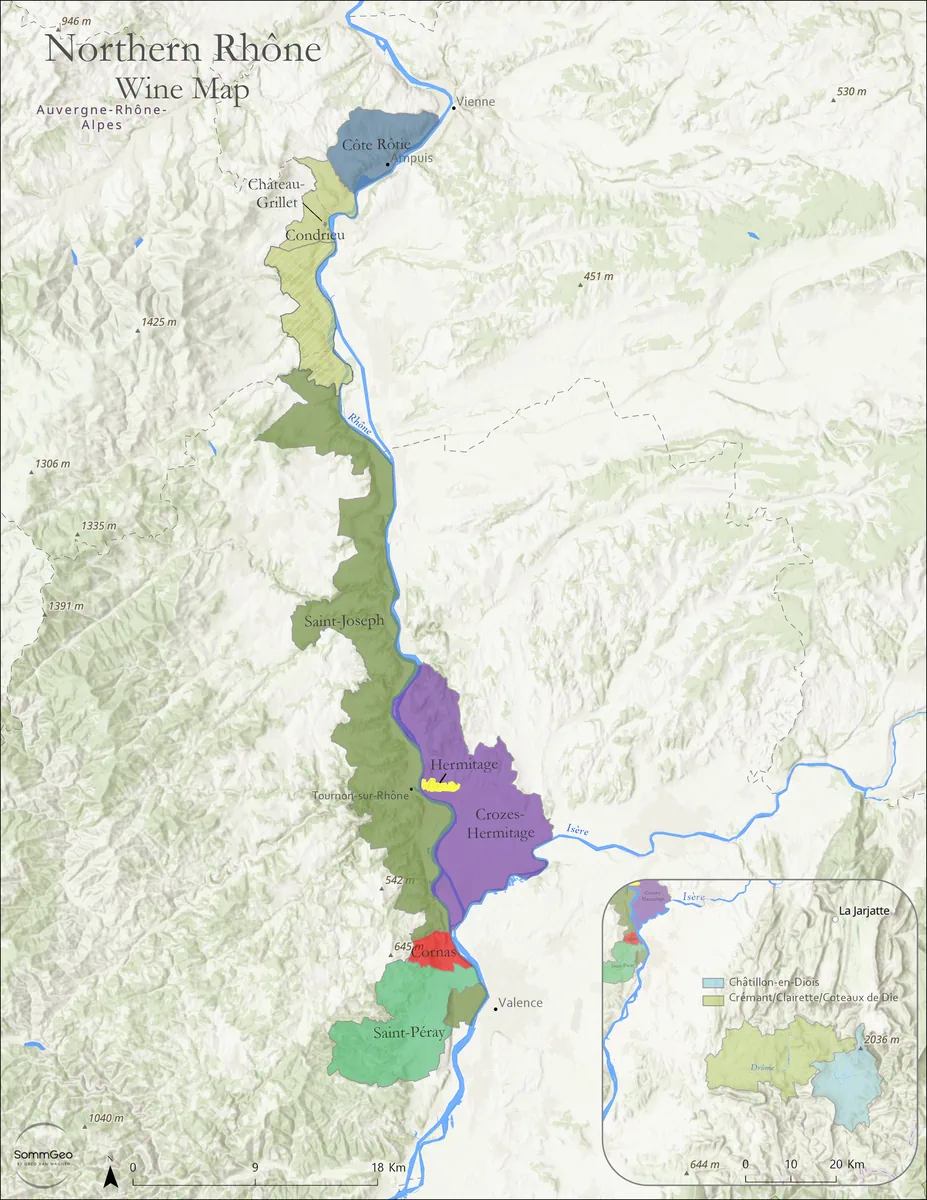

What This Map Covers
This classic map provides a geographic overview of the Northern Rhône’s eight cru appellations and their positions along the Rhône River between Vienne and Valence. You’ll see the steep right-bank slopes where Côte-Rôtie, Condrieu, Saint-Joseph, Cornas, and Saint-Péray cling to granite hillsides, the singular south-facing hill of Hermitage overlooking Tain l’Hermitage, and the broader terraces of Crozes-Hermitage — the region’s largest appellation — fanning out across the left bank.
- All eight Northern Rhône cru appellations: Côte-Rôtie, Condrieu, Château-Grillet, Saint-Joseph, Hermitage, Crozes-Hermitage, Cornas, and Saint-Péray
- The Rhône River corridor from Vienne to Valence — the geographic spine of the entire region
- Key towns including Ampuis, Tain l’Hermitage, Tournon-sur-Rhône, and the village of Cornas
- Right bank versus left bank positioning — critical for understanding sun exposure and mesoclimate differences
- Topographic context showing the steep, terraced slopes that define the region’s most prestigious vineyard sites
- The lesser known appellations bordering the Drôme River: Châtillon-en-Diois and the three AOPs of Die.
Geography and Climate
The Northern Rhône is defined by a single geographic feature: a narrow, steep-sided river valley where the Rhône cuts south through the eastern edge of the Massif Central before opening into the wider plains of the south. The commercially viable vineyard sites — almost all of them carved into hillsides — exist only where the slopes catch enough sun to ripen Syrah fully, which in this continental climate at 45 degrees north latitude is not guaranteed. The best sites face south or southeast, and many are so steep that pulley systems and shoulder-carried harvest bins are the only options. Flat land here generally means unremarkable wine; the magic happens on the slopes.
The soils are predominantly granitic — an extension of the Massif Central’s ancient crystalline bedrock — though the details change appellation by appellation. You’ll find decomposed granite and mica-schist on the steep right-bank slopes of Côte-Rôtie, massive granite with iron-rich clay in Cornas, a complex mosaic of granite, loess, and alluvial glacial deposits on the hill of Hermitage, and pebble-covered terraces with sand and clay across the flatter stretches of Crozes-Hermitage. These soil differences are partly responsible for the dramatically different expressions of Syrah you’ll taste across the region, even though the grape and the general climate are shared.
The Mistral — cold, dry, and ferocious — blows from the north through the valley and is a constant presence. It’s both a blessing and a curse: it dries the vines after rain and reduces disease pressure, but it can also damage shoots and stress the plants. Côte-Rôtie, the northernmost appellation, is cool enough that full ripeness is never a foregone conclusion. By the time you reach Cornas, roughly 60 kilometers south, temperatures are measurably warmer — sheltered by its amphitheater of granite slopes and often one of the first appellations in the region to harvest.
Syrah — and the Practice of Blending With Whites
Syrah is the sole red grape permitted in the Northern Rhône, and every red wine produced here is built around it. But the expressions are so varied across the eight appellations that tasting Côte-Rôtie next to Cornas, you might not immediately believe they come from the same variety. The Northern Rhône style of Syrah is generally marked by higher acidity, more herbal and smoky complexity, and a signature aromatic profile of black olive, cracked pepper, violets, and what’s often described as bacon fat or woodsmoke. These are not fruit bombs; they are wines of structure, savory character, and serious aging potential.
One of the Northern Rhône’s most distinctive practices is the co-fermentation of red Syrah with small amounts of white grapes. In Côte-Rôtie, up to 20% Viognier is permitted (though most producers use far less, typically 5–10%, and many use none at all). The Viognier must be co-fermented — placed in the same tank from the start, not blended later — and it contributes floral lift, aromatic complexity, and a certain textural richness to the wine and can stabilize color. In Hermitage, Crozes-Hermitage, and Saint-Joseph, up to 15% of Marsanne and Roussanne can be included in the red wines, though this is relatively rare in practice. Cornas, by contrast, is strictly 100% Syrah — no white grapes permitted at all — and its wines show it: dark, dense, tannic, and unapologetically powerful.
The white wines of the region — made from Viognier (in Condrieu and Château-Grillet), Marsanne and Roussanne (in Hermitage, Crozes-Hermitage, Saint-Joseph, and Saint-Péray) — are produced in much smaller volumes but are world-class in their own right. White Hermitage in particular, from producers like Jean-Louis Chave and Chapoutier, ranks among the most long-lived and complex white wines made anywhere.
Five Expressions of Syrah
Côte-Rôtie
The “roasted slope” is the Northern Rhône at its most extreme — and its most refined. Located just south of Vienne, the appellation’s steep, southeast-facing slopes rise sharply from the Rhône’s right bank, with the finest sites concentrated above the town of Ampuis. The traditional division is between the Côte Brune (darker soils rich in iron and mica-schist, producing more structured, tannic wines) and the Côte Blonde (lighter, sandier granite soils that yield more perfumed, elegant styles). In practice, many producers blend fruit from both slopes, and the distinction is more gradient than boundary. The vines are often trained in pairs staked together to meet at a point — forming shapes that look like Christmas trees from a distance — a practical adaptation to the twin threats of wind damage and soil erosion on slopes that can exceed 60 degrees.
For much of the 20th century, Côte-Rôtie was neglected and underdeveloped. The renaissance came largely through the Guigal family — Etienne founded the house in 1946, and his son Marcel’s single-vineyard bottlings of La Mouline (Côte Blonde, first vintage 1966), La Landonne (Côte Brune, 1978), and La Turque (Côte Brune, 1985) captured international attention and established Côte-Rôtie on par with Hermitage. These three “La-La” wines, aged 42 months in new French oak, remain among the most collectible bottles in the Rhône Valley. Beyond Guigal, producers like Jamet, Rostaing, Clusel-Roch, Gilles Barge, and Jean-Michel Gerin are making wines of extraordinary quality.
Hermitage
Hermitage is the undisputed benchmark for Syrah — the appellation against which every other expression of the grape is ultimately measured. And yet it’s astonishingly small: roughly 140 hectares of vineyard on a single south-facing granite hill overlooking the Rhône and the town of Tain l’Hermitage. To put that in perspective, Château Lafite in Pauillac is roughly 100 hectares on its own. The hill’s prestige dates back centuries — Hermitage was served at the courts of Louis XIII and XIV, and for much of history its wines commanded prices that rivaled the greatest Bordeaux. There’s even a long history (no longer permitted) of Hermitage being blended into Bordeaux and Burgundy to add body, color, and tannin in weaker vintages.
The hill is a granitic outcrop extending from the Massif Central, but the soil complexity is remarkable. The key is that at this point, the Rhône briefly flows east-west rather than north-south, giving the entire hillside full southern exposure. The western lieux-dits — particularly Les Bessards, the most granitic of all — produce the most tannic, structured wines that form the backbone of great Hermitage. Le Méal, with its glacial stones and alluvial influence, gives richer, riper fruit. L’Hermite, surrounding the famous Chapel of Saint Christopher at the summit, has granite, loess, and alpine residues. Most of the best producers — Jean-Louis Chave (whose family has made wine here since 1481), Chapoutier, Paul Jaboulet Aîné, and Delas — own parcels across multiple lieux-dits and blend them for complexity. Chave’s Hermitage, assembled from seven different lieux-dits, is the masterclass in this approach. Chapoutier is the largest landholder with roughly 34 hectares, followed by Jaboulet at about 22.
Cornas
Cornas is the Northern Rhône’s pure Syrah statement — no white grapes allowed. This small appellation of roughly 110 hectares on the right bank, just north of Valence, produces the darkest, most muscular Syrah in the valley. The village sits in a natural amphitheater of steep granite slopes that traps heat and shelters vineyards from the Mistral, making Cornas warmer than its neighbors and typically one of the earliest to harvest. Vineyards climb from 150 meters up to 380 meters, with eleven streams running through the appellation providing much-needed moisture in hot, dry years. The result is wines of extraordinary concentration: dark-fruited, tannic, savory, and built for serious aging.
For years, Cornas was dismissed as “rustic” — a source of sturdy country wine that couldn’t compete with the prestige of Côte-Rôtie or Hermitage. Auguste Clape changed that. He was the first in the village to estate-bottle his wine (in the late 1950s), and his classical, age-worthy Syrah — from eight hectares of vines in the finest central lieux-dits including Reynard, La Côte, and Sabarotte — became the reference point for the entire appellation. He passed away in 2018 at 93; his son Pierre-Marie and grandson Olivier continued the tradition without deviation: whole-cluster fermentation in concrete, aging in old foudres, no new oak. Thierry Allemand is the other essential name — farming five hectares who learned his craft under local legend Robert Michel. His Reynard bottling (vinified from vines Noël Verset sold him) is widely regarded as the appellation’s single greatest wine. Prices have risen dramatically — Clape was $20 a bottle 25 years ago; it’s closer to $150 now — but for the quality, Cornas remains one of the Northern Rhône’s most compelling values.
Saint-Joseph
Saint-Joseph is the Northern Rhône’s longest appellation, straggling down the right bank from Condrieu almost to Saint-Péray. It’s also the one with the widest quality range — a consequence of dramatic expansion in the 1970s and 1980s that added large stretches of flat land to the steep terraced hillsides above Tournon that produce the appellation’s finest wines. At its best, Saint-Joseph offers something unique: a Northern Rhône Syrah with more vibrancy, lift, and drinkability than its more famous neighbors, often at a fraction of the price. The greatest bottlings — particularly from producers working old-vine terraces on granite soils — can reach heights equal to Côte-Rôtie and Hermitage. At its worst, from high-yielding flatland vineyards, it can be dilute and forgettable.
Up to 10% Marsanne and Roussanne are permitted in the reds (though rarely used), and the appellation also produces excellent whites from those varieties. The producers who matter most are those working the steep, original hillside sites: Jean-Louis Chave, Pierre Gonon, Yves Cuilleron, Bernard Gripa, and André Perret. When buying Saint-Joseph, origin matters enormously — the difference between a hillside wine and a flatland wine is the difference between genuine Northern Rhône character and an anonymous Syrah.
Crozes-Hermitage
Crozes-Hermitage is the Northern Rhône’s largest appellation by a significant margin, regularly accounting for more than half of all wine produced in the region. It surrounds the hill of Hermitage on the left bank (east), and the quality spectrum is broad — from simple, early-drinking food wines to genuinely impressive Syrahs that punch well above their weight class. The critical distinction is between wines from the sloped, terraced vineyards in the northern part of the appellation (near the hill of Hermitage itself, where granite-clay soils and good exposures produce structured, aromatic wines) and those from the flatter southern terraces (with more pebbles, sand, and alluvial soils that tend toward lighter styles with more dried herbal notes and less fruit density).
This is the appellation most wine lovers should start with if they want to understand Northern Rhône Syrah without committing to the prices of Hermitage or Côte-Rôtie. Cave de Tain, the large cooperative, handles a significant portion of the appellation’s production, and Jaboulet is another major presence. But there are excellent smaller producers making wines of real distinction — Alain Graillot, Yann Chave, and the Crozes bottlings from Chapoutier, Delas, and Cuilleron are all worth seeking out. White Crozes-Hermitage from Marsanne and Roussanne can also be outstanding value.
The Rhône River & Notable Towns
The Rhône itself is the backbone of everything. Rising in the Swiss Alps, by the time it reaches the Northern Rhône wine region south of Lyon, it flows through a narrow valley carved between the Massif Central to the west and the Alps to the east. The key geographic detail — and one you’ll see clearly on the map — is that at Hermitage, the river briefly flows east-west rather than north-south, which is precisely why the hill gets its extraordinary full southern exposure. Everywhere else in the Northern Rhône, the river runs roughly north-south, and the finest vineyards are those on the right (western) bank where the slopes face southeast and catch the morning and midday sun.
Ampuis is the heart of Côte-Rôtie — a small, ancient village directly below the Côte Brune and Côte Blonde, and the headquarters of Guigal since 1946. Tain l’Hermitage and Tournon-sur-Rhône sit on opposite banks of the river beneath the hill of Hermitage — Tain on the left (where Chapoutier and Jaboulet are based) and Tournon on the right (the base for many Saint-Joseph producers). Tain is also home to Valrhona’s Cité du Chocolat, which makes it a doubly worthwhile stop. Cornas is a small village tucked into its granite amphitheater — barely more than a cluster of stone houses and cellars. And Valence, at the southern end, marks the unofficial boundary where the narrow granite valley gives way to the broader, warmer, Mediterranean-influenced landscape of the Southern Rhône — a gap of roughly 40 kilometers of non-vineyard land that separates two completely different wine worlds.
Want to explore the Northern Rhône in 3D with interactive layers, elevation data, and appellation boundaries? Join 200+ wine organizations already using SommGeo.
Start Your 15-Day Free Trial $5/month billed annually after trial · Cancel anytimeMap Usage
Free for your own study and tastings. If you share or teach with a map, credit it visibly as Map: SommGeo (sommgeo.com). Commercial use requires a Commercial Embed License. See Map Usage, Credit and Licensing.