Victoria, NSW and Tasmania Wine Map: 36 Regions in 3D, Interactive
Yarra Valley, Hunter Valley, Mornington Peninsula, and Tasmania in full 3D terrain.
This interactive 3D wine map of southeastern Australia shows 36 regions on real terrain: Victoria’s 21, from the Yarra Valley, Mornington Peninsula and Geelong around Melbourne through Heathcote, Bendigo and the Goulburn Valley to Rutherglen, Beechworth and the King Valley in the northeast and the Grampians and Pyrenees in the west; 14 in New South Wales, from the Hunter Valley and Orange to Canberra, Hilltops, Tumbarumba and the Riverina; and Tasmania, drawn in 3D by SommGeo, with the Hunter, Grampians and Goulburn Valley subregions marked. Fly between regions with the bookmarks, check elevation and slope, run the daylight animation and click any region for its grapes and profile. The interactive map is part of SommGeo membership, which starts with a free 15-day trial.
- Regions on the map: 36 GIs, every boundary clickable: 21 in Victoria, 14 in New South Wales and Tasmania, plus 5 subregions
- Victoria: More wine regions than any other state, packed into a small area where a few hundred meters of altitude or a few kilometers of coast change the wine
- Hunter Valley: Low, warm and humid, at roughly 60 to 150 meters (200 to 490 feet), yet the home of Semillon that ages for decades at 10 to 11% alcohol
- Tasmania: One GI for the whole island, with vineyards in the Tamar, Coal River, Derwent and Huon valleys and on the east coast, the country’s sparkling wine and cool-climate Pinot Noir stronghold
- Rutherglen: Warm continental northeast Victoria, where fortified Muscat and Topaque (Muscadelle) are aged for decades in a style made nowhere else
- 3D tools: Tilt and rotate the terrain, bookmarks to fly between areas, elevation profile readouts, daylight and shadow animation and layer controls
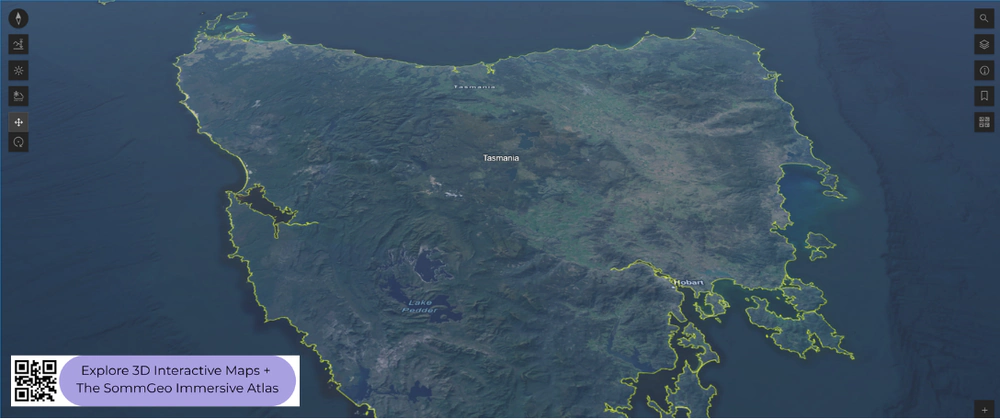
This 3D Fast Map covers Australia’s eastern wine regions across three states with very different geographic personalities. Victoria packs a high number of distinct GIs into a relatively small area, driven by varied topography and coastal influence. New South Wales is well-known for the Hunter Valley, one of Australia’s oldest wine regions, where low elevation and warm, humid conditions produce a style unlike anything else in the country. Tasmania, separated by Bass Strait, offers a genuinely cool maritime climate that makes it a natural fit for sparkling wine, Pinot Noir, and Chardonnay. The terrain differences across these three states are striking, and 3D is the best way to see why they produce such different wines.
Unlock the Full SommGeo Toolkit
Gain exclusive access to our entire suite of premium features, including interactive Map Makers, immersive 3D Tours, high-resolution classic Maps, and advanced analytical tools.
Start Free TrialWhat You’ll Explore
This 3D Fast Map covers wine regions across Victoria, New South Wales, and Tasmania. Click any mapped region for detailed popup content covering grape varieties, classification details, and geographic specifics. Use the bookmarks to jump between key areas./p>
- Full 3D terrain across Victoria, NSW, and Tasmania wine regions
- Bookmarks for quick navigation to key areas within the map
- Elevation profile tool for measuring vineyard altitude and slope gradients
- Daylight and shadow animation to visualize aspect and sun exposure
Key Regions in Focus
Victoria: Yarra Valley and Mornington Peninsula
Victoria has more individual GIs than any other Australian state, packed into a compact area where small changes in elevation and coastal proximity create distinct growing conditions. The Yarra Valley, northeast of Melbourne, ranges from around 50 meters (164 ft) on the valley floor to over 400 meters (1,312 ft) in the Upper Yarra, producing everything from ripe Shiraz at the warmer, lower elevations to taut Pinot Noir and Chardonnay higher up. The Mornington Peninsula juts into Bass Strait south of Melbourne, where maritime influence keeps temperatures moderate and wind is a constant factor. Pinot Noir and Chardonnay dominate. Further north, Rutherglen and the King Valley offer completely different conditions: Rutherglen’s warm continental climate produces fortified Muscat and Topaque (Muscadelle) of a style found nowhere else in Australia.
New South Wales: Hunter Valley
The Hunter Valley sits at low elevation (roughly 60 to 150 meters / 197 to 492 ft) about 160 kilometers (99 miles) north of Sydney, and its warm, humid climate would seem an unlikely setting for fine wine. But the Brokenback Range to the west shelters the valley, while the region’s proximity to the coast brings afternoon cloud cover and moderating breezes that temper the heat during the growing season. The Hunter’s signature is Semillon, picked early at low sugar levels and bottled without oak, producing wines that seem simple in youth but develop complexity with a decade or more of bottle age. Shiraz is the main red, and Hunter Shiraz tends toward a medium-bodied, earthy style quite different from the Barossa or McLaren Vale.
Tasmania
Tasmania is Australia’s coolest and most southerly wine-producing state, sitting between 41°S and 43°S across Bass Strait from the mainland. The island’s climate is genuinely maritime with cool temperatures and reliable rainfall. The Tamar Valley in the north, Coal River Valley near Hobart, and the East Coast each offer different mesoclimates shaped by the island’s rugged topography and varied coastal exposure. Pinot Noir and Chardonnay are the dominant varieties, and the state has become an increasingly important source for sparkling wine base. The cool conditions and long hang times produce fruit with natural acidity and flavor intensity.
Regions on this map (36 GIs, 5 subregions)
Every GI on the map, by state and zone, with the subregions the map marks at the end. The 3D map adds the terrain, elevation and sun tools plus a full profile for each.
| Region | Zone | Principal grapes |
|---|---|---|
| Victoria | ||
| Yarra Valley | Port Phillip | Pinot Noir, Chardonnay, Cabernet Sauvignon |
| Mornington Peninsula | Port Phillip | Pinot Noir, Chardonnay, Pinot Gris |
| Geelong | Port Phillip | Pinot Noir, Chardonnay, Shiraz |
| Macedon Ranges | Port Phillip | Pinot Noir, Chardonnay, sparkling |
| Sunbury | Port Phillip | Shiraz, Chardonnay |
| Heathcote | Central Victoria | Shiraz |
| Bendigo | Central Victoria | Shiraz, Cabernet Sauvignon |
| Goulburn Valley | Central Victoria | Shiraz, Marsanne, Cabernet Sauvignon |
| Strathbogie Ranges | Central Victoria | Riesling, Pinot Noir, Chardonnay |
| Upper Goulburn | Central Victoria | Chardonnay, Pinot Noir, Sauvignon Blanc |
| Rutherglen | North East Victoria | Muscat, Topaque, Durif, Shiraz |
| Glenrowan | North East Victoria | Shiraz, Durif, Muscat |
| King Valley | North East Victoria | Prosecco, Sangiovese, Pinot Grigio |
| Alpine Valleys | North East Victoria | Chardonnay, Pinot Noir, Italian varieties |
| Beechworth | North East Victoria | Chardonnay, Shiraz, Pinot Noir |
| Grampians | Western Victoria | Shiraz, Riesling |
| Pyrenees | Western Victoria | Shiraz, Cabernet Sauvignon |
| Henty | Western Victoria | Riesling, Pinot Noir, Chardonnay |
| Gippsland | Gippsland (zone-level GI) | Pinot Noir, Chardonnay |
| Murray Darling | North West Victoria (shared with NSW) | Chardonnay, Shiraz, Cabernet Sauvignon |
| Swan Hill | North West Victoria (shared with NSW) | Shiraz, Chardonnay |
| New South Wales | ||
| Hunter Valley | Hunter Valley | Semillon, Shiraz, Chardonnay |
| Mudgee | Central Ranges | Shiraz, Cabernet Sauvignon, Chardonnay |
| Orange | Central Ranges | Chardonnay, Sauvignon Blanc, Shiraz, Cabernet Sauvignon |
| Cowra | Central Ranges | Chardonnay, Shiraz |
| Canberra District | Southern New South Wales | Shiraz, Riesling |
| Hilltops | Southern New South Wales | Shiraz, Cabernet Sauvignon |
| Tumbarumba | Southern New South Wales | Chardonnay, Pinot Noir, sparkling |
| Gundagai | Southern New South Wales | Shiraz, Cabernet Sauvignon, Chardonnay |
| Riverina | Big Rivers | Semillon (botrytis), Shiraz, Chardonnay |
| Perricoota | Big Rivers | Shiraz, Chardonnay |
| Shoalhaven Coast | South Coast | Chambourcin, Chardonnay, Semillon |
| Southern Highlands | South Coast | Chardonnay, Pinot Noir, Sauvignon Blanc |
| New England Australia | Northern Tablelands | Chardonnay, Shiraz, Cabernet Sauvignon |
| Hastings River | Northern Rivers | Chambourcin, Semillon, Chardonnay |
| Tasmania | ||
| Tasmania | Tasmania (single GI) | Pinot Noir, Chardonnay, sparkling, Riesling |
| Subregions marked on the map | ||
| Pokolbin | Hunter Valley | Semillon, Shiraz |
| Broke Fordwich | Hunter Valley | Semillon, Shiraz, Verdelho |
| Upper Hunter Valley | Hunter Valley | Chardonnay, Semillon, Shiraz |
| Great Western | Grampians | Shiraz, sparkling |
| Nagambie Lakes | Goulburn Valley | Marsanne, Shiraz, Cabernet Sauvignon |
Hopefully this index is useful on its own. To explore these regions interactively, with every boundary on real terrain and a full profile for each, start a 15-day free trial. To see what one of these maps is like first, a different map is unlocked for everyone every day. For a flat view of every Australian region, see the Australia Fast Map; the South Australia 3D map covers the rest of the mainland’s big names.
Victoria, NSW and Tasmania 3D Wine Map: Frequently Asked Questions
Which Australian wine regions are on this map?
Everything in the southeast outside South Australia: all 21 Victorian GIs, from the Yarra Valley, Mornington Peninsula, Geelong, Macedon Ranges and Sunbury around Port Phillip to Heathcote, Bendigo and the Goulburn Valley, the northeast cluster of Rutherglen, Glenrowan, Beechworth, the King Valley and the Alpine Valleys, the Grampians, Pyrenees and Henty in the west, Gippsland and the Murray Darling and Swan Hill on the river; 14 in New South Wales, from the Hunter Valley, Mudgee, Orange and Cowra to Canberra, Hilltops, Tumbarumba and Gundagai, the Riverina and Perricoota, the Shoalhaven Coast and Southern Highlands, New England and the Hastings River; and Tasmania. Western Australia and South Australia have their own 3D maps.
Why is Hunter Valley Semillon unusual?
Because it is picked early and made plain. The Hunter is warm, humid and low, so growers pick Semillon at around 10 to 11% potential alcohol, ferment it in steel without oak or malolactic, and bottle it young, when it tastes of little more than lemon and grass. Then it does something few white wines do: after five to ten years in bottle it turns golden and develops toast, honey, lanolin and beeswax without ever having seen a barrel. The Pokolbin subregion, marked on the map, is its historic heart.
Why is Tasmania good for sparkling wine?
Latitude and sea. Tasmania sits between 41 and 43 degrees south, further from the equator than any mainland region, with a maritime climate that keeps summers cool and the ripening season long, so Chardonnay and Pinot Noir reach flavour at the low sugars and high acidity that traditional-method sparkling wine needs. The island is a single GI, but the terrain shows why site matters: the Tamar and Pipers River in the north, the Coal River and Derwent valleys near Hobart, the Huon to the south and the east coast each sit in their own pocket of shelter.
What can the 3D map show that a flat map can’t?
You can tilt and rotate the terrain, use the bookmarks to fly from the Yarra Valley to the Hunter and across Bass Strait to Tasmania, read elevation and slope from the Yarra floor to the Upper Yarra, on the Macedon and Strathbogie ranges and up the Tumbarumba slopes of the Snowy Mountains, and animate daylight and shadows to see which hillsides catch the sun. For a flat view of every Australian region, see the Australia Fast Map.
Is the Victoria, NSW and Tasmania 3D wine map free?
The region index on this page is free to use. The interactive 3D map itself, with clickable boundaries and a full profile for every region, is part of SommGeo membership, which starts with a free 15-day trial. If you want a feel for what one of these maps is like before signing up, SommGeo unlocks one map every day on a rotation, different every day, no signup needed. Today’s unlocked map is on the home page.
New to 3D Fast Maps? Learn how to navigate 3D terrain, use elevation profiles, animate sunlight, and get the most from your map.
3D Fast Maps Guide →Ready to explore these wine regions in full 3D? Join 200+ wine organizations already using SommGeo.
Start Your 15-Day Free Trial $5/month billed annually after trial · Cancel anytimeMap Usage
Free for your own study and tastings. If you share or teach with a map, credit it visibly as Map: SommGeo (sommgeo.com). Commercial use requires a Commercial Embed License. See Map Usage, Credit and Licensing.
Map by Greg Van Wagner, SommGeo