
France Wine Regions Map: Interactive Guide to French Appellations
The birthplace of modern wine classification. ~363 AOP appellations, a thousand years of terroir knowledge, and the system the rest of the world copied.
Any serious France wine regions map has to contend with an uncomfortable reality: this is the most complex wine country on the planet. With over 360 AOP appellations spread across a dozen major regions, from the chalk cellars of Champagne to the sun-baked garrigue of the southern Rhône, from Burgundy’s obsessively subdivided vineyard plots to Bordeaux’s sprawling left and right banks, France doesn’t just produce great wine. It invented the framework that every other wine-producing nation eventually borrowed. The Appellation d’Origine Contrôlée system, born in 1935 and overseen by the INAO, codified for the first time the revolutionary idea that where a wine comes from matters as much as who makes it. This interactive map lets you explore every major French wine region and appellation boundary, with searchable layers that bring the country’s geographic complexity to life. Click any region for a comprehensive profile covering grape varieties, classification rules, climate and soil data, key producers, and the geographic specifics that define each appellation, essentially a reference-level guide built directly into the map.
Unlock the Full SommGeo Toolkit
Gain exclusive access to our entire suite of premium features, including interactive Map Makers, immersive 3D Tours, high-resolution classic Maps, and advanced analytical tools.
Start Free TrialWhat You’ll Explore
This interactive Fast Map puts every major French wine region and AOP appellation at your fingertips, but the real depth is in what each region reveals. Click on any mapped appellation and a comprehensive info panel opens with sommelier-level content: permitted grape varieties, classification hierarchy, climate and soil profiles, key producers, and the geographic specifics that define the appellation’s wines. From broad regional designations like Côtes du Rhône down to tiny single-commune AOPs like Château-Grillet, every mapped area carries this level of built-in intelligence. The sidebar search lets you look up any appellation by name and instantly zoom to its boundaries.
- All major wine regions from Champagne to Provence with AOP boundaries
- In-depth appellation profiles for every mapped area: varieties, classification, soils, climate, and producers
- Bordeaux’s left bank and right bank appellations with commune-level detail
- Burgundy’s Côte d’Or, Chablis, Côte Chalonnaise, and Mâconnais mapped
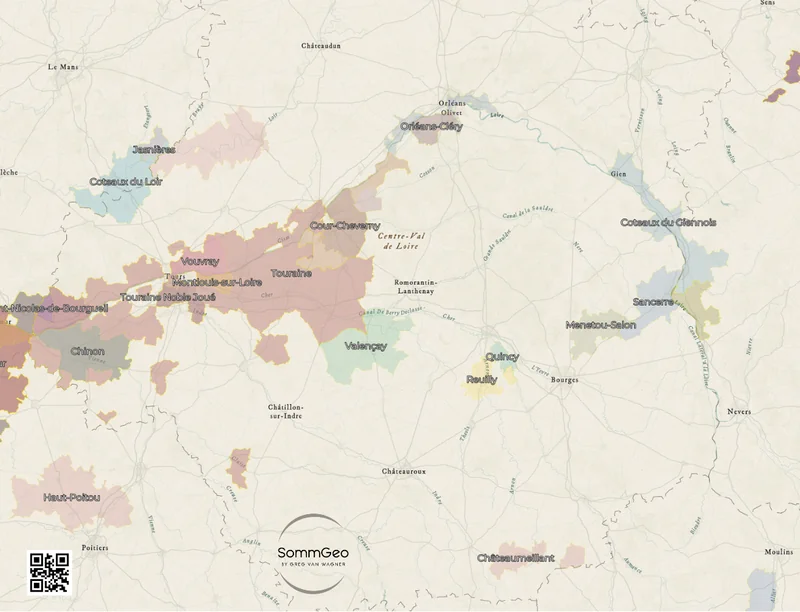
- The Loire Valley’s 52 AOP appellations from Muscadet to Sancerre
- Rhône Valley northern and southern divisions with cru designations


The AOP System and the INAO
You can’t understand French wine without understanding the classification system that shapes it. In the early twentieth century, French viticulture was in crisis. Phylloxera had devastated vineyards across the country, and fraud was rampant; wines from the Midi and even from Algeria were being sold under the names of prestigious regions. The 1907 winegrowers’ revolt in Languedoc-Roussillon nearly sparked civil unrest. Something had to give.
The solution came in 1935, when senator Joseph Capus pushed through a decree-law creating the Comité National des Appellations d’Origine (CNAO), the body that would become the INAO (Institut National de l’Origine et de la Qualité). By May 1936, France’s first six Appellations d’Origine Contrôlée were officially recognized: Arbois, Cassis, Châteauneuf-du-Pape, Cognac, Monbazillac, and Tavel. Baron Pierre Le Roy of Châteauneuf-du-Pape was instrumental in developing the framework, having already established internal vineyard regulations in the 1920s that prefigured the AOC system. By 1937, the major regions (Bordeaux, Burgundy, Champagne) had their own AOC designations in place.
The core principle was revolutionary and deceptively simple: the place where wine is made is inseparable from what it is. Each AOC defines not just a geographic boundary but the grape varieties permitted, maximum yields, minimum ripeness, vine density, pruning methods, and winemaking techniques. Today, more than 360 AOP appellations (the EU-harmonized term that replaced AOC in 2009) govern French wine production, overseen by the INAO from Paris. Below the AOP tier sits IGP (Indication Géographique Protégée, replacing the former Vin de Pays), offering more flexibility on grape varieties and methods, and Vin de France at the base, essentially table wine without geographic restrictions.
What makes the system both brilliant and maddening is its nested hierarchy. Appellations fit inside other appellations like Russian dolls. Pauillac sits within the Haut-Médoc, which sits within the broader Bordeaux appellation. In Burgundy, the layering peaks in its precision: a single vineyard row can separate a Grand Cru from a Premier Cru from a village wine. This is exactly the kind of geographic complexity that an interactive map makes tangible: seeing how these boundaries relate to each other spatially is worth a thousand pages of textbook reading.
Geography and Climate of France
France’s genius as a wine country comes down to one thing: it occupies the sweet spot. Sitting between the 42nd and 49th parallels (roughly the band where viticulture operates at its most expressive) the country is influenced by three distinct climate systems that create radically different growing conditions from region to region.
The Atlantic (maritime) influence dominates the west. Bordeaux, the Loire Valley, and the southwest receive moderate temperatures, ample rainfall, and the kind of long, slow ripening season that builds complexity in Cabernet Sauvignon, Merlot, and Chenin Blanc. Continental climate takes over as you move east and inland. Burgundy, Alsace, and Champagne experience cold winters, warm summers, and significant diurnal temperature shifts (the daily swing between daytime heat and nighttime cooling that preserves acidity while allowing full phenolic ripeness). This is why Pinot Noir reaches its apex in Burgundy: the grape demands that knife-edge balance between warmth and freshness.
The Mediterranean climate governs the south (Provence, Languedoc-Roussillon, the southern Rhône) with hot, dry summers and mild winters. Here the challenge isn’t ripening the fruit; it’s retaining freshness and avoiding overextraction. Grenache, Mourvèdre, and Syrah thrive in this heat, producing wines of power and concentration. And then there are the transitional zones where climate systems overlap. The northern Rhône, for instance, sits at the collision point of Mediterranean warmth pushing north and continental cold pushing south, creating the conditions that make Hermitage and Côte-Rôtie so distinctive.
Geology adds another dimension. The chalk of Champagne and the limestone of Burgundy’s Côte d’Or contribute minerality and structure. Bordeaux’s famed gravel banks in the Médoc provide the drainage that Cabernet Sauvignon demands. The granite of Beaujolais gives Gamay its mineral backbone, while the schist of Banyuls on the Spanish border concentrates its fortified Grenache. Understanding these geographic intersections (where climate meets geology meets human tradition) is the entire point of the appellation system.
Major Wine Regions
Bordeaux
Bordeaux is the world’s most recognizable fine wine region, and it’s also one of the most complex, with ~65 AOP appellations spread across approximately 105,000 hectares (259,460 acres) of vineyard. The Gironde estuary and its tributaries (the Dordogne and Garonne rivers) create the defining geographic split. The Left Bank (Médoc, Graves, Sauternes) sits on deep gravel deposits ideal for Cabernet Sauvignon, producing wines of structure and longevity. The Right Bank (Saint-Émilion, Pomerol, Fronsac) favors clay and limestone soils where Merlot dominates, producing rounder, more approachable wines. The 1855 Classification of the Médoc remains the most famous (and controversial) wine ranking in existence, essentially unchanged for 170 years. Nowadays, the real energy in Bordeaux is coming from both the satellite appellations offering serious value and the increasing number of estates adopting organic and biodynamic practices.
Burgundy
If Bordeaux is about estates, Burgundy is about dirt. Nowhere on earth is the relationship between vineyard site and wine quality more meticulously documented. The Côte d’Or (that roughly 50-kilometer stretch of golden slope running from Dijon to Santenay) is where Pinot Noir and Chardonnay reach their most profound expressions. The classification system here is geographically driven: Regional, Village, Premier Cru, Grand Cru, each level defined by specific vineyard boundaries, many recognized since medieval Cistercian monks first mapped them. With 84 AOP appellations and well over 440 named Premier Cru vineyards, Burgundy rewards the kind of granular geographic study that interactive mapping was made for. Beyond the Côte d’Or, Chablis delivers some of the world’s finest expressions of Chardonnay on Kimmeridgian limestone, while the Côte Chalonnaise and Mâconnais offer increasingly compelling value.
Champagne
Champagne sits at the absolute northern limit of viable viticulture in France, and that marginality is precisely the point. The combination of chalk subsoil (some of it laid down 70 million years ago), cool continental climate, and northerly latitude produces base wines with the razor-sharp acidity that sparkling wine demands. The region’s 34,000 hectares (84,016 acres) are planted predominantly to Pinot Noir, Chardonnay, and Pinot Meunier, with distinct subregional characters: the Montagne de Reims favors Pinot Noir, the Côte des Blancs is Chardonnay country, and the Vallée de la Marne contributes Meunier’s approachable fruit. The commune-based cru system rates villages, with Grand Cru status reserved for the 17 villages at the top.
The Rhône Valley
The Rhône is really two regions separated by a 40-kilometer gap with no vineyards. The northern Rhône is a narrow, steep, dramatic corridor where Syrah reigns supreme on terraced granite and schist slopes, producing some of the most age-worthy wines in France at Hermitage, Côte-Rôtie, and Cornas. The southern Rhône is broader, flatter, warmer, and dominated by Grenache-based blends across a patchwork of appellations from the massive Côtes du Rhône (spanning roughly 30,000 hectares (74,132 acres)) down to the concentrated crus of Châteauneuf-du-Pape, Gigondas, and Vacqueyras. The contrast between north and south is one of the most dramatic geographic stories in all of French wine.
The Loire Valley
The Loire is France’s longest wine river, and its ~52 AOP appellations stretch nearly 1,000 kilometers (621 miles) from the volcanic soils of the Massif Central to the Atlantic coast. This is a versatile wine region: bone-dry Muscadet from Melon de Bourgogne near the ocean, extraordinary Chenin Blanc in every style from dry to sparkling to botrytized at Vouvray and Savennières, world-class Sauvignon Blanc at Sancerre and Pouilly-Fumé, and serious Cabernet Franc reds at Chinon and Bourgueil. The sheer diversity of terroir along the river (from volcanic tuff to silex (flint) to Kimmeridgian limestone) gives each appellation its own distinct voice.
Alsace
Alsace is a geographic anomaly. Protected from Atlantic rainfall by the Vosges Mountains to the west, it’s one of the driest vineyard regions in France, enjoying what is effectively a continental microclimate in a country dominated by maritime and Mediterranean influences. The region is almost exclusively white wine territory: Riesling, Gewurztraminer, Pinot Gris, and Muscat are the four noble varieties, each producing wines of aromatic intensity and structural precision on the region’s patchwork of granite, limestone, sandstone, and volcanic soils. The 51 Grand Cru vineyards are individually named and mapped, each with distinct geological profiles that shape profoundly different wines, even from the same grape variety.
Languedoc-Roussillon & Provence
The Mediterranean south is where France’s wine story gets interesting for value-seekers. Languedoc-Roussillon is the country’s largest wine-producing area by volume, and for decades it was dismissed as a source of bulk wine. That reputation is long outdated. Appellations like Pic Saint-Loup, Faugères, La Clape, and Corbières are producing serious wines from Grenache, Syrah, Mourvèdre, and Carignan at prices that would be unthinkable in Bordeaux or Burgundy. Roussillon, tucked against the Pyrenees near the Spanish border, adds Banyuls and Maury, remarkable fortified Grenache wines from ancient schist soils. Provence, meanwhile, dominates the global rosé market but increasingly earns recognition for its structured reds from Bandol (Mourvèdre-driven) and its historic white wines.
New to the Fast Maps? Learn how to search regions, navigate layers, and get the most from your interactive map.
Fast Map Guide →Ready to explore France’s wine regions in full detail? Join 200+ wine organizations already using SommGeo.
Start Your 15-Day Free Trial $5/month billed annually after trial · Cancel anytime