
Alsace Wine Tour: Grand Crus, Producers & Classifications in 3D
51 Grand Crus, each its own AOP, plus the producers, classifications, and terroir details that make Alsace one of France’s most rewarding deep dives.
Alsace sits behind one of the most important geographic features in French viticulture: the Vosges rain shadow. That single fact (that the mountains strip moisture from westerly Atlantic winds, making Colmar one of the driest cities in France) explains almost everything about why this narrow strip of vineyard produces wines of such concentration and aromatic intensity. But the real complexity starts when you get into the classification system. Since 2011, each of Alsace’s 51 Grand Crus operates as its own independent AOP with its own production rules, a structure that’s more Burgundian than people realize. This Tour walks through the Grand Crus, regional appellations, the producers who define them, and the legal framework that holds it all together.
Unlock the Full SommGeo Toolkit
Gain exclusive access to our entire suite of premium features, including interactive Map Makers, immersive 3D Tours, high-resolution classic Maps, and advanced analytical tools.
Start Free TrialInside This Tour
This 33-frame Tour flies through Alsace’s Grand Cru vineyards from the southern Haut-Rhin to the northern Bas-Rhin, with clickable pins on every major producer, Grand Cru site, and classification detail along the way. Every map frame is fully interactive. Don’t just watch the flythrough. Click, drag, zoom, and rotate the 3D terrain to explore from any angle. The info panel and pins contain the bulk of the content, so click every pin on every frame for the full picture.
- Grand Cru profiles with soil type, permitted varieties, and notable producers for each site
- Full producer breakdowns on Trimbach, Marcel Deiss, Albert Boxler, Zind-Humbrecht, and more
- Vendanges Tardives and Sélection de Grains Nobles classification rules and minimum sugar thresholds
- Crémant d’Alsace production details and permitted varieties
- Vosges rain shadow effect and soil diversity: granite, limestone, schist, volcanic, sandstone, and marl
- The 2011 Grand Cru AOP reform and what it means for each of the 51 sites

Alsace Classifications & Wine Law
For a geographic overview of Alsace, see the Alsace & Champagne Fast Map. Here, we focus on the legal framework.
The defining moment in modern Alsace wine law came in 2011, when each of the 51 Grand Crus was recognized as its own independent AOP, each with its own cahier des charges governing permitted varieties, yields (capped at 55 hl/ha), and production methods. This is closer to how Burgundy’s Grand Crus function than most people appreciate. Schlossberg was the first site recognized in 1975; Kaefferkopf, the last, in 2007. Four noble varieties are permitted across most Grand Crus (Riesling, Gewurztraminer, Pinot Gris, and Muscat) but exceptions exist: Zotzenberg allows Sylvaner, Altenberg de Bergheim and Kaefferkopf permit blends, and since 2022, Hengst and Kirchberg de Barr became the first Grand Crus authorized for Pinot Noir.
The Vendanges Tardives and Sélection de Grains Nobles designations, legally defined since 1984, represent some of France’s strictest sweet wine classifications. VT currently requires minimum must weights of 244 g/l for Riesling and Muscat or 270 g/l for Gewurztraminer and Pinot Gris, with no chaptalization permitted. SGN pushes those thresholds to 276 g/l and 306 g/l respectively, demands botrytis-affected grapes selected through successive passes, and requires 18 months of aging before release. And then there’s Crémant d’Alsace, traditional method sparkling that accounts for roughly a quarter of the region’s production, primarily Pinot Blanc–based, and increasingly serious in quality.
Key Producers
Trimbach
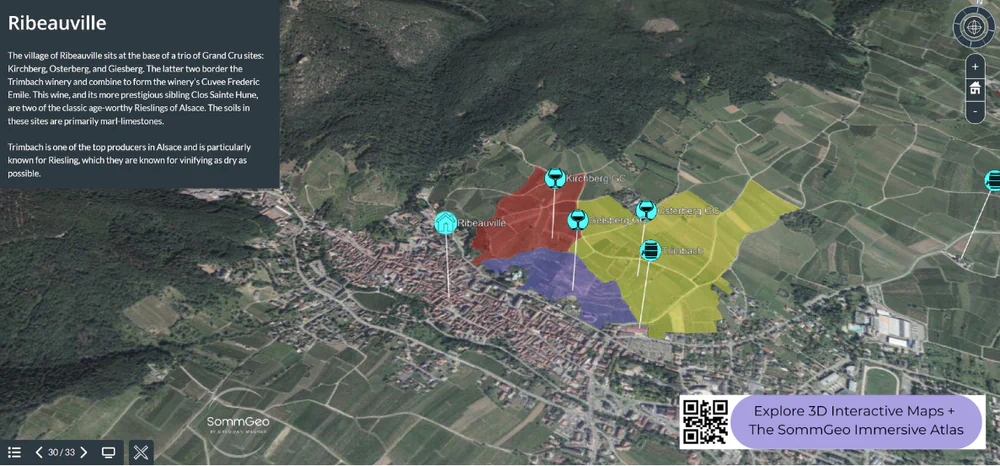
The house most synonymous with precision Alsace Riesling. Trimbach’s Clos Ste Hune (sourced from a 1.67-hectare parcel within the Rosacker Grand Cru) is arguably the most famous dry Riesling in the world, though it’s deliberately sold under the regional Alsace AOP rather than carrying the Grand Cru designation. The house style is austere, mineral, and built for aging, the antithesis of the fruit-forward approach found elsewhere in the region.
Marcel Deiss
Jean-Michel Deiss essentially forced the system to accommodate him. His insistence on field blends (co-planting and co-fermenting multiple varieties together in Grand Cru sites) challenged the single-variety orthodoxy that dominated Alsace for decades. The eventual allowance of blends in Altenberg de Bergheim and Kaefferkopf is partly his legacy. His wines are terroir-driven in the purest sense: the site speaks, not the grape.
Albert Boxler
Based in Niedermorschwihr, Boxler farms Grand Cru Sommerberg and Brand, producing Rieslings, Pinot Gris, and Gewurztraminers of exceptional concentration from granite soils. The wines are powerful but precise: not showy, not heavy, just dense with mineral extract and built to age. A reference point for what Alsace Grand Cru Riesling can be at its best.
Notable Vintages: Alsace
Among the standout vintages of the past two decades, 2007 delivered excellence across all varieties with a long harvest window that produced exceptional Vendanges Tardives and SGN. 2008 is a benchmark for Riesling: classic structure, exceptional minerality, and broad success. 2015 brought heat, richness, and concentration, with ripe fruit and lower acidity giving the wines broad early appeal. 2019 combined ripeness with freshness in a way that made it one of Alsace’s most complete recent vintages. 2022 offered concentrated fruit, surprisingly fresh acidity despite summer heat, and excellent aging potential across all varieties.
Conversely, 2013 was cool and wet, producing lighter wines with high acidity and lower alcohol, fine for everyday drinking but not a year that rewarded cellaring. 2021 saw spring frosts and severe mildew from heavy rains through May, June, and July, cutting production by 20% and making it a year of careful selection.
New to the Tours? Learn how to navigate frames, click pins for detailed producer and region profiles, and get the most from your 3D experience.
Tours Guide →Ready to go deeper into Alsace? Join 200+ wine organizations already using SommGeo.
Start Your 15-Day Free Trial $5/month billed annually after trial · Cancel anytime