
Germany Wine Tour: Mosel, Rheingau, VDP & Beyond in 3D
Steep slate, marginal ripeness, and a classification system that’s become one of the most rigorous in the world.
Germany is the key country for Riesling, a variety that registers every detail of where it was grown. The difference between a Scharzhofberger from the Saar and a Berg Schlossberg from the Rheingau is stark, driven by slate versus quartzite, river aspect versus hillside exposure, and the marginal ripening conditions that define Germany’s best sites. The VDP (Verband Deutscher Prädikatsweingüter) has built a vineyard classification system (Grosse Lage, Erste Lage, Ortswein, Gutswein) that maps this diversity with a precision that rivals anything in France. This Tour covers the key regions, the top Einzellagen, the sweetness question, the Sekt revolution, and the producers who define German wine at the highest level.
Unlock the Full SommGeo Toolkit
Gain exclusive access to our entire suite of premium features, including interactive Map Makers, immersive 3D Tours, high-resolution classic Maps, and advanced analytical tools.
Start Free TrialInside This Tour
This Tour covers Germany’s 13 Anbaugebiete with detailed stops at the most important Einzellagen, producer profiles, and classification breakdowns. Every map frame is fully interactive. Don’t just watch the flythrough. Click, drag, zoom, and rotate the 3D terrain to explore from any angle, then click every pin for the full content.
- VDP four-tier classification: Grosse Lage, Erste Lage, Ortswein, and Gutswein explained
- Top Einzellagen: Scharzhofberger, Bernkasteler Doctor, Graacher Domprobst, Berg Schlossberg
- Prädikat sweetness levels and the dry (trocken) vs. off-dry question
- German Sekt: from cheap Deutscher Sekt to serious traditional-method sparkling
- Mosel, Rheingau, Nahe, Pfalz, and the Ahr in 3D flythrough
- Producer profiles with vineyard holdings and winemaking philosophy
The VDP, Sweetness & Sekt
The VDP is a private association of roughly 200 top estates, but its classification system has effectively become Germany’s most trusted quality framework, filling a gap the official Prädikat system never addressed. The four-tier pyramid mirrors Burgundy’s logic: Gutswein (regional), Ortswein (village), Erste Lage (Premier Cru equivalent), and Grosse Lage (Grand Cru equivalent). VDP Grosse Lage dry wines are labeled GG (Grosses Gewächs) and must meet strict yield and quality standards. It’s not legally binding on all producers, but the best estates treat it as law.
The sweetness question confuses more people than any other aspect of German wine. The Prädikat system (Kabinett, Spätlese, Auslese, Beerenauslese, Trockenbeerenauslese, Eiswein) is based on grape ripeness at harvest. The label tells you ripeness level; you need to check for “trocken” or “halbtrocken” (or the VDP’s GG designation) to know the actual style. Checking the alcohol is still the fastest shortcut: a Spätlese at 8% ABV almost certainly carries significant residual sugar, while one at 12.5% was fermented to near-dryness.The trend toward dry Riesling has been dominant for decades, but the greatest German wines still include gloriously off-dry and sweet examples.
German Sekt deserves a brief note because it spans an enormous quality range. The bulk category (Deutscher Sekt) is cheap, tank-method sparkling, often from imported base wine, and largely unremarkable. But a growing number of VDP estates and specialist producers are making traditional-method Sekt from Riesling and Pinot Noir that rivals serious Champagne in complexity. The new Sekt b.A. classification (Sekt bestimmter Anbaugebiete) requires regional origin, and the best examples from the Rheingau and Pfalz are among the most undervalued sparkling wines in the world.
A Closer Look
The Mosel & Its Great Einzellagen
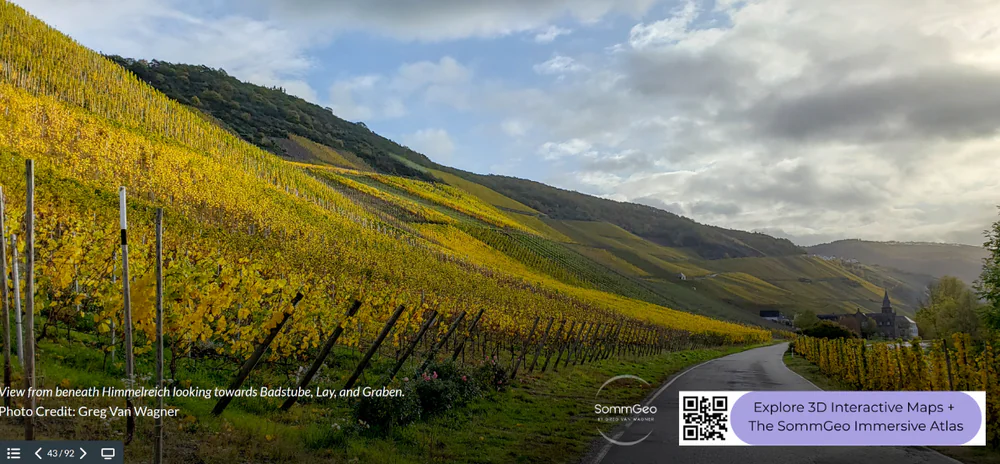
The Mosel’s steep blue and grey slate vineyards produce Riesling of unmatched delicacy: low alcohol, piercing acidity, and a minerality that changes with every bend in the river. Scharzhofberger in the Saar tributary is arguably Germany’s greatest vineyard: the wines from Egon Müller’s holdings here are among the most expensive white wines on earth, with an ethereal precision that no other site replicates. In the Middle Mosel, Bernkasteler Doctor (a tiny 3.26-hectare site above Bernkastel-Kues) and Graacher Domprobst produce Rieslings of extraordinary concentration from vertiginous south-facing slopes.
The Rheingau & Berg Schlossberg
The Rheingau’s south-facing slopes along the Rhine produce a fuller, more structured style of Riesling than the Mosel; slate gives way to quartzite and phyllite soils, and the wines tend toward more body and richness. Berg Schlossberg in Rüdesheim is one of the Rheingau’s most celebrated steep sites: fully south-facing, slate-based, producing Rieslings of power and mineral depth. The region was historically Germany’s most prestigious, and serious estates like Leitz, Breuer, and Künstler continue to produce GG wines that justify that reputation.
Producers Worth Knowing
Egon Müller, Scharzhofberg, Saar/Mosel
The estate’s Scharzhofberger Rieslings (particularly the Auslese, Beerenauslese, and Trockenbeerenauslese bottlings) regularly set auction records as the most expensive white wines in the world. The style is uncompromisingly delicate: low alcohol, crystalline purity, and an ability to age for decades that few wines of any kind can match.
Dönnhoff, Nahe
Helmut Dönnhoff (now succeeded by his son Cornelius) put the Nahe on the world map. The estate works some of the region’s finest Einzellagen (Hermannshöhle, Dellchen, and Felsenberg) producing both dry GG wines and off-dry Rieslings of exceptional clarity and mineral precision. The Nahe’s diverse soils (volcanic porphyry, slate, sandstone) show through clearly in site-specific bottlings.
Bassermann-Jordan, Pfalz
One of the Pfalz’s oldest estates, with holdings in some of the region’s top Einzellagen including Hohenmorgen, Kirchenstück, and Pechstein in Forst and Deidesheim. The Pfalz is warmer than the Mosel or Nahe, and Bassermann-Jordan’s dry GG Rieslings show the resulting generosity (richer, broader, with stone fruit and spice) while retaining the acidity and structure that mark serious German wine.
Peter Lauer, Saar/Mosel
Florian Lauer runs this Saar estate with a philosophy that embraces the full spectrum of German Riesling (dry, off-dry, and nobly sweet) rather than chasing the trocken-only trend. The single-vineyard bottlings from Kupp, Schonfels, and Kern (designated by barrel number) are wines of extraordinary tension and site character, often at prices that dramatically undervalue what’s in the bottle. Lauer is one of the most compelling arguments for the Saar as a distinct and world-class zone.
Notable Vintages: Germany
Among the great recent vintages, 2019 produced excellent results across all regions: ripe, balanced, and age-worthy in both dry and off-dry styles. 2021 brought a return to classic cool-vintage character: vibrant acidity, lower alcohol, and wines of elegance and tension. 2001 remains a reference for the Mosel and Saar, with Kabinett and Spätlese of extraordinary delicacy. 2015 was warm and generous, producing rich, accessible dry Rieslings across the Pfalz and Rheingau. 2005 was well received.
On the difficult side, 2006 was uneven, with botrytis pressure causing problems in the Mosel. 2013 saw a late, cool season that required ruthless selection; some excellent sweet wines emerged, but dry wines were inconsistent.
New to the Tours? Learn how to navigate frames, click pins for detailed producer and region profiles, and get the most from your 3D experience.
Tours Guide →Ready to go deeper into Germany’s wine regions? Join 200+ wine organizations already using SommGeo.
Start Your 15-Day Free Trial $5/month billed annually after trial · Cancel anytime