Champagne Wine Tour: Méthode Champenoise, Regions & Producers in 3D
The world’s most famous sparkling wine region, where chalk, climate, and centuries of technique converge in one of France’s most marginal ripening zones.
Champagne is the northernmost major wine region in France, and that marginality is the whole point. Grapes struggle to fully ripen here, producing base wines of high acidity and relatively low alcohol: exactly the raw material that the méthode champenoise transforms into something extraordinary. But Champagne is far more than a method. The chalk subsoils that define the best vineyard sites, the specific geography of the Montagne de Reims versus the Côte des Blancs versus the Vallée de la Marne, these are what create the stylistic range from the power of Pinot Noir-driven Ambonnay to the laser precision of Chardonnay from Le Mesnil-sur-Oger. This Tour covers the regions, the process, the evolving philosophy of dosage and winemaking, and the producers who are shaping where Champagne goes next.
Unlock the Full SommGeo Toolkit
Gain exclusive access to our entire suite of premium features, including interactive Map Makers, immersive 3D Tours, high-resolution classic Maps, and advanced analytical tools.
Start Free TrialInside This Tour
This Tour flies through Champagne’s major districts and Grand Cru villages, with producer pins, winemaking detail, and classification breakdowns at every stop. Every map frame is fully interactive. Don’t just watch the flythrough. Click, drag, zoom, and rotate the 3D terrain to explore from any angle, then click every pin for the full content.
- Grand Cru and Premier Cru village classifications
- Montagne de Reims, Vallée de la Marne, Côte des Blancs, and the Aube in 3D flythrough
- Méthode champenoise step-by-step: from assemblage through disgorgement
- Oxidative vs. reductive winemaking philosophies and how they shape house style
- Dosage trends: the shift toward extra brut and zero dosage across the region
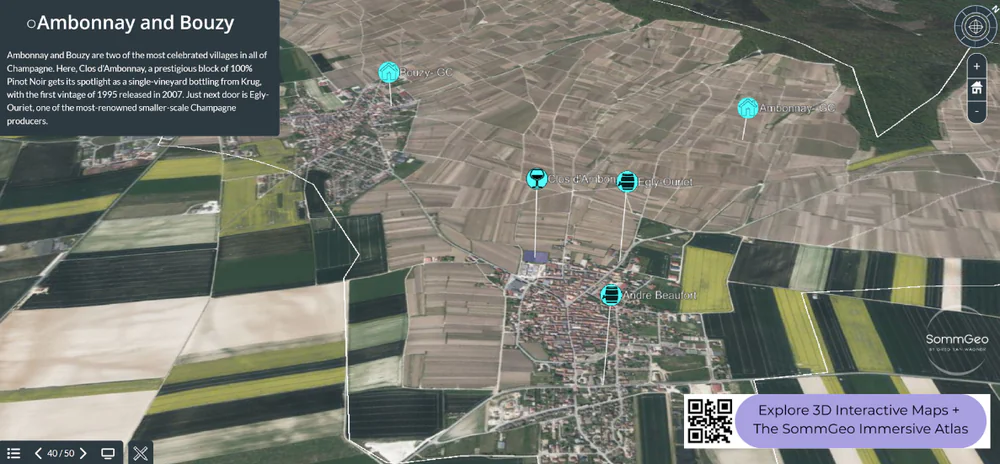
- Clos-vineyard Champagnes: single-site bottlings from Ambonnay, Mareuil-sur-Aÿ, and beyond

The Champagne Method & Its Evolving Philosophy
The méthode champenoise (officially méthode traditionnelle outside Champagne) is a second fermentation in bottle, and the terminology surrounding it is notoriously dense. The short version: still base wines are blended (assemblage), a mixture of yeast and sugar (liqueur de tirage) triggers a second fermentation inside the sealed bottle, the wine ages on its spent yeast cells (lees, or sur lie), the bottles are gradually tilted to collect sediment in the neck (riddling, or remuage), the neck is frozen and the plug of sediment is ejected (disgorgement, or dégorgement), and a final dosage of wine and sugar (liqueur d’expédition) adjusts sweetness before the cork goes in. The entire process, from tirage to release, takes a minimum of 15 months for non-vintage and 36 months for vintage, though serious houses age far longer.
What matters more than the mechanics, though, is the philosophy behind them. The biggest stylistic divide in Champagne today is oxidative versus reductive winemaking. Oxidative houses (Bollinger and Krug are the classic examples) ferment and age reserve wines in oak barrels, encouraging controlled oxygen contact that builds richness, breadth, toasted notes, and textural complexity. Reductive houses (Roederer being a benchmark) work in stainless steel under inert conditions, preserving primary fruit, freshness, and precision. Most houses fall somewhere on this spectrum, and understanding where a producer sits tells you alot about their style.
The other major shift is dosage. Twenty years ago, a Brut Champagne routinely carried 10–12 grams per liter of residual sugar. Today, many top producers have dropped to 4–6 g/L or lower, with the Extra Brut (0–6 g/L) and Brut Nature/Zero Dosage (0 g/L) categories growing rapidly. The logic is straightforward: as base wine quality has improved (partly through climate change extending ripeness, partly through better viticulture) there’s less need for sugar to mask acidity or fill out thin wine. Zero dosage Champagne exposes everything: the quality of the fruit, the precision of the winemaking, and the site character of the vineyard. It’s not better by default, but when it’s good, it’s a great stylistic option.
A Closer Look
Montagne de Reims
The broad, forested mountain south of Reims is Champagne’s heartland for Pinot Noir. Grand Cru villages wrap around the mountain, from the sun-drenched southern slopes of Ambonnay and Bouzy to the paradoxically warm, north-facing slopes of Verzenay, producing Pinot Noir of immense power, structure, and red-fruit depth. The chalk here sits under a layer of clay and lignite, giving the Pinots more body than you’ll find elsewhere in the region. Ambonnay in particular is the source for some of Champagne’s most vinous, age-worthy wines.
Vallée de la Marne
The Marne River cuts west through the region, and its right bank (particularly around Aÿ and Mareuil-sur-Aÿ) is prime Grand Cru Pinot Noir territory. The valley is also Meunier’s stronghold: this often-dismissed third variety dominates the western reaches around Château-Thierry, where clay soils and later-ripening conditions suit it perfectly. Meunier brings roundness, fruit, and approachability: underrated qualities that the best grower-producers like Jérôme Prévost are now showcasing as a serious variety in its own right.
Côte des Blancs
This south-facing escarpment running from Chouilly to Vertus is Chardonnay country, and the source of Champagne’s most precise, mineral-driven wines. Grand Cru villages Cramant, Avize, Oger, and Le Mesnil-sur-Oger sit on nearly pure chalk, sometimes just a meter below the surface. The wines are taut, linear, and almost saline when young, opening up with extended lees aging into wines of extraordinary complexity. Le Mesnil is the most celebrated: Salon’s entire production comes from a single Grand Cru vineyard here, and Krug’s Clos du Mesnil is among the most expensive Champagnes made.
Côte des Bar (Aube)
The Aube, 100 kilometers (62 miles) southeast of Épernay, was historically treated as Champagne’s poor cousin, but that’s changing fast. Kimmeridgian marl and limestone soils (the same formations as nearby Chablis) produce Pinot Noir of distinctive richness and spice. The area now accounts for roughly a quarter of all Champagne vineyard land, and grower-producers like Cédric Bouchard and Marie-Courtin are making some of the most exciting wines in the region.
Producers Worth Knowing
Louis Roederer, Reims
Roederer is the benchmark for reductive, precision-driven Champagne. Under cellar master Jean-Baptiste Lécaillon, the house has converted its 240 hectares (593 acres) of estate vineyards to biodynamic farming, an extraordinary commitment at this scale. The non-vintage Brut (now called Collection, with a vintage year and unique dosage each release) has become a reference point for how good NV Champagne can be. Cristal, the prestige cuvée, is made exclusively from Grand Cru fruit and is one of the most consistently brilliant tête de cuvées produced anywhere.
Salon, Le Mesnil-sur-Oger
Salon makes one wine: a single-vineyard, single-vintage, single-variety Blanc de Blancs from Le Mesnil-sur-Oger. In years that don’t meet the standard, there is no Salon; the fruit goes to sister house Delamotte instead. Only about 40 vintages have been declared since the house was founded in 1911. The wine spends roughly a decade on lees before release, and the result is one of the most concentrated, age-worthy Champagnes in existence: linear, chalky, almost austere in youth, but unfolding over decades into something profound.
Bollinger, Aÿ
Bollinger is the archetype of the oxidative school. The house ferments its base wines in used Burgundy barrels and maintains an extraordinary library of reserve wines (magnums stored under cork, called the réserve perpétuelle), some dating back decades. The result is a house style of unusual richness, vinosity, and toasted complexity: Champagne that drinks more like great wine than sparkling wine. The Vieilles Vignes Françaises, sourced from ungrafted, pre-phylloxera Pinot Noir vines in Aÿ and Bouzy, is one of the rarest and most remarkable wines in the world.
Jacques Selosse, Avize
Anselme Selosse essentially invented the grower-Champagne revolution. Starting in the 1980s, he applied Burgundian thinking to Champagne (single-vineyard bottlings, barrel fermentation, biodynamic farming, minimal dosage) at a time when the region’s identity was built on blending, consistency, and house style above all else. The wines are polarizing: intensely oxidative, vinous, and unlike anything else in Champagne. Whether you consider Selosse a genius or an iconoclast (he’d probably accept both), his influence on the current generation of grower-producers is impossible to overstate.
Notable Vintages: Champagne
Among the great recent vintages, 2008 is widely considered the finest Champagne vintage in recent decades: exceptional acidity, concentration, and aging potential across all three varieties and all major districts. 2002 produced rich, generous wines with remarkable depth that are drinking beautifully now. 2012 delivered precision, chalk-driven minerality, and classic structure after a cool growing season that favored patient producers. 1996 remains the benchmark for high-acid, long-lived Champagne. 2019 is emerging as excellent: warm but balanced, with ripe fruit and surprising freshness.
On the difficult side, 2001 was a weak vintage across the board: dilute, lacking concentration, with most major houses declining to declare it. 2003 brought unprecedented heat to Champagne, producing atypically ripe, low-acid wines that lacked the tension the region is known for. 2011 was irregular, with frost and uneven ripening producing mixed results; some good wines exist, but it was a year for ruthless selection.
New to the Tours? Learn how to navigate frames, click pins for detailed producer and region profiles, and get the most from your 3D experience.
Tours Guide →Ready to go deeper into Champagne? Join 200+ wine organizations already using SommGeo.
Start Your 15-Day Free Trial $5/month billed annually after trial · Cancel anytime