
Willamette Valley Wine Map — Free Download
All 11 nested AVAs, the Coast Range rain shadow, and the Van Duzer Corridor — the geography behind America’s Pinot Noir capital.
This Willamette Valley wine map covers one of the most important New World Pinot Noir and Chardonnay regions on the planet. Stretching over 100 miles from Portland south to Eugene, the Willamette Valley AVA holds 11 nested sub-AVAs, more than 700 wineries, and some of the strictest wine labeling laws in the United States. What makes the valley so compelling from a site character perspective isn’t just the Pinot — it’s the geography. The Coast Range to the west and the Cascades to the east create a sheltered corridor with a long, gentle growing season. But it’s the exceptions to that shelter — particularly the Van Duzer Corridor, a gap in the Coast Range that funnels cool Pacific air directly into the valley — that create the mesoclimate variations responsible for the distinct character of each sub-AVA. Download the free map below to see how it all fits together.
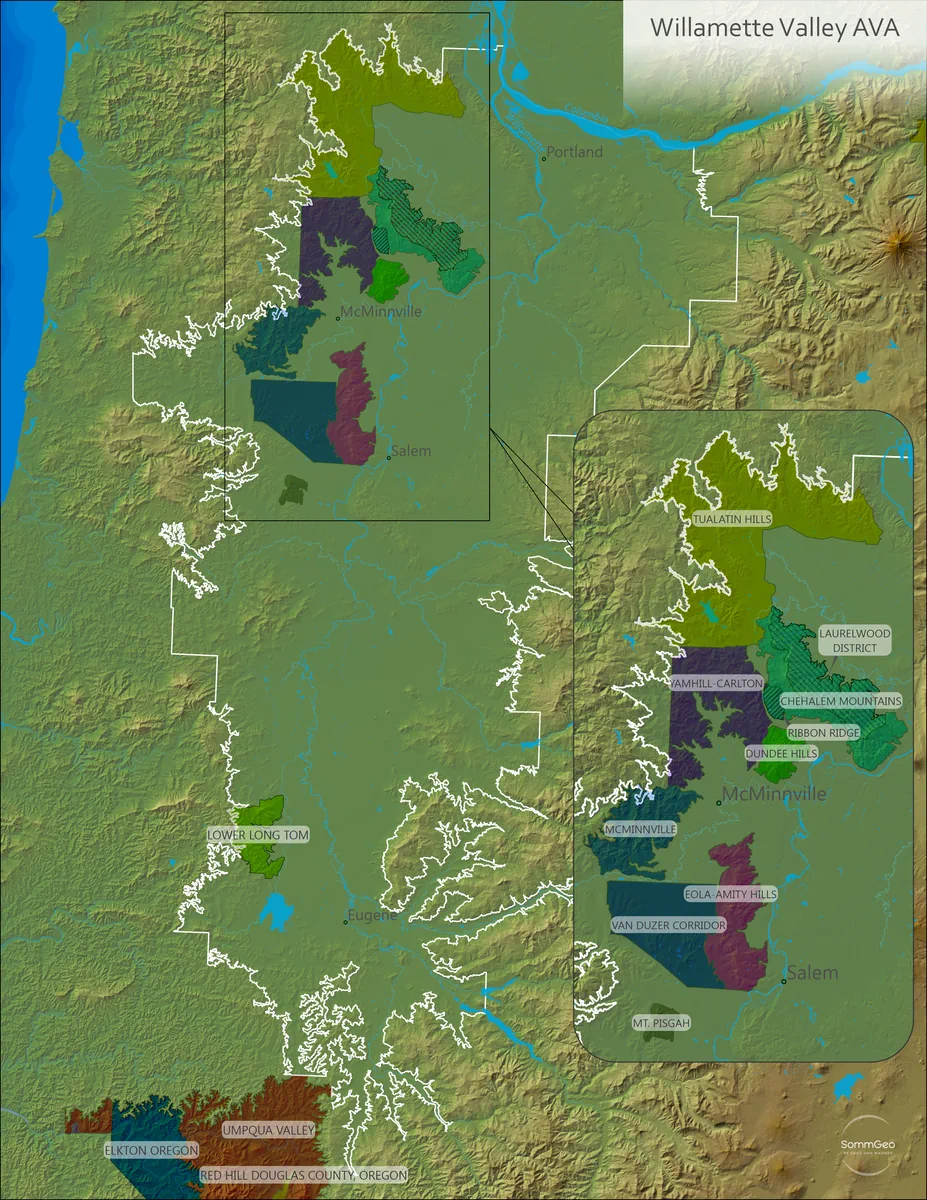

What This Map Covers
This classic map provides an overview of the entire Willamette Valley AVA and its 11 nested sub-appellations. You’ll see how the Coast Range and Cascade Range frame the valley, where the Van Duzer Corridor cuts through to the Pacific, and how each AVA sits relative to the major geographic features shaping its climate and soil profile.
- All 11 nested AVAs from Chehalem Mountains and Tualatin Hills in the north to Lower Long Tom in the south
- The Van Duzer Corridor and its influence on the Eola-Amity Hills and surrounding vineyards
- Coast Range and Cascade Range boundaries showing the valley’s natural climate shelter
- Major towns and wine route reference points including Dundee, McMinnville, and Newberg
- Elevation relief of the region in full.
- Relative positioning of the original six northern AVAs versus the newer southern appellations
Geography and Sense of Place in the Willamette Valley
The Willamette Valley sits in a geological sweet spot. The Coast Range to the west absorbs the brunt of Pacific moisture and storm systems, creating a rain shadow effect that gives the valley a long, dry growing season — warm summers with cool evenings, and mild winters that rarely threaten the vines. The Cascades to the east block the harsh continental climate of eastern Oregon. The result is a corridor that’s remarkably well-suited to cool-climate viticulture, and Pinot Noir in particular.
The Van Duzer Corridor is the single most important geographic feature within the valley for understanding mesoclimate variation. This low-elevation gap in the Coast Range — roughly between the towns of Dallas and Lincoln City — acts as a funnel for cool marine air every afternoon during the growing season. The effect is dramatic: vineyards in the path of the corridor (particularly in the Eola-Amity Hills and Van Duzer Corridor AVAs) experience afternoon temperature drops that can exceed 20°F compared to sites further north. This daily cooling extends the ripening period, preserves natural acidity, and produces Pinot Noir with a structure and aromatic intensity that’s distinct from warmer northern sites like Dundee Hills. The AVA’s very name, Eola-Amity Hills, nods to this — “Eola” derives from Aeolus, the Greek god of wind.
Soils across the valley tell the story of volcanic eruptions, ancient seabeds, and catastrophic floods. Three primary types dominate: volcanic basalt (the iconic red Jory soils of Dundee Hills), marine sedimentary soils (prominent in Yamhill-Carlton and McMinnville), and loess — wind-blown silt deposited over millennia. The Missoula Floods, a series of cataclysmic glacial floods roughly 15,000 years ago, deposited gravel and sediment across the valley floor, which is why quality vineyards almost exclusively occupy the hillsides above 200 feet where these flood deposits didn’t reach.
Oregon’s Labeling Laws — Why They Matter
Oregon operates under some of the strictest wine labeling regulations in the United States, and understanding them is essential to understanding why Willamette Valley wines carry the credibility they do. For more than 50 grape varieties — including Pinot Noir, Pinot Gris, Chardonnay, and Pinot Blanc — a wine labeled with a varietal name must contain at least 90% of that grape. The federal standard is just 75%. That means a California Pinot Noir can legally contain 25% of other varieties, while an Oregon Pinot Noir can contain no more than 10%. Additionally, if a wine lists an Oregon AVA on the label, 95% of the grapes must come from that appellation (versus 85% federally), and if it says “Oregon,” 100% of the fruit must be grown in the state.
There are 18 exempted varieties — mostly Bordeaux and Rhône grapes like Cabernet Sauvignon, Syrah, and Grenache — that follow the federal 75% blending standard. This makes sense: those varieties have long blending traditions. But the core message is clear. When you pick up a bottle of Willamette Valley Pinot Noir, you’re getting more transparency about what’s in the glass than virtually anywhere else in the New World. Oregon’s pioneers pushed for these rules precisely because they believed the sense of place spoke for itself — and that strict labeling was the best way to prove it.
Beyond Pinot Noir — Chardonnay, Riesling, and More
The Willamette Valley has become synonymous with Pinot Noir, and for good reason — it accounts for roughly 70% of the valley’s plantings. But if you’re only paying attention to the reds, you’re missing what might be the most exciting development in Oregon wine right now: Chardonnay. The valley’s best producers — Martin Woods, Hundred Suns, Résonance (owned by Louis Jadot), and Walter Scott among them — are making Chardonnays with a nuanced elegance and a distinctive saline, sea-spray mineral quality that you simply don’t find in most American versions of the grape. These are not the ripe, oak-driven California Chardonnays that dominated the market for decades. Oregon Chardonnay, at its best, is lean, focused, and alive with acidity — more Chablis than Napa, with a marine minerality that reflects the ancient seabed soils many vineyards sit on. Chardonnay currently covers about 7% of the valley’s vineyards, but that number is growing, and the quality-to-price ratio remains exceptional compared to Burgundy or Sonoma Coast.
Riesling is another variety that thrives here but flies under the radar. Brooks Winery produces more than two dozen different Rieslings from sites across the valley — an almost fanatical commitment to the grape. Martin Woods produces another top-quality Riesling in both dry and BA styles in select years. The cool climate and extended daylight hours during the growing season give Oregon Riesling a tension and aromatic purity that ranks with the best on the West Coast. And for those looking further off the beaten path, Gamay is making a small but compelling case for itself in the valley. Producers are finding that the same cool-climate conditions that make Pinot sing also produce Gamay with bright cranberry fruit and a spice-driven backbone that’s worth seeking out. Add Pinot Gris (16% of plantings), Pinot Blanc, and even small amounts of Gamay, Melon de Bourgogne, and Grüner Veltliner to the mix, and you start to see the Willamette Valley for what it truly is: not a one-grape region, but a cool-climate playground with Pinot Noir at its center.
Key AVAs of the Willamette Valley
Dundee Hills
This is where it all started. The first Pinot Noir vines in the Willamette Valley were planted here by David Lett (Eyrie Vineyards) in 1966, and Dundee Hills remains the most densely planted AVA in the state. The red volcanic Jory soils — basalt from ancient lava flows roughly 15 million years old — are the signature here, producing Pinot Noir with generous fruit, approachability, and a silky texture that’s made the AVA synonymous with Oregon wine. Producers like Domaine Drouhin (the Burgundy house that validated Oregon by setting up shop here in 1987), Sokol Blosser, and Archery Summit continue to define the standard.
Eola-Amity Hills
Situated directly in the path of the Van Duzer Corridor, Eola-Amity Hills produces some of the most structured, age-worthy Pinot Noir in the valley. The combination of shallow volcanic basalt soils and relentless afternoon wind creates small berries with concentrated flavors and firm acidity. Cristom and Bethel Heights are benchmark producers here. If Dundee Hills is the approachable face of Willamette Pinot, Eola-Amity Hills is the intellectual one — wines that reward patience and demand a second look.
Yamhill-Carlton
The oldest marine sedimentary soils in the valley sit in Yamhill-Carlton, and they’re among the fastest-draining in the region. The Coast Range provides a pronounced rain shadow here, making it one of the warmer, drier pockets of the northern valley. The resulting wines tend to be richer and rounder than their Eola-Amity or Dundee Hills counterparts, with softer tannins and a broader mouthfeel. Ken Wright Cellars has been a champion of this AVA’s distinctive character.
Chehalem Mountains
The Chehalem Mountains AVA is unique in that it contains all three of the valley’s major soil types — volcanic basalt, marine sedimentary, and loess — sometimes within a single vineyard. Higher elevations mean cooler temperatures and later harvest dates. Two sub-AVAs nest within it: Ribbon Ridge (an elevated, protected site with exceptional marine sedimentary soils) and Laurelwood District (designated in 2020 for its distinctive Laurelwood loess soils). Adelsheim Vineyard, whose founder David Adelsheim led the original petition to establish the Willamette Valley AVA in 1983, calls this home.
Van Duzer Corridor
Approved as an AVA in 2019, the Van Duzer Corridor formalizes what growers had known for decades: the gap in the Coast Range creates conditions unlike anywhere else in the valley. The near-constant afternoon wind reduces disease pressure (making organic and biodynamic farming more viable), extends hang time, and produces wines with bright acidity and pronounced aromatic complexity. Pinot Noir dominates, but Chardonnay and Riesling also thrive in the cooler conditions.
McMinnville, Tualatin Hills, Lower Long Tom & Mount Pisgah
The remaining AVAs round out the valley’s diversity. McMinnville sits in the Coast Range foothills with elevations up to 1,000 feet and a mix of marine sedimentary and basalt soils. Tualatin Hills, in the northwest corner, is home to Oregon’s first commercial vineyard and features rich Laurelwood soils with slightly less rainfall than neighboring AVAs. Lower Long Tom (2021) is the only nested AVA in the southern Willamette Valley, focused on Pinot Noir and Pinot Gris. And Mount Pisgah (2022), the newest addition, surrounds the city of Dallas with distinctive ocean sedimentary soils and a dry-farmed tradition driven by the scarcity of aquifers — a constraint that, as any good sommelier will tell you, tends to make for more interesting wine.
Want to explore Willamette Valley with interactive layers, soil data, and elevation tools? Join 200+ wine organizations already using SommGeo.
Start Your 15-Day Free Trial $5/month billed annually after trial · Cancel anytimeMap Usage
Free for your own study and tastings. If you share or teach with a map, credit it visibly as Map: SommGeo (sommgeo.com). Commercial use requires a Commercial Embed License. See Map Usage, Credit and Licensing.