
Washington Wine Tour: Columbia Valley, Walla Walla & Beyond in 3D
Desert viticulture east of the Cascades. Where irrigation is survival and the AVA map keeps expanding.
Washington is America’s second-largest wine-producing state, built almost entirely on irrigation, desert sun, and a landscape shaped by ancient floods. East of the Cascades, the Columbia Valley stretches across an arid basin that receives as little as 150mm (5.9 in.) of annual rainfall, meaning every vine depends on snowpack-fed rivers and aquifer access to survive. What makes it work, and work remarkably well, is the combination of long, warm growing days, dramatic diurnal temperature swings, and the kind of site diversity that lets a single state produce everything from powerful Red Mountain Cabernet to cool-climate Gorge Pinot Noir. This Tour covers the AVAs, the irrigation-driven viticulture, and the producers who are defining Washington’s identity.
Unlock the Full SommGeo Toolkit
Gain exclusive access to our entire suite of premium features, including interactive Map Makers, immersive 3D Tours, high-resolution classic Maps, and advanced analytical tools.
Start Free TrialInside This Tour
This Tour covers the Columbia Valley and its nested AVAs, with producer pins and vineyard-level data at every stop. Every map frame is fully interactive. Don’t just watch the flythrough. Click, drag, zoom, and rotate the 3D terrain to explore from any angle, then click every pin for the full content.
- Columbia Valley and its nested AVAs: how site and climate shape each district
- Irrigation as a winemaking tool: controlling vigor in a desert environment
- Walla Walla Valley and The Rocks District’s basalt cobblestones
- Red Mountain: Washington’s warmest and most sought-after AVA
- The Columbia Gorge exception: rain, elevation, and cool-climate varieties
- New and emerging AVAs: Goose Gap, Candy Mountain, Royal Slope, White Bluffs
Desert Viticulture & the Gorge Exception
Almost everything about Washington viticulture flows from one fact: this is a desert. East of the Cascades, annual rainfall drops to 150-200mm (5.9-7.9 in.), and irrigation is not optional. But rather than a limitation, controlled irrigation is a precision tool. Growers can manage vine vigor, berry size, and ripening with a level of control that rain-fed regions simply don’t have. The flip side is that Washington vineyards are entirely dependent on snowpack-fed rivers and aquifer access, and water rights are a real and growing concern.
The landscape itself creates meaningful variation across the Columbia Valley. South-facing ridges like Red Mountain trap heat and produce some of the state’s most powerful Cabernet Sauvignon. The valleys between them collect cold air, creating frost risk and cooler mesoclimates that influence which varieties succeed where. And the soils, deposited by catastrophic Ice Age floods, vary dramatically from site to site: gravel, sand, silt, and loess in different combinations, which is why neighboring AVAs can produce such different wines.
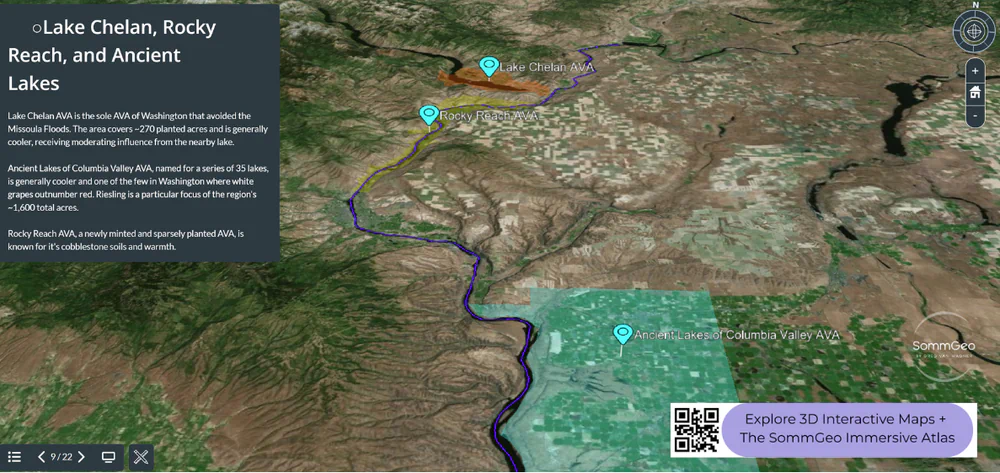
The Columbia Gorge is the exception to virtually everything above. This gap in the Cascade Range funnels moist Pacific air inland, creating a dramatic west-to-east climate gradient within a single AVA. The western end near Hood River receives enough rainfall for dry-farming and grows cool-climate varieties like Pinot Noir and Gewürztraminer. The eastern end, just 30 miles (48 km) away, is warm and dry enough for Syrah and Zinfandel. It’s the most climatically diverse single AVA in the state.
A Closer Look
Walla Walla Valley
Walla Walla is Washington’s most prestigious wine district and the one that first drew international attention to the state. The valley straddles the Oregon border, with distinctly different soils on each side: Washington’s Walla Walla vineyards sit primarily on wind-deposited loess over basalt, producing polished, structured reds, while the Oregon side (including The Rocks District) features the famous basalt cobblestones that give Syrah its smoky, mineral intensity. The town of Walla Walla itself has become the creative center of Washington wine.
New AVAs & the Expanding Map
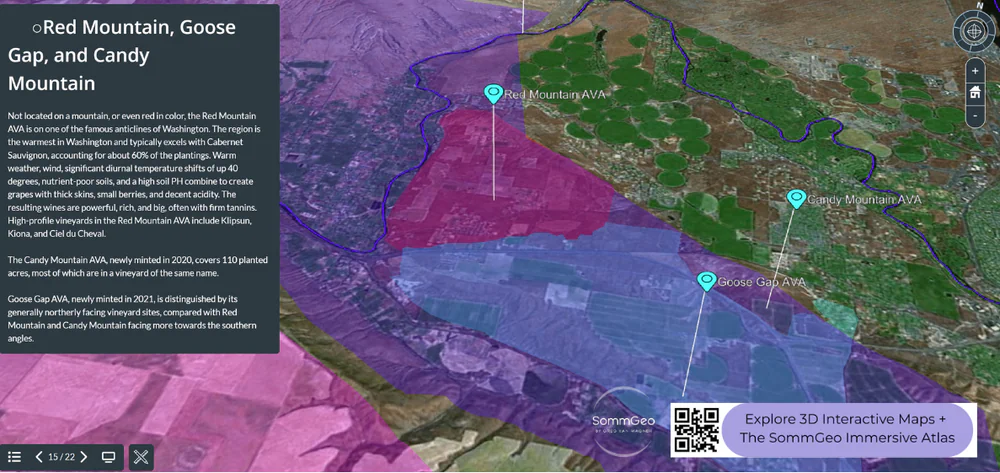
Washington’s AVA count has grown rapidly, and the new designations reflect increasingly precise understanding of how site differences translate to the glass. Goose Gap (2021) and Candy Mountain sit adjacent to Red Mountain but on different soil types and aspects, producing distinct styles. Royal Slope, on the northern edge of the Frenchman Hills, is emerging as a source of high-quality Cabernet and Riesling from wind-deposited loess at elevation. White Bluffs, along the Columbia River, benefits from thermal moderation and deep sandy soils. Each new AVA represents a real refinement of the viticultural map.
Producers Worth Knowing
Cayuse Vineyards, Walla Walla / The Rocks District
Christophe Baron, a Champenois transplant, arrived in Walla Walla in the late 1990s and recognized the basalt cobblestones of what would become The Rocks District as something extraordinary. Cayuse farms biodynamically: no irrigation, no tractors in the vineyard, everything by hand and horse, on sites that most people considered impossible to plant. The single-vineyard Syrahs (Cailloux, En Chamberlin, Armada, God Only Knows) are fiercely site-expressive: smoky, mineral, savory, and unlike anything else in Washington. Baron’s work was instrumental in defining the region and establishing The Rocks District as its own AVA.
Quilceda Creek, Columbia Valley
Quilceda Creek has produced what many consider Washington’s greatest Cabernet Sauvignon since Alex Golitzin (nephew of André Tchelistcheff) founded the winery in 1978. The Columbia Valley Cabernet, sourced primarily from Champoux, Klipsun, and Galitzine vineyards, is a wine of extraordinary power, density, and polish, consistently ranking among the highest-scoring wines in America. Production is small, the mailing list is long, and the wine represents the absolute ceiling of what Washington Cabernet can achieve.
Andrew Will, Columbia Valley
Chris Camarda founded Andrew Will in 1989 and was among the first Washington producers to demonstrate that specific vineyard sites produce meaningfully different wines. The single-vineyard bottlings (Champoux, Ciel du Cheval, Two Blondes) are Bordeaux-style blends from distinct AVAs across the Columbia Valley, and tasting across them is one of the best ways to understand how Washington’s site diversity translates to the glass. Andrew Will bridges the state’s early ambition with its current site-focused identity.
Notable Vintages: Washington
Among the standout recent vintages, 2016 was excellent across the Columbia Valley: a season that started hot but finished cool, producing balanced, structured Cabernet Sauvignon with outstanding aging potential. 2014 produced generous, ripe wines with excellent concentration, particularly in Red Mountain and Walla Walla. 2012 was a superlative vintage for both reds and whites, tracking perfectly to historical averages with warm days and cool nights that preserved freshness alongside ripeness. 2018 was widely hailed as one of the state’s best vintages in two decades, delivering generous concentration and superb balance across the board. 2007 remains a benchmark for Washington Cabernet, with wines now showing beautiful development.
On the difficult side, 2011 was the coolest vintage on record, producing lighter wines overall, though top producers crafted elegant, age-worthy bottles that showcased what Washington can achieve in mild conditions. 2010 was similarly cool, with a late-season freeze damaging vines in Horse Heaven Hills and Walla Walla and resulting in the latest harvest on record for many vineyards. 2020 saw wildfire smoke affect parts of the state, pausing harvest for nearly ten days in some areas, though Washington was less broadly impacted than Oregon or California.
New to the Tours? Learn how to navigate frames, click pins for detailed producer and region profiles, and get the most from your 3D experience.
Tours Guide →Ready to go deeper into Washington? Join 200+ wine organizations already using SommGeo.
Start Your 15-Day Free Trial $5/month billed annually after trial · Cancel anytime