
Burgundy & Beaujolais Wine Tour: Premier Crus, Cru Beaujolais & Winemaking in 3D
The world’s most intricate classification system, Premier Crus that rival Grand Crus, ten Beaujolais Crus on granite hillsides, and the winemaking decisions that shape everything.
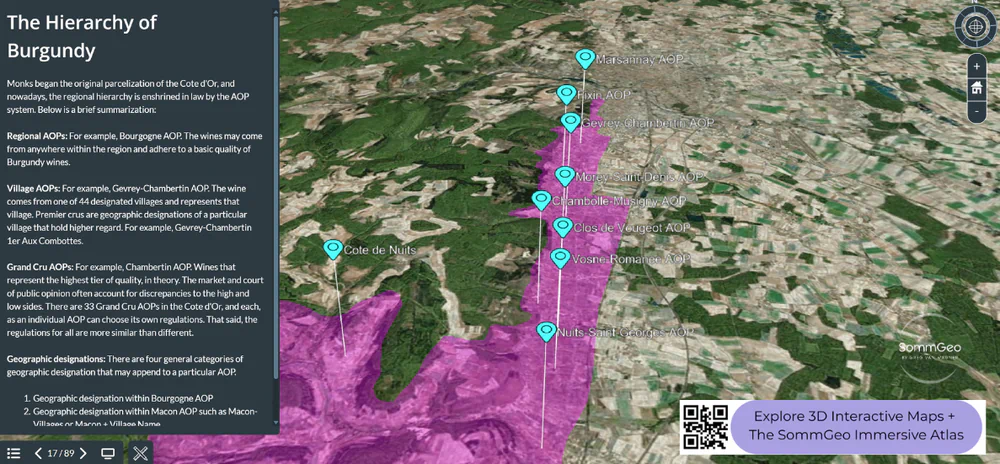
Burgundy’s classification system is the most granular in the wine world, and the most misunderstood. The hierarchy from regional Bourgogne through Village, Premier Cru, and Grand Cru is well known in theory, but the practical reality is messier and more interesting. Some Premier Crus (Clos Saint-Jacques, Les Amoureuses) are priced and regarded as Grand Crus in all but name. Whole-cluster fermentation, once the old guard’s default, has become a deliberate stylistic choice. New oak percentages have dropped across the Côte d’Or as producers chase purity over extraction. And just south, the ten Crus of Beaujolais (planted on granite, limestone, and pierre bleue) have earned serious critical recognition in their own right, far removed from the Nouveau reputation. This Tour walks through all of it.
Unlock the Full SommGeo Toolkit
Gain exclusive access to our entire suite of premium features, including interactive Map Makers, immersive 3D Tours, high-resolution classic Maps, and advanced analytical tools.
Start Free TrialInside This Tour
This Tour covers Burgundy from Chablis through the Côte de Nuits, Côte de Beaune, Côte Chalonnaise, and south through all ten Crus of Beaujolais, with pins on every major vineyard, classification tier, and producer along the way. Every map frame is fully interactive. Don’t just watch the flythrough. Click, drag, zoom, and rotate the 3D terrain to explore from any angle, then click every pin for the full content.
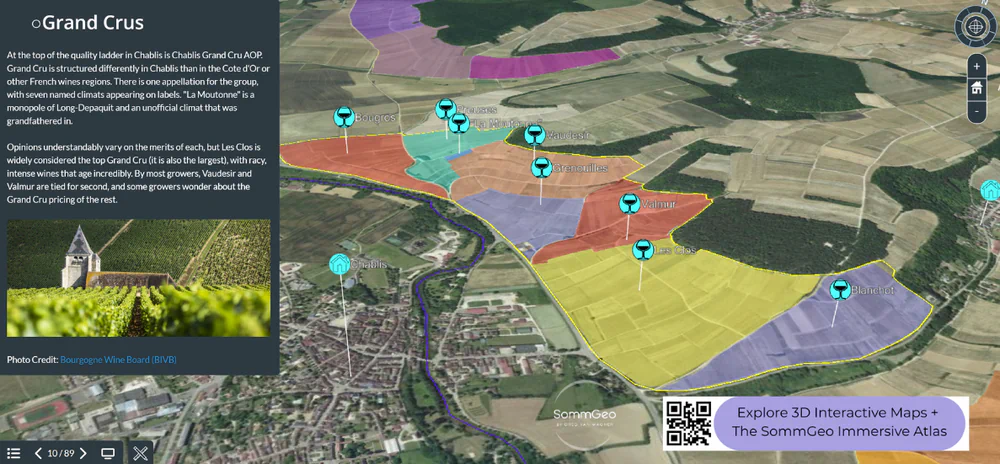
- Chablis Grand Cru and Premier Cru vineyards: right bank vs. left bank aspect differences
- Premier Crus that rival Grand Cru quality and pricing
- Winemaking trends: whole-cluster fermentation, oak reduction, and the pursuit of transparency
- Commune-by-commune profiles across the Côte de Nuits and Côte de Beaune
- All ten Beaujolais Crus: limestone, granite, and pierre bleue shaping Gamay from Moulin-à-Vent to Morgon
- Historic and modern vintages with context for what defines a great Burgundy year
Modern Burgundy: Style & Winemaking
For a geographic overview of Burgundy’s vineyards, see the Burgundy Vineyards Fast Map. Here, we focus on what’s happening in the cellar and how it shapes the wines.
The biggest stylistic shift in modern Burgundy is subtraction. New oak percentages have dropped significantly across the Côte d’Or; where 50–100% new barrels were once standard for Premier and Grand Cru, many of the region’s best producers now use 20–30%, prioritizing fruit transparency and terroir expression over wood-driven richness. Whole-cluster fermentation (including the stems in the fermentation vessel) has swung back into favor after decades of near-total destemming. Producers like Dujac, de Montille, and Domaine de la Romanée-Conti have long used significant whole-cluster percentages; now a broader generation is experimenting with it, seeking the floral lift, structural grip, and aromatic complexity that stems can contribute when fully ripe. The net effect across the region is wines that are more precise, more site-transparent, and often lighter in extraction than a generation ago.
In Chablis, the right bank vs. left bank Premier Cru distinction matters more than many drinkers realize. Right bank vineyards (Montée de Tonnerre, Mont de Milieu, Fourchaume) face primarily southwest and get the warmer afternoon sun, producing rounder, riper styles. Left bank Premier Crus (Vaillons, Montmains, Côte de Léchet, Vau de Vey) face east and southeast with more morning exposure, tending toward leaner, more mineral profiles. Understanding this single geographic divide helps decode most of Chablis Premier Cru.
A Closer Look: Premier Crus Worth Knowing
Not every Premier Cru is created equal. These five consistently perform at or above their classification, and understanding them means understanding how Burgundy’s hierarchy works in practice versus on paper.
Clos Saint-Jacques, Gevrey-Chambertin
Grand Cru in everything but name. The INAO’s 1930s rule that only vineyards touching Chambertin or Clos de Bèze could receive Grand Cru status is the only reason Clos Saint-Jacques sits at Premier Cru level. Its southeast-facing slopes in the Combe de Lavaux, white marl soils rich in limestone, and five elite owners (Rousseau, Fourrier, Bruno Clair, Jadot, Esmonin) produce wines of extraordinary depth and longevity. Rousseau’s bottling, in particular, is among the most sought-after wines in Burgundy at any level.
Les Amoureuses, Chambolle-Musigny
Sitting just below the Grand Cru Musigny on the Côte d’Or slope, Les Amoureuses produces wines of silky, perfumed elegance that trade at Grand Cru prices, and have for decades. The 5.4-hectare vineyard is the textbook example of why Burgundy’s classification, while broadly reliable, has gaps that the market has long since corrected.
Aux Combottes, Gevrey-Chambertin
Isolated at the southern end of the Gevrey commune, Aux Combottes borders the Grand Cru Clos de la Roche in Morey-Saint-Denis. It’s regularly grouped with Clos Saint-Jacques and Les Amoureuses as one of the Côte de Nuits’ “super second” Premier Crus: wines that outperform their classification in both quality and market price.
Aux Malconsorts, Vosne-Romanée
Bordering La Tâche Grand Cru to the south, Aux Malconsorts benefits from a similar exposure and soil profile. The Cuvée Christiane from de Montille (sourced from the upper, steeper section) is widely regarded as one of the finest Premier Cru wines in the entire Côte de Nuits: structured, deep, and capable of decades of aging.
Aux Boudots, Nuits-Saint-Georges
Located at the northern end of Nuits-Saint-Georges, right on the border with Vosne-Romanée, Aux Boudots benefits from a transitional terroir that gives it some of Vosne’s perfume alongside Nuits’ characteristic earth and structure. It’s one of the most compelling arguments for looking beyond the commune name on a Burgundy label.
A Closer Look: The Crus of Beaujolais
South of the Mâconnais, the landscape shifts dramatically. The ten Crus of Beaujolais sit on steep, convex granite hillsides where Gamay (exiled from Burgundy proper by ducal decree in 1395) found its ideal home. The vines are traditionally trained as gobelet bush vines, and the best sites produce wines of genuine complexity and aging potential that have nothing to do with Nouveau.
Three soil types define the region. Limestone dominates southern Beaujolais (the Beaujolais AOP zone), where flatter terrain and richer soils produce the lighter, fruitier wines meant for early drinking. Moving north into the Crus, granite takes over: pink granite in particular anchors Fleurie, Chiroubles, and Régnié, producing wines with bright acidity, floral lift, and firm mineral structure. And then there’s pierre bleue (blue stone), the ancient, hard diorite found most prominently on Côte de Brouilly’s volcanic slopes and scattered through several other Crus. Blue stone gives wines a distinctive mineral depth and structural grip that sets them apart. Across the ten Crus, the interplay of soil type, slope angle, and altitude creates their individuality: Chiroubles, the highest Cru at up to 500 meters (1,640 feet), makes some of the lightest wines, while Moulin-à-Vent and Morgon at lower elevations produce the most powerful.
Notable Vintages: Burgundy
Burgundy’s vintage narrative extends further back than most regions. Among the classics, 1990 is exceptional: rich, aromatic, with sumptuous ripeness and silky tannins that have aged magnificently. 1999 is powerful and deeply colored, particularly successful in the Côte de Beaune, with acidity that has kept the wines alive and evolving. Moving to the modern era, 2005 remains the benchmark of the 21st century: structured, balanced, with Grand Crus still far from their peak. 2015 drew comparisons to 1990, producing concentrated, harmonious reds with excellent aging potential across both Côtes. 2019 combined generosity with freshness in low yields, and is shaping up as one of the decade’s better years.
Conversely, 2011 was damp and uneven, with mildew and variable ripeness producing lighter wines that required strict selection, better in the Côte de Nuits than the Côte de Beaune. 2013 was cold and hail-ravaged, particularly in the Côte de Beaune, yielding lean wines with high acidity that only the best producers managed to finesse. 2007 was troubled by rain and rot, producing soft, early-drinking wines that peaked quickly.
New to the Tours? Learn how to navigate frames, click pins for detailed producer and region profiles, and get the most from your 3D experience.
Tours Guide →Ready to go deeper into Burgundy and Beaujolais? Join 200+ wine organizations already using SommGeo.
Start Your 15-Day Free Trial $5/month billed annually after trial · Cancel anytime