
South Africa Wine Regions Map: Interactive Guide
Where Antarctic currents, Dutch colonial history, and one of the world’s most dramatic viticultural landscapes converge at the tip of Africa.
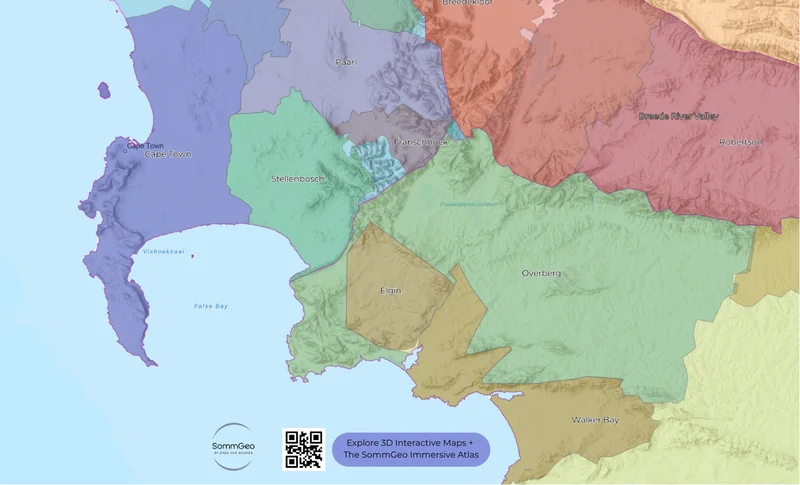
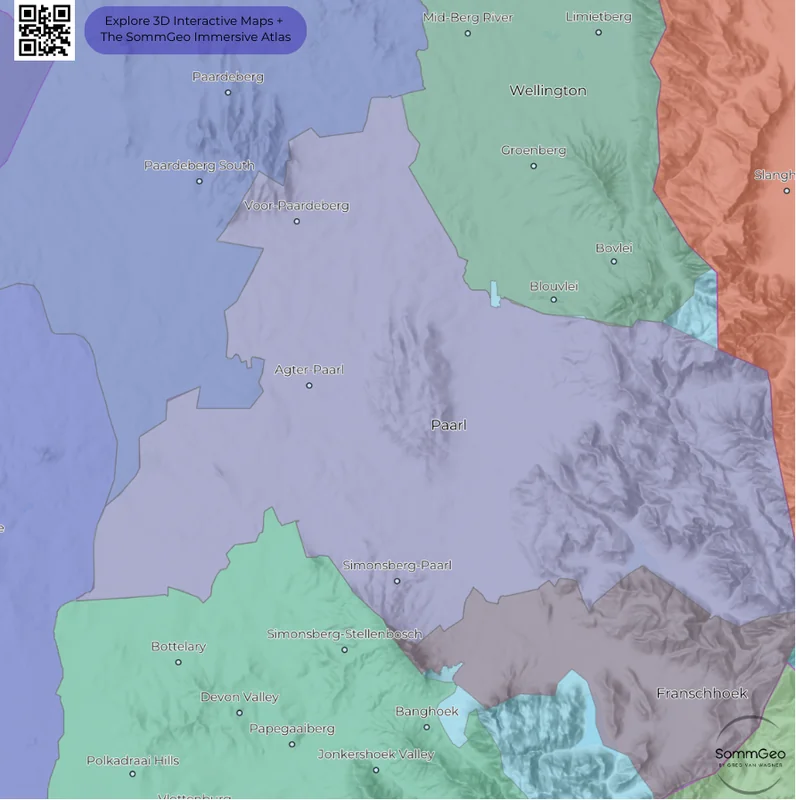
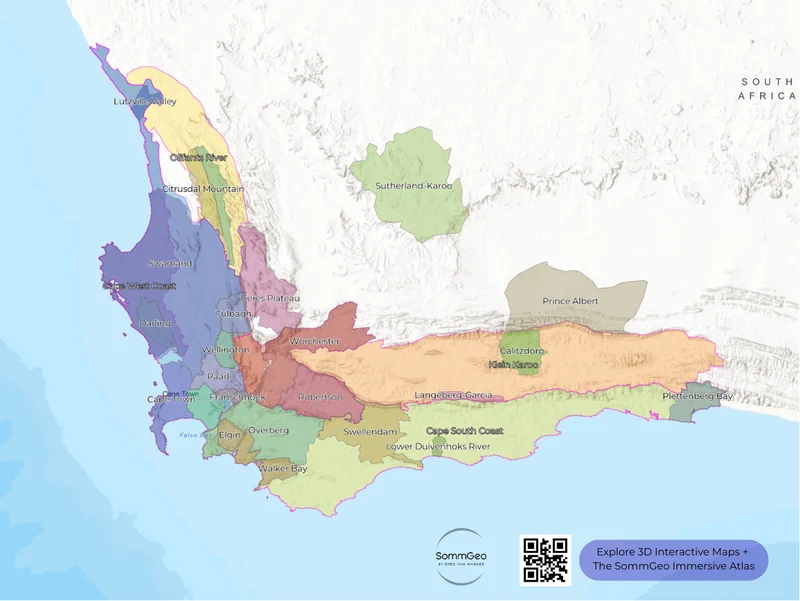
South Africa is the oldest New World wine country. Wine has been produced at the Cape since 1659, making it the first non-European region to establish a viable wine industry, and yet for most of the 20th century, isolation, apartheid-era sanctions, and a cooperative system that prioritized quantity over quality kept South African wine off the international stage. That changed dramatically after 1994. Today, with roughly 86,500 hectares (213,746 acres) under vine, over 500 wineries, and a Wine of Origin system that encompasses 30 districts and more than 100 wards, South Africa produces wines that compete at top levels, from the old-vine Chenin Blancs of Swartland to the Bordeaux-blend reds of Stellenbosch. This interactive South Africa wine regions map lets you explore every WO district, ward, and geographic influence shaping these wines, and every mapped region includes detailed popup content covering grape varieties, climate and geographic profiles, soil types, and viticulture, putting a complete wine reference directly inside the map.
Unlock the Full SommGeo Toolkit
Gain exclusive access to our entire suite of premium features, including interactive Map Makers, immersive 3D Tours, high-resolution classic Maps, and advanced analytical tools.
Start Free TrialWhat You’ll Explore
This interactive portal maps every major South African wine district and ward across the Western Cape and beyond, but the real depth is in what each region reveals. Click on any mapped area and a comprehensive info panel opens with sommelier-level content: dominant grape varieties, climate and geographic profiles, and soil composition, and the viticultural specifics that define each district and ward. Whether you’re reading about Stellenbosch’s decomposed granite soils and their role in world-class Cabernet, the Swartland’s old-bush-vine Chenin Blanc on schist and iron-stone, or the maritime influence of the Benguela Current shaping Walker Bay’s Pinot Noir, every single region on the map carries this level of built-in intelligence.
- All WO regions, districts, and wards across the Western Cape and beyond
- In-depth region profiles for every mapped area: varieties, soils, climate, and wine law
- Coastal Region districts: Stellenbosch, Paarl, Franschhoek, Swartland, Darling, and Cape Town
- Walker Bay’s Hemel-en-Aarde trio: Valley, Ridge, and Upper Hemel-en-Aarde wards
- Breede River Valley and Klein Karoo inland wine regions
- The impact of various mountain chains on top districts
From the Dutch East India Company to the Modern Renaissance
South Africa’s wine story begins in 1652, when the Dutch East India Company (VOC) established a supply station at the Cape of Good Hope. A Dutch surgeon named Jan van Riebeeck was tasked with managing the station and, critically, planting vineyards to produce wine that would help stave off scurvy among sailors on the spice route to India. The first harvest came on February 2, 1659. His successor, Simon van der Stel, took a far more serious interest in wine quality; in 1685 he established the 750-hectare Constantia estate just outside Cape Town, which would go on to produce a legendary sweet Muscat wine that was coveted by European royalty throughout the 18th and 19th centuries (Napoleon reportedly requested it during his exile on St. Helena).
The arrival of French Huguenots in 1688 accelerated things considerably. Settling primarily in the Franschhoek Valley (“French corner”), they brought winemaking expertise and new grape varieties that elevated the Cape’s viticultural ambitions. But the centuries that followed were turbulent. Phylloxera devastated Cape vineyards in the late 1800s. The formation of the KWV cooperative in 1918 rescued struggling farmers but imposed a quota system that rewarded volume over quality. And then apartheid-era international sanctions, beginning in the 1960s, effectively sealed South African wine off from the world for decades.
The modern renaissance dates to 1994. When sanctions lifted and the export market opened, the South African wine industry essentially reinvented itself in a single generation. The KWV was privatized in 1997. Flying winemakers brought international techniques. New cool-climate regions were planted. And a new generation of producers (many of them in Swartland, working with old bush-vine Chenin Blanc and Rhône varieties) began making wines that rivaled anything in the Southern Hemisphere. The quality today has never been higher, and for the prices being charged, South African wine remains one of the great values in the wine world.
The Benguela Current and the Cape Doctor
If you want to understand why South Africa can grow world-class wine grapes at latitudes that would otherwise be far too warm for viticulture, you need to understand two things: the Benguela Current and the Cape Doctor. Together, they’re the geographic lifeline of the entire South African wine industry.
The Benguela Current is a cold oceanic current that flows northward along South Africa’s west coast from Antarctic waters. It drops sea surface temperatures along the Atlantic coastline to below 15°C (59°F) even in midsummer, dramatically cooler than what you’d expect at 33-34° south latitude. The effect on nearby vineyards is profound: cool maritime air flows inland during the afternoon, moderating temperatures and extending the growing season. Vineyards closest to the Atlantic coast (Constantia, Darling, the west-facing slopes of Stellenbosch) benefit most directly. Where the cold Benguela meets the warmer Agulhas Current from the Indian Ocean (roughly between Cape Point and Cape Agulhas) the two systems create a remarkable diversity of microclimates along a relatively short stretch of coastline.
The Cape Doctor is the legendary southeasterly wind that sweeps across the Cape Winelands during spring and summer. It earns its name by acting as a natural sanitizer; the strong, sustained gusts inhibit mildew, fungal diseases, and humidity that would otherwise plague vineyards in a Mediterranean climate. The Cape Doctor also has a direct cooling effect, lowering temperatures by several degrees and extending the impact of the Benguela Current further inland. The trade-off is real: the wind can be ferocious enough to damage leaves and disrupt flowering, reducing yields. But for wine quality, the benefits overwhelmingly outweigh the risks. It’s one of the reasons South Africa has some of the healthiest, most disease-resistant vineyards in the world, and why organic and sustainable viticulture has taken hold here more readily than in many comparable regions.
WOSA and the Wine of Origin System
South Africa’s Wine of Origin (WO) system was established in 1973 (making it one of the earlier New World appellation systems) and is overseen by the Wine and Spirit Board. Wines of South Africa (WOSA) serves as the industry’s export promotion body, marketing South African wines internationally. The WO system divides production areas into a four-tier hierarchy: geographical units (the largest, like the Western Cape), regions (like the Coastal Region or Breede River Valley), districts (like Stellenbosch or Walker Bay), and wards (like Hemel-en-Aarde Valley or Banghoek).
What’s distinctive about the WO system (and what separates it from most European appellation models) is that it’s primarily concerned with geographic accuracy in labeling, not with dictating winemaking practices. Unlike French AOC or Italian DOC rules, the WO system does not regulate permitted grape varieties, trellising methods, irrigation practices, or maximum yields within a given district or ward. The philosophy is essentially: tell the truth about where the grapes come from, but let the winemaker decide how to grow and make the wine. Wards are the designation level most defined by distinct soil and climate characteristics (similar in concept to a European appellation), while districts and regions are drawn along broader geographic and political boundaries.
The Western Cape geographical unit accounts for roughly 90-95% of all South African wine production. Within it, the five main regions (Coastal Region, Breede River Valley, Cape South Coast, Klein Karoo, and Olifants River) encompass the full spectrum from premium, terroir-driven production to bulk wine and distillation. Estate wines must be grown, produced, and bottled on a single registered estate, and single-vineyard wines must come from a defined area of no more than six hectares.
Grape Varieties
White varieties account for 55% of South Africa’s vineyard area, and the undisputed king of white grapes here is Chenin Blanc, locally known as “Steen” for much of the 20th century, when it was used primarily for brandy and bulk production. Nowadays, old-vine Chenin Blanc (particularly from Swartland’s bush vines) is producing some of the most compelling white wines in the Southern Hemisphere: textured, complex, and age-worthy in a way that would surprise anyone who still associates the grape with cheap, forgettable wine. Chenin alone represents over 18% of all plantings. Sauvignon Blanc, Colombard, and Chardonnay round out the major whites, with Sauvignon Blanc from regions like Elgin, Cape Point, and Darling competing against quality estates from Marlborough.
On the red side, Cabernet Sauvignon leads plantings (roughly 10% of total vineyard area), followed closely by Shiraz (9.6%) and then Pinotage (7.6%). The Bordeaux varieties (Cabernet Sauvignon, Merlot, and Cabernet Franc) produce serious, structured wines in Stellenbosch, particularly from the Helderberg and Simonsberg-Stellenbosch wards. Shiraz (the South African industry uses “Shiraz” rather than “Syrah”) excels across a range of styles, from the peppery, restrained expressions of cooler sites to the rich, concentrated versions from warmer wards. And then there’s Pinotage.
Pinotage is South Africa’s signature grape, a crossing of Pinot Noir and Cinsaut (then known locally as “Hermitage”), created by Professor Abraham Izak Perold at Stellenbosch University in 1925. The grape has had a complicated reputation. Early Pinotage was often rustic and dominated by volatile acetone-like aromas that put many drinkers off. But a new generation of producers has transformed the variety, producing wines with real depth, complexity, and site character. At its best, Pinotage delivers a combination of dark fruit concentration, earthy structure, and a smoky, savory quality that is genuinely unique. The “Cape Blend” (a red blend that includes Pinotage as a component alongside Bordeaux varieties) has become an evolving signature category, though there’s no formal regulation defining the blend proportions.
Key Wine Districts
Stellenbosch
Stellenbosch is the hub of premium South African wine production, and has been since the focus of the industry shifted here from Paarl in the late 20th century. The district benefits from remarkable geographic diversity within a compact area: seven wards (Banghoek, Bottelary, Devon Valley, Jonkershoek Valley, Papegaaiberg, Polkadraai Hills, and Simonsberg-Stellenbosch) offer dramatically different soil types, elevations, and aspects thanks to the surrounding mountain ranges. Granite-derived soils on the slopes of the Simonsberg, decomposed shale in the Bottelary Hills, alluvial deposits in the valley floors, the variety of growing conditions is exceptional for a single district. Cabernet Sauvignon and Bordeaux-style blends are the stars here, with producers like Kanonkop, Rust en Vrede, and Thelema making wines that stand up to serious international competition.
Swartland
If Stellenbosch is the establishment, Swartland is the revolution. Once dismissed as a source of bulk wine and wheat farming, Swartland has undergone one of the most dramatic transformations in the New World wine story. A generation of independent-minded winemakers (led by figures like Eben Sadie, Adi Badenhorst, and Chris and Andrea Mullineux) has turned this warm, dry district into the beating heart of South Africa’s natural wine and old-vine movement. The secret is the old bush-vine Chenin Blanc, some of it 40-60 years old, planted on granite and schist soils that produce wines of extraordinary texture and complexity. Rhône-variety reds (Shiraz, Grenache, Mourvèdre, Cinsaut) thrive here as well, and the Swartland Independent Producers group has become a mark of quality and philosophical alignment. Dry farming is common; many vineyards receive no irrigation, relying entirely on winter rainfall and deep-rooted old vines.
Walker Bay & Hemel-en-Aarde
Walker Bay, on the Cape South Coast, is South Africa’s answer to the question “can we make top-quality Pinot Noir and Chardonnay?” The answer is yes. The district sits close to the convergence point of the Benguela and Agulhas currents, and the trio of Hemel-en-Aarde wards (Valley, Ridge, and Upper) are among the coolest vineyard sites in the country. Hamilton Russell Vineyards, established in 1975, pioneered cool-climate viticulture here, and their Pinot Noir and Chardonnay remain benchmarks. The neighboring Bot River ward is gaining recognition for Shiraz and old-vine Chenin Blanc, while the Elgin district (technically in the Overberg) has emerged as a top source of Sauvignon Blanc, Riesling, and Pinot Noir grown in what was once an apple-farming valley.
Constantia & Cape Town
Constantia is where it all began: Simon van der Stel’s 1685 estate, where the legendary Vin de Constance sweet wine was produced. The ward occupies the cool, southeast-facing slopes of Table Mountain’s eastern flank, fully exposed to the Cape Doctor and the maritime influence of False Bay. Today, Constantia is known for racy, mineral-driven Sauvignon Blanc and Sémillon, and the historic Klein Constantia estate has revived the Vin de Constance dessert wine in a style that nods to the 18th-century original. The broader Cape Town district, created relatively recently, encompasses several emerging wards that benefit from the city’s remarkable proximity to serious vineyard land.
New to the Fast Maps? Learn how to search regions, navigate layers, and get the most from your interactive map.
Fast Map Guide →Ready to explore South Africa’s wine regions in full detail? Join 200+ wine organizations already using SommGeo.
Start Your 15-Day Free Trial $5/month billed annually after trial · Cancel anytime