
Gevrey-Chambertin Vineyard Map — Free Download
Nine Grand Crus, 26 Premier Crus, and the largest village appellation in the Côte de Nuits — this is where Burgundy earns the title “King.”
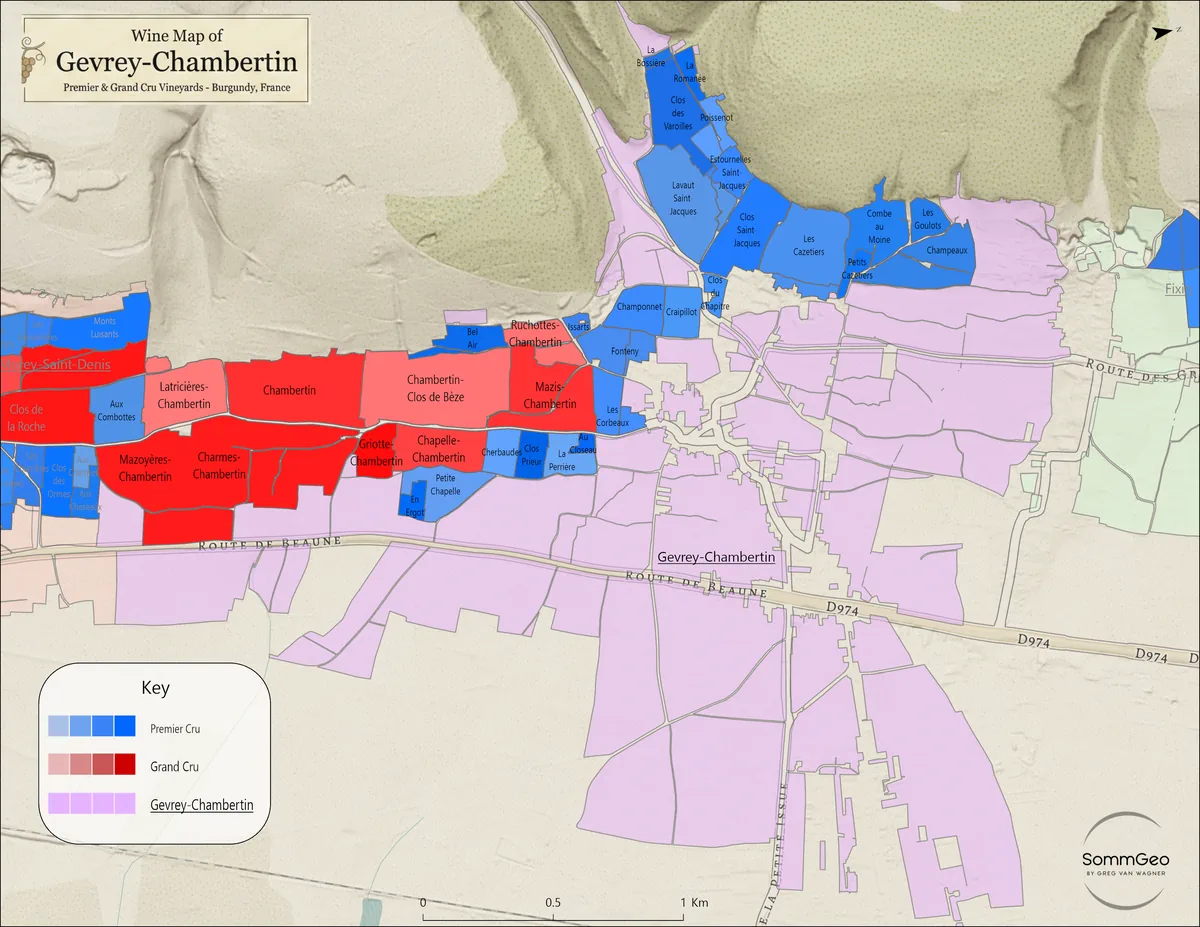
This Gevrey-Chambertin wine map covers one of the most powerful and historically significant communes on Burgundy’s Côte de Nuits. Gevrey-Chambertin is home to nine Grand Cru vineyards — more than any other village in Burgundy — headlined by Chambertin itself, Napoleon’s legendary wine of choice and a climat that sits in the highest level of Burgundian Pinot Noir. With roughly 410 hectares under vine, 26 Premier Cru climats (including Clos Saint-Jacques, which routinely commands Grand Cru prices), and archaeological evidence of viticulture dating to the first century BC, Gevrey isn’t just a great wine village — it’s the foundation story of Burgundy as we know it. The wines here tend to be deeper in color, firmer in structure, and more tannic than most of the Côte de Nuits, built for serious aging. Download the free map below to see where every climat sits on the slope.
What This Map Covers
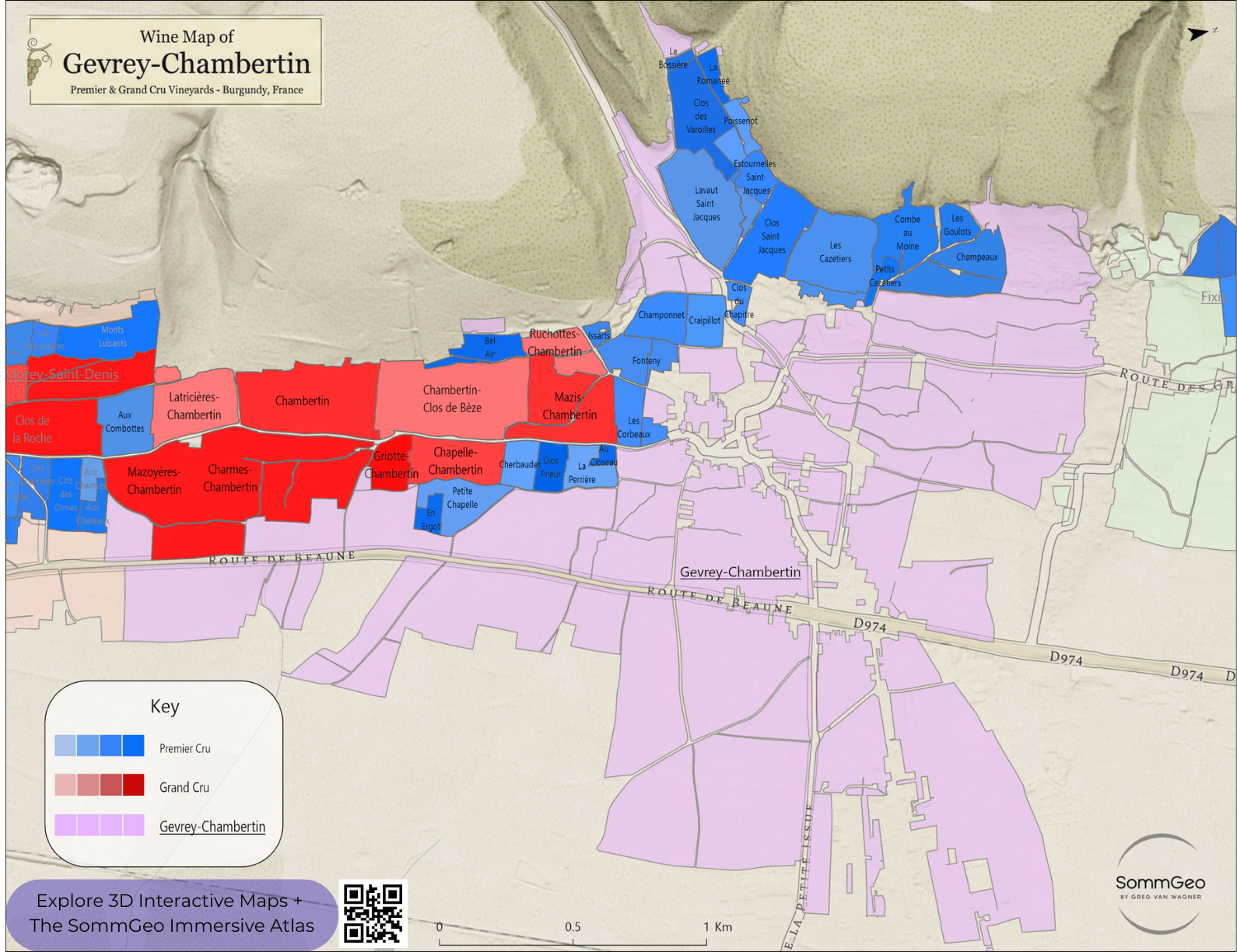
This classic map provides a vineyard-level overview of the entire Gevrey-Chambertin commune — every Grand Cru, Premier Cru, and village-level climat positioned on the Côte d’Or slope. You’ll see how the nine Grand Crus line up south of the village along the Route des Grands Crus, how the Premier Crus divide into two distinct clusters, and why the village appellation extends unusually far east of the main road into the plain.
- All 9 Grand Cru vineyards: Chambertin, Chambertin-Clos de Bèze, Charmes, Mazis, Latricières, Ruchottes, Chapelle, Griotte, and Mazoyères
- 26 Premier Cru climats including Clos Saint-Jacques, Les Cazetiers, Aux Combottes, Lavaux Saint-Jacques, and Combe aux Moines
- The two distinct Premier Cru clusters: the Combe de Lavaut group northwest of the village and the Grand Cru–adjacent sites to the south
- Village-level vineyards extending east beyond the N74 road — explaining Gevrey’s unusually large total area
- Elevation and slope position showing how Grand Crus occupy the ideal mid-slope band between 240 and 300 meters
- Commune boundaries with Brochon to the north and Morey-Saint-Denis to the south
Geography and Vineyard Character
Gevrey-Chambertin sits at the northern end of the Côte de Nuits, roughly 15 kilometers south of Dijon, and its vineyard geography divides into three clearly distinct zones. The Grand Crus occupy a gentle, east-facing slope south of the village between about 240 and 300 meters elevation — a strip of impeccably positioned land where limestone bedrock, clay-rich marl, and centuries of accumulated alluvial debris create the deep, iron-rich soils that give Gevrey its signature power. Above and behind the village, the Premier Crus climb higher up the Côte d’Or hillside into the Combe de Lavaut, a narrow valley that channels cool air from the plateau above, adding freshness and tension to wines from sites like Clos Saint-Jacques and Les Cazetiers. And then there’s the vast eastern plain beyond the N74 road — flat, more clay-heavy, and responsible for Gevrey’s large volume of village-level wine that ranges from excellent to unremarkable depending on the producer.
The commune’s terroir is shaped by two geological forces. First, the underlying Jurassic limestone of the Côte d’Or escarpment provides the calcium-rich subsoil that Pinot Noir needs for structure and longevity. Second, the Combe de Lavaut has, over millennia, washed alluvial material — clay, limestone scree, iron-rich red silt — down from the plateau and deposited it across the vineyard slopes. This creates the complex mosaic of soils that distinguishes one climat from the next, sometimes within a few meters.
The Grand Crus
Chambertin & Chambertin-Clos de Bèze
These are the twin pinnacles — not just of Gevrey, but of all Burgundy. Chambertin (12.9 hectares) takes its name from a medieval farmer named Bertin whose field (champ de Bertin) adjoined the vineyards of the Abbey of Bèze, and whose wine proved so exceptional that it earned a reputation rivaling the monks’ own. Clos de Bèze (15.4 hectares), first planted by the Benedictine Abbey of Bèze around 630 AD, is among the oldest documented vineyards in France. The two share the same east-facing mid-slope position on clay-limestone soils over a limestone bedrock, and historically they were treated as a single vineyard — which is why wine from Clos de Bèze can legally be labeled as Chambertin (though the reverse is not permitted, and few producers exercise this option today).
In style, Chambertin is often described as the more powerful and masculine of the two — dense, structured, with dark fruit, chocolate, and licorice — while Clos de Bèze leans toward refinement, with more floral lift and a silkier texture. These are wines that demand patience: 10 to 15 years minimum for top vintages, with the best bottles developing for 30 years or more. Domaine Armand Rousseau is the largest single holder of Chambertin at 2.55 hectares across four parcels, and their bottling is widely considered the benchmark. Domaine Leroy’s tiny 0.5-hectare holding produces one of the most sought-after (and expensive) wines in existence, while Domaine Trapet’s 1.9 hectares deliver a more classically structured interpretation.
The Other Seven Grand Crus
South of Chambertin and Clos de Bèze, seven more Grand Crus complete the lineup — each carrying the Chambertin suffix. Charmes-Chambertin (30.8 hectares including the Mazoyères-Chambertin climat, whose wine can be sold under either name) is the largest and typically the most approachable: seductive, round, and earlier-drinking. Mazis-Chambertin (9.1 hectares) sits at the northern end of the Grand Cru band adjacent to Clos de Bèze and produces wines of serious structure and aging potential — this is an undervalued climat worth seeking out. Latricières-Chambertin (7.3 hectares) abuts the southern boundary of Chambertin itself, transitioning toward Morey-Saint-Denis, and tends toward a finer, more elegant expression.
Ruchottes-Chambertin (3.3 hectares) sits at the highest elevation of the group and produces tightly wound, mineral wines that need time to open. Domaine Rousseau’s Clos des Ruchottes, a monopole within the climat, is the reference point. Chapelle-Chambertin (5.5 hectares) offers a lighter, more fragrant style — often elegant but less commanding than its neighbors. Griotte-Chambertin, at just 2.7 hectares, is the smallest Grand Cru and one of the most consistently compelling: a velvety, concentrated wine whose name likely derives from the shape of the vineyard, or its griotte cherry aromatics, depending on who you ask. Laurent Ponsot and Claude Dugat are excellent sources here.
Premier Crus That Rival the Grand Crus
Clos Saint-Jacques
If there’s a single Premier Cru vineyard in Burgundy that deserves Grand Cru status, it’s Clos Saint-Jacques. This 6.7-hectare walled vineyard sits on the southeast-facing slope above the village in the Combe de Lavaut cluster, and it regularly produces wines that match many of the commune’s Grand Crus in quality, complexity, and price. The site benefits from a unique combination of factors: the combe channels cool air that preserves acidity, the elevation (up to around 325 meters) provides excellent drainage and sun exposure, and the stony, limestone-rich soils contribute a taut minerality that gives the wine its backbone. Five producers divide the vineyard — Domaine Armand Rousseau (2.21 hectares), Domaine Fourrier, Domaine Jadot, Bruno Clair, and Domaine Sylvie Esmonin.
At Rousseau, Clos Saint-Jacques is served in the tasting order just before Chambertin and Clos de Bèze — ahead of the other Grand Crus. That placement tells you everything about how the family views this vineyard. The wine is complete: structured and age-worthy like the Grand Crus, but with an additional dimension of freshness and aromatic complexity that can make it the most compelling bottle in the lineup. It was never promoted to Grand Cru in the 1936 classification, and the reasons are political rather than qualitative — a historical oversight that has, if anything, only burnished its mystique.
Aux Combottes & Other Notable Premier Crus
Aux Combottes (4.6 hectares) occupies one of the most interesting positions on the map: it’s entirely enclosed by Grand Crus — bordered by Latricières-Chambertin, Mazoyères-Chambertin, and the Morey-Saint-Denis Grand Cru Clos de la Roche. The vineyard was never elevated to Grand Cru status, some say because its principal owners were from Morey rather than Gevrey (local politics being what they are in Burgundy). The wines are serious, structured, and age-worthy. Domaine Leroy, Dujac, and Hubert Lignier are among the top holders, and this is a climat where you consistently get Grand Cru quality at Premier Cru pricing — one of the better values in the commune.
Les Cazetiers (8.5 hectares), adjacent to Clos Saint-Jacques in the Combe de Lavaut cluster, is the other Premier Cru most frequently cited as Grand Cru quality — darker-fruited and a touch more rustic than Clos Saint-Jacques, but with serious depth. Lavaux Saint-Jacques sits just above Clos Saint-Jacques on the slope and benefits from similar geology, though the higher elevation gives the wines a leaner, more tightly wound profile. And Combe aux Moines (4.8 hectares), at the very top of the combe near the Brochon border, produces firm, limestone-driven wines with excellent aging potential from producers like Fourrier.
Key Producers
Domaine Armand Rousseau
No discussion of Gevrey-Chambertin is complete without Rousseau — the domaine that, more than any other, put this village on the global map. Armand Rousseau was born in 1884 into a family of vignerons, coopers, and wine merchants. After inheriting vineyard plots and marrying into additional holdings in 1909, he spent the 1910s and 1920s acquiring parcels in Charmes-Chambertin, Clos de la Roche, and Chambertin itself. But his most consequential decision came in the 1930s, when — on the advice of Raymond Baudoin, future founder of the Revue du Vin de France — he began bottling and selling wine under his own name rather than selling to négociants. He was among the first in Burgundy to do so, and among the first to export to the United States after Prohibition. Three generations later, the domaine is run by Éric Rousseau (Armand’s grandson) and his daughter Cyrielle, farming roughly 15 hectares — over 8 of which are Grand Cru. The Chambertin, Clos de Bèze, and Clos Saint-Jacques are the crown jewels, but even the village Gevrey-Chambertin is a model of the commune’s style.
Other Essential Producers
Beyond Rousseau, Gevrey-Chambertin is home to a deep bench of serious domaines. Domaine Denis Mortet (now run by Arnaud Mortet) produces concentrated, deeply colored wines that represent the more modern, powerful end of the Gevrey spectrum. Domaine Claude Dugat and the related Dugat-Py are among the most sought-after names in the village, with tiny production and intensely concentrated bottlings from old vines. Domaine Fourrier takes a more Chambolle-like approach to Gevrey with lighter extraction and wines of remarkable finesse that reward patience. Domaine Trapet Père et Fils, practicing biodynamic viticulture, is the second-largest holder of Chambertin (1.9 hectares) and produces an excellent range from village through Grand Cru. The quality across Gevrey has never been higher, though as with all of Burgundy, knowing your producer matters as much as knowing the climat — particularly at the village level, where the range in quality from one bottle to the next can be dramatic.
Want to explore Gevrey-Chambertin and the entire Côte d’Or in 3D with interactive layers, elevation data, and vineyard boundaries? Join 200+ wine organizations already using SommGeo.
Start Your 15-Day Free Trial $5/month billed annually after trial · Cancel anytimeMap Usage
Free for your own study and tastings. If you share or teach with a map, credit it visibly as Map: SommGeo (sommgeo.com). Commercial use requires a Commercial Embed License. See Map Usage, Credit and Licensing.