
Central & Eastern Europe Wine Map: Interactive Map Maker
Eight EU nations, centuries of indigenous grape culture, and some of Europe’s most compelling wine stories you’ve probably never been told.
The Central and Eastern European Union wine regions represent one of the most fascinating (and chronically underexplored) corners of the wine world. We’re talking about eight countries with viticultural histories stretching back millennia: Hungary, where Tokaj’s classified vineyards predate Bordeaux by over a century. Croatia, where Plavac Mali clings to sun-blasted Adriatic terraces and DNA testing proved the country is the ancestral home of Zinfandel. Slovenia, where the rolling flysch hills of Goriška Brda produce orange wines and skin-contact Rebula that rival anything coming out of Friuli across the border. Romania, with more vineyard area than any other Eastern European country and a trio of indigenous Fetească varieties. Bulgaria, where ancient Thracian winemaking traditions survive in Mavrud and Broadleaf Melnik. Cyprus, home to Commandaria (the world’s oldest named wine still in production, documented since 800 BC). And the Czech Republic and Slovakia, completing the picture with their own distinctive contributions. This interactive Map Maker lets you explore every PDO, PGI, and wine region across all eight nations in full detail. Every mapped region includes detailed popup content covering indigenous grape varieties, climate profiles, soil types, classification rules, a sommelier-level reference built directly into the map.
Unlock the Full SommGeo Toolkit
Gain exclusive access to our entire suite of premium features, including interactive Map Makers, immersive 3D Tours, high-resolution classic Maps, and advanced analytical tools.
Start Free TrialNew to the Map Makers? Explore all the tools, tips, and features in our complete walkthrough.
Map Maker Guide →Free to learn from. Credit when you share it.
Studying for an exam or just exploring on your own? It’s all yours, no credit needed. But if a map is going to be seen by others, used to teach, or put to any commercial use, we’d ask that you credit it prominently as Made with SommGeo Map Maker.
Building something bigger? We design licensed and co-branded maps for teams, associations, importers, and producers. Get in touch.
What You’ll Explore
This Map Maker covers every wine PDO and PGI designation across eight Central and Eastern EU member states, but the real depth is in what each region reveals. Click on any mapped area and a comprehensive info panel opens with sommelier-level content: indigenous grape varieties, climate and geographic profiles, soil composition, classification details, the viticultural specifics that define each appellation. Whether you’re reading about Tokaj’s volcanic clay over loess, Croatia’s Plavac Mali on sun-blasted Dalmatian limestone, or Slovenia’s flysch-driven Rebula in Goriška Brda, every mapped region carries this level of built-in intelligence. Beyond the content, switch between satellite imagery, topographic relief, and newspaper-style basemaps to build custom views, measure distances, and export your finished maps.
- Hungary’s 22 wine regions and 31+ PDOs including Tokaj, Eger, Villány, and the Balaton appellations
- In-depth region profiles for every mapped area: indigenous varieties, soils, climate
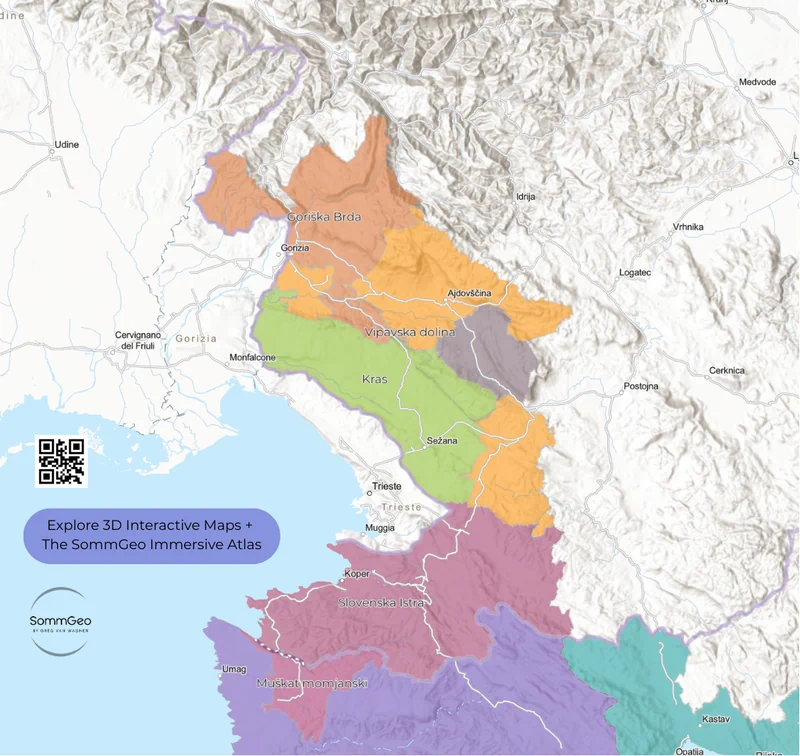
- Slovenia’s three wine regions (Primorska, Podravje, and Posavje) with Goriška Brda highlighted
- Romania’s 33 DOC areas including Dealu Mare, Cotnari, Drăgășani, and the Transylvanian highlands
- Bulgaria’s PDOs across the Thracian Valley, Struma River Valley, Danube Plain, and Black Sea coast
- Cyprus’s Commandaria PDO and seven wine route regions plus Czech Republic and Slovakia designations



Geography and Site Character Across the Region
What makes this collection of countries so compelling from a geographic perspective is the sheer range of influences at play. You have the Pannonian Basin (that vast, flat interior stretching across Hungary and into parts of Croatia, Romania, and Serbia) where continental extremes drive everything from Furmint’s electric acidity in Tokaj to the power of Villány’s Cabernet Franc. Then there’s the Adriatic corridor, where Croatia’s Dalmatian coast and Slovenia’s Primorska region enjoy Mediterranean warmth tempered by mountain barriers, producing wines with an entirely different character. The Carpathian arc that wraps around Romania creates its own set of mesoclimates, sheltering Transylvania’s high-altitude whites while exposing the southern slopes of Dealu Mare to the heat that ripens Fetească Neagră. And out in the eastern Mediterranean, Cyprus sits in isolation with its volcanic Troodos Mountains creating altitude-driven growing zones from sea level to 1,400 meters (4,593 ft).
Soil diversity is equally staggering. The volcanic substrates around Hungary’s Balaton and Somló produce whites with unmistakable mineral tension. Slovenia’s Goriška Brda sits on flysch and opoka (a local marl-sandstone combination) that gives Rebula its signature texture. Croatia’s Dingač vineyards grow on rocky limestone with schist, contributing to wines of extraordinary concentration. Bulgaria’s Struma Valley benefits from sandy soils and Mediterranean heat funneled through a river gorge from Greece. Romania’s Dealu Mare has iron-rich red-brown soils that favor the country’s best reds. And Cyprus’s Commandaria zone is volcanic basalt at altitude, conditions that produce one of the most singular wines on the planet. Understanding these geographic relationships is the key to understanding why this part of Europe produces such wildly different wines within relatively short distances.
Key Wine Regions
Hungary: Tokaj, Eger & Beyond
Hungary is the heavyweight of Central European wine. With 22 wine regions, 31 PDOs, and a viticultural history that includes the world’s first classified vineyard system (Tokaj, 1737, predating Bordeaux’s 1855 classification by over a century), this is a country that has always punched above its weight. Tokaj remains the crown jewel: a UNESCO World Heritage landscape at the confluence of the Bodrog and Tisza rivers, where volcanic soils and autumn botrytis produce Aszú wines of staggering complexity. But the revolution happening in dry Furmint (led by producers like Disznókő, Royal Tokaji, and Szepsy) is arguably the bigger story for modern wine professionals. Eger, home of the famous Bikavér (Bull’s Blood) blend, is reinventing itself with more terroir-focused reds. Villány has earned the unofficial title of “Hungary’s capital of Cabernet Franc” with structured, age-worthy reds. Finally, the volcanic hills of Badacsony and Somló near Lake Balaton produce whites that are unlike anything else in Europe; while the widely planted Olaszrizling achieves powerful minerality on these basalt soils, it is incredibly rare, hyper-local varieties, like Somló’s fiery Juhfark and Badacsony’s smoky Kéknyelű, that serve as the ultimate signatures of these ancient buttes.
Croatia: Istria, Dalmatia & Slavonia
Croatia’s wine map divides into two fundamentally different worlds. The coastal regions (Istria in the northwest and Dalmatia stretching south to Dubrovnik) are Mediterranean in every sense, with Malvazija Istarska dominating the north and Plavac Mali ruling the south. Plavac Mali is the undisputed king of Croatian reds, and its connection to Zinfandel (DNA analysis confirmed Plavac Mali is a cross between Crljenak Kaštelanski, which is genetically identical to Zinfandel, and Dobričić) makes Croatia a pilgrimage site for anyone serious about grape genetics. The Dingač appellation on the Pelješac Peninsula (Croatia’s first PDO, recognized in 1961) produces some of the most intense expressions, with vineyards on impossibly steep slopes receiving triple sun exposure from direct sunlight, sea reflection, and radiant heat from the rocky soil. Inland, Slavonia’s continental climate produces Croatia’s most planted variety, Graševina (Welschriesling), in styles ranging from crisp and mineral to rich and skin-contact.
Slovenia: Goriška Brda, Vipava & Štajerska
Slovenia may be tiny (just 0.5% of European vineyard area) but its cultural footprint on the wine world is outsized in a way that’s hard to overstate. This is, arguably, the country that handed the modern orange wine movement its passport. Joško Gravner’s experiments with extended skin-contact and amphora fermentation in the Collio/Brda border zone didn’t happen in a vacuum; the tradition of macerating white grapes on their skins runs deep in this part of the world, and Slovenian producers like Movia and Kabaj were part of the conversation from the beginning. That said, Slovenia is not a one-trick orange pony: its winemakers are equally capable of producing clean, precise modern whites and structured reds, and the best estates move fluidly between styles depending on the vintage and the vineyard.
The country’s three main regions (Primorska, Podravje, and Posavje) cover an astonishing range of climates and exposures. Goriška Brda is the star. Sharing the same flysch and opoka geological formation as Collio across the Italian border, Brda produces textured, mineral-driven Rebula (Ribolla Gialla), Malvazija, and Chardonnay that hold their own against anything from Friuli. Marjan Simčič is making some of the most refined, internationally competitive whites in the region, and not all of them are orange. The Vipava Valley, just east of Brda, is the home of indigenous varieties Zelen and Pinela, grapes you literally will not find anywhere else on earth, which should be reason enough to seek them out. And in the northeast, Štajerska (Styria) produces aromatic whites from Šipon (Furmint), Laški Rizling, and Sauvignon Blanc in a style closer to Austria than the Mediterranean: cool, precise, and built for the table.
Romania: Dealu Mare, Cotnari & Transylvania
Romania is Europe’s fifth-largest wine-producing country with nearly 180,000 hectares (444,789 acres) under vine, and its potential is only beginning to be realized. The star indigenous varieties are the Fetească family: Fetească Regală (the most planted), Fetească Albă, and Fetească Neagră, the last being Romania’s answer to a serious, age-worthy red grape. Dealu Mare, on the Carpathian foothills north of Bucharest, is the country’s most recognized red wine region, where iron-rich soils and warm summers produce concentrated Fetească Neagră alongside Cabernet Sauvignon and Merlot. Even Piero Antinori invested here, planting 100 hectares (247 acres) at Viile Metamorfosis. In the northeast, Cotnari’s golden sweet wines from Grasă de Cotnari and Tămâioasă Românească once rivaled Tokaj in fame. Transylvania’s high-altitude vineyards, particularly the Târnave region, produce some of Romania’s most exciting whites: fresh, mineral, and aromatic. Drăgășani in Oltenia is the homeland of Crâmpoșie and Negru de Drăgășani, two more indigenous gems worth seeking out. Key producers include Davino, Cramele Recaș, Budureasca, and Crama Histria.
Bulgaria has 52 PDOs and two PGIs on paper, but don’t expect to find most of them on a label. The PDO system sees limited use in practice, and producers typically identify their wines by region or village rather than formal appellation. If you want to get oriented on the five overarching geographic zones before diving deeper, the SommGeo Overarching Bulgarian Regions 3D Fast Map is the place to start. While international varieties (particularly Cabernet Sauvignon and Merlot) still dominate plantings, the quality revolution is being driven by producers zeroing in on indigenous grapes: Villa Yustina, Midalidare Estate, and Villa Melnik leading the charge.
Bulgaria: Thracian Valley & Struma
Bulgaria’s wine history stretches back over 7,000 years to the ancient Thracians, who considered wine sacred enough to place Dionysus (himself a Thracian deity) at the center of their culture. The country’s five wine regions are anchored by the Thracian Valley in the south, home to Mavrud, Bulgaria’s most powerful indigenous red, with deep blackberry and leather character and serious aging potential. Plovdiv, the region’s cultural center, was named the European wine capital for 2025. In the southwest, the Struma River Valley near the Greek border produces Broadleaf Melnik (Shiroka Melnishka Loza), a late-ripening, site-expressive variety that has drawn comparisons to Nebbiolo for its structure and peppery complexity. Rubin, a successful Bulgarian crossing of Nebbiolo and Syrah developed in the 1940s, adds another dimension worth exploring.
Cyprus: Commandaria & the Troodos
Cyprus holds one of the most remarkable claims in wine: Commandaria, produced from sun-dried Xynisteri and Mavro grapes on the southern slopes of the Troodos Mountains, is the world’s oldest named wine still in production, with documentation going back to 800 BC. Richard the Lionheart reportedly called it “the wine of kings and the king of wines” after tasting it at his wedding on the island in 1191. The Commandaria PDO is restricted to just 14 designated villages at 500–900 meters (1,640–2,953 ft) elevation, and the production method (late-harvested grapes dried in the sun, then fermented and aged minimum two years in oak) has remained mostly unchanged for centuries. Beyond Commandaria, Cyprus’s modern wine scene is driven by its indigenous varieties: Xynisteri (the island’s most planted white, often compared to Chenin Blanc) and Maratheftiko (a red requiring cross-pollination that produces structured wines reminiscent of Nebbiolo). The island has seven PDOs and four PGIs, with vineyards reaching up to 1,400 meters (4,593 ft) on the Troodos, among the highest in Europe.
Czech Republic & Slovakia
The Czech Republic’s wine production is concentrated overwhelmingly in Moravia, in the southeast near the Austrian border, where the Pannonian climate influence produces solid Grüner Veltliner, Riesling, and the local Frankovka (Blaufränkisch). Slovakia’s most significant wine story is its share of the Tokaj region, a small but historically important area in the southeast where Furmint and Hárslevelű are grown in the same tradition as Hungarian Tokaj, under a coexisting PDO recognized by the EU. The Little Carpathians wine region near Bratislava also produces distinctive whites from Welschriesling and Müller-Thurgau on limestone soils.
New to the Map Makers? Explore all the tools, tips, and features in our complete walkthrough.
Map Maker Guide →Ready to explore Central & Eastern Europe’s wine regions in full detail? Join 200+ wine organizations already using SommGeo.
Start Your 15-Day Free Trial $5/month billed annually after trial · Cancel anytimePlease let us know what you think in the form below. Thanks!