
Romanian Wine Regions 3D Map
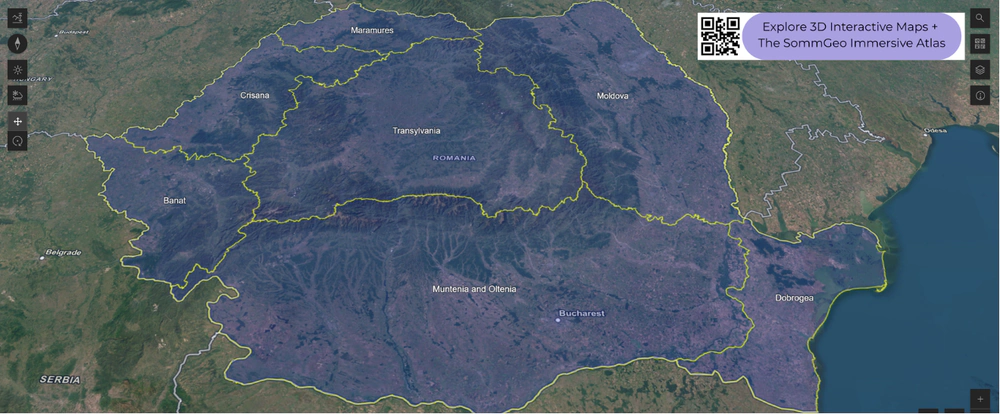
Transylvania, Muntenia, Moldova, Dobrogea, Banat, Crișana, and Maramureș: Romania’s major viticultural regions.
Romania’s viticultural regions are the broad geographic zones that divide the country’s wine landscape into recognizable areas. Where the PDOs (DOC-DOPs) map specific appellations, these regions define the larger territories shaped by the Carpathian Mountains, which arc through the center of the country and create the fundamental geographic divisions. Each region contains one or more officially registered PGIs (Protected Geographical Indications), the EU-recognized designations that sit between varietal wines and PDOs in Romania’s quality hierarchy. Transylvania sits inside the arc on an elevated plateau. Muntenia and Oltenia spread south toward the Danube. Moldova stretches east toward the Republic of Moldova. Dobrogea meets the Black Sea. Banat, Crișana, and Maramureș fill in the west and north. This 3D Fast Map shows these viticultural regions and how the Carpathians create the boundaries between them.
Unlock the Full SommGeo Toolkit
Gain exclusive access to our entire suite of premium features, including interactive Map Makers, immersive 3D Tours, high-resolution classic Maps, and advanced analytical tools.
Start Free TrialWhat You’ll Explore
This 3D Fast Map shows Romania’s major viticultural regions. These are the broad geographic zones that organize the country’s wine landscape at the highest level. Click any mapped region for detailed popup content covering grape varieties, climate profiles, and geographic specifics. Use the layer controls to toggle different region groupings on and off. For Romania’s specific PDO appellations (Dealu Mare, Cotnari, Murfatlar, etc.), see the companion Romania PDOs 3D Fast Map.
- Full 3D terrain with Romania’s major viticultural regions mapped
- Toggleable layers to control which region groupings are displayed
- Elevation profile tool for measuring vineyard altitude and slope gradients
- Daylight and shadow animation to visualize aspect and sun exposure
- Weather overlay to see how atmospheric conditions interact with terrain
- Detailed popup data for every mapped region: varieties, climate, geography
Key Regions in Focus
Transylvania
Transylvania occupies the elevated plateau inside the Carpathian arc, at altitudes generally between 300 and 600 meters (984 and 1,968 ft). The enclosed position creates a cooler, more continental climate than the regions outside the mountains, with cold winters and moderate summers. This is white wine territory: Fetească Albă, Fetească Regală, Sauvignon Blanc, and Italian Riesling produce fresh, aromatic styles with good natural acidity. The Târnave PDO sits within this region and is the traditional center of Transylvanian winemaking. In the 3D map, the Carpathian walls enclosing the plateau are the defining visual feature, and the elevation difference between Transylvania and the surrounding lowlands is immediately apparent.
Muntenia, Oltenia, and the Southern Slopes
South of the Carpathians, Muntenia and Oltenia spread across the Wallachian Plain and up into the foothills. The southern and southeastern slopes of the Carpathian foothills hold the country’s warmest and most sheltered vineyard sites. The Dealu Mare PDO falls within Muntenia, and the broader zone supports both indigenous varieties (Fetească Neagră, Tămâioasă Românească) and international plantings (Cabernet Sauvignon, Merlot, Pinot Noir). Oltenia, to the west, includes the Drăgășani PDO along the Olt River valley. The terrain transitions from flat plains near Bucharest to rolling foothills and then steep Carpathian slopes, a gradient that is clearly traceable in 3D.
Moldova and Dobrogea
Moldova (not to be confused with the neighboring Republic of Moldova) occupies the eastern side of the country between the Carpathians and the Prut River. The climate is continental with warm summers, and the region has a long viticultural history. The Cotnari PDO, with its tradition of botrytis-affected sweet wines, sits within this region. Dobrogea, in the southeast between the Danube and the Black Sea, is geographically distinct: flat, dry, and moderated by maritime influence. The Murfatlar PDO benefits from this coastal proximity. Banat and Crișana fill in the western side of the country along the Hungarian border, with Banat extending south to the Serbian border and warmer conditions across both regions influenced by the Pannonian Plain. Maramureș, in the far north, is among Romania’s smallest and least commercially prominent wine zones.
New to 3D Fast Maps? Learn how to navigate 3D terrain, use elevation profiles, animate sunlight, and get the most from your map.
3D Fast Maps Guide →Ready to explore Romania’s wine regions in full 3D? Join 200+ wine organizations already using SommGeo.
Start Your 15-Day Free Trial $5/month billed annually after trial · Cancel anytimeMap Usage & Permissions
Personal Use
You are welcome to use, download, and share the maps on this site for personal, educational, and non-commercial purposes. If you share a map, please credit SommGeo with a link back to sommgeo.com.
Commercial Use
Use of these maps for any commercial purpose, including websites, print publications, marketing materials, or any other commercial venture, is strictly prohibited without prior written permission.
To inquire about custom SommGeo platforms, maps, or commercial licensing, please contact [email protected].