
Australia Wine Regions Map: Interactive Guide
From the ancient Shiraz vines of the Barossa to the cool-climate frontier of Tasmania. Mapping a continent-sized wine country with over 65 designated regions.
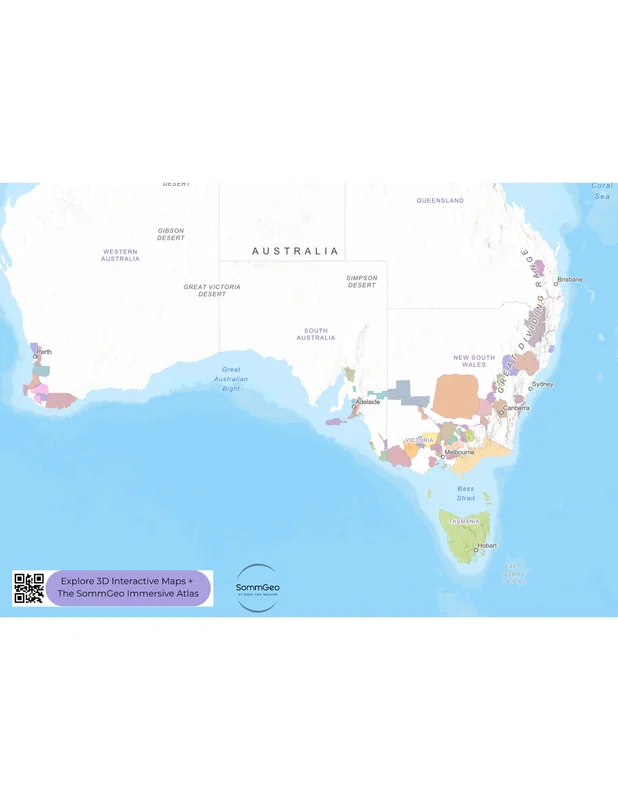
Australia is a wine country of absurd geographic range. You’re looking at vineyards spanning from the 27th parallel in Queensland down to the 43rd in Tasmania, roughly 2,400 kilometers (1,491 miles) of latitude, covering everything from subtropical warmth to genuinely cool maritime climates. The Geographical Indication (GI) system organizes this sprawl into a hierarchy of zones, regions, and subregions, with over 65 designated wine regions across six states. South Australia alone accounts for more than half the country’s vineyard area, but the real story is the diversity: the same nation produces blockbuster old-vine Barossa Shiraz, razor-sharp Clare Valley Riesling, world-class Margaret River Cabernet, and elegant Tasmanian sparkling. This interactive Australia wine regions map lets you explore every GI boundary, state, and zone, and every mapped region includes detailed popup profiles covering key grape varieties, climate and geographic data, soil composition, viticulture, and what makes each region distinct.
Unlock the Full SommGeo Toolkit
Gain exclusive access to our entire suite of premium features, including interactive Map Makers, immersive 3D Tours, high-resolution classic Maps, and advanced analytical tools.
Start Free TrialWhat You’ll Explore
This interactive Fast Map is a searchable 2D atlas of every classified Australian wine Geographical Indication, but the map is only half the story. Click on any GI boundary and a comprehensive info panel opens with sommelier-level detail on that region: dominant grape varieties with planting context, climate and geographic profiles, soil composition, viticultural character, and what distinguishes the region’s wines. Whether you’re reading about the ancient Barossa soils that give old-vine Shiraz its depth, the maritime influence shaping Margaret River’s Cabernet, or the diurnal swings driving Clare Valley Riesling’s trademark acidity, every single mapped region carries this level of built-in intelligence. It’s a complete wine reference embedded directly in the map.
- All GI zones, regions, and subregions across six states with clickable boundaries
- In-depth region profiles for every mapped area: grape varieties, climate, soils, and geographic character
- South Australia’s powerhouse regions: Barossa Valley, Eden Valley, McLaren Vale, Clare Valley, Coonawarra
- Victoria’s cool-climate stars: Yarra Valley, Mornington Peninsula, Heathcote, Geelong, Rutherglen
- Western Australia from Margaret River through Great Southern and its five subregions
- Tasmania’s emerging wine zones plus Queensland’s Granite Belt and South Burnett


A Brief History of Australian Wine
The first vines arrived in Australia with the First Fleet in 1788, planted by Governor Arthur Phillip at Sydney Cove. They didn’t survive; nobody on board had any real viticultural knowledge, and the humid subtropical climate of coastal Sydney was about as hostile to Vitis vinifera as you could find. But the ambition stuck. By the early 1800s, pioneers like Gregory Blaxland and John Macarthur were establishing the first commercial vineyards around Parramatta and Camden, with Blaxland shipping wine to England as early as 1822 and winning a silver medal in London for his efforts.
The pivotal figure was James Busby, widely regarded as the father of Australian wine. A Scottish-born immigrant who’d studied viticulture in France, Busby returned from a tour of European vineyards in 1832 with a collection of approximately 543 vine cuttings, including Syrah (Shiraz) from Hermitage in the northern Rhône. Those cuttings, planted at the Sydney Botanic Gardens and later distributed to growers in the Hunter Valley, South Australia, and Victoria, became the genetic foundation of the entire Australian wine industry. Many of the old-vine Shiraz, Mourvèdre, and Grenache plantings that survive in the Barossa Valley today trace their lineage directly back to Busby’s collection, pre-phylloxera material that no longer exists in Europe.
Growth accelerated through the mid-1800s. German Lutheran settlers fleeing religious persecution established the Barossa Valley’s first vineyards in the 1840s (Johann Gramp at Rowland Flat in 1847, Samuel Smith founding Yalumba in 1849). The Victorian gold rushes of the 1850s brought European immigrants, including Swiss vignerons who planted the Yarra Valley and Geelong, and by the 1870s, Australian wines were winning medals at major international exhibitions across Europe. Phylloxera did reach Australia (Victoria’s Geelong district in 1877), but South Australia’s strict quarantine measures kept the pest out of its borders entirely. That single policy decision is why the Barossa today is home to some of the oldest continuously producing grapevines in the world, Shiraz vines dating to 1843 at Langmeil’s Freedom Vineyard, and pre-phylloxera material at Henschke’s Hill of Grace dating from the 1860s.
The 20th century brought booms and busts. For decades, Australia was primarily a fortified wine country: sweet, strong reds and tawny styles dominated. The table wine revolution didn’t arrive until the 1950s and ’60s, when Max Schubert at Penfolds created Grange (first vintage 1951). The export boom of the 1980s and ’90s made Australian wine a global force, though the pendulum swung too far toward mass-market brands and an overproduction crisis followed. Nowadays, the story is increasingly about diversity, regionality, and a return to site-specific winemaking, alternative varieties from Italy, Spain, and Portugal alongside the classic portfolio of Shiraz, Cabernet, Chardonnay, and Riesling.
The GI System: How Australia Classifies Wine
Australia’s wine classification is built on Geographical Indications (GIs), established in 1993 through the Australian Wine and Brandy Corporation Act to meet obligations under trade agreements with the European Community. The system is deliberately minimalist compared to European appellations; it defines where grapes are grown but places almost no restrictions on how wine is made. No mandatory varieties, no yield limits, no aging requirements. The only rule: if a wine carries a GI region name on the label, at least 85% of the grapes must come from that region. The same 85% threshold applies to vintage and variety claims.
The hierarchy runs from broad to specific: the super zone “South Eastern Australia” (encompassing all of New South Wales, Victoria, Tasmania, and parts of Queensland and South Australia) sits at the top, followed by individual states, then zones (28 in total, established in 1996), then regions (over 65), and finally subregions. Registering a new GI region is a notoriously slow and expensive process; the infamous six-year legal battle over the boundaries of Coonawarra cost millions, but the system gives winemakers enormous freedom to innovate within their geographic designations. It’s a distinctly New World approach: the geography matters, but what you do with it is up to you.
Climate & Geography
Australia is a continent, and its viticultural range reflects that. Vineyards stretch from around 27°S in Queensland’s Granite Belt down to 43°S in Tasmania, covering Mediterranean, maritime, continental, and subtropical climate zones. The vast majority of quality wine production concentrates in the southern third of the country, where cooler temperatures and the moderating influence of the Southern Ocean create conditions that actually suit grapevines, despite the popular image of Australia as uniformly hot and dry. Altitude plays a critical role in the warmer states: the Great Dividing Range running down the eastern seaboard provides elevated sites with dramatically cooler temperatures, and many of Victoria’s and New South Wales’ best vineyards sit at 500 meters (1,640 ft) or above.
Water is the defining challenge. Much of Australia’s vineyard land is semi-arid, and irrigation has been fundamental to the industry since the 1880s, when Canadian engineers George and William Chaffey developed irrigation schemes along the Murray River. The large-volume inland regions (Riverland in South Australia, Riverina in New South Wales, Murray Darling spanning the Victoria–New South Wales border) still account for a huge portion of national production and depend entirely on irrigation. Premium regions increasingly rely on careful water management, drip irrigation, and drought-resistant rootstocks, and climate change is accelerating interest in heat-tolerant Mediterranean and Iberian varieties as alternatives to the dominant Shiraz-Cabernet-Chardonnay trio.
Grape Varieties
Australia has no native wine grapes; every vine traces back to European cuttings, the earliest from South Africa and France. Over 130 varieties are now commercially grown, but the industry remains dominated by a core group. Shiraz is the undisputed king, accounting for roughly a quarter of all grapes crushed and producing everything from the massive, concentrated old-vine reds of the Barossa to the peppery, medium-bodied styles of cooler regions like Heathcote and the Grampians. Chardonnay is the most planted white variety.
Cabernet Sauvignon runs a strong second among reds, with Coonawarra and Margaret River producing benchmark examples on the country’s distinctive terra rossa and gravel soils. Riesling deserves special mention: Clare Valley and Eden Valley produce some of the finest dry Rieslings on Earth, with a precision and longevity that rival the best of Alsace. Sémillon from the Hunter Valley is another uniquely Australian classic: harvested early, bottled unoaked, and capable of extraordinary transformation with a decade or more in bottle. Pinot Noir has surged in quality in cooler areas; the Yarra Valley, Mornington Peninsula, and Tasmania are all producing wines that compete on the international stage.
The traditional Rhône-style blends remain important: GSM (Grenache, Shiraz, Mourvèdre) is a signature of the Barossa and McLaren Vale, drawing on old-vine material that dates back to the 19th century. And increasingly, winemakers are exploring alternatives: Tempranillo, Fiano, Vermentino, Nero d’Avola, Grüner Veltliner, and dozens of other varieties from Italy, Spain, Portugal, and Greece are finding footholds across the country, driven by both changing consumer tastes and the practical reality of a warming climate.
Key Wine States & Regions
South Australia
The powerhouse. South Australia accounts for around half of the national vineyard area and a majority of the country’s wine. It’s home to the Barossa Valley, Australia’s most prestigious red wine address and the custodian of the world’s oldest Shiraz, Grenache, and Mourvèdre vines. Neighboring Eden Valley delivers stunning Riesling at altitude, while the Clare Valley offers both gutsy reds and world-class dry Riesling. McLaren Vale brings Mediterranean warmth and old-vine Grenache, Coonawarra delivers Cabernet Sauvignon from its famous terra rossa strip, and the Adelaide Hills provides cool-climate Sauvignon Blanc, Chardonnay, and Pinot Noir. The inland Riverland is the engine room of volume production. Critically, South Australia remains phylloxera-free (the strictest quarantine regime in the country) which is why vines dating to the 1840s still survive on their own roots.
Victoria
Victoria punches above its weight for diversity. The Yarra Valley, less than an hour from Melbourne, produces benchmark Pinot Noir and Chardonnay alongside serious Cabernet and Shiraz. Mornington Peninsula is maritime and cool, leaning into Pinot Noir and Chardonnay. Heathcote’s ancient Cambrian greenstone soils yield Shiraz of remarkable intensity and minerality. The northeast (Rutherglen and Glenrowan) makes Australia’s greatest fortified wines: lusciously sweet Muscat and Topaque (Muscadelle) that age in solera-like systems for decades. Geelong, the Macedon Ranges, and the Grampians round out a state that offers everything from sparkling to sticky. Phylloxera does exist in parts of Victoria, which has shaped regional development and underscored the importance of quarantine between states.
Western Australia
Only about 5% of national production, but a wildly disproportionate share of premium wine. Margaret River dominates the conversation; its maritime Mediterranean climate produces Cabernet Sauvignon and Chardonnay of rare power and elegance, and the region is arguably Australia’s most complete fine wine address. Great Southern is the largest GI region in the state, with five subregions (Frankland River, Mount Barker, Porongurup, Albany, Denmark) each offering distinct expressions driven by varying altitude, rainfall, and ocean exposure. The Swan District near Perth is one of Australia’s oldest wine areas but runs hot; the action has decisively shifted south.
New South Wales
The birthplace of Australian wine. The Hunter Valley, barely two hours north of Sydney, remains the emotional heart of the state’s wine industry, its Sémillon, harvested at startlingly low sugar levels and bottled unoaked, is one of the great unique wine styles in the world. Hunter Shiraz, softer and more earthy than its South Australian counterparts, is the other classic. Inland, the Big Rivers Zone (Riverina, Perricoota, Murray Darling) produces high volumes of commercial wine. Cooler-climate pockets at elevation (Orange, Hilltops, Tumbarumba) are increasingly recognized for quality Chardonnay, Pinot Noir, and Cabernet.
Tasmania
Australia’s coolest wine state and one of its most exciting. Long growing seasons, high natural acidity, and clean maritime air make Tasmania ideal for premium sparkling wine (many of Australia’s finest carry Tasmanian fruit), and the state’s Pinot Noir and Chardonnay continue to gain international attention. Tasmania has no officially registered GI regions or subregions (the entire state operates as a single GI) though informal references to areas like the Tamar Valley, Coal River Valley, Derwent Valley, Huon Valley, and the East Coast are increasingly common. It’s a frontier, and it’s moving fast.
Queensland
The smallest contributor, but the Granite Belt (sitting at 700–1,000 meters (2,297–3,281 ft) of elevation on the New England Tableland near the New South Wales border) produces genuinely interesting wines in a climate moderated entirely by altitude. Alternative varieties like Tempranillo, Verdelho, and Viognier thrive here alongside the mainstream trio. South Burnett rounds out the state’s two GI regions.
New to the Fast Maps? Learn how to search regions, navigate layers, and get the most from your interactive map.
Fast Map Guide →Ready to explore Australia’s wine regions in full detail? Join 200+ wine organizations already using SommGeo.
Start Your 15-Day Free Trial $5/month billed annually after trial · Cancel anytime