Provence and Corsica Wine Map: All 13 AOPs in 3D, Interactive
Bandol, Cassis, Côtes de Provence, Patrimonio, Ajaccio, and the Mediterranean south in full 3D terrain.
This interactive 3D Provence and Corsica wine map shows all 13 AOPs on real terrain: Côtes de Provence, Coteaux d’Aix-en-Provence, Coteaux Varois en Provence, Les Baux de Provence and Pierrevert across the mainland, Bandol, Cassis, Palette and Bellet along the coast, and Patrimonio, Ajaccio, Muscat du Cap Corse and the island-wide Vin de Corse on Corsica, drawn in 3D by SommGeo. Tilt and fly from the Alpilles to the calanques and across the sea to Cap Corse, check elevation and slope, run the daylight animation and click any appellation for its grapes and rules. The interactive map is part of SommGeo membership, which starts with a free 15-day trial.
- Appellations on the map: All 13, every boundary clickable: 9 in Provence and 4 on Corsica
- Rosé country: Rosé is roughly 90% of Provence AOP production, most of it from Côtes de Provence, the largest appellation, with five named sub-zones from Sainte-Victoire to Notre-Dame des Anges
- Bandol: A south-facing limestone amphitheater west of Toulon where Mourvèdre must make up at least half of the red blend, aged at least 18 months in wood
- Corsica: A granite island with limestone at Patrimonio and schist on Cap Corse; Niellucciu (Sangiovese), Sciaccarellu and Vermentinu are its grapes
- Firsts: Cassis was among the first AOCs in France (1936); Patrimonio was the first on Corsica (1968)
- 3D tools: Tilt and rotate the terrain, elevation profile readouts, daylight and shadow animation and layer controls
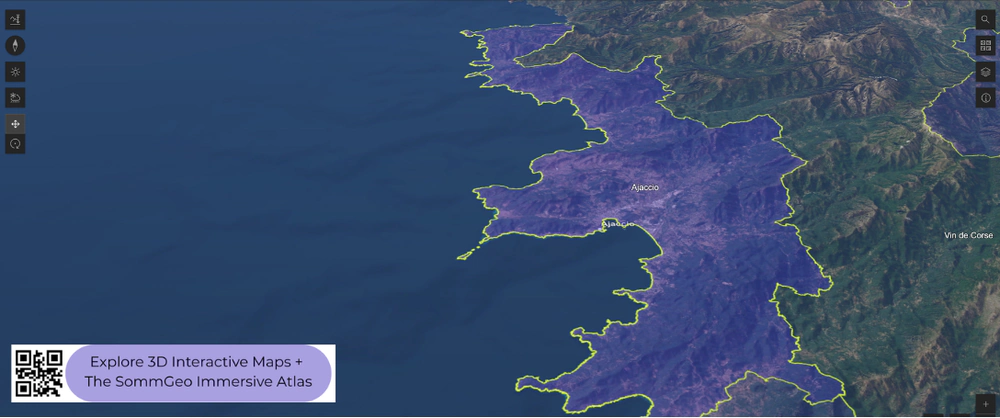
Provence and Corsica sit on the same Mediterranean arc and share the same sun-drenched climate, but the terrain underneath tells a different story. On the mainland, Provence’s appellations unfold across limestone ranges, schist hills, and coastal plateaus that slope gradually toward the sea. On Corsica, 170 kilometers (106 miles) offshore, granite peaks exceeding 2,700 meters (8,860 feet) compress vineyard land into a narrow coastal band where elevation changes are abrupt and exposure shifts dramatically from one cove to the next. In 3D, the geology that connects these two regions and the topography that separates them are both visible at a glance.
Unlock the Full SommGeo Toolkit
Gain exclusive access to our entire suite of premium features, including interactive Map Makers, immersive 3D Tours, high-resolution classic Maps, and advanced analytical tools.
Start Free TrialWhat You’ll Explore
This 3D Fast Map covers the appellations of Provence and Corsica. Click any mapped appellation for detailed popup content covering grape varieties, classification details, and geographic specifics. Use the layer controls to toggle different appellation groupings on and off.
- Full 3D terrain of Provence and Corsica wine regions
- Elevation profile tool for measuring vineyard altitude and slope gradients
- Daylight and shadow animation to visualize aspect and sun exposure
- Detailed popup data for every mapped appellation: varieties, classifications, geography

Key Regions in Focus
Provence
Provence is dominated by rosé (roughly 90% of AOP production), but the geography behind that rosé is more varied than the category might suggest. Côtes de Provence, the largest appellation, spans a wide area from the Massif des Maures near the coast to higher-elevation sites inland, with recognized named sub-zones (Sainte-Victoire, Fréjus, La Londe, Pierrefeu, Notre-Dame des Anges) that are beginning to distinguish terroir differences within the larger AOP. Bandol, tucked into a limestone amphitheater facing the sea west of Toulon, is the serious red wine appellation: Mourvèdre must make up at least 50% of the blend, and the variety needs the warmth and shelter this south-facing bowl provides to ripen fully. The reds require a minimum of 18 months in wood. Cassis, tucked between dramatic limestone cliffs (the calanques), produces mineral-driven whites built on Marsanne and Clairette, often blended with Ugni Blanc, Bourboulenc, and other accessory varieties. Les Baux-de-Provence, in the Alpilles foothills, sits on limestone and produces structured reds and rosés.
Corsica
Corsica is essentially a granite and schist mountain in the Mediterranean, rising to 2,706 meters (8,878 ft) at Monte Cinto. Vineyards sit almost entirely on the coastal fringe, at low elevations where the moderating sea influence makes viticulture viable. The island’s grape varieties reflect its Italian history: Nielluccio (genetically identical to Sangiovese) is the primary red, producing firm, aromatic wines with the most concentrated expressions coming from the limestone clay soils of Patrimonio on the northern tip. Sciaccarellu (Sciacarello), the other signature red, grows primarily around Ajaccio on the western coast on granitic soils, producing lighter, more aromatic, peppery wines. Vermentinu (Vermentino) is the dominant white across the island. Patrimonio and Ajaccio are the two AOPs with the strongest individual identities, while Vin de Corse covers the broader island with several named village designations (Calvi, Sartène, Figari, Porto-Vecchio, Coteaux de Cap Corse). The 3D terrain makes the island’s rugged interior and narrow coastal vineyard strips visible at a glance.
Appellations on this map (13)
Every AOP on the map, mainland first. The 3D map adds the terrain, elevation and sun tools plus a full profile for each.
| Appellation | Principal grapes |
|---|---|
| Provence | |
| Côtes de Provence | Grenache, Syrah, Cinsault, Mourvèdre, Rolle (Vermentino) |
| Coteaux d’Aix-en-Provence | Grenache, Syrah, Cinsault, Cabernet Sauvignon |
| Coteaux Varois en Provence | Grenache, Syrah, Cinsault, Mourvèdre |
| Les Baux de Provence | Grenache, Syrah, Mourvèdre |
| Bandol | Mourvèdre, Grenache, Cinsault |
| Cassis | Marsanne, Clairette |
| Palette | Grenache, Mourvèdre, Cinsault, Clairette |
| Bellet (Vin de Bellet) | Braquet, Folle Noire, Rolle (Vermentino) |
| Pierrevert | Grenache, Syrah, Cinsault, Grenache Blanc, Vermentino (Rolle) |
| Corsica | |
| Vin de Corse (Corse) | Niellucciu (Sangiovese), Sciaccarellu, Vermentinu |
| Patrimonio | Niellucciu (Sangiovese), Vermentinu |
| Ajaccio | Sciaccarellu, Vermentinu |
| Muscat du Cap Corse | Muscat Blanc à Petits Grains |
Hopefully this index is useful on its own. To explore these regions interactively, with every boundary on real terrain and a full profile for each, start a 15-day free trial. To see what one of these maps is like first, a different map is unlocked for everyone every day. For a flat view of the same appellations, see the France Fast Map.
Provence and Corsica 3D Wine Map: Frequently Asked Questions
What are the wine appellations of Provence?
Nine on this map. Côtes de Provence is by far the largest, running from the Massif des Maures on the coast to the hills inland; Coteaux d’Aix-en-Provence covers the west toward the Rhône and Coteaux Varois en Provence the cooler, higher middle. Four are small and specific: Bandol for Mourvèdre reds and rosés, Cassis for whites, Palette above Aix with its single historic estate, and Bellet in the hills behind Nice. Pierrevert, on the Durance around Manosque, is the northern outlier, where the Rhône Valley meets Provence. Les Baux de Provence, on the Alpilles, has been its own AOP since 1995.
What grapes grow on Corsica?
Three do most of the work. Niellucciu, the island’s form of Sangiovese, makes the structured reds of Patrimonio and the east; Sciaccarellu, lighter and peppery, is the grape of Ajaccio and the granite west; Vermentinu, Corsica’s Vermentino, makes nearly all the whites. Muscat Blanc à Petits Grains goes into the fortified Muscat du Cap Corse. Vin de Corse, the island-wide AOP, adds five village names that can appear on the label: Calvi, Coteaux du Cap Corse, Figari, Porto-Vecchio and Sartène.
Why is Bandol red so different from the rest of Provence?
Because it is built on Mourvèdre, a late-ripening grape that needs more heat than most of the region can give it. Bandol’s vineyards sit in a bowl of limestone terraces, the restanques, that face the sea and trap the sun, so Mourvèdre ripens fully and must make up at least half of the red blend, with Grenache and Cinsault around it. The reds spend at least 18 months in wood and age for decades; the rosés, also Mourvèdre-led, are the most structured in Provence.
What can the 3D map show that a flat map can’t?
You can tilt and rotate the terrain, read elevation and slope on the Bandol terraces, the limestone of Sainte-Victoire and the calanques above Cassis, then cross the water to see Corsica’s mountain spine and the narrow coastal strips where its vines grow. The daylight animation shows why Bandol’s south-facing bowl and Patrimonio’s slopes ripen as they do. For a flat view of the same appellations, see the France Fast Map.
Is the Provence and Corsica 3D wine map free?
The region index on this page is free to use. The interactive 3D map itself, with clickable boundaries and a full profile for every region, is part of SommGeo membership, which starts with a free 15-day trial. If you want a feel for what one of these maps is like before signing up, SommGeo unlocks one map every day on a rotation, different every day, no signup needed. Today’s unlocked map is on the home page.
New to 3D Fast Maps? Learn how to navigate 3D terrain, use elevation profiles, animate sunlight, and get the most from your map.
3D Fast Maps Guide →Ready to explore Provence and Corsica in full 3D? Join 200+ wine organizations already using SommGeo.
Start Your 15-Day Free Trial $5/month billed annually after trial · Cancel anytimeMap Usage
Free for your own study and tastings. If you share or teach with a map, credit it visibly as Map: SommGeo (sommgeo.com). Commercial use requires a Commercial Embed License. See Map Usage, Credit and Licensing.
Map by Greg Van Wagner, SommGeo