
Languedoc, Roussillon & Southwest France Wine Tour
France’s Mediterranean arc and Pyrenean foothills: where the most exciting terroir stories are being written with the least fanfare.
The Languedoc, Roussillon, and Southwest France cover an enormous stretch of ground, from the sun-baked garrigue above Montpellier to the steep slate slopes of Banyuls on the Spanish border to the misty Pyrenean foothills of Jurançon and Madiran. For decades, this was France’s bulk wine engine. That story is over. The best producers in appellations like Terrasses du Larzac, Pic Saint-Loup, and Faugères are making wines of real complexity and geographic precision, while the Southwest’s indigenous varieties (Tannat, Petit Manseng, Gros Manseng) offer flavors you simply cannot find anywhere else. This Tour walks through the regions driving that transformation, the classification systems shaping it, and the producers who put these places on the map.
Unlock the Full SommGeo Toolkit
Gain exclusive access to our entire suite of premium features, including interactive Map Makers, immersive 3D Tours, high-resolution classic Maps, and advanced analytical tools.
Start Free TrialInside This Tour
This Tour covers the Languedoc’s top crus, the schist-driven appellations of Roussillon, and the foothills of the Southwest, with detailed pins on terroir, classification, and producer profiles. Every map frame is fully interactive. Don’t just watch the flythrough. Click, drag, zoom, and rotate the 3D terrain to explore from any angle, then click every pin for the full content.
- Terrasses du Larzac, Pic Saint-Loup, Faugères, and the Languedoc’s rising crus mapped in 3D
- Banyuls and Collioure: Roussillon’s coastal schist vineyards on the Spanish border
- Madiran and its tannic Tannat reds in the Pyrenean foothills
- Jurançon’s steep slopes and the Petit Manseng/Gros Manseng whites that grow nowhere else like this
- Classification hierarchy: from broad IGP Pays d’Oc through Languedoc AOP to named crus
- Producer profiles: Grange des Pères, Mas de Daumas Gassac, Domaine Cauhapé, Château Montus

A Closer Look
Terrasses du Larzac
Terrasses du Larzac is the appellation that changed the conversation about what the Languedoc could be. Elevated vineyards at 200 to 400 meters (650 to 1,300 feet) on the southern edge of the Larzac plateau, northwest of Montpellier, benefit from a microclimate that is cooler and drier than the coastal Languedoc. The diurnal temperature shifts here are large, preserving acidity and freshness in the reds (Syrah, Grenache, Mourvèdre, Carignan blends) in a way the lower-lying appellations cannot replicate. Granted full AOP status in 2014 after years as a named terroir within Coteaux du Languedoc, Terrasses du Larzac now anchors the quality end of the region. Limestone, schist, and basalt soils across the appellation’s 32 communes create meaningful site variation within a relatively compact area.
Banyuls & the Roussillon Coast
Banyuls sits at the southern tip of France, where the Pyrenees meet the Mediterranean. The vineyards here are among the most dramatic in the country: steep, terraced schist slopes called “costers” that can only be worked by hand. Banyuls AOP produces Vin Doux Naturel from old-vine Grenache Noir, with oxidative and reductive styles ranging from young and fruity to decades-old rancio with flavors of coffee, cocoa, and dried fig. The dry wines of the overlapping Collioure AOP (same vineyards, different designation) have gained serious traction with collectors and sommeliers looking for Mediterranean reds with genuine structure and mineral character.
Jurançon
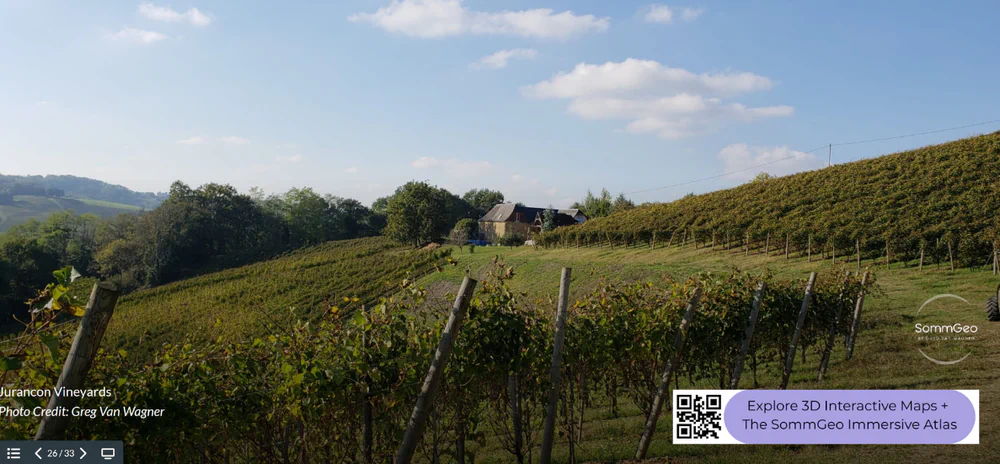
Jurançon is one of France’s great geographic outliers. Tucked into the foothills south of Pau, looking directly at the Pyrenees, the appellation produces dry and sweet whites from Petit Manseng and Gros Manseng that you simply will not find made at this level anywhere else. The sweet wines (Jurançon moelleux) rely not on botrytis but on passerillage: grapes left on the vine into November and December, concentrating sugars through desiccation in the warm foehn winds that funnel through the mountain passes. The dry wines (Jurançon Sec), once an afterthought, have become increasingly serious, with vibrant acidity, exotic aromatics, and a waxy texture that recalls top Alsatian Pinot Gris.
Madiran
If you want to understand Tannat, you start in Madiran. This small appellation in the Gers department, about 150 kilometers (93 miles) southwest of Toulouse, is where Tannat achieves its most complete expression: dark, tannic, and structured reds that demand patience but reward it with complexity. The name is literal; Tannat’s tannin levels are among the highest of any major red grape variety. Historically, the wines were dense to the point of being impenetrable, but modern winemaking (including micro-oxygenation, pioneered here by Patrick Ducournau) has brought balance without sacrificing the grape’s essential character. The best Madiran reds combine dark fruit, spice, and a firm mineral backbone that develops beautifully over a decade or more.
Producers Worth Knowing
Grange des Pères, Languedoc
In the Hérault, it is routinely cited as one of the finest in all of southern France. The red (Syrah, Mourvèdre, Cabernet Sauvignon) and white (Roussanne, Marsanne, Chardonnay) are produced in tiny quantities, sold primarily through a dedicated mailing list, and priced well above anything else in the Languedoc. What sets Grange des Pères apart is precision: the wines have a refinement and restraint that feels more northern Rhône than Mediterranean, with layered aromatics and a structure built for long aging.
Mas de Daumas Gassac, Languedoc
Often called the “Lafite of the Languedoc,” Mas de Daumas Gassac was founded in the 1970s by Aimé Guibert after a geological study revealed that his property near Aniane sat on glacial gravel deposits with exceptional drainage, similar in character to the great graves of the Médoc. The red, a Cabernet Sauvignon-dominant blend, was a provocation at the time: concentrated, age-worthy, and impossible to classify within the Languedoc hierarchy. The estate deliberately declined AOP status, bottling as IGP Pays d’Hérault.
Domaine Cauhapé, Jurançon
Henri Ramonteu’s estate is the modern reference point for Jurançon. The range spans from crisp, aromatic Jurançon Sec (the “Chant des Vignes” bottling) through increasingly rich late-harvest cuvées culminating in the “Quintessence du Petit Manseng,” made from grapes picked berry by berry in December. Cauhapé demonstrated that Jurançon’s sweet wines could compete at the very highest level of French dessert wine, and its dry whites have pushed the appellation’s reputation forward just as forcefully.
Château Montus, Madiran
Alain Brumont’s flagship estate is synonymous with Madiran. Montus, along with its sibling property Château Bouscassé, essentially reinvented the appellation in the 1980s and 1990s, proving that Tannat could produce wines of power and sophistication rather than just density. The top cuvées (Prestige, XL) are 100% Tannat from old vines on clay-limestone soils, aged in new oak, and built for decades. Brumont is also credited with championing micro-oxygenation as a tool for taming Tannat’s formidable tannins without stripping the wine of its character.
Notable Vintages
The Languedoc, Roussillon, and Southwest France benefit from generally consistent Mediterranean and Atlantic-influenced climates, making dramatic vintage variation less of a factor here than in more northerly French regions. The warm, reliable growing seasons mean outright failures are rare. Among standout years, 2020 produced excellent wines with fresh acidity and concentrated aromatics. 2016 was warm and sunny with usefully cool nights, delivering high flavor intensity across reds and whites. 2009 was a warm, smaller-than-average crop with very high quality across the region.
Conversely, 2012 was described as the worst the Languedoc had seen in 22 years, with drought and mildew producing late, uneven ripening. 2007 brought a cool, grey summer that left grapes struggling to reach full maturity.
New to the Tours? Learn how to navigate frames, click pins for detailed producer and region profiles, and get the most from your 3D experience.
Tours Guide →Ready to go deeper into France’s southern wine regions? Join 200+ wine organizations already using SommGeo.
Start Your 15-Day Free Trial $5/month billed annually after trial · Cancel anytime