
USA Wine Regions Map: Interactive Guide to American AVAs
277 AVAs across 34 states. From the fog-shrouded valleys of the Pacific Coast to the hills of Missouri, America’s viticultural landscape is far bigger than Napa.
The United States is the world’s fourth-largest wine producer and home to one of the most geographically diverse viticultural landscapes on the planet. This interactive USA wine regions map lets you explore the full scope of American winemaking, all 277 federally recognized American Viticultural Areas (AVAs) spread across 34 states, from the iconic appellations of California’s North Coast to the volcanic soils of Oregon’s Willamette Valley, the rain-shadow deserts of Washington’s Columbia Valley, and emerging regions most wine professionals still underestimate. What makes American wine geography fascinating isn’t just the famous names. It’s the sheer range of climates, elevations, and soil types compressed into a single country, and an appellation system that, unlike Europe’s, defines regions purely by geography without dictating what you can plant or how you make the wine. Every mapped region includes detailed popup content covering grape varieties, climate and geographic profiles, soil types, and viticulture, a sommelier-level reference built directly into the map.
Unlock the Full SommGeo Toolkit
Gain exclusive access to our entire suite of premium features, including interactive Map Makers, immersive 3D Tours, high-resolution classic Maps, and advanced analytical tools.
Start Free TrialWhat You’ll Explore
This interactive portal maps every major American wine region and AVA designation across the continental United States, but the real depth is in what each region reveals. Click on any mapped AVA and a comprehensive info panel opens with sommelier-level content: dominant grape varieties, climate and geographic profiles, soil composition, and the viticultural specifics that define each appellation. Whether you’re reading about the alluvial benchland soils of Napa’s Rutherford, the basalt-driven vineyards of Washington’s Red Mountain, or the volcanic Jory soils of Oregon’s Dundee Hills, every single mapped region carries this level of built-in intelligence.
- All 277 federally recognized AVAs across 34 states with searchable boundaries
- In-depth AVA profiles for every mapped area: varieties, soils, climate, and more
- California’s nested AVA system from broad North Coast down to individual sub-appellations
- Oregon’s Willamette Valley and its sub-AVAs including Dundee Hills, Eola-Amity Hills, and Chehalem Mountains
- Washington’s Columbia Valley and sub-regions: Red Mountain, Walla Walla, Horse Heaven Hills, and Yakima Valley
- Emerging regions: Finger Lakes, Texas Hill Country, Virginia, and the Willamette-Columbia cross-border AVAs


The AVA System: How America Defines Wine Regions
Understanding American wine starts with understanding the AVA system, and how fundamentally it differs from European appellations. An American Viticultural Area is a federally recognized grape-growing region defined by geographic, geologic, and climatic features. That’s it. Unlike France’s AOC or Italy’s DOCG, an AVA doesn’t dictate which grapes you can plant, how you must train your vines, what yields are acceptable, or how you age the wine. It’s purely a geographic marker. This gives American winemakers extraordinary freedom, and also means the AVA on a label tells you where the grapes grew, but nothing about how the wine was made.
The system launched in 1980 when Augusta, Missouri (not Napa, not Sonoma) became the first designated AVA. Napa Valley followed in January 1981. Today there are 277 AVAs spread across 34 states, with over half (154) concentrated in California. They range from the absurdly large (the Upper Mississippi River Valley AVA covers 19 million acres across four states) to the remarkably small (Cole Ranch in Mendocino County sits on just 62 acres (25 hectares)). The hierarchy of nested AVAs is what trips up most people: a wine labeled “North Coast” is drawing from a much broader area than one labeled “Rutherford,” even though Rutherford sits entirely within the North Coast AVA.
Grape Variety Labeling: The Percentage Game
Here’s where it gets interesting, and where state-level differences matter enormously. Under federal law, a wine labeled with an AVA must contain at least 85% of grapes from that AVA, and a wine labeled with a specific grape variety must contain at least 75% of that variety. So that “Napa Valley Cabernet Sauvignon” on a restaurant list? At minimum, 85% Napa grapes and 75% Cabernet. The remaining percentages are the winemaker’s playground.
Oregon rewrote those rules. The state requires 90% of the named variety for most varietal wines, a deliberate decision by early Willamette Valley pioneers who wanted their Pinot Noir to actually taste like Pinot Noir, not a blending exercise. Oregon also demands that if you put an Oregon AVA on your label, 95% of the grapes must come from that appellation, and 100% must come from Oregon. There are exceptions for 18 traditionally blended varieties (examples include Cabernet Sauvignon, Syrah, Grenache, Zinfandel, Tempranillo, and some Italian varieties), which follow the federal 75% rule, but Pinot Noir is explicitly excluded from any exception. California, meanwhile, requires 100% of grapes from the state for any wine carrying a “California” appellation. These aren’t just bureaucratic details; they fundamentally shape the wines you’ll find from each state.
The Pacific Ocean Effect
If there’s a single geographic force that defines West Coast American wine, from the southernmost vineyards of Santa Barbara to the northernmost plantings in the Puget Sound, it’s the Pacific Ocean. The cold California Current runs south along the entire coastline, dropping surface water temperatures well below what you’d expect for these latitudes. That current drives the fog systems and marine air that define cool-climate California and Oregon viticulture. Without it, Napa would be too hot for Cabernet, and Pinot Noir in the Willamette Valley simply wouldn’t exist.
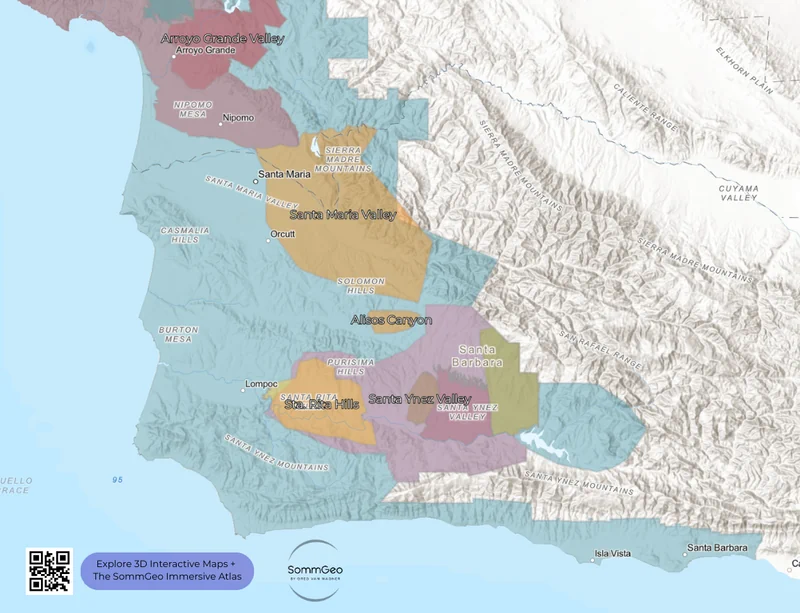
But the ocean’s influence doesn’t penetrate uniformly. Mountain ranges act as gatekeepers. In Oregon, the Coast Range moderates the Willamette Valley but the Cascades block that influence entirely from reaching the Columbia Valley to the east. In California, gaps in the Coast Ranges (particularly the Petaluma Gap, the Golden Gate, and the Transverse Ranges of Santa Barbara) funnel marine air inland, creating pockets of cool-climate viticulture within an otherwise warm state. This is why you can drive 30 minutes from the fog-chilled Sonoma Coast to the heat-baked Alexander Valley and feel like you’ve changed continents. Understanding these corridors and barriers is the key to understanding why American West Coast wine is so varied across such short distances.
Key Wine Regions
California: Napa Valley & the North Coast
Napa Valley is, for better or worse, the center of gravity for American wine. It’s where Cabernet Sauvignon became an international contender (the 1976 Judgment of Paris sealed that), and where some vineyard land now commands prices that rival Burgundy’s Grand Crus. But Napa is a more nuanced place than its reputation suggests. The valley floor, the benchlands, and the mountain AVAs (Howell Mountain, Spring Mountain, Diamond Mountain, Mount Veeder) produce fundamentally different expressions of Cabernet. The valley’s north-south orientation creates a significant temperature gradient; Calistoga at the north end is measurably warmer than Carneros at the south, where San Pablo Bay’s cool maritime air intrudes and Pinot Noir and Chardonnay replace Cabernet.
Beyond Napa, the broader North Coast includes Sonoma County’s staggering diversity, from the fog-drenched Russian River Valley (Pinot Noir and Chardonnay territory) to the warmer Dry Creek Valley (Zinfandel) and Alexander Valley (Cabernet). Mendocino’s Anderson Valley produces world-class sparkling wine and Pinot Noir in one of California’s coolest growing sites. Lake County, increasingly recognized for value-driven Cabernet Sauvignon and Sauvignon Blanc, rounds out a North Coast that holds more stylistic range than most entire countries.
Oregon: The Willamette Valley
The Willamette Valley is the undisputed heart of Oregon wine, and Pinot Noir is its reason for being. David Lett planted the first Pinot Noir here in 1965 at Eyrie Vineyards, and the region’s trajectory since then has been remarkable, from a handful of idealistic pioneers to one of the world’s most respected Pinot Noir regions, with sub-AVAs (Dundee Hills, Eola-Amity Hills, Ribbon Ridge, Chehalem Mountains, Yamhill-Carlton, McMinnville, and Van Duzer Corridor among them) that produce genuinely distinct expressions of the grape.
The valley sits in a north-south trough between the Coast Range to the west and the Cascades to the east. Marine air penetrates through the Van Duzer Corridor and other gaps in the Coast Range, moderating temperatures and extending the growing season. Soils tell the deeper story: the volcanic Jory soils of the Dundee Hills generally yield elegant, higher-toned Pinot Noirs driven by bright red fruit, floral aromatics, and baking spice. Conversely, the fast-draining marine sedimentary Willakenzie soils of Yamhill-Carlton and Ribbon Ridge force vines to struggle, generally producing powerful wines with darker black and blue fruit, robust tannins, and earthy, cola-like depth. Eola-Amity Hills, with its direct wind exposure through the Van Duzer gap, produces some of the most structured, savory Pinots in the valley. Producers like Domaine Drouhin, Eyrie, Martin Woods, Beaux Frères, and Cristom have set the standard, but the depth of quality across the region has never been greater.
Washington State: Columbia Valley & Beyond
Washington is the great misunderstanding of American wine. People associate the state with rain, and western Washington is indeed one of the wettest places in the continental US. But the Cascade Range creates one of the most dramatic rain shadows in North American agriculture. East of the Cascades, the Columbia Valley receives as little as 6–8 inches (152–203 mm) of annual rainfall, with intense sunshine, dramatic diurnal temperature swings (30–40°F (-1–4°C) shifts from day to night), and volcanic and loess soils that give Washington reds their characteristic combination of ripe fruit and natural acidity.
The Columbia Valley AVA contains 99% of Washington’s wine grapes and includes important sub-appellations: Yakima Valley (the state’s oldest AVA, established 1983), Red Mountain (tiny, searingly hot, producing some of the state’s most concentrated Cabernet), Walla Walla Valley (shared with Oregon, known for Syrah and Cabernet), Horse Heaven Hills, Wahluke Slope, and the newer Ancient Lakes AVA. Quilceda Creek, Leonetti Cellar, Cayuse, K Vintners, and L’Ecole N° 41 represent wine that puts Washington on many serious wine consumer’s radar.
Beyond the West Coast
The conversation doesn’t end at the Cascades. New York’s Finger Lakes region has quietly become one of America’s most exciting cool-climate wine zones, producing Rieslings with tension and precision that stand alongside top German examples. Virginia’s wine industry has grown substantially, with Viognier and Bordeaux-variety reds finding genuine expression in the Blue Ridge foothills. Texas Hill Country (the country’s third-largest AVA by area) is a frontier with serious potential despite brutal growing conditions. And Michigan’s Old Mission Peninsula and Leelanau Peninsula AVAs on the shores of Lake Michigan are producing increasingly compelling cool-climate whites. American wine geography is still evolving, and the 277-and-counting AVA list reflects a viticultural landscape that’s nowhere close to being fully mapped.
Ready to explore America’s wine regions in full detail? Join 200+ wine organizations already using SommGeo.
Start Your 15-Day Free Trial $5/month billed annually after trial · Cancel anytime