Burgundy Vineyard Map Maker: Build Custom Climat Maps in 3D
Build custom views of the world’s most celebrated vineyard landscape, from the Kimmeridgean slopes of Chablis to the Grand Cru heart of the Côte d’Or.
The Burgundy Map Maker is an interactive GIS workspace built on SommGeo’s Côte d’Or and Chablis vineyard layers: 32 Grands Crus, 451 Premier Cru climats and 26 village appellations from Marsannay to Maranges, plus Chablis and Petit Chablis, the 40 Chablis Premier Cru climats and the Chablis Grands Crus, each parcel with its own boundary and profile. Load the Grand Cru, Premier Cru or village layer on its own, choose a basemap, tilt the slope in 3D, sketch and label on top, then save the view as an image for study or a presentation. The interactive map is part of SommGeo membership, which starts with a free 15-day trial.
- Vineyards on the map: 32 Côte d’Or Grands Crus, 451 Premier Cru climats and 26 village appellations, plus Chablis, Petit Chablis, 40 Chablis Premiers Crus and the Chablis Grands Crus
- Layers: Grand Cru, Premier Cru and village layers for the Côte d’Or and separate Chablis layers, each as a fill, an outline or a white-label version
- Tools: 2D and 3D views, basemap gallery, layer transparency and labels, interactive legend, sketch and label (2D only), save as image
- Export: Save captures the current view as a downloadable image; untick “Include Legend” for a clean map
- Profiles: Every climat opens a popup with its classification, grapes, geology and aspect; where a Premier Cru sits inside a village, arrows in the popup header step through both
- Slope: The Côte d’Or vineyards climb from about 220 m (720 ft) at the foot of the slope to around 400 m (1,300 ft) at the top, with the Grands Crus mainly between 250 and 300 m (820 and 980 ft)

The Burgundy vineyards map you’ve always wanted to build yourself. Burgundy is the ultimate test case for why geography matters in wine, a region where two vineyards separated by a dirt path can produce radically different wines selling at a tenfold price difference. This Map Maker puts every classified climat at your fingertips in full 3D, letting you rotate, tilt, and zoom through the slopes that define Pinot Noir and Chardonnay at their most site-specific. From the southwest-facing Grand Cru hillside above Chablis to the narrow strip of Premier and Grand Cru vineyards running through the Côte d’Or, you can build exactly the view you need, whether you’re prepping for an exam, planning a visit, or just trying to understand why Montée de Tonnerre keeps getting called the eighth Grand Cru. Every mapped climat includes detailed popup content covering classification, grape varieties, soil profiles, aspect data, a sommelier-level reference built directly into the map.
Unlock the Full SommGeo Toolkit
Gain exclusive access to our entire suite of premium features, including interactive Map Makers, immersive 3D Tours, high-resolution classic Maps, and advanced analytical tools.
Start Free TrialFree to study. Credit when you share it.
Use the map for your own study and tastings. If you share or teach with it, credit it visibly as Map: SommGeo (sommgeo.com). Commercial use requires a license.
See Map Usage, Credit and Licensing for the full terms and the Commercial Embed License.
What You’ll Explore
This Map Maker covers Burgundy’s classified vineyards across Chablis, the Côte de Nuits, and the Côte de Beaune, but the real depth is in what each climat reveals. Click on any mapped vineyard and a comprehensive info panel opens with sommelier-level content: classification level, key producers, soil and geological profiles, aspect and slope data, and the specifics that define each site. Whether you’re reading about the Kimmeridgean limestone driving Chablis Grand Cru, the iron-rich marls of Chambertin, or the white limestone scree of Corton-Charlemagne, every climat on the map carries this level of built-in intelligence. Beyond the content, switch between 2D and 3D views, choose basemaps, toggle vineyard classification layers, and save custom compositions.
- Full 3D terrain with adjustable tilt and rotation. See how slope and aspect actually shape vineyard sites
- In-depth climat profiles for every mapped vineyard: classification, varieties, geology, aspect
- Complete Côte de Nuits vineyard coverage from Marsannay through Nuits-Saint-Georges and Prémeaux-Prissey
- 40 basemap options- including satellite imagery, topographic contours, and clean outline views
- Switchable vineyard layers with classification-level color coding (Grand Cru, Premier Cru, Village)
- Save and download custom map views for study, presentations, or personal reference

Geography and Vineyard Identity of Burgundy
Burgundy’s genius (and its maddening complexity) comes down to one concept: the climat. A climat is a precisely delimited vineyard parcel defined by its unique combination of soil, slope, aspect, altitude, and microclimate. Nowhere else in the wine world has this idea been taken to such extremes. The UNESCO World Heritage designation awarded to Burgundy’s climats in 2015 wasn’t ceremonial; it was an acknowledgment that this landscape represents the most detailed expression of site-specific viticulture ever developed.
The underlying geology ties everything together. Jurassic-era limestone forms the bedrock across the region, but the specifics vary enormously. In Chablis, it’s the famous Kimmeridgean limestone (clay-rich marl studded with fossilized oyster shells (Exogyra virgula) dating back 150 million years) that gives the wines their characteristic mineral bite and steely structure. On the Côte d’Or, the picture is more complex: Bajocian and Bathonian limestones, mixed with varying ratios of clay, iron-rich marls, and alluvial deposits washed down from the plateau through the combes (valley cuts) that punctuate the escarpment. These combes are critical; they channel cool air, deposit specific soil types at their mouths, and create the microclimatic variations that distinguish one commune from the next.
Aspect and altitude are the other defining factors. The Côte d’Or escarpment faces predominantly east to southeast, and the Grand Cru vineyards almost universally occupy the mid-slope sweet spot, high enough for excellent drainage and air circulation, low enough to avoid the cold and thin soils near the hilltop. In Chablis, the calculus is different: the Grand Crus all sit on a single southwest-facing hillside, and the Premier Crus fan out along the Serein River valley and its tributaries, where aspect and bank position (right versus left) create meaningful stylistic differences.
A Sample of Villages and Vineyards
Chablis: Right Bank vs. Left Bank
You’ll often hear discussion of “Right-Bank” and “Left-Bank” Premier Crus of Chablis, and the distinction is more than academic. The Serein River flows roughly south to north through the heart of the appellation, and where a vineyard sits in relation to it defines its character. The right (eastern) bank is home to all seven Grand Cru climats on their famous southwest-facing slope overlooking the town, and many of the most prestigious Premier Crus (Montée de Tonnerre, Fourchaume, Mont de Milieu, Vaucoupin) share similar geology and exposure. Right-bank wines tend toward power, mineral complexity, and nutty, steely depth. Left-bank Premier Crus like Vaillons, Montmains, and Vosgros sit on east-facing slopes with different ratios of limestone and clay, producing wines that are more floral, lighter in body, and driven by a peachy, bright-fruit character.
The Map Maker’s 3D terrain view makes the right-bank/left-bank divide immediately visible. Rotate the view to see how the Grand Cru hillside catches the afternoon sun while left-bank vineyards across the valley face the cooler morning light. Montée de Tonnerre, sitting immediately adjacent to the Grand Cru slope, shares nearly identical geology and exposure, which is why producers like Louis Michel, William Fèvre, and Raveneau regularly produce wines from this site that rival the Grand Crus in quality and price. Some argue it’s the unofficial eighth Grand Cru, and in 3D you can see exactly why.
Morey-Saint-Denis: Five Grand Crus in 1.5 Kilometers
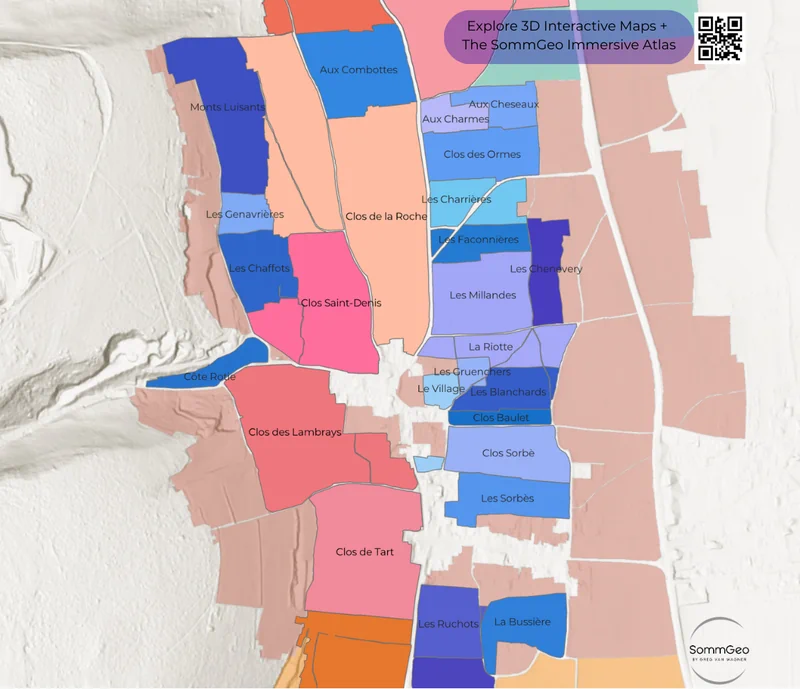
Morey-Saint-Denis is Burgundy’s quiet overachiever. Squeezed between the more famous communes of Gevrey-Chambertin to the north and Chambolle-Musigny to the south, it holds five Grand Crus (Clos de la Roche, Clos Saint-Denis, Clos des Lambrays, Clos de Tart, and the northern portion of Bonnes-Mares) in a commune that stretches barely 1.5 kilometers (~1 mile) from end to end. For decades, much of Morey’s production was sold under the labels of its more marketable neighbors, which kept prices relatively low and the village under the radar. That’s changing.
Clos de la Roche (16.9 hectares (22 acres)) is generally considered the finest of the group: a wine of structure, mineral depth, and serious aging potential. Domaine Ponsot holds the largest and best-situated parcels and remains the benchmark, with Domaine Dujac’s 1.95-hectare holding producing a more elegant interpretation. Clos de Tart (7.53 hectares (131 acres)) is notable as Burgundy’s largest Grand Cru monopole, a true walled vineyard owned since 2018 by the Pinault family (who also own Château Latour). And Clos Saint-Denis, the vineyard that gave the commune its hyphenated name, produces a silkier, more fruit-driven style that sits somewhere between Gevrey’s power and Chambolle’s perfume. The 2D outline view in the Map Maker is particularly useful here for seeing how these five Grand Crus line up in a neat band across the mid-slope, with 20 Premier Cru vineyards filling in below.
Nuits-Saint-Georges: The Commune Without a Grand Cru
Nuits-Saint-Georges is the largest town on the Côte de Nuits and gives the entire subregion its name, yet it contains no Grand Cru vineyards, a historical quirk that says more about politics than quality. With 41 Premier Cru climats spread across some 147 hectares (363 acres), several of its top sites (Les Saint-Georges, Les Vaucrains, Les Cailles) produce wines that sometimes compete with Grand Cru bottlings from neighboring communes. Les Saint-Georges, the 7.5-hectare vineyard whose name was appended to the town in 1892, has the strongest case for promotion, and there’s an active push from within the commune to make it happen.
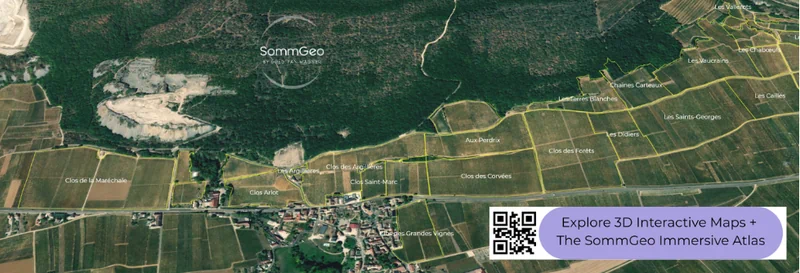
The town itself sits on the Meuzin valley, which splits the appellation into two distinct zones. To the north, vineyards bordering Vosne-Romanée produce more refined, elegant wines; Aux Boudots and Les Chaignots share something of Vosne’s floral finesse. South of town, the Premier Crus become broader, more structured, and longer-lived, with Les Saint-Georges, Les Vaucrains, and Clos des Corvées among the most powerful wines on the Côte de Nuits. The appellation also extends into the commune of Prémeaux-Prissey, where monopole vineyards like Clos de la Maréchale (Domaine Jacques-Frédéric Mugnier) and Clos Arlot produce wines of understated elegance. Domaine Henri Gouges, Robert Chevillon, and Domaine de l’Arlot are essential producers to know here.
New to the Map Makers? Explore all the tools, tips, and features in our complete walkthrough.
Map Maker Guide →Grands Crus and villages you can build with
Every Grand Cru and village appellation on the Map Maker, as drawn on the Burgundy layers. The Premier Cru layers add all 451 Côte d’Or climats and the 40 of Chablis; load any layer from the legend and click a parcel for its profile.
| Name | Village | Color |
|---|---|---|
| Chablis | ||
| Petit Chablis | Chablis area | White |
| Chablis | Chablis area | White |
| Chablis Premier Cru (40 climats) | Chablis area | White |
| Blanchot | Chablis Grand Cru | White |
| Bougros | Chablis Grand Cru | White |
| Grenouilles | Chablis Grand Cru | White |
| Les Clos | Chablis Grand Cru | White |
| Preuses | Chablis Grand Cru | White |
| Valmur | Chablis Grand Cru | White |
| Vaudésir | Chablis Grand Cru | White |
| Côte de Nuits Grand Crus | ||
| Chambertin | Gevrey-Chambertin | Red |
| Chambertin-Clos de Bèze | Gevrey-Chambertin | Red |
| Chapelle-Chambertin | Gevrey-Chambertin | Red |
| Charmes-Chambertin | Gevrey-Chambertin | Red |
| Griotte-Chambertin | Gevrey-Chambertin | Red |
| Latricières-Chambertin | Gevrey-Chambertin | Red |
| Mazis-Chambertin | Gevrey-Chambertin | Red |
| Mazoyères-Chambertin | Gevrey-Chambertin | Red |
| Ruchottes-Chambertin | Gevrey-Chambertin | Red |
| Clos de la Roche | Morey-Saint-Denis | Red |
| Clos Saint-Denis | Morey-Saint-Denis | Red |
| Clos des Lambrays | Morey-Saint-Denis | Red |
| Clos de Tart | Morey-Saint-Denis | Red |
| Bonnes-Mares | Chambolle-Musigny and Morey-Saint-Denis | Red |
| Musigny | Chambolle-Musigny | Red and white |
| Clos de Vougeot ou Clos Vougeot | Vougeot | Red |
| Echezeaux | Flagey-Echezeaux | Red |
| Grands-Echezeaux | Flagey-Echezeaux | Red |
| Richebourg | Vosne-Romanée | Red |
| Romanée-Conti | Vosne-Romanée | Red |
| La Romanée | Vosne-Romanée | Red |
| La Tâche | Vosne-Romanée | Red |
| Romanée-Saint-Vivant | Vosne-Romanée | Red |
| La Grande Rue | Vosne-Romanée | Red |
| Côte de Beaune Grand Crus | ||
| Corton | Aloxe-Corton, Ladoix-Serrigny, Pernand-Vergelesses | Red (some white) |
| Corton-Charlemagne | Aloxe-Corton, Ladoix-Serrigny, Pernand-Vergelesses | White |
| Charlemagne | Aloxe-Corton, Pernand-Vergelesses | White |
| Montrachet | Puligny-Montrachet and Chassagne-Montrachet | White |
| Chevalier-Montrachet | Puligny-Montrachet | White |
| Bâtard-Montrachet | Puligny-Montrachet and Chassagne-Montrachet | White |
| Bienvenues-Bâtard-Montrachet | Puligny-Montrachet | White |
| Criots-Bâtard-Montrachet | Chassagne-Montrachet | White |
| Côte de Nuits villages | ||
| Marsannay | Village appellation | Red, white, rosé |
| Fixin | Village appellation | Red, white |
| Gevrey-Chambertin | Village appellation | Red |
| Morey-Saint-Denis | Village appellation | Red, white |
| Chambolle-Musigny | Village appellation | Red |
| Vougeot | Village appellation | Red, white |
| Vosne-Romanée | Village appellation | Red |
| Nuits-Saint-Georges | Village appellation | Red, white |
| Côte de Beaune villages | ||
| Ladoix | Village appellation | Red, white |
| Aloxe-Corton | Village appellation | Red, white |
| Pernand-Vergelesses | Village appellation | Red, white |
| Savigny-lès-Beaune | Village appellation | Red, white |
| Chorey-lès-Beaune | Village appellation | Red, white |
| Beaune | Village appellation | Red, white |
| Pommard | Village appellation | Red |
| Volnay | Village appellation | Red |
| Monthélie | Village appellation | Red, white |
| Auxey-Duresses | Village appellation | Red, white |
| Saint-Romain | Village appellation | Red, white |
| Meursault | Village appellation | White, red |
| Blagny | Village appellation | Red |
| Puligny-Montrachet | Village appellation | White, red |
| Chassagne-Montrachet | Village appellation | White, red |
| Saint-Aubin | Village appellation | White, red |
| Santenay | Village appellation | Red, white |
| Maranges | Village appellation | Red, white |
Hopefully this index is useful on its own. To explore these regions interactively, with every boundary on real terrain and a full profile for each, start a 15-day free trial. To see what one of these maps is like first, a different map is unlocked for everyone every day. For ready-made views of the same vineyards, see the Burgundy Fast Map, the Côte d’Or 3D Fast Map and the Chablis 3D Fast Map; the Map Maker Guide walks through every tool.
Burgundy Map Maker: Frequently Asked Questions
How is the Map Maker different from the Burgundy Fast Map?
The Fast Map shows every classified vineyard at once with a profile a click away. The Map Maker gives you the same climats as separate layers over a basemap you choose, so you can show the Grands Crus alone, add the Premiers Crus of a single village, strip the labels for a blind test or draw your own notes on the slope, then save the result. Same data, your composition.
Can I show only the Grands Crus?
Yes. Turn on the Grand Cru layer and leave the Premier Cru and village layers off, and the 32 Côte d’Or Grands Crus sit as a thin chain from Gevrey-Chambertin to Corton and the Montrachets with nothing around them. Add the village layer underneath to see how each Grand Cru relates to its commune, or switch to the white-label layers for a clean export.
Are the Premiers Crus drawn individually?
Yes, all 451 Premier Cru climats of the Côte d’Or and the 40 of Chablis, each its own clickable parcel with a profile. The index above lists the Grands Crus and villages and counts the Premiers Crus to keep it readable; on the map you can load a village’s Premiers Crus and read each one. Chablis sits on its own layers: Chablis and Petit Chablis, the Premiers Crus and the Grands Crus.
Can I download the map I build?
Yes. Save captures the current view, sketches and labels included, as an image you can drop into slides, a handout or a study sheet. Untick “Include Legend” for a cleaner export. Sketching works in 2D, so build annotated views flat and switch to 3D for terrain shots. The Map Maker Guide walks through each tool.
Is the Burgundy Map Maker free?
The region index on this page is free to use. The Map Maker itself, with its layers, tools and a full profile for every region, is part of SommGeo membership, which starts with a free 15-day trial. If you want a feel for what one of these maps is like before signing up, SommGeo unlocks one map every day on a rotation, different every day, no signup needed. Today’s unlocked map is on the home page.
Ready to explore Burgundy’s vineyards in full 3D with interactive layers, elevation data, and vineyard boundaries? Join 200+ wine organizations already using SommGeo.
Start Your 15-Day Free Trial $5/month billed annually after trial · Cancel anytimeMap by Greg Van Wagner, SommGeo
Please let us know what you think in the form below. Thanks!