
Greece Wine Map Maker: Interactive 3D Guide
From volcanic Santorini to the Xinomavro heartland of Naoussa. Mapping the birthplace of European wine culture in full 3D.
Greece is where European wine began, and it’s not even close. Archaeological evidence dates winemaking here to at least 6,500 years ago, making it one of the oldest wine-producing territories on the planet. But here’s what makes Greece genuinely exciting right now: after decades of being dismissed as retsina country, the modern Greek wine revolution has produced some of Europe’s most compelling wines from an almost absurd wealth of indigenous grape varieties, roughly 200 distinct types, with about 60 in serious commercial production. Across 33 PDO designations and 114 PGIs, the geographic diversity is staggering, from the continental foothills of Macedonia to the windswept volcanic caldera of Santorini, from the high-altitude plateaus of the Peloponnese to the sun-drenched slopes of Crete. This Greece wine regions Map Maker lets you explore every PDO, every major vineyard zone, and the dramatic topography behind these wines in full interactive 3D. Every mapped region includes detailed popup content covering indigenous grape varieties, climate and geographic profiles, soil types, a sommelier-level reference built directly into the map.
Unlock the Full SommGeo Toolkit
Gain exclusive access to our entire suite of premium features, including interactive Map Makers, immersive 3D Tours, high-resolution classic Maps, and advanced analytical tools.
Start Free TrialFree to study. Credit when you share it.
Use the map for your own study and tastings. If you share or teach with it, credit it visibly as Map: SommGeo (sommgeo.com). Commercial use requires a license.
See Map Usage, Credit and Licensing for the full terms and the Commercial Embed License.
What You’ll Explore
The Greece Map Maker puts full 3D control in your hands, but the real depth is in what each region reveals. Click on any mapped PDO and a comprehensive info panel opens with sommelier-level content: indigenous grape varieties, climate and geographic profiles, soil composition, the viticultural specifics that define each appellation. Whether you’re reading about Santorini’s volcanic ash soils and basket-trained Assyrtiko, the Xinomavro clones driving Naoussa’s age-worthy reds, or Nemea’s Agiorgitiko at varying altitudes, every mapped region carries this level of built-in intelligence. Beyond the content, you can rotate terrain, switch between satellite imagery, topographic relief, and stylized basemaps, and zoom into individual PDO boundaries.
- All 33 Greek PDO wine appellations with toggleable boundary layers
- In-depth appellation profiles for every mapped area: indigenous varieties, soils, climate
- 40 basemap options: satellite, terrain, hillshade, and stylized views like the “Color Pencil” rendering
- Built-in measurement tools for calculating distances and areas between wine zones
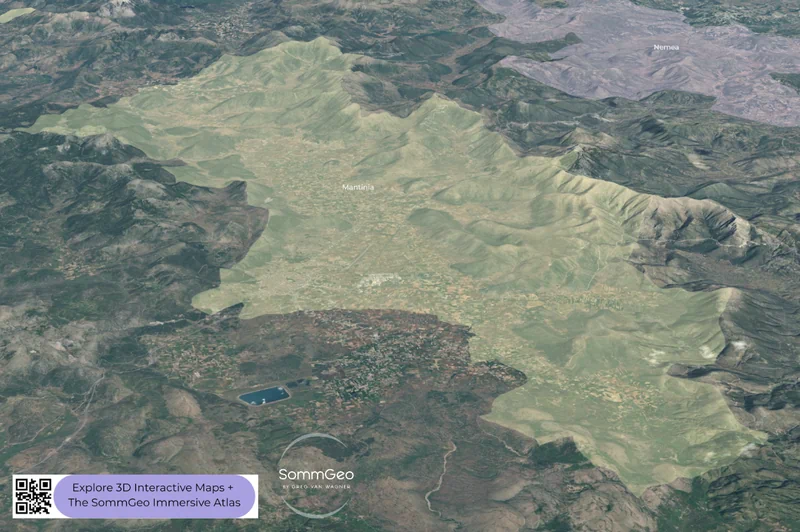
- Peloponnese detail: Nemea, Mantinia, Patras, and Monemvasia-Malvasia PDOs
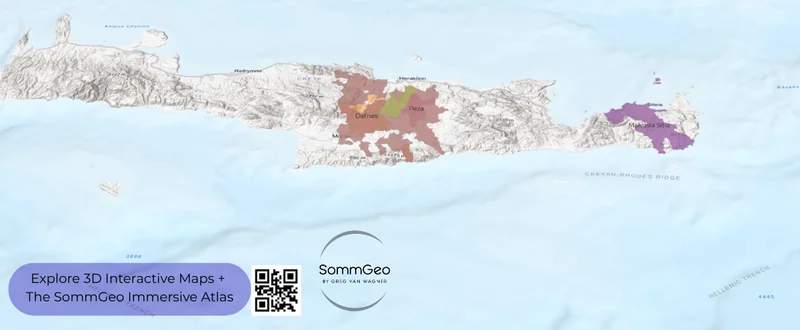
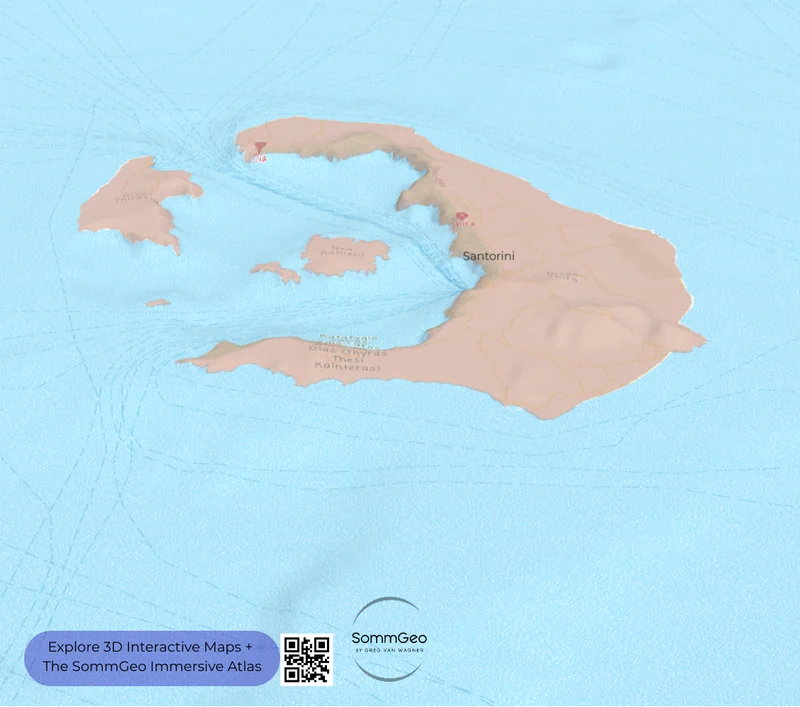
- Island coverage: Santorini, Crete (Peza, Archanes, Dafnes, Sitia), Samos, Rhodes, Cephalonia, and Paros
Geography and Site Character of Greece
Greece’s viticultural genius comes down to one thing: altitude. In a country most people associate with sun-baked beaches, many of the best vineyards sit at elevations between 300 and 800 meters (984–2,625 ft), where the wide diurnal temperature shifts (hot days followed by cool nights) slow ripening, preserve acidity, and produce wines with a freshness that surprises anyone expecting flabby Mediterranean whites. This single geographic fact explains why Assyrtiko from Santorini can maintain razor-sharp acidity at 13.5% alcohol, and why Xinomavro from Naoussa ages with the structure and complexity of Nebbiolo.
The topography is relentlessly mountainous. The Pindos range runs like a spine through the mainland, creating rain shadows, channeling winds, and generating an enormous patchwork of mesoclimates within short distances. In Macedonia, Mount Vermion shelters Naoussa from cold Balkan winds while pulling cool Aegean breezes through the foothills, creating a surprisingly continental climate for a Mediterranean country. In the Peloponnese, the high plateaus of Mantinia and the hillside vineyards of Nemea benefit from similar elevation-driven cooling. And then there are the islands, each a geological world unto itself: Santorini’s volcanic pumice and basalt, Cephalonia’s fractured limestone slopes beneath Mount Ainos, Crete’s massive mountain ranges creating entirely separate growing zones on north and south faces.
Soil diversity is equally dramatic. Volcanic substrates on Santorini (where phylloxera never took hold, leaving ungrafted vines with root systems potentially centuries old), limestone and clay in Macedonia’s foothills, schist and slate on certain Aegean islands, and deep alluvial deposits in the plains. The interaction of all these variables (altitude, aspect, soil type, maritime versus continental influence) is what makes Greek wine so varied and so impossible to reduce to simple generalizations.
Key Wine Regions
Naoussa & Macedonia
Naoussa is, without exaggeration, the most important red wine appellation in Greece. Created in 1971 as the country’s very first official PDO, it set the template for the entire Greek appellation system. The wines are 100% Xinomavro (no blending partners allowed) and the best examples are structured, savory reds with high acidity, firm tannins, and extraordinary aging potential. The comparison to Nebbiolo and Barolo comes up constantly, and while DNA has disproven any genetic link, the parallels are striking: both occupy limestone-rich mountain foothills, both fade to brick-garnet early, and both reward patience with complexity that unfolds over decades.
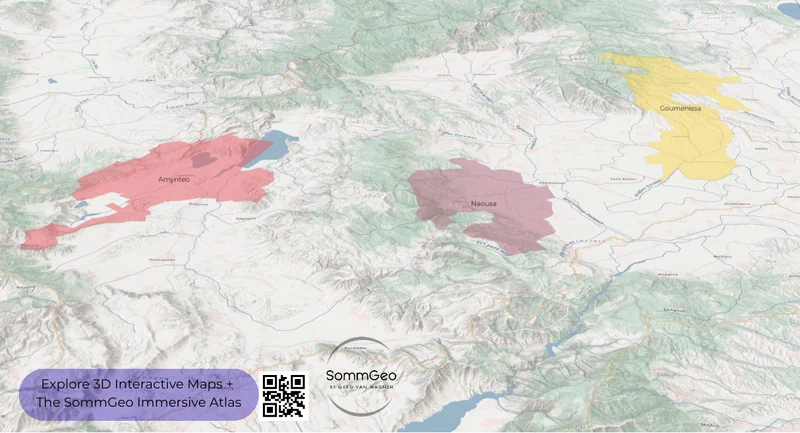
The vineyards sit on the eastern slopes of Mount Vermion at elevations between 150 and 350 meters (492–1,148 ft), with the best sites on south and southeast-facing exposures. The climate here is genuinely continental: cold winters (there are ski resorts on the Vermion range), hot summers, and significant diurnal shifts. Producers like Kir-Yianni (whose estate in Yianakohori was planted in 1970 and was instrumental in the region’s revival), Thymiopoulos (biodynamic since 2009), Dalamara, and Chrisohoou are making wines that have wine professionals globally paying attention. Nearby, PDO Amynteo (the coldest appellation in Greece) produces Greece’s only PDO rosé from Xinomavro, while PDO Goumenissa requires a blend of Xinomavro with the native Negoska.
Santorini & the Cyclades
Santorini is one of the most singular wine islands on earth. The volcanic eruption of approximately 1630 BC created the dramatic caldera landscape we see today, and the resulting soils (pumice, volcanic ash, basalt, and andesite) are what make this place so extraordinary. Phylloxera simply cannot survive in these sandy, calcium-poor volcanic substrates, which means the vines here are ungrafted and self-rooted, with some root systems estimated to be several hundred years old. It’s the oldest continuously cultivated vineyard in Greece, and one of the oldest in the world.
The signature grape is Assyrtiko, accounting for roughly 70% of plantings and required at a minimum of 85% in dry PDO Santorini wines (with Athiri and Aidani permitted for the balance). To protect the grapes from the relentless meltemia winds and intense sun, growers developed the kouloura, a basket-shaped vine training system where shoots are woven into low, circular formations hugging the ground. It’s an ancient technique found nowhere else, and it’s one reason Santorini was included in Greece’s National Index of Intangible Cultural Heritage. The wines themselves are powerful, mineral-driven whites with citrus and saline character, capable of aging far longer than most white wines. The island also produces Vinsanto, a sun-dried sweet wine of extraordinary depth, and increasingly impressive reds from the rare Mavrotragano variety.
The Peloponnese: Nemea & Mantinia
The Peloponnese is the largest vineyard area in Greece, responsible for roughly 31% of the country’s wine production, and it’s anchored by two flagship PDOs that every wine professional should know. Nemea is the red wine story: 100% Agiorgitiko, sometimes called “St. George’s grape,” producing wines that range from soft, approachable everyday reds to serious, oak-aged bottlings with real structure and aging potential. The best Nemea vineyards sit at higher elevations where cooler temperatures preserve the acidity that gives these wines their balance.
Mantinia is the white counterpart, a high-altitude plateau at roughly 650 meters (2,133 ft) in the heart of the Peloponnese, where Moschofilero (a pink-skinned grape) produces aromatic, crisp whites with distinctive floral notes of orange blossom and rose. These are wines that deserve far more attention than they get. Around Patras in the northwest, you’ll find three additional PDOs dedicated to sweet wines: Muscat of Patras, Muscat of Rion, and the famous Mavrodaphne of Patras, a fortified wine with rich, complex character.
Crete
Crete produces over 10% of all Greek wine, and the island’s sheer size (it’s the fifth largest island in the Mediterranean) means it contains dramatic internal variety. Four PDOs dot the landscape: Peza, Archanes, Dafnes, and Sitia, each positioned at different elevations and aspects along the island’s mountainous spine. The indigenous varieties here are genuinely distinctive. Vidiano (white) has emerged as one of Greece’s most exciting rediscoveries, while Kotsifali and Liatiko (both red) produce wines with character and joy. Liatiko, one of the oldest Greek varieties, is increasingly recognized for its potential in both dry and sweet styles; the PDO Dafnes designation requires a minimum of 80% Liatiko. The island’s viticultural history stretches back millennia, and the Venetian merchants who once exported Cretan Malvasia across Europe recognized what modern producers are now rediscovering.
The Ionian Islands: Cephalonia
Cephalonia deserves a mention for Robola alone. This white grape thrives on the island’s fractured limestone slopes beneath Mount Ainos, at elevations up to 800 meters (2,625 ft), producing zesty, mineral-driven wines with bright acidity and subtle citrus notes. PDO Robola of Cephalonia is a designation worth seeking out; these are wines with real site character and a sense of place that’s immediately compelling. The Ionian Islands’ position on Greece’s west coast, facing Italy across the sea, gives them a slightly more humid climate distinct from the drier, sun-baked Aegean islands to the east.
New to the Map Makers? Explore all the tools, tips, and features in our complete walkthrough.
Map Maker Guide →Ready to explore Greece’s wine regions in full 3D? Join 200+ wine organizations already using SommGeo.
Start Your 15-Day Free Trial $5/month billed annually after trial · Cancel anytimePlease let us know what you think in the form below. Thanks!