
New Zealand Wine Regions Map: Interactive Guide
From Marlborough’s popular Sauvignon Blanc to Central Otago’s Pinot Noir. Mapping the rise of one of the New World’s most successful wine exporting countries.
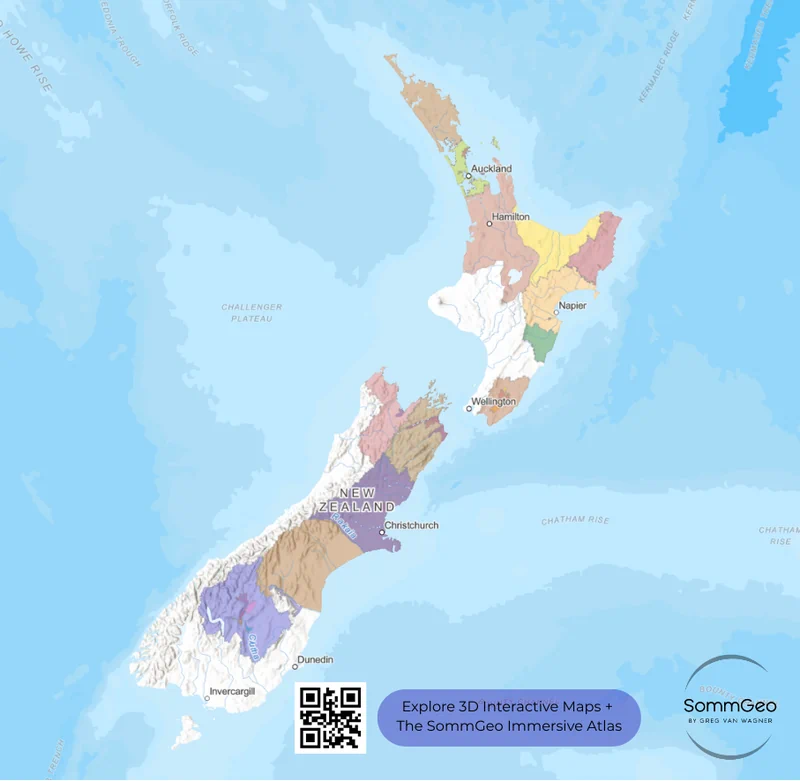
New Zealand’s wine regions map tells one of the most remarkable stories in modern winemaking. In barely four decades, a country with no serious viticultural reputation transformed itself into a global force, largely on the back of a single grape variety from a single region. Marlborough Sauvignon Blanc didn’t just put New Zealand on the wine map; it redefined what that grape could be. But the story runs far deeper than that. Across 42,000 hectares of vineyard stretching from subtropical Northland to the Southern Alps of Central Otago (one of the world’s most southerly wine regions), New Zealand produces wines of broad diversity from an almost entirely maritime climate. No vineyard sits more than 120 kilometers (75 miles) from the ocean. This interactive New Zealand wine regions map lets you explore every GI, key sub-regions, and geographic influence shaping these wines, and every mapped region includes detailed popup content covering grape varieties, climate and geographic profiles, soil types, and viticulture, putting a complete wine reference directly inside the map.
Unlock the Full SommGeo Toolkit
Gain exclusive access to our entire suite of premium features, including interactive Map Makers, immersive 3D Tours, high-resolution classic Maps, and advanced analytical tools.
Start Free TrialWhat You’ll Explore
This interactive portal maps New Zealand’s wine regions across both islands, but the real value is in what each region reveals when you click it. Every mapped area opens a comprehensive info panel with sommelier-level content: dominant grape varieties with planting context, climate and geographic profiles, soil composition, key producers, and the viticultural specifics that define each region’s wines. Whether you’re reading about Marlborough’s greywacke river gravels and their role in Sauvignon Blanc’s signature intensity, the schist soils driving Central Otago’s Pinot Noir, or the maritime influence shaping Hawke’s Bay’s Gimblett Gravels, every single region on the map carries this depth of built-in intelligence.
- All major Geographical Indications across both North and South Islands
- In-depth region profiles for every mapped area: varieties, soils, and climate
- Marlborough’s Wairau and Awatere Valley sub-regions with topographic context
- Central Otago’s six sub-regions: Gibbston, Bannockburn, Bendigo, Cromwell Basin, Wānaka, and Alexandra
- Hawke’s Bay and its Gimblett Gravels wine-growing district
- North Island regions from Martinborough’s compact valley to Waiheke Island’s maritime-influenced slopes


A Brief History of New Zealand Wine
New Zealand’s viticultural timeline is short but intense. The Reverend Samuel Marsden planted the country’s first recorded grapevines at the Bay of Islands in 1819, a vineyard that was promptly destroyed by goats. James Busby, the British Resident who would later co-author the Treaty of Waitangi, produced the country’s first recorded wine at Waitangi in the 1830s. French explorer Dumont d’Urville tasted an early vintage in 1840 and described it as “a light white wine, very sparkling, and delicious to taste.” Mission Estate, established by Marist missionaries in Hawke’s Bay in 1851, remains the country’s oldest surviving winery.
For the next century, the story is one of fits and starts. Croatian immigrants (then called Dalmatians) planted vines around Auckland and formed the backbone of early commercial winemaking. Romeo Bragato, an Italian viticulturist hired by the government in the 1890s, surveyed the country and confirmed its potential, even identifying Central Otago as suitable for fine wine. But prohibitionist politics, cheap imports, and a beer-drinking culture conspired against real progress. As late as the 1960s, New Zealand’s annual wine production was a modest 4 million liters, much of it forgettable.
Everything changed in the 1970s and 1980s. Montana Wines (now Brancott Estate, owned by Pernod Ricard) planted Marlborough’s first vineyards in 1973 and released its first Sauvignon Blanc in 1979. By 1985, Cloudy Bay’s debut vintage had captured international attention and effectively rewired how the world thought about Sauvignon Blanc. The industry grew by 17% annually from 2000 to 2020, and today New Zealand’s 42,000 hectares produce wines exported to over 100 countries, with 90% of all production heading overseas.
Marlborough Sauvignon Blanc
Let’s be direct: Marlborough Sauvignon Blanc is the engine that drives New Zealand’s entire wine economy. With over 30,000 hectares (roughly 72% of the country’s total vineyard area), Marlborough is dominant to a degree that would make Bordeaux blush. And within Marlborough, Sauvignon Blanc accounts for about 85% of plantings. The variety alone makes up around 67% of all New Zealand vineyard area and the overwhelming majority of exports. It’s a one-grape, one-region phenomenon unlike anything else in the wine world.
What makes it work is geography. Marlborough sits at the northern tip of the South Island, protected from prevailing westerly winds by the Richmond Ranges. The Wairau Valley (the larger and warmer of Marlborough’s two main sub-regions) produces the classic style: pungent, expressive wines with explosive gooseberry, passionfruit, and cut-grass aromatics backed by driving acidity. The Awatere Valley, further south and cooler, tends toward a more herbaceous, mineral profile. The region’s free-draining alluvial soils, high sunshine hours, and cool nights create the intense aromatics and natural acidity that define the style.
Producers like Greywacke, Dog Point, and Clos Henri are making oak-aged Sauvignon Blancs, and sub-regional distinctions between the Wairau and Awatere are increasingly recognized. But make no mistake: the entry-level, tank-fermented, screw-capped Marlborough Sauvignon Blanc remains one of the most commercially successful wine categories on the planet.
Beyond Sauvignon Blanc: Grape Varieties
While Sauvignon Blanc commands the headlines (and the hectares), New Zealand’s grape variety story is considerably more interesting than its reputation suggests. Pinot Noir is the second most significant variety at over 5,300 hectares (roughly 13% of total plantings) and arguably the more exciting conversation for serious wine enthusiasts. It thrives in Marlborough, Martinborough, and above all Central Otago, producing wines with concentration and depth.
Chardonnay, once the country’s most planted variety before Sauvignon Blanc overtook it in 2002, produces excellent wines in Hawke’s Bay and Gisborne, the latter sometimes called “the Chardonnay capital.” Pinot Gris has seen rapid growth, particularly in Central Otago and Marlborough, often made in a richer, Alsatian style. Riesling punches above its small planting weight in Marlborough and Nelson, offering everything from bone-dry to lusciously sweet. And in the warmer climates of Hawke’s Bay, Bordeaux-style blends of Merlot and Cabernet Sauvignon produce structured reds; Te Mata Estate’s Coleraine, first released in 1982, remains a benchmark for what New Zealand can do with these varieties. Syrah from Hawke’s Bay, particularly from the Gimblett Gravels district, is increasingly garnering serious critical attention.
The Screwcap Revolution
New Zealand didn’t invent the screwcap, but it arguably did more than any other country to make it commonplace. In 2001, a group of Marlborough winemakers (frustrated by cork taint affecting an estimated 5–10% of bottles) launched the New Zealand Screwcap Wine Seal Initiative. Led by producers including Lawson’s Dry Hills, Forrest Estate, Jackson Estate, and Foxes Island, with Michael Brajkovich MW of Kumeu River as chair, they commissioned research that confirmed screwcaps as a superior closure for preserving their wine’s freshness and consistency.
The adoption was rapid and, at times, contentious. Not everyone was on board; some winemakers saw screwcaps as undermining the perceived quality of their wines, and sommeliers mourned the loss of the cork-pull ceremony. But the science was compelling, and New Zealand’s export-driven industry had a powerful incentive: wines sealed under screwcap arrived in London, New York, and Sydney tasting exactly as the winemaker intended. Today, approximately 98% of New Zealand wine is sealed with screwcaps, the highest adoption rate of any country on Earth. The move helped normalize screwcaps globally and stands as one of New Zealand’s most significant contributions to modern winemaking practice.
Central Otago Pinot Noir
If Marlborough Sauvignon Blanc is New Zealand’s commercial powerhouse, Central Otago Pinot Noir is its more elevated play. Situated in the rain shadow of the Southern Alps on the South Island, Central Otago is New Zealand’s only area with a genuinely continental climate. Vineyards sit at around 200–420 meters (656-1377 ft) elevation, protected from maritime influence by mountains rising to nearly 3,700 meters (12,139 ft). The result is hot, dry summers, cold winters, and dramatic diurnal temperature shifts that build intensity and structure in Pinot Noir.
The region’s wine history is surprisingly old. French gold miner Jean Desire Feraud planted vines near Alexandra in the 1860s and won medals at Australian competitions. Romeo Bragato identified the region’s potential in the 1890s. But modern commercial viticulture didn’t begin until the late 1970s and early 1980s, when pioneers like Rippon, Chard Farm, and Gibbston Valley planted the first vines, and most people thought they were out of their minds. Since then, the region has expanded to over 1,900 hectares across six distinct sub-regions.
Bannockburn, where Felton Road and Mt. Difficulty have established themselves as benchmarks, produces dense, concentrated wines from sandy silt loams and schist. Gibbston, the highest and coolest sub‑region at roughly 320–420 meters, tends to give lighter, more ethereal Pinot Noir. Bendigo, east of Lake Dunstan, is among the warmest areas, producing more full‑bodied, tannic styles. Wānaka at the northern edge offers elegant, bright‑fruited wines from producers like Rippon and Maude. Alexandra, the most southerly sub‑region, is known for fragrant aromatics and often shows a distinctive wild thyme note in its Pinot Noir.. The soils across Central Otago (schist, mica, loess, alluvial gravels) are geologically young and mineral-rich, and the variation even within a single vineyard can be remarkable. Felton Road’s Blair Walter has noted up to ten different soil types along a single three-kilometer (1.86 miles) stretch of road in Bannockburn.
The style of Central Otago Pinot Noir has evolved significantly over the past decade. Earlier vintages tended toward bigger, darker, more extracted wines, impressive but sometimes heavy-handed. The current generation of winemakers is pushing toward elegance and restraint, allowing site character to speak more clearly. With the oldest vines in the region barely exceeding 25 years, there’s a strong argument that Central Otago hasn’t yet shown its full potential. The best is very likely still ahead.
New to the Fast Maps? Learn how to search regions, navigate layers, and get the most from your interactive map.
Fast Map Guide →Ready to explore New Zealand’s wine regions in full detail? Join 200+ wine organizations already using SommGeo.
Start Your 15-Day Free Trial $5/month billed annually after trial · Cancel anytime