
California Wine Tour: Napa, Sonoma, Central Coast & AVAs in 3D
1,300 kilometers (808 miles) of Pacific coastline, fog gaps that define every major AVA, and a grape-growing diversity matched by no other state.
Almost everything about California wine comes back to the Pacific Ocean. The California Current pulls frigid water south from British Columbia, keeping the offshore temperature below 18°C (64°F) even in summer. As hot air rises in the Central Valley, it creates a vacuum that draws cold marine air and fog inland through every gap in the coastal ranges: the Petaluma Gap, the Russian River corridor, the Templeton Gap in Paso Robles, the transverse valleys of Santa Barbara. Where the fog reaches, you get cool-climate Pinot Noir and Chardonnay. Where it doesn’t, you get Cabernet Sauvignon and Zinfandel baking in sunshine. Understanding this single mechanism (which gaps are open and which mountains are in the way) unlocks the logic of California’s AVA system. This Tour flies through the major regions with that framework as the lens.
Unlock the Full SommGeo Toolkit
Gain exclusive access to our entire suite of premium features, including interactive Map Makers, immersive 3D Tours, high-resolution classic Maps, and advanced analytical tools.
Start Free TrialInside This Tour
This Tour covers California’s major wine regions from the North Coast through the Central Coast, with detailed pins on AVA boundaries, key vineyards, and producer profiles. Every map frame is fully interactive. Don’t just watch the flythrough. Click, drag, zoom, and rotate the 3D terrain to explore from any angle, then click every pin for the full content.
- The Pacific Ocean mechanism: fog gaps, the California Current, and how marine influence defines every AVA
- Napa Valley sub-AVAs: Oakville, Rutherford, Stags Leap District, Howell Mountain, Carneros, and more
- Sonoma’s diversity: Russian River Valley, Sonoma Coast, Alexander Valley, Petaluma Gap
- Central Coast: Paso Robles, Santa Barbara County, Sta. Rita Hills, Santa Lucia Highlands
- Grape variety distribution: why Cabernet dominates Napa and Pinot Noir dominates the coast
- Producer profiles across multiple AVAs with vineyard-level detail

The Pacific Factor & What Grows Where
For a geographic overview of all U.S. wine regions, see the USA Fast Map. Here, we focus on the climatic logic behind California’s grape distribution.
California grows over 100 grape varieties commercially, but the dominant plantings tell the story of the state’s climate gradient. Cabernet Sauvignon thrives in the warmest premium sites: the benchland and alluvial fans of Napa Valley (Oakville, Rutherford, Stags Leap District), the upper elevations of Howell Mountain and Spring Mountain, and the warmer inland reaches of Paso Robles. These are sites sheltered from direct marine influence, where long, warm days build the phenolic ripeness and tannic structure that define California Cabernet.
Where the Pacific reaches in, everything changes. Pinot Noir and Chardonnay dominate the fog-cooled corridors: Russian River Valley, Sonoma Coast (and the newly delineated West Sonoma Coast, approved in 2022 for its most extreme coastal sites), Carneros at the base of San Pablo Bay, the Santa Lucia Highlands above Monterey Bay, and the Sta. Rita Hills in Santa Barbara where east-west transverse valleys funnel ocean air directly into the vineyards. Syrah occupies a middle ground; serious cool-climate expressions come from Carneros and the Petaluma Gap, while richer, warmer styles thrive in Paso Robles and the Ballard Canyon AVA, the only appellation in North America where Syrah is the most-planted grape.
A Closer Look
Napa Valley
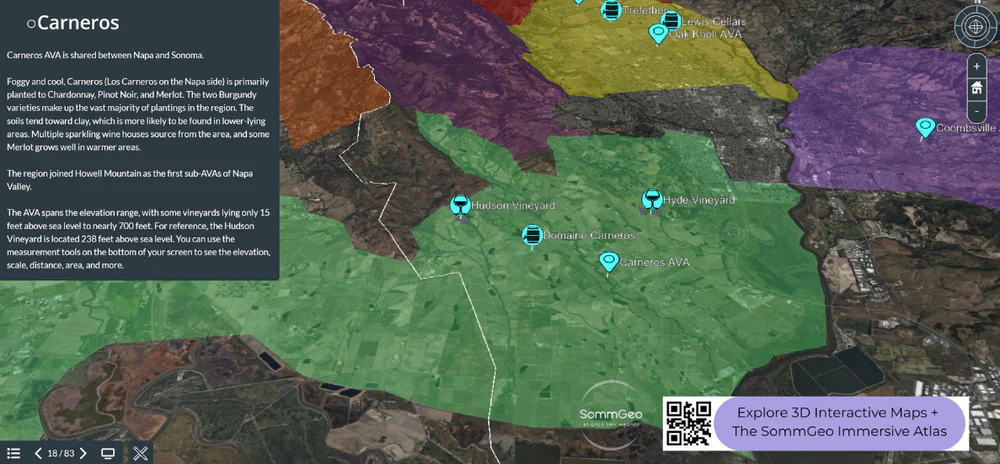
Thirty miles long and roughly five miles wide at its broadest, Napa Valley contains 17 sub-AVAs that reflect meaningful differences in elevation, soil, and fog exposure. The valley floor AVAs (Oakville, Rutherford, Stags Leap District) produce the ripe, age-worthy Cabernet Sauvignon that built Napa’s reputation. Mountain AVAs (Howell Mountain, Spring Mountain, Diamond Mountain) deliver more tannic, concentrated wines from volcanic and rocky soils above the fog line. At the southern end, Carneros (open to San Pablo Bay winds) is Pinot Noir and Chardonnay territory, and home to landmark vineyards like Hudson and Hyde that supply fruit to dozens of the state’s top producers.
Sonoma County
Sonoma is twice the size of Napa and far more climatically diverse, with AVAs spanning from fog-drenched coastal ridgetops to warm inland valleys. Russian River Valley is the most well-known for Pinot Noir and Chardonnay; the fog that pours through the river corridor every evening drops temperatures dramatically, extending the growing season and preserving acidity. Alexander Valley, warmer and more sheltered, is prime Cabernet Sauvignon country. The Petaluma Gap (AVA approved 2017) channels wind from Bodega Bay to San Pablo Bay, producing intensely flavored cool-climate Pinot Noir and Syrah.
Central Coast
The Central Coast stretches from the southern edge of San Francisco Bay to Santa Barbara, an enormous span that contains some of California’s most important regions. Paso Robles, with its extreme diurnal temperature swings (often exceeding 25°C (77°F)) and calcareous soils, has established itself as a hotbed for Rhône varieties and Cabernet Sauvignon. Santa Barbara County’s transverse ranges (mountains that run east-west rather than north-south) create direct ocean funnels into the Sta. Rita Hills and Santa Maria Valley, producing some of the state’s most Burgundian Pinot Noir and Chardonnay.
Producers Worth Knowing
Mayacamas, Mount Veeder, Napa Valley
One of Napa’s oldest continuously operating estates, founded in 1889 on the volcanic soils of Mount Veeder. Mayacamas makes Cabernet Sauvignon in a style that has more in common with 1970s Napa than with the modern valley floor: structured, tannic, restrained in fruit, and built to age for decades. It’s the antithesis of the lush, high-scoring Napa Cab paradigm, and that’s precisely why it matters.
Heitz Cellar, Napa Valley
Joe Heitz’s Martha’s Vineyard Cabernet Sauvignon (sourced from a single vineyard in Oakville) was one of the first California wines to demonstrate that a specific site could produce a consistently distinctive wine, vintage after vintage. The trademark eucalyptus and mint character of Martha’s Vineyard is unmistakable and has been debated for decades. Heitz remains a reference point for site-specific California Cabernet.
Colgin Cellars, Napa Valley
Ann Colgin’s estate is among the most sought-after cult Cabernet producers in California. The flagship wines (Tychson Hill, Cariad, and IX Estate) come from distinct Napa sites and showcase a style that balances power with polish. Production is tiny, demand is enormous, and the wines consistently rank among the highest-scoring Cabernets in the state.
Littorai, Sonoma Coast & Anderson Valley
Ted Lemon, who worked at Domaine Roulot and Domaine A. & P. de Villaine in Burgundy, brought that sensibility to California’s coolest coastal sites. Littorai’s single-vineyard Pinot Noirs and Chardonnays from the Sonoma Coast and Anderson Valley are among the most terroir-transparent wines made in the state: restrained, mineral, and site-specific in a way that few California producers achieve.
Stolpman Vineyards, Ballard Canyon, Santa Barbara
Located in Ballard Canyon on limestone soils with extreme diurnal temperature swings, Stolpman is one of California’s most compelling Syrah producers. The estate-grown wines show the lifted, peppery, savory character that Ballard Canyon’s direct ocean exposure encourages, a cool-climate Syrah style closer to the Northern Rhône than to most of California. They also produce excellent Roussanne and estate-grown Sangiovese.
Notable Vintages: California
Among the standout vintages of the past two decades, 2013 was a dream year for Napa Cabernet: a long, dry, sunny growing season produced one of the earliest harvests in decades with exceptional concentration and balance. 2016 offered near-perfect conditions with even temperatures, elegant structure, and is widely considered one of Napa’s strongest Cabernet vintages. 2005 delivered a cooler, longer season with balanced acids and excellent aging potential, still drinking beautifully. 2012 was long and mild across Northern California, producing wines with richness and texture that drew comparisons to the best of the preceding decade. 2019 brought moderate conditions and low yields.
On the difficult side, 2020 was defined by devastating wildfires across Northern California; many producers declassified or didn’t release their top wines due to smoke taint, and it remains a vintage to approach with caution. 2011 was cool, wet, and late, producing lighter, higher-acid wines that lacked the ripeness California is known for, but many are showing beautifully now. 2017 saw wildfires during harvest (though most fruit was already in), and while quality was strong for early picks, it was uneven overall.
New to the Tours? Learn how to navigate frames, click pins for detailed producer and region profiles, and get the most from your 3D experience.
Tours Guide →Ready to go deeper into California? Join 200+ wine organizations already using SommGeo.
Start Your 15-Day Free Trial $5/month billed annually after trial · Cancel anytime