
Central & Southern Italy Wine Tour: Brunello, Etna, Taurasi & Beyond in 3D
From Sangiovese on Tuscan galestro to Aglianico on volcanic slopes. Where indigenous varieties and ancient soils create Italy’s most distinctive wines.
The Central and Southern Italy Tour is a guided 3D flythrough in 83 frames: Tuscany from Chianti Classico, Carmignano and Vino Nobile to Brunello di Montalcino and its subzones, Bolgheri, Elba and the Maremma, then Umbria’s Montefalco, the Marche’s Verdicchio, Lazio, Abruzzo, Molise, Campania’s coast and Taurasi, Basilicata, Puglia’s Salento, Calabria’s Cirò, Sicily from Faro and Etna to Avola, Vittoria, Marsala and Pantelleria, and Sardinia. Along the way 114 producers, the Montalcino subzones, 104 appellations and places and 40 towns are marked as clickable pins, each opening a profile in the panel. The Tour is part of SommGeo membership, which starts with a free 15-day trial.
- Frames: 83, with named stops at Chianti, Chianti Classico, Carmignano, Vino Nobile, Brunello and its subzones, Bolgheri, Elba, Suvereto, Umbria, Marche, Lazio, Abruzzo, Molise, Campania, Taurasi, Basilicata, Puglia, Calabria, Sicily, Etna, Avola, Cerasuolo di Vittoria, Marsala, Pantelleria and Sardegna
- Pins on the tour: 114 producers, 10 Montalcino subzones and sites, 104 DOCGs, DOCs and places, and 40 towns and communes, every one clickable
- Tools: Frame navigator with a frame list, clickable pins that load the info panel, compass and camera tilt, measurement tools for distance, height, slope and area, full screen
- Inside the pins: Appellation pins give the rules, grapes and soils; producer pins give the estate, its sites and its style; subzone pins in Montalcino give altitude and aspect
- Volcanic south: Etna’s northern and eastern contrade, Monte Vulture in Basilicata and the Campi Flegrei all sit on volcanic soils, and the Tour reads each slope in 3D
- Chianti in full: All seven Chianti subzones are pinned alongside Chianti Classico, nine of its communes from Greve to Castelnuovo Berardenga, and the village of Panzano

Central and Southern Italy is where volcanic geology, Mediterranean heat, and an extraordinary concentration of indigenous grape varieties converge, and where the relationship between grape and soil is as specific and non-transferable as anywhere in the wine world.
Unlock the Full SommGeo Toolkit
Gain exclusive access to our entire suite of premium features, including interactive Map Makers, immersive 3D Tours, high-resolution classic Maps, and advanced analytical tools.
Start Free TrialInside This Tour
This Tour covers Central and Southern Italy with producer profiles, classification details, and vineyard-level data behind every pin. Every map frame is fully interactive. Don’t just watch the flythrough. Click, drag, zoom, and rotate the 3D terrain to explore from any angle, then click every pin for the full content.
- Brunello di Montalcino: north vs. south subzones and how position shapes Sangiovese style
- Chianti Classico producers and the Gran Selezione tier
- Taurasi and Fiano di Avellino: Campania’s Aglianico and white wine benchmarks
- Etna’s volcanic contrade and the producers redefining Sicilian wine
- Abruzzo: Montepulciano d’Abruzzo beyond the bulk market
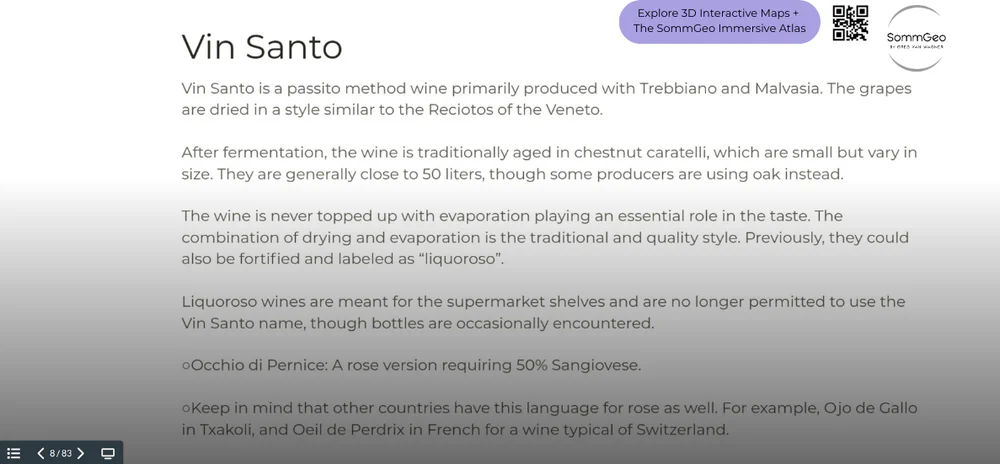
- Vin Santo production, Vino Nobile di Montepulciano, and Umbria’s Sagrantino
What Sets the Center & South Apart
For a geographic overview of all Italian wine regions, see the Italy Fast Map. Here, we focus on the site-specific details that shape the wines.
Central and Southern Italy spans an enormous range of conditions (from the temperate, continental-influenced hills of inland Tuscany to the full Mediterranean heat of coastal Campania and Sicily) and the wines reflect that range. The dominant varieties are deeply rooted in their sites: Sangiovese across Tuscany in its many clonal expressions, Aglianico in the volcanic soils of Campania and Basilicata, Nerello Mascalese on Etna’s lava flows, Montepulciano in Abruzzo and the Adriatic coast, and whites like Fiano and Greco that have been grown in Campania since antiquity. The soils are equally varied: Tuscany’s galestro and alberese clays give way to the volcanic tuff and basalt of Campania and Etna, with pockets of limestone, sand, and marine sediment throughout. What ties it all together is that the grape-to-soil relationships here are extraordinarily specific: move any of these varieties to a different site and the wine changes fundamentally, or stops being interesting at all.
Brunello di Montalcino is the clearest case study in how geography shapes a single variety. The vineyards form a ring around the hilltop town, and the differences between the cooler north and warmer south are dramatic. Northern slopes (Montosoli in particular) produce paler, more aromatic Brunellos with firm acidity and classical structure. Southern slopes (Sant’Angelo in Colle, Castelnuovo dell’Abate) are hotter and drier, producing darker, more powerful wines with riper fruit and salinity. The southeast benefits from Mount Amiata’s cooling night breezes, creating a sweet spot where concentration meets freshness; estates like Poggio di Sotto and Mastrojanni work this terrain. The subzone debate remains politically unresolved, but the stylistic differences are undeniable.
A Closer Look
Taurasi & Fiano di Avellino, Campania
Taurasi is the DOCG for Aglianico in Campania’s Irpinia hills, a grape of extraordinary tannic power and acidity that demands aging and rewards it with earth, tar, dark fruit, and mineral complexity that rivals the best Nebbiolo. The volcanic tuff soils and high elevations (up to 600 meters) keep temperatures in check despite the southern latitude. Fiano di Avellino, from the same hills, is one of Southern Italy’s great white wines: textured, nutty, with a waxy depth that develops well over five to ten years.
Etna, Sicily
Etna has become the most talked-about wine region in Italy over the past decade, and the excitement is warranted. Nerello Mascalese grown on ancient lava flows at elevations up to 1,000 meters produces wines of ethereal transparency: pale color, high acidity, mineral-driven aromatics that have drawn inevitable (if imperfect) comparisons to Burgundy. The contrade system (named vineyard districts on different aspects and elevations of the volcano) is where the real complexity lies.
Abruzzo
Montepulciano d’Abruzzo is one of Italy’s most produced wines, and most of it is unremarkable. But from the right hillside sites in the provinces of Chieti and Teramo (where producers limit yields and work with older vines on calcareous clay) the grape produces deeply colored, structured reds with black cherry, earth, and a savory quality that over-delivers for the price. It’s one of Italy’s best-kept secrets at the serious end.
Producers Worth Knowing
Biondi-Santi, Montalcino, Tuscany
The estate that invented Brunello. Ferruccio Biondi-Santi released the first modern Brunello in 1888, and the family’s Il Greppo vineyard (above 500 meters on calcareous, stony soil southeast of Montalcino town) remains the reference point for austere, age-worthy Brunello. The Riserva, produced only in exceptional vintages, is one of Italy’s most long-lived wines. The style is deliberately restrained: early-picked, structured, and built for decades, not for drinking young.
Benanti, Etna, Sicily
Giuseppe Benanti was among the first to recognize Etna’s potential for world-class wine in the modern era, beginning in the late 1980s. The estate farms vineyards across multiple contrade on the volcano’s slopes, producing Nerello Mascalese reds of remarkable elegance and site-specific Carricante whites. Benanti’s wines helped put Etna on the international map and remain benchmarks for the region.
Arnaldo Caprai, Montefalco, Umbria
Sagrantino di Montefalco was an obscure, near-extinct grape when Marco Caprai took over his family estate in the 1980s. He essentially rescued the variety, investing in vineyard research and modern winemaking to produce Sagrantino of extraordinary tannic density and dark fruit concentration. The 25 Anni bottling is the flagship: one of Italy’s most powerful reds, built for long aging from a grape that produces higher tannin levels than virtually any other variety in the country.
Montevertine, Radda in Chianti, Tuscany
Sergio Manetti founded Montevertine in 1967 and famously withdrew from the Chianti Classico consorzio in the early 1980s rather than comply with rules he felt compromised quality. Le Pergole Torte (100% Sangiovese, no blending, no compromise) is the estate’s defining wine and one of Tuscany’s greatest. It’s technically an IGT, not a DOCG, because Manetti refused to play by rules he didn’t believe in. The estate, now run by his son Martino, remains a symbol of Tuscan independence.
Elena Fucci, Aglianico del Vulture, Basilicata
Elena Fucci’s Titolo (sourced from a single vineyard of old-vine Aglianico at 600 meters on volcanic soils in Basilicata’s Vulture district) is a benchmark for what Southern Italian Aglianico can achieve. The wine combines the grape’s natural power and tannin with a floral, mineral elegance that reflects the volcanic site character. One wine, one vineyard, one grape, and one of the south’s most compelling producers.
Notable Vintages: Central & Southern Italy
Among the standout vintages of the past two decades, 2010 is widely regarded as the finest recent Brunello vintage: classical structure, firm tannins, and exceptional aging potential across Montalcino. 2015 delivered ripe, concentrated Sangiovese across Tuscany with balance that invites comparisons to the great years. 2016 brought freshness, precision, and fine-grained tannins; many producers consider it superior to 2015 for long-term cellaring. 2006 was outstanding across Brunello, Chianti Classico, and much of Southern Italy: rich, structured wines that are drinking beautifully now. 2019 produced excellent results across virtually all Central and Southern Italian regions with freshness and generosity in balance.
On the difficult side, 2014 was cool and wet across Tuscany, with lighter wines that required strict selection; the best are charming but not built for long aging. 2002 was one of the worst vintages in recent Tuscan memory, with heavy rains producing dilute, problematic wines. 2011 brought extreme heat, particularly in Montalcino, producing ripe but sometimes unbalanced Brunellos with low acidity.
Pins on this tour (268)
Every producer, Montalcino subzone, appellation, place and town marked with a pin on the Central and Southern Italy Tour, as loaded in the tour itself. Click any pin in the Tour for its profile.
| Name | On the tour as |
|---|---|
| Producers (114) | |
| Agricola Punica | Producer |
| Altesino | Producer |
| Antinori | Producer |
| Argiano | Producer |
| Arianna Occhipinti | Producer |
| Arnaldo Caprai | Producer |
| Azienda Palari | Producer |
| Azienda Rivera | Producer |
| Badia a Coltibuono | Producer |
| Barone Ricasoli | Producer |
| Benanti | Producer |
| Biondi | Producer |
| Biondi-Santi | Producer |
| Bisceglia | Producer |
| Ca’Marcanda | Producer |
| Campo alla Sughera | Producer |
| Cantina Argiolas | Producer |
| Cantina del Vermentino | Producer |
| Cantina Mesa | Producer |
| Cantine Lonardo | Producer |
| Cantine Odoardi | Producer |
| Capannelle | Producer |
| Capezzana | Producer |
| Casanova di Neri | Producer |
| Case Basse “Soldera” | Producer |
| Castello Banfi | Producer |
| Castello dei Rampolla | Producer |
| Castello della Sala | Producer |
| Castello di Ama | Producer |
| Castello di Monsanto | Producer |
| Chiaromonte | Producer |
| Ciacci Piccolomini | Producer |
| Ciro Picariello | Producer |
| Col d’Orcia | Producer |
| Colle Gaio | Producer |
| Colli di Lapio | Producer |
| COS | Producer |
| D’Angelo | Producer |
| Donnafugata “Ben Rye” | Producer |
| Elena Fucci | Producer |
| Emidio Pepe | Producer |
| Falesco | Producer |
| Farnese Fantini | Producer |
| Fattoria dei Barbi | Producer |
| Felsina | Producer |
| Feudi di San Gregorio | Producer |
| Feudi San Marzano | Producer |
| Florio | Producer |
| Fontodi | Producer |
| Frank Cornelissen | Producer |
| Fratelli Averna | Producer |
| Frescobaldi | Producer |
| Frescobaldi- Castello di Nipozzano | Producer |
| Gianfranco | Producer |
| Graci | Producer |
| Grattamacco | Producer |
| Guado al Tasso | Producer |
| Guido Marsella | Producer |
| il Poggione | Producer |
| Ippolito | Producer |
| Isole e Olena | Producer |
| Le Macchiole | Producer |
| Librandi | Producer |
| Livio Sassetti Pertimali | Producer |
| Lombardo | Producer |
| Luigi Tecce | Producer |
| Lungarotti | Producer |
| Marco de Bartoli | Producer |
| Marco de Bartoli “Bukkuram” | Producer |
| Marisa Cuomo | Producer |
| Masseria Felicia | Producer |
| Mastroberardino | Producer |
| Mastrojanni | Producer |
| Moio | Producer |
| Montevertine | Producer |
| Paolo Bea | Producer |
| Passopisciaro Winery | Producer |
| Paternoster | Producer |
| Pellegrino | Producer |
| Pian delle Vigne | Producer |
| Pietradolce | Producer |
| Pieve Santa Restituta | Producer |
| Poggio Antico | Producer |
| Poggio di Sotto | Producer |
| Producers | Producer |
| Querciabella | Producer |
| Salvatore Molettieri | Producer |
| Salvatore Murana | Producer |
| Salvioni | Producer |
| Salvo Foti | Producer |
| San Felice | Producer |
| Sella & Mosca | Producer |
| Siro Pacenti | Producer |
| Tabarrini | Producer |
| Talenti | Producer |
| Tenuta Argentiera | Producer |
| Tenuta dell’Ornellaia | Producer |
| Tenuta delle Terre Nere | Producer |
| Tenuta Iuzzolini | Producer |
| Tenuta Lamborghini | Producer |
| Tenuta San Guido “Sassicaia” | Producer |
| Terre de la Custodia | Producer |
| Terredora di Paolo | Producer |
| Tiberio | Producer |
| Torrevento | Producer |
| Tua Rita | Producer |
| Uccelliera | Producer |
| Valdicava | Producer |
| Valentini | Producer |
| Valle dell’Acate | Producer |
| Vigne Surrau | Producer |
| Vigneti del Vulture | Producer |
| Villa Diamante | Producer |
| Villa Matilde | Producer |
| Montalcino subzones and sites (10) | |
| Bosco | Montalcino subzone |
| Camigliano | Montalcino subzone |
| Canalicchio | Montalcino subzone |
| Castelnuovo dell’Abate | Montalcino subzone |
| Montalcino | Montalcino subzone |
| Montosoli | Montalcino subzone |
| Sant’Angelo in Colle | Montalcino subzone |
| Sant’Angelo Scalo | Montalcino subzone |
| Tavernelle | Montalcino subzone |
| Torrenieri | Montalcino subzone |
| Appellations and places (104) | |
| Aglianico del Taburno | DOCG |
| Aglianico del Vulture | DOC |
| Aglianico del Vulture Superiore | DOCG |
| Alcamo | DOC |
| Aleatico di Gradoli | DOC |
| Aversa | DOC |
| Bianchello del Metauro | DOC |
| Biferno | DOC |
| Bolgheri | DOC |
| Brindisi | DOC |
| Brunello di Montalcino | DOCG |
| Campi Flegrei | DOC |
| Cannellino di Frascati | DOCG |
| Cannonau di Sardegna | DOC |
| Capri | DOC |
| Carignano del Sulcis | DOC |
| Carmignano | DOCG |
| Castelli di Jesi Verdicchio doc/ Riserva | DOCG |
| Castelli Romani | DOC |
| Cerasuolo di Vittoria | DOCG |
| Cerasuolo di Vittoria (Classico zone) | DOCG |
| Cesanese del Piglio | DOCG |
| Chianti | DOCG |
| Chianti Classico | DOCG |
| Chianti Colli Aretini | Place |
| Chianti Colli Fiorentini | Place |
| Chianti Colli Senesi | Place |
| Chianti Colline Pisane | Place |
| Chianti Montalbano | Place |
| Chianti Montespertoli | Place |
| Chianti Rufina | Place |
| Cilento | DOC |
| Cirò | DOC |
| Colline Teramane Montepulciano d’Abruzzo | DOCG |
| Conero Rosso Riserva | DOCG |
| Controguerra | DOC |
| Cortona | DOC |
| Costa d’Amalfi | DOC |
| Elba Aleatico Passito | DOCG |
| Eloro | DOC |
| Est! Est!! Est!!! di Montefiascone | DOC |
| Etna | DOC |
| Falanghina del Sannio | DOC |
| Falerno del Massico | DOC |
| Faro | DOC |
| Fiano di Avellino | DOCG |
| Frascati | DOC |
| Frascati Superiore | DOCG |
| Galluccio | DOC |
| Greco di Bianco | DOC |
| Greco di Tufo | DOCG |
| Irpinia | DOC |
| Ischia | DOC |
| Isola dei Nuraghi | IGT |
| Lacrima di Morro d’Alba | DOC |
| Lago di Corbara | DOC |
| Malvasia delle Lipari | DOC |
| Malvasia di Bosa | DOC |
| Maremma Toscana | DOC |
| Marsala | DOC |
| Melissa | DOC |
| Molise | DOC |
| Montecucco | DOC |
| Montecucco Sangiovese | DOCG |
| Montefalco | DOC |
| Morellino di Scansano | DOCG |
| Moscadello di Montalcino | DOC |
| Noto | DOC |
| Offida | DOCG |
| Orvieto | DOC |
| Pachino | Place |
| Pantelleria | DOC |
| Panzano | Chianti Classico village |
| Penisola Sorrentina | DOC |
| Pentro di Isernia | DOC |
| Pomino | DOC |
| Primitivo di Manduria | DOC |
| Rosso Conero | DOC |
| Rosso della Val di Cornia | DOCG |
| Rosso di Montalcino | DOC |
| Rosso Piceno | DOC |
| Sagrantino di Montefalco | DOCG |
| Salento | IGT |
| Salice Salentino | DOC |
| San Severo | DOC |
| Sannio | DOC |
| Sant’Antimo | DOC |
| Sciacca | DOC |
| Sicilia | DOC |
| Siracusa | DOC |
| Suvereto | DOCG |
| Taurasi | DOCG |
| Terre di Cosenza | DOC |
| Tintilia del Molise | DOC |
| Torgiano Rosso Riserva | DOCG |
| Tullum | DOCG |
| Valle d’Itria | Place |
| Verdicchio di Matelica doc/ Riserva | DOCG |
| Vermentino di Gallura | DOCG |
| Vernaccia di Oristano | DOC |
| Vernaccia di San Gimignano | DOCG |
| Vernaccia di Serrapetrona | DOCG |
| Vesuvio | DOC |
| Vino Nobile di Montepulciano | DOCG |
| Towns and villages (40) | |
| Agrigento | Town or village |
| Arezzo | Town or village |
| Avola | Town or village |
| Barberino Val d’Elsa | Chianti Classico commune |
| Campiglia Marittima | Town or village |
| Castelfranci | Town or village |
| Castellina in Chianti | Chianti Classico commune |
| Castelnuovo Berardenga | Chianti Classico commune |
| Catania | Town or village |
| Florence/Firenze | Town or village |
| Gaiole in Chianti | Chianti Classico commune |
| Greve in Chianti | Chianti Classico commune |
| Lapio | Town or village |
| Linguaglossa | Town or village |
| Milo | Town or village |
| Mirabella Eclano | Town or village |
| Montefalcione | Town or village |
| Montefredane | Town or village |
| Montemarano | Town or village |
| Naples | Town or village |
| Palermo | Town or village |
| Passopisciaro | Town or village |
| Paternopoli | Town or village |
| Piano d’Angelo | Town or village |
| Piombino | Town or village |
| Pisa | Town or village |
| Poggibonsi | Chianti Classico commune |
| Radda in Chianti | Chianti Classico commune |
| Ragusa | Town or village |
| Randazzo | Town or village |
| Rome | Town or village |
| San Casciano Val di Pesa | Chianti Classico commune |
| Santa Maria di Licodia | Town or village |
| Sassetta | Town or village |
| Siena | Town or village |
| Summonte | Town or village |
| Taormina | Town or village |
| Tavarnelle Val di Pesa | Chianti Classico commune |
| Viagrande | Town or village |
| Vittoria | Town or village |
Hopefully this index is useful on its own. To explore these regions interactively, with every boundary on real terrain and a full profile for each, start a 15-day free trial. To see what one of these maps is like first, a different map is unlocked for everyone every day. For the open maps of the same appellations, see the Italy Fast Map and the Central Italy and Southern Italy 3D maps; the Tours User Guide explains the controls.
Central and Southern Italy Tour: Frequently Asked Questions
How is the Tour different from the Central and Southern Italy 3D maps?
The 3D Fast Maps are open maps of every DOC and DOCG: click any boundary for its profile. The Tour is a guided presentation in 83 frames that runs from Tuscany to Sardinia in order, with the grapes and soils of each stop in the panel and its producers, subzones and villages as pins. The map answers where; the Tour tells each region’s story in sequence.
How do I move through the Tour?
Step frame by frame with the arrows in the lower left, or open the frame list there and jump to any stop; the counter shows where you are. At each frame the panel in the upper left gives the context, and the pins on the terrain hold most of the content: click a producer, vineyard or appellation pin and its profile loads into the panel. The compass in the upper right tilts and rotates the camera, the ruler opens the measurement tools, and full screen is in the lower right. The Tours User Guide walks through all of it.
Which Montalcino subzones does the Tour mark?
Montalcino itself and the places the trade uses to read a Brunello: Montosoli and Canalicchio to the north, Torrenieri to the north-east, Bosco, Tavernelle and Camigliano to the west, and Sant’Angelo in Colle, Sant’Angelo Scalo and Castelnuovo dell’Abate to the south, each pinned with its altitude and aspect, with Brunello, Rosso di Montalcino, Sant’Antimo and Moscadello drawn as appellations around them.
Can I use the Tour for teaching or exam prep?
Yes, for personal study, exam preparation and non-commercial teaching, with a credit to sommgeo.com when you reference it in study materials or a group setting. Tours are not available for commercial use or licensing; custom or co-branded Tours are scoped separately. The full terms are on the Map Usage, Credit and Licensing page.
Is the Central and Southern Italy Tour free?
The index on this page is free to use. The Tour itself, with its frames, pins and profiles, is part of SommGeo membership, which starts with a free 15-day trial. The Jura, Savoie and Switzerland Tour is open to everyone as a sample, and SommGeo also unlocks one map every day on a rotation, different every day, no signup needed. Today’s unlocked map is on the home page.
New to the Tours? Learn how to navigate frames, click pins for detailed producer and region profiles, and get the most from your 3D experience.
Tours Guide →Ready to go deeper into Central and Southern Italy? Join 200+ wine organizations already using SommGeo.
Start Your 15-Day Free Trial $5/month billed annually after trial · Cancel anytimeMap by Greg Van Wagner, SommGeo