
Burgundy Vineyards Map: Interactive Guide
From the Kimmeridgian slopes of Chablis to the golden escarpment of the Côte d’Or. Navigating the world’s most terroir-obsessed wine region at the vineyard level.
Burgundy is where the concept of terroir was born, and where it still matters more than anywhere else on earth. Across roughly 28,000 hectares (69,000 acres) of vines (excluding Beaujolais), Burgundy’s classification system maps an almost forensic hierarchy of place: 33 Grand Cru vineyards representing barely 2% of production, 585 Premier Cru climats, 44 village appellations, and a web of regional AOCs, all from essentially two grape varieties. Pinot Noir and Chardonnay. That’s it. The entire reputation of this region (the most expensive vineyard land on the planet, where a single hectare of Grand Cru can sell for over €10 million) rests on the premise that a few hundred meters of difference in slope position, soil composition, or aspect can produce fundamentally different wines. And Burgundy proves that premise right, vintage after vintage. This interactive Burgundy vineyards map lets you explore every climat, cru, and village across the full sweep of the region, from the isolated Kimmeridgian limestone slopes of Chablis to the legendary villages of the Côte de Nuits and Côte de Beaune.
Unlock the Full SommGeo Toolkit
Gain exclusive access to our entire suite of premium features, including interactive Map Makers, immersive 3D Tours, high-resolution classic Maps, and advanced analytical tools.
Start Free TrialWhat You’ll Explore
This interactive portal maps Burgundy’s vineyard hierarchy from regional Bourgogne all the way up to individual Grand Cru climats, with every level of the classification rendered as navigable layers. Click on any mapped vineyard and a detail panel opens with appellation rules, permitted varieties, soil profiles, and the geographic specifics that make each site distinct. Whether you’re tracing the Grand Cru slope from Gevrey-Chambertin to Vougeot or comparing right-bank and left-bank Premier Crus in Chablis, the depth is built directly into the map.
- All 33 Grand Cru vineyards and 585 Premier Cru climats with searchable navigation
- Chablis: Grand Cru hillside, right-bank and left-bank Premier Crus, and Kimmeridgian soil zones
- Côte de Nuits villages: Gevrey-Chambertin, Morey-Saint-Denis, Chambolle-Musigny, Vougeot, Vosne-Romanée, Nuits-Saint-Georges
- Côte de Beaune: Corton hill, Meursault, Puligny-Montrachet, Chassagne-Montrachet, Pommard, Volnay
- In-depth appellation profiles for every mapped climat: varieties, classification rules, geology, and viticultural data


The Burgundy Classification: Terroir as Law
Burgundy’s classification system is unique in the wine world because it classifies the land itself, not the producer. Unlike Bordeaux, where the 1855 classification ranked châteaux, Burgundy’s hierarchy was built over centuries by Cistercian monks who observed that specific vineyard plots produced consistently different wines, and codified those observations into law. The result is a four-tier pyramid: Grand Cru at the apex (roughly 550 hectares (1,359 acres), less than 2% of production), Premier Cru below that (about 585 climats accounting for roughly 10% of production), village-level wines (around 36% of production), and regional Bourgogne at the base (the remaining half).
What makes this system both elegant and maddening is the fragmentation. The Napoleonic Code required equal division of inheritance among heirs: not one vineyard per child, but each vineyard divided equally among all children. The result is that a single Grand Cru like Clos de Vougeot, originally farmed as one 50-hectare (124-acre) parcel by Cistercian monks, is now split among nearly 80 different owners, some of whom produce barely a barrel per vintage. Every one of those owners can legally put “Grand Cru” on the label, but the quality, style, and price can vary enormously. In Burgundy, the name on the vineyard tells you where to look; the name of the producer tells you what you’ll actually find in the glass.
Geography: The Côte d’Or Escarpment
The Côte d’Or (literally the “Golden Slope,” though likely a contraction of “Côte d’Orient” referencing its eastern aspect) is a 50-kilometer (31-mile) limestone escarpment running from Marsannay just south of Dijon to Santenay in the south. In most places, the wine-growing strip is less than 2 kilometers (1.2 miles) wide. This is arguably the most valuable continuous stretch of vineyard land on earth, and the geographic logic behind its classification is visible on the map: Grand Cru vineyards typically occupy the mid-slope, where drainage, sun exposure, and soil depth hit an optimal balance. Premier Cru sites sit just above or below, while village-level vineyards extend onto the flatter land near the road and the plain.
The escarpment divides into two distinct halves. The Côte de Nuits, running from Marsannay to Corgoloin, covers roughly 1,700 hectares (4,200 acres) and contains 24 of Burgundy’s 25 red Grand Crus; this is Pinot Noir’s spiritual home. The Côte de Beaune, from Ladoix to Santenay, is larger at approximately 3,600 hectares (8,896 acres) and, while it produces exceptional reds from villages like Pommard and Volnay, is the kingdom of white Burgundy: Meursault, Puligny-Montrachet, Chassagne-Montrachet, and the hill of Corton-Charlemagne. The soils are predominantly limestone and marl, but the specific mix of clay, chalk, iron-rich oolitic limestone, and gravel changes from commune to commune and sometimes from one row of vines to the next.
Then there’s Chablis, geographically isolated, sitting over 100 kilometers (62 miles) northwest of the Côte d’Or and closer to Champagne than to Beaune. The vineyards occupy roughly 5,800 hectares (14,332 acres) of Kimmeridgian limestone slopes along the Serein River, producing Chardonnay of a completely different character: leaner, more mineral, with a saline tension that comes from soils packed with 150-million-year-old fossilized oyster shells. It may seem like an outlier, but Chablis is unquestionably Burgundy: same classification system, same obsession with place.
Key Villages & Regions
Chablis: Chardonnay in Its Purest Form
Chablis is where Chardonnay strips down to its essentials. No new oak (or minimal at most), no malolactic softness: just grape, soil, and climate. The region’s four-tier hierarchy (Petit Chablis, Chablis, Premier Cru, Grand Cru) maps directly onto geography. The seven Grand Cru vineyards (Les Clos, Valmur, Vaudésir, Blanchots, Preuses, Bougros, and Grenouilles) all occupy a single southwest-facing slope on the right bank of the Serein River, overlooking the town. This amphitheater-like exposure on pure Kimmeridgian limestone produces Chablis at its most concentrated and age-worthy.
You’ll often hear discussion of “right-bank” and “left-bank” Premier Crus, and the distinction matters. The right bank (home to celebrated climats like Fourchaume, Mont de Milieu, and Montée de Tonnerre) shares similar geology and exposure to the Grand Cru slope, producing wines of weight, power, and stony tension. The left bank, with vineyards like Vaillons, Montmains, Côte de Léchet, and Vau de Vey, tends toward a cooler, more precise style: more floral, higher acidity, and a flinty character that differs meaningfully from the richness across the river. The best Premier Crus from top producers like William Fèvre, Raveneau, and Vincent Dauvissat rival Grand Cru quality at a fraction of the price.
Gevrey-Chambertin: Power and Prestige
Gevrey-Chambertin is the largest village-named appellation in the Côte de Nuits, roughly 409 hectares (1,011 acres) in production, and arguably its most powerful. The village boasts more Grand Crus than any other commune: nine in total, led by Chambertin and Chambertin-Clos de Bèze (the two undisputed flagships), followed by Mazis-Chambertin, Charmes-Chambertin, Mazoyères-Chambertin, Griotte-Chambertin, Chapelle-Chambertin, Latricières-Chambertin, and Ruchottes-Chambertin. Napoleon famously declared Chambertin his favorite wine, and the vineyard’s reputation has only grown since. The wines here tend toward structure, concentration, and tannic grip: Pinot Noir with backbone. Producers like Armand Rousseau, Claude Dugat, and Domaine Trapet set the benchmark.
Morey-Saint-Denis: The Overlooked Jewel
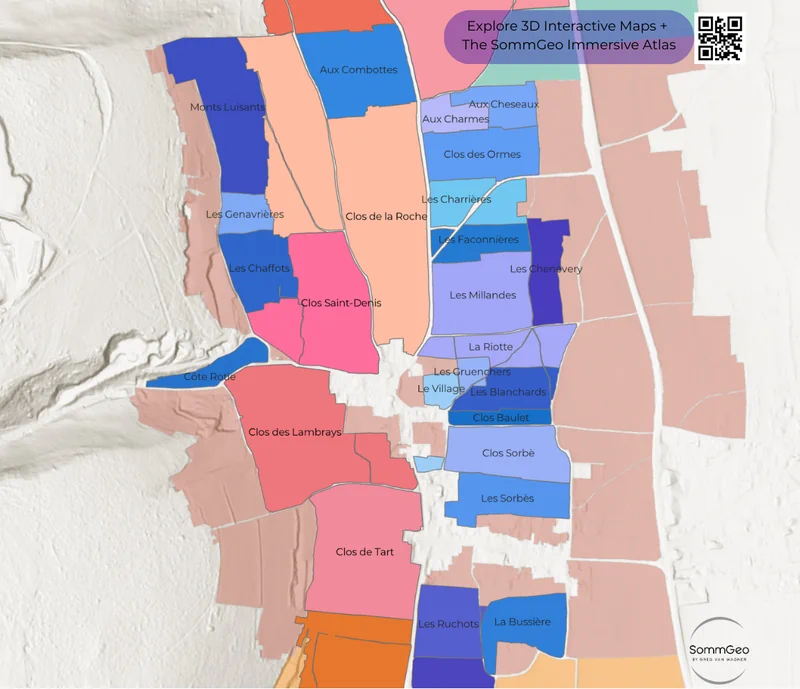
Sandwiched between the fame of Gevrey-Chambertin to the north and Chambolle-Musigny to the south, Morey-Saint-Denis is perpetually underrated, which makes it one of the Côte de Nuits’ best values for serious Burgundy. Four Grand Crus (Clos de la Roche, Clos Saint-Denis, Clos des Lambrays, and Clos de Tart) form a continuous band across the commune, and 20 climats are classified as Premier Cru across 39 hectares (96 acres). The village produces roughly 500,000 bottles of red annually (96% of production) alongside a tiny amount of white. Clos de la Roche in particular can rival the best of Gevrey or Chambolle, and producers like Domaine Dujac, Domaine Ponsot, and Domaine des Lambrays produce wines that justify far more attention than Morey typically receives.
Vosne-Romanée: The Heart of Burgundy
If Burgundy has a center of gravity, it’s Vosne-Romanée. This small village contains six Grand Crus, including Romanée-Conti (1.8 hectares (4.4 acres), the most expensive vineyard on earth), La Romanée (0.85 hectares (2.1 acres), the smallest AOC in France), La Tâche, Richebourg, Romanée-Saint-Vivant, and a portion of Grands Échézeaux. The wines are the definition of Burgundian elegance: perfumed, complex, seemingly weightless in the best vintages yet with extraordinary depth and persistence. Domaine de la Romanée-Conti, Domaine Leroy, Méo-Camuzet, and Domaine du Comte Liger-Belair are among the names that make this arguably the most sought-after half-kilometer of vineyard land in the world.
Nuits-Saint-Georges: Backbone Without the Crown
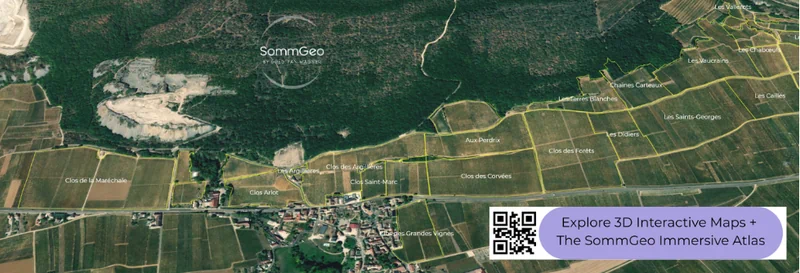
Nuits-Saint-Georges gave its name to the entire northern Côte d’Or, yet (in one of Burgundy’s great ironies) the village has no Grand Cru vineyards. What it does have is 41 Premier Cru climats spread across 146 hectares (361 acres), producing some of the Côte de Nuits’ most structured, earthy, and age-worthy reds. The village straddles the Meuzin stream, which divides it into a northern sector (closer to Vosne-Romanée, with more finesse) and a southern sector (closer to Premeaux-Prissey, with more rustic power). Top Premier Crus like Les Saint-Georges, Les Vaucrains, and Les Cailles are widely considered Grand Cru–caliber, and the absence of the top designation is a historical accident more than a reflection of quality. Producers like Domaine de l’Arlot, Robert Chevillon, and Henri Gouges consistently demonstrate what this village is capable of.
The Côte de Beaune: White Burgundy’s Kingdom
South of the Côte de Nuits, the escarpment shifts character. Pommard and Volnay produce the Côte de Beaune’s most celebrated reds: Pommard with earthy power, Volnay with silky finesse. But the Côte de Beaune’s global reputation rests on its whites. Meursault delivers broad, textural Chardonnay from its Premier Crus (Perrières, Charmes, Genevrières). Puligny-Montrachet and Chassagne-Montrachet share the legendary Le Montrachet Grand Cru, 8 hectares (20 acres) widely considered the greatest white wine vineyard on earth. And the hill of Corton, straddling Ladoix, Aloxe-Corton, and Pernand-Vergelesses, is the only Côte d’Or site producing both red and white Grand Cru: Corton (red) and Corton-Charlemagne (white), named for Emperor Charlemagne himself.
New to the Fast Maps? Learn how to search regions, navigate layers, and get the most from your interactive map.
Fast Map Guide →Ready to explore Burgundy’s vineyards in full detail? Join 200+ wine organizations already using SommGeo.
Start Your 15-Day Free Trial $5/month billed annually after trial · Cancel anytime