
Italy Wine Map Maker: Interactive DOC & DOCG Guide
Over 400 appellations across 20 wine-producing regions. Build your own custom maps of the most complex wine country on earth.
Italy is, by any reasonable measure, the most diverse and complicated wine country in the world. All 20 administrative regions produce wine. There are ~79 DOCGs and ~332 DOCs (over 400 individual appellations in total) and the indigenous grape variety count tops 500 depending on who’s counting. From the Nebbiolo-driven slopes of Barolo and Barbaresco in the northwest to the volcanic terraces of Etna in Sicily, this is a country where every hillside seems to have its own grape, its own tradition, and its own fiercely held opinion about how wine should be made. This Italy wine regions Map Maker gives you the tools to explore all of it. Toggle between nested and overarching appellations, filter by DOC or DOCG, switch basemaps, and build presentation-ready maps in 2D or 3D. Every mapped appellation includes detailed popup content covering grape varieties, classification rules, climate and soil profiles, a sommelier-level reference built directly into the map.
Unlock the Full SommGeo Toolkit
Gain exclusive access to our entire suite of premium features, including interactive Map Makers, immersive 3D Tours, high-resolution classic Maps, and advanced analytical tools.
Start Free TrialFree to learn from. Credit when you share it.
Studying for an exam or just exploring on your own? It’s all yours, no credit needed. But if a map is going to be seen by others, used to teach, or put to any commercial use, we’d ask that you credit it prominently as Made with SommGeo Map Maker.
Building something bigger? We design licensed and co-branded maps for teams, associations, importers, and producers. Get in touch.
What You’ll Explore
This Map Maker covers the full scope of Italy’s DOC and DOCG system across all 20 wine-producing regions, but the real depth is in what each region reveals. Click on any mapped appellation and a comprehensive info panel opens with sommelier-level content: permitted grape varieties, DOCG and DOC classification requirements, soil and geological profiles, climate data, the viticultural specifics that define each area. Whether you’re reading about the calcareous marl of Barolo’s Serralunga, the volcanic soils of Etna’s Contrada system, or the clay-limestone galestro of Chianti Classico, every mapped appellation carries this level of built-in intelligence. Like the France Map Maker, Italy’s sheer number of appellations required a layered approach; you’ll find multiple options in the Layers panel that let you control exactly how much detail you’re working with at any given time.
Layers, Nesting & Filtering
The layer system offers nested vs. overarching appellations. “Overarching” layers show the broad regional designations (think Chianti DOCG as a whole, or the sprawling Prosecco DOC), while “Nested” layers let you drill into the individual appellations that sit within those larger zones. For example, you can display Barolo without the overarching Langhe or Piedmont designations cluttering the view. This is particularly useful for study, presentations, or anytime you need a clean, focused map of a specific area.
There’s also a “Primary” appellations layer, a Greg Van Wagner/SommGeo-curated selection of the most prominent and important wine regions across the country. If you don’t need all 400+ appellations on screen at once (and your device will thank you for it), this is an excellent starting point. Beyond that, dedicated DOC-only and DOCG-only layers let you filter by classification level, which is invaluable when you’re studying the hierarchy of Italian wine law or want to isolate the DOCG zones from the broader DOC landscape.
- All Italian DOC and DOCG boundaries with nested and overarching layer options
- In-depth appellation profiles for every mapped area: varieties, classification rules, geology, climate
- Dedicated DOC-only and DOCG-only filter layers for classification study
- 2D and 3D views with multiple basemap options including satellite, topographic, and terrain
- Elevation profile, measurement, and solar aspect tools for vineyard analysis
- Full-screen mode for building presentation-ready custom maps

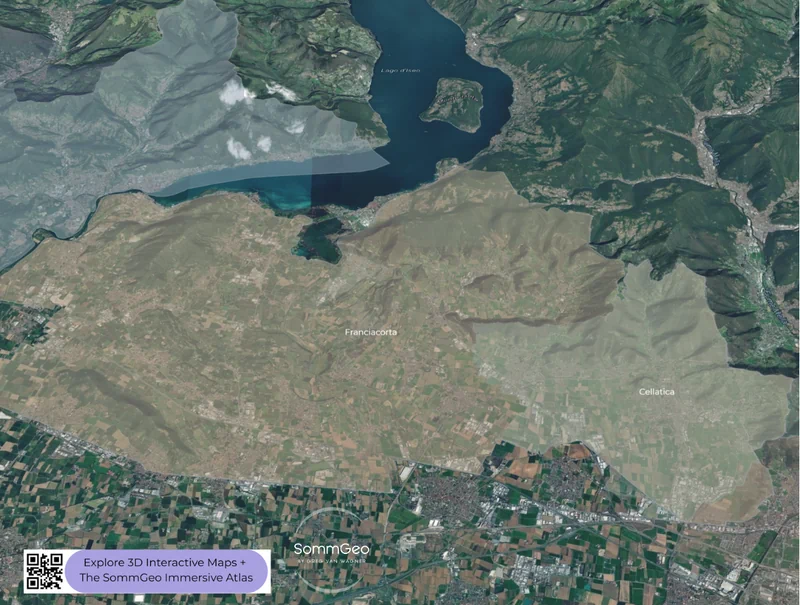
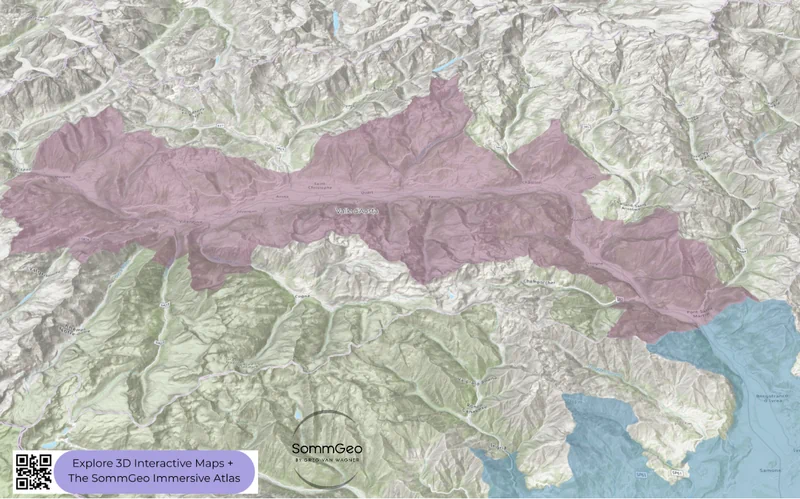

Geography and Site Character of Italy
Italy’s viticultural identity is shaped by one fundamental geographic fact: it’s a long, narrow peninsula flanked by seas on three sides, with the Apennine Mountains running down its spine like a backbone and the Alps forming a wall across the north. This creates an extraordinary range of growing conditions within a relatively compact landmass. In the northwest, the continental climate of Piedmont (sheltered by both the Alps and the Apennines) produces the structured, tannic Nebbiolo wines of Barolo and Barbaresco. In the northeast, the moderating influence of the Adriatic and the cool air descending from the Dolomites gives Friuli-Venezia Giulia and Alto Adige their aromatic precision. Move south and the Mediterranean takes over, with Campania’s volcanic soils (Taurasi, Fiano di Avellino), Puglia’s sun-drenched plateaus, and the dramatic elevations of Etna adding complexity to what could otherwise be a simple warm-climate story.
The soil diversity is equally staggering. Calcareous marls in the Langhe, volcanic basalt and ash on Etna and in Soave, galestro and alberese in Chianti Classico, the tufo of Campania, and the red iron-rich soils of Bolgheri, every major region has a distinct geological signature that shapes its wines in measurable ways. Add in over 500 documented indigenous grape varieties (Italy has more than any other country on earth), and you begin to understand why Italian wine resists easy generalization. The Map Maker lets you see these relationships firsthand. Toggle between topographic and satellite views, run elevation profiles across vineyard sites, and understand why location matters as much here as anywhere in the wine world.
Key Wine Regions
Piedmont
Piedmont is the undisputed king of Italian red wine, and it’s not particularly close. With 19 DOCGs (the most of any region), this is where Nebbiolo reaches its highest expression in Barolo and Barbaresco. The Langhe hills, with their calcareous marl soils and significant diurnal temperature shifts, produce wines of power, structure, and remarkable aromatic complexity. Beyond the Nebbiolo headliners, Barbera d’Asti and Barbera d’Alba deliver some of Italy’s best-value serious reds, while Gavi (from Cortese) and Roero Arneis offer whites with genuine character. The recent elevation of Nizza to DOCG status (2014) signaled what local producers have long known: Barbera from the right sites can compete at the highest level. Producers like Giacomo Conterno, Bruno Giacosa, and Vietti continue to set the standard, but the depth of quality across the region has never been greater.
Tuscany
Tuscany is Sangiovese country, and the range of expression from this single variety across the region is extraordinary. Chianti Classico (the historic heart, not the expanded zones) has seen a dramatic quality revolution, with the Gran Selezione category (introduced in 2014) now representing some of the most serious wines in Italy. Brunello di Montalcino remains the region’s crown jewel for age-worthy Sangiovese, though the topic of officially designating subzones continues to be complicated by local politics (sound familiar?). Bolgheri, on the Tuscan coast, took a completely different path; Sassicaia, Ornellaia, and their neighbors built reputations on Cabernet Sauvignon and Merlot in what became the Super Tuscan movement, proving that great site character transcends grape variety orthodoxy.
Veneto & Friuli-Venezia Giulia
The northeast is Italy’s volume engine and its precision instrument in the same breath. Veneto produces more wine than any other region, anchored by the massive Prosecco DOC, the Valpolicella system (including Amarone, one of Italy’s most distinctive and powerful reds), and Soave, a white wine zone that has quietly become one of the country’s best values when you find the right producers on volcanic soils in the Classico zone. Friuli-Venezia Giulia, by contrast, is all about aromatic whites: Friulano, Ribolla Gialla, Pinot Grigio with actual character, and increasingly exciting orange wines from producers working in the Collio and Colli Orientali del Friuli zones near the Slovenian border.
Southern Italy & the Islands
The south is where the action is for anyone looking at Italian wine’s future. Campania’s volcanic soils produce three of the most compelling DOCGs in all of Italy: Taurasi (Aglianico), Fiano di Avellino, and Greco di Tufo. Puglia, long dismissed as bulk wine territory, is increasingly delivering serious Primitivo and Negroamaro from old-vine vineyards. And then there’s Sicily, specifically Etna, which has become arguably the most talked-about wine region in Italy over the past decade. Nerello Mascalese grown on volcanic slopes at elevations up to 1,000 meters (3,281 ft) produces wines of Burgundian transparency and elegance, with the individual contrade (vineyard sites) showing dramatic site-specific character depending on altitude, aspect, and lava flow age. Producers like Passopisciaro, Benanti, and Ciro Biondi are making wines that belong in any serious conversation about Italy’s finest.
New to the Map Makers? Explore all the tools, tips, and features in our complete walkthrough.
Map Maker Guide →Ready to explore Italy’s wine regions in full detail? Join 200+ wine organizations already using SommGeo.
Start Your 15-Day Free Trial $5/month billed annually after trial · Cancel anytimePlease let us know what you think in the form below. Thanks!