
Central & Southern Italy Wine Tour: Brunello, Etna, Taurasi & Beyond in 3D
From Sangiovese on Tuscan galestro to Aglianico on volcanic slopes. Where indigenous varieties and ancient soils create Italy’s most distinctive wines.
Central and Southern Italy is where volcanic geology, Mediterranean heat, and an extraordinary concentration of indigenous grape varieties converge, and where the relationship between grape and soil is as specific and non-transferable as anywhere in the wine world.
Inside This Tour
This Tour covers Central and Southern Italy with producer profiles, classification details, and vineyard-level data behind every pin. Every map frame is fully interactive. Don’t just watch the flythrough. Click, drag, zoom, and rotate the 3D terrain to explore from any angle, then click every pin for the full content.
- Brunello di Montalcino: north vs. south subzones and how position shapes Sangiovese style
- Chianti Classico producers and the Gran Selezione tier
- Taurasi and Fiano di Avellino: Campania’s Aglianico and white wine benchmarks
- Etna’s volcanic contrade and the producers redefining Sicilian wine
- Abruzzo: Montepulciano d’Abruzzo beyond the bulk market
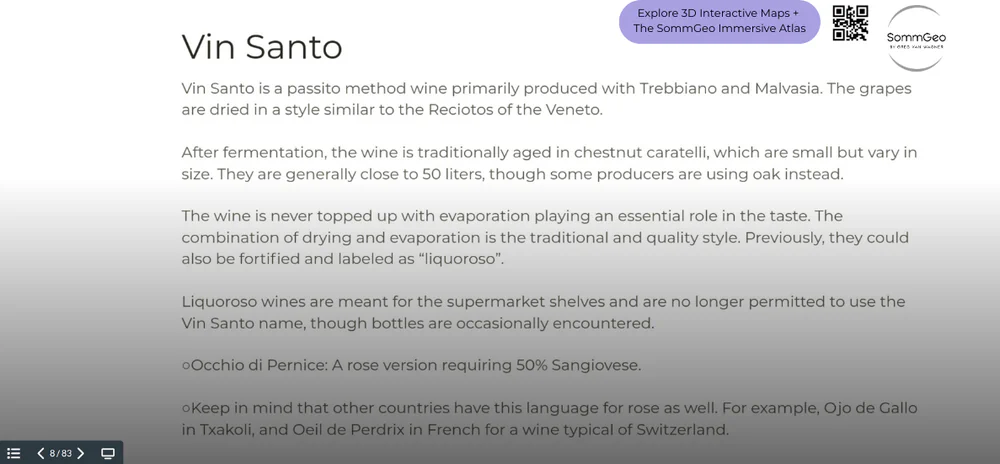
- Vin Santo production, Vino Nobile di Montepulciano, and Umbria’s Sagrantino

What Sets the Center & South Apart
For a geographic overview of all Italian wine regions, see the Italy Fast Map. Here, we focus on the site-specific details that shape the wines.
Central and Southern Italy spans an enormous range of conditions (from the temperate, continental-influenced hills of inland Tuscany to the full Mediterranean heat of coastal Campania and Sicily) and the wines reflect that range. The dominant varieties are deeply rooted in their sites: Sangiovese across Tuscany in its many clonal expressions, Aglianico in the volcanic soils of Campania and Basilicata, Nerello Mascalese on Etna’s lava flows, Montepulciano in Abruzzo and the Adriatic coast, and whites like Fiano and Greco that have been grown in Campania since antiquity. The soils are equally varied: Tuscany’s galestro and alberese clays give way to the volcanic tuff and basalt of Campania and Etna, with pockets of limestone, sand, and marine sediment throughout. What ties it all together is that the grape-to-soil relationships here are extraordinarily specific: move any of these varieties to a different site and the wine changes fundamentally, or stops being interesting at all.
Brunello di Montalcino is the clearest case study in how geography shapes a single variety. The vineyards form a ring around the hilltop town, and the differences between the cooler north and warmer south are dramatic. Northern slopes (Montosoli in particular) produce paler, more aromatic Brunellos with firm acidity and classical structure. Southern slopes (Sant’Angelo in Colle, Castelnuovo dell’Abate) are hotter and drier, producing darker, more powerful wines with riper fruit and salinity. The southeast benefits from Mount Amiata’s cooling night breezes, creating a sweet spot where concentration meets freshness; estates like Poggio di Sotto and Mastrojanni work this terrain. The subzone debate remains politically unresolved, but the stylistic differences are undeniable.
A Closer Look
Taurasi & Fiano di Avellino, Campania
Taurasi is the DOCG for Aglianico in Campania’s Irpinia hills, a grape of extraordinary tannic power and acidity that demands aging and rewards it with earth, tar, dark fruit, and mineral complexity that rivals the best Nebbiolo. The volcanic tuff soils and high elevations (up to 600 meters) keep temperatures in check despite the southern latitude. Fiano di Avellino, from the same hills, is one of Southern Italy’s great white wines: textured, nutty, with a waxy depth that develops well over five to ten years.
Etna, Sicily
Etna has become the most talked-about wine region in Italy over the past decade, and the excitement is warranted. Nerello Mascalese grown on ancient lava flows at elevations up to 1,000 meters produces wines of ethereal transparency: pale color, high acidity, mineral-driven aromatics that have drawn inevitable (if imperfect) comparisons to Burgundy. The contrade system (named vineyard districts on different aspects and elevations of the volcano) is where the real complexity lies.
Abruzzo
Montepulciano d’Abruzzo is one of Italy’s most produced wines, and most of it is unremarkable. But from the right hillside sites in the provinces of Chieti and Teramo (where producers limit yields and work with older vines on calcareous clay) the grape produces deeply colored, structured reds with black cherry, earth, and a savory quality that over-delivers for the price. It’s one of Italy’s best-kept secrets at the serious end.
Producers Worth Knowing
Biondi-Santi, Montalcino, Tuscany
The estate that invented Brunello. Ferruccio Biondi-Santi released the first modern Brunello in 1888, and the family’s Il Greppo vineyard (above 500 meters on calcareous, stony soil southeast of Montalcino town) remains the reference point for austere, age-worthy Brunello. The Riserva, produced only in exceptional vintages, is one of Italy’s most long-lived wines. The style is deliberately restrained: early-picked, structured, and built for decades, not for drinking young.
Benanti, Etna, Sicily
Giuseppe Benanti was among the first to recognize Etna’s potential for world-class wine in the modern era, beginning in the late 1980s. The estate farms vineyards across multiple contrade on the volcano’s slopes, producing Nerello Mascalese reds of remarkable elegance and site-specific Carricante whites. Benanti’s wines helped put Etna on the international map and remain benchmarks for the region.
Arnaldo Caprai, Montefalco, Umbria
Sagrantino di Montefalco was an obscure, near-extinct grape when Marco Caprai took over his family estate in the 1980s. He essentially rescued the variety, investing in vineyard research and modern winemaking to produce Sagrantino of extraordinary tannic density and dark fruit concentration. The 25 Anni bottling is the flagship: one of Italy’s most powerful reds, built for long aging from a grape that produces higher tannin levels than virtually any other variety in the country.
Montevertine, Radda in Chianti, Tuscany
Sergio Manetti founded Montevertine in 1967 and famously withdrew from the Chianti Classico consorzio in the early 1980s rather than comply with rules he felt compromised quality. Le Pergole Torte (100% Sangiovese, no blending, no compromise) is the estate’s defining wine and one of Tuscany’s greatest. It’s technically an IGT, not a DOCG, because Manetti refused to play by rules he didn’t believe in. The estate, now run by his son Martino, remains a symbol of Tuscan independence.
Elena Fucci, Aglianico del Vulture, Basilicata
Elena Fucci’s Titolo (sourced from a single vineyard of old-vine Aglianico at 600 meters on volcanic soils in Basilicata’s Vulture district) is a benchmark for what Southern Italian Aglianico can achieve. The wine combines the grape’s natural power and tannin with a floral, mineral elegance that reflects the volcanic site character. One wine, one vineyard, one grape, and one of the south’s most compelling producers.
Notable Vintages: Central & Southern Italy
Among the standout vintages of the past two decades, 2010 is widely regarded as the finest recent Brunello vintage: classical structure, firm tannins, and exceptional aging potential across Montalcino. 2015 delivered ripe, concentrated Sangiovese across Tuscany with balance that invites comparisons to the great years. 2016 brought freshness, precision, and fine-grained tannins; many producers consider it superior to 2015 for long-term cellaring. 2006 was outstanding across Brunello, Chianti Classico, and much of Southern Italy: rich, structured wines that are drinking beautifully now. 2019 produced excellent results across virtually all Central and Southern Italian regions with freshness and generosity in balance.
On the difficult side, 2014 was cool and wet across Tuscany, with lighter wines that required strict selection; the best are charming but not built for long aging. 2002 was one of the worst vintages in recent Tuscan memory, with heavy rains producing dilute, problematic wines. 2011 brought extreme heat, particularly in Montalcino, producing ripe but sometimes unbalanced Brunellos with low acidity.
New to the Tours? Learn how to navigate frames, click pins for detailed producer and region profiles, and get the most from your 3D experience.
Tours Guide →Ready to go deeper into Central and Southern Italy? Join 200+ wine organizations already using SommGeo.
Start Your 15-Day Free Trial $5/month billed annually after trial · Cancel anytime