
Australia Wine Tour: Key Regions, Producers & the Langtons Classification in 3D
From Hunter Valley Semillon to Tasmanian Pinot Noir. Australia’s wine identity is being rewritten by cool-climate ambition and site-specific precision.
Australia’s wine landscape is vast, fragmented, and in the middle of a genuine identity shift. The 8th edition of the Langtons Classification (the country’s most respected secondary market guide to fine wine) signaled what many producers already knew: the market is moving decisively toward elegance, cool-climate regions, and lighter-bodied styles. Tasmanian Chardonnay, Yarra Valley Pinot Noir, and refined Barossa Shiraz are gaining ground on the blockbuster reds that defined Australian wine for decades. This Tour flies through the regions that matter most, from the oldest wine country in New South Wales to the maritime vineyards of Western Australia, with producer profiles and classification context at every stop.
Unlock the Full SommGeo Toolkit
Gain exclusive access to our entire suite of premium features, including interactive Map Makers, immersive 3D Tours, high-resolution classic Maps, and advanced analytical tools.
Start Free TrialInside This Tour
This Tour covers Australia’s most important wine regions across New South Wales, Victoria, South Australia, Western Australia, and Tasmania. Every map frame is fully interactive. Don’t just watch. Click, drag, zoom, and rotate the 3D terrain to explore from any angle, then click every pin for the full content.
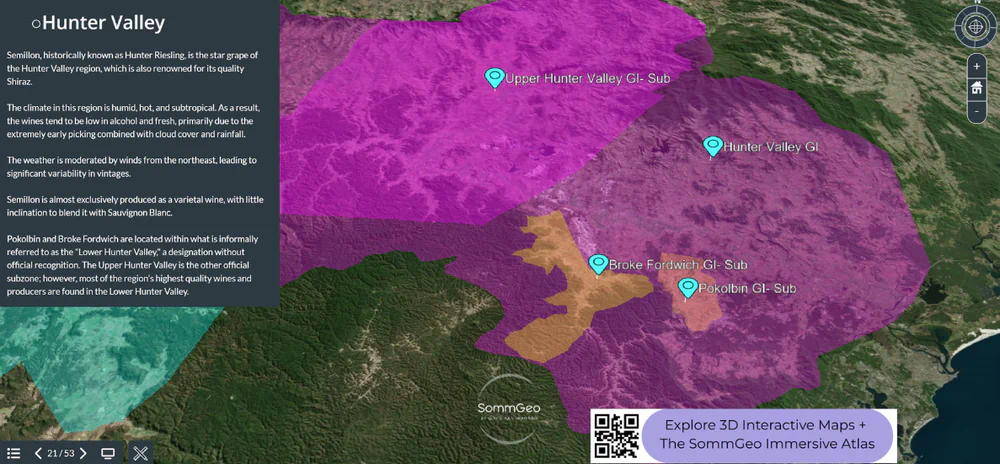
- Hunter Valley subregions and its unique warm-climate Semillon and earthy Shiraz tradition
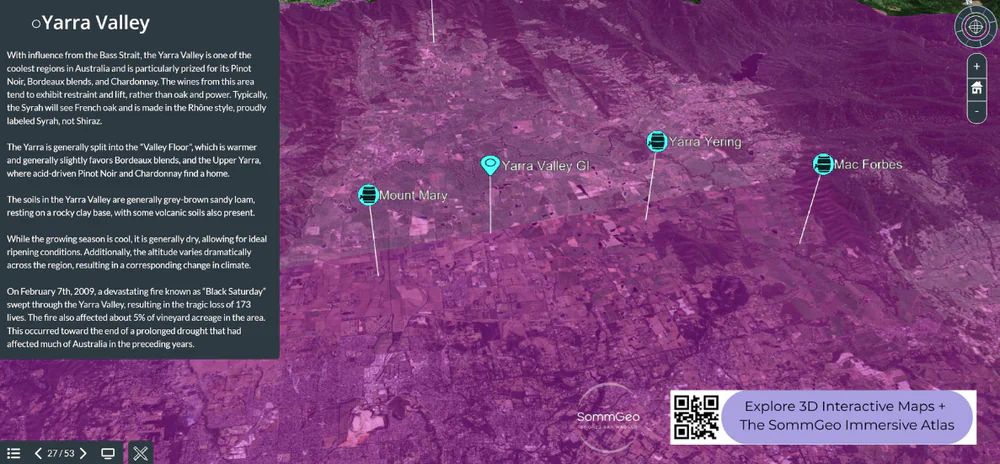
- Yarra Valley: Pinot Noir, Chardonnay, and the cool-climate revolution reshaping Australian fine wine
- Tasmania’s rise as a source of world-class sparkling, Pinot Noir, and Chardonnay
- Coonawarra’s terra rossa soils and their relationship to structured Cabernet Sauvignon
- Margaret River’s maritime climate and its status as Australia’s premium Bordeaux-blend region
- The Langtons Classification: how Australia’s auction-based ranking system works and what it signals
The Langtons Classification & Australia’s Regional Framework
For a geographic overview of Australia’s wine regions, see the Australia Fast Map. Here, we focus on the classification system and regional identity.
Australia doesn’t use a European-style appellation hierarchy. Instead, the Geographical Indication (GI) system defines zones, regions, and subregions, but imposes minimal production rules beyond geographic origin. The real hierarchy comes from the market, and that’s where the Langtons Classification matters. First published in 1990, the Langtons ranks wines based on secondary market performance across a minimum of ten vintages: essentially, what collectors actually buy at auction, consistently, over time. The latest edition simplified the tiers to “First Classified” and “Classified,” with a small group of wines at the top: Penfolds Grange, Henschke Hill of Grace, Leeuwin Estate Art Series Chardonnay, and Wendouree Shiraz among them. The most striking trend in the current edition: a decisive shift toward cool-climate wines, Pinot Noir, and top-tier Chardonnay from Tasmania, the Yarra Valley, and the Mornington Peninsula, with a slight majority of classified wines now coming from cool-climate regions.
Regionally, the key distinction for advanced study is understanding how climate and soil drive style differences. Coonawarra’s famous terra rossa, a thin strip of red limestone soil over a limestone base, produces structured, firm Cabernet Sauvignon with a distinctive minty eucalyptus character. Margaret River’s maritime climate (moderated by both the Indian and Southern Oceans) yields Bordeaux-style blends with balance. The Hunter Valley, despite its warm, humid climate, produces dry Semillon at low alcohol (10–11%) that ages into toasty, honeyed complexity over decades, one of Australia’s most singular wine styles.
Key Producers
Henschke, Eden Valley, Barossa
Hill of Grace is, alongside Penfolds Grange, the most revered Shiraz in Australia. Sourced from a single vineyard of pre-phylloxera vines planted in the 1860s in Eden Valley, it’s a wine of depth and longevity. The Henschke family, now in their sixth generation, farms biodynamically and produces across the Barossa, Eden Valley, and Adelaide Hills, but Hill of Grace remains the reference point for what old-vine Australian Shiraz can achieve.
Leeuwin Estate, Margaret River, Western Australia
The Art Series Chardonnay is Langtons First Classified and regularly cited as one of the finest Chardonnays produced in Australia. Located in the southern end of Margaret River, Leeuwin benefits from maritime cooling and ancient gravelly soils. The Art Series wines (Chardonnay, Cabernet Sauvignon, Riesling, and Shiraz) are produced from estate fruit with an emphasis on site expression over winemaking intervention.
Mac Forbes, Yarra Valley, Victoria
Mac Forbes has become a key voice in Australia’s cool-climate movement. His approach is site-specific and minimal: single-vineyard Chardonnays and Pinot Noirs from different Yarra Valley subregions, each vinified to express the differences between them. The wines are restrained, textural, and more Burgundian in spirit than most Australian producers would dare.
Brokenwood, Hunter Valley, New South Wales
The Graveyard Vineyard Shiraz is Langtons Classified and one of the Hunter Valley’s defining wines: medium-bodied, earthy, and structured in a style that has nothing to do with the big, ripe Shiraz of the Barossa. Brokenwood has been instrumental in demonstrating that Hunter Valley Shiraz is its own thing: savory, regional, and built for long aging in a way that surprises people who associate Australian Shiraz solely with power.
Notable Vintages: Australia
Given Australia’s continental scale, vintage quality varies enormously by region. Among broadly excellent years, 2010 produced outstanding results across South Australia: deep, structured wines from the Barossa, Clare, and McLaren Vale with excellent aging potential. 2012 delivered powerful, stylish Shiraz and Cabernet across most regions. 2013 and 2014 were standouts for Hunter Valley, with low yields from drought producing concentrated Semillon and Shiraz. 2018 was widely praised across Victoria and South Australia, with warm days and cool nights yielding balanced wines with fine tannins and expressive fruit. 2021 is considered one of the best vintages this century for South Australia: average conditions across the season producing fresh, concentrated, ageworthy wines of both quality and quantity.
On the difficult side, 2011 was a washout across much of eastern Australia, with excessive rain producing dilute wines and severe fungal pressure, a genuinely poor year. 2020 was defined by the devastating bushfires; between fire damage, smoke taint, and the smallest harvest in over a decade, many producers lost significant production. 2023 was extremely challenging in Victoria, with too much precipitation and high fungal pressure producing a cool, light, and lean vintage.
New to the Tours? Learn how to navigate frames, click pins for detailed producer and region profiles, and get the most from your 3D experience.
Tours Guide →Ready to go deeper into Australia? Join 200+ wine organizations already using SommGeo.
Start Your 15-Day Free Trial $5/month billed annually after trial · Cancel anytime