
Greece Wine Tour: Naoussa, Santorini, Crete & Beyond in 3D
Indigenous varieties, volcanic soils, and a winemaking tradition older than Rome. Greece’s modern renaissance is built on ancient raw material.
Greece may have the oldest continuous winemaking history in Europe, but for most of the 20th century its wines were an afterthought on the international stage. That’s changed dramatically. A new generation of producers has taken Greece’s extraordinary indigenous grape varieties (Xinomavro, Assyrtiko, Agiorgitiko, Moschofilero, Vidiano) and applied modern winemaking to sites that have been under vine for millennia. The results are wines with a geographic fingerprint you simply can’t find anywhere else. This Tour covers the regions driving that renaissance, from the high-altitude Xinomavro crus of Naoussa to the wind-blasted volcanic vineyards of Santorini.
Unlock the Full SommGeo Toolkit
Gain exclusive access to our entire suite of premium features, including interactive Map Makers, immersive 3D Tours, high-resolution classic Maps, and advanced analytical tools.
Start Free TrialInside This Tour
This Tour covers Greece’s major PDO regions with producer pins, cru designations, and vineyard-level data at every stop. Every map frame is fully interactive. Don’t just watch the flythrough. Click, drag, zoom, and rotate the 3D terrain to explore from any angle, then click every pin for the full content.
- Naoussa’s cru village system and Xinomavro at elevation
- Santorini: volcanic Assyrtiko, kouloura training, and Nykteri
- Crete’s quality resurgence with Vidiano and indigenous reds
- Mantinia: high-altitude Moschofilero in the Peloponnese
- Nemea, Drama, and the broader Greek PDO landscape
- Producer profiles with vineyard holdings and winemaking detail

What Makes Greek Wine Distinct
Greece’s wine identity is built on indigenous varieties that exist virtually nowhere else. Xinomavro (literally “acid black”) in the north produces tannic, high-acid reds that draw comparisons to Nebbiolo: pale color, enormous structure, and an ability to age for decades. Assyrtiko on Santorini is one of the world’s great white grapes, producing wines of razor-sharp acidity and saline minerality from volcanic soils. Moschofilero, Agiorgitiko, Malagousia, Vidiano, the variety list is deep and almost entirely unique to Greece.
The PDO (Protected Designation of Origin) system governs the top appellations. Within that framework, Naoussa has recently introduced cru village designations, a significant step toward site-specific classification that acknowledges what producers have known for decades: that Xinomavro from different villages on Mount Vermion produces meaningfully different wines.
A Closer Look
Naoussa: Xinomavro at Elevation
Naoussa sits on the southeastern slopes of Mount Vermion in Macedonia, at elevations ranging from 150 to over 450 meters (1,476 feet). The combination of altitude, continental climate influence, and limestone-clay soils produces Xinomavro of extraordinary complexity: firm tannins, bright acidity, aromatics of tomato leaf, dried roses, and dark cherry that evolve into leather and tobacco with age. The cru village system now distinguishes sites like Trilofos, Fytia, Giannakochori, and Yiannitsa, each with different elevations, exposures, and soil compositions that shape distinct styles. Higher-altitude villages produce more aromatic, structured wines; lower sites tend toward earlier-maturing richness.
Santorini: Assyrtiko & Nykteri
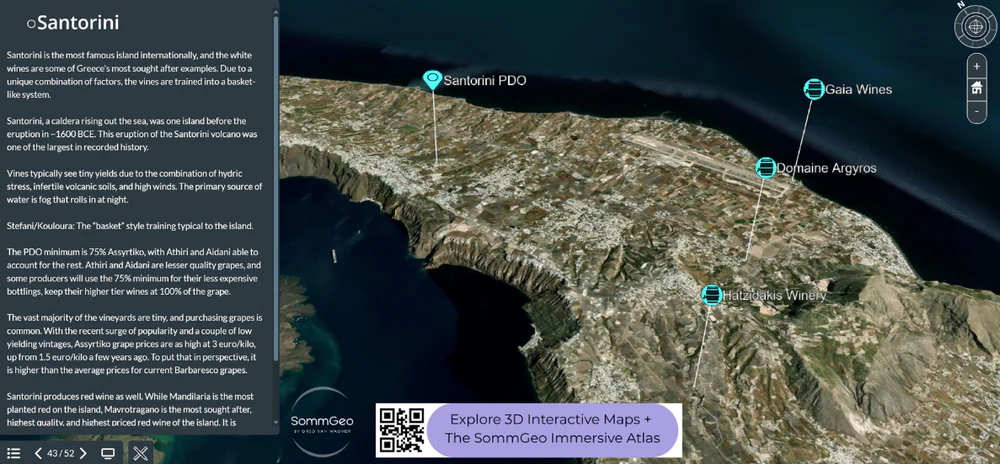
Santorini is one of the most extreme vineyard environments in the world. The island is the rim of a volcanic caldera, and its vineyards grow on pumice, volcanic ash, and mineral-rich soils that have never seen phylloxera. Vines are trained in the kouloura basket shape, coiled close to the ground to protect them from the relentless Aegean wind. Assyrtiko from these conditions produces wines of piercing acidity, saline minerality, and citrus intensity. Nykteri is the island’s traditional barrel-fermented, higher-alcohol style: richer and more textured, aged in oak, and increasingly sought after as a serious alternative to the fresh, unoaked bottlings.
Crete
Crete is experiencing a genuine quality revolution. Greece’s largest island has been making wine for over 4,000 years, but modern investment and a focus on indigenous varieties like Vidiano (white) and Kotsifali and Mandilari (red) are producing wines that compete at a level Cretan wine hasn’t reached in the modern era. The island’s size creates significant climatic diversity (from hot, dry coastal sites to cooler, elevated inland vineyards) and the best producers are increasingly identifying specific sites that drive distinctive character.
Mantinia
The Mantinia plateau in the central Peloponnese sits at 650 meters (2,133 feet), one of the highest vineyard sites in Greece. Moschofilero, a pink-skinned aromatic variety, is the sole grape of the PDO and produces whites of floral intensity, delicate structure, and refreshing acidity. It’s an excellent-value introduction to Greek white wine and increasingly used as a base for quality sparkling production.
Producers Worth Knowing
Karydas, Naoussa
A small-production estate focused exclusively on Xinomavro from old vines in Naoussa. The wines are traditional in the best sense: extended maceration, large-format oak aging, and a refusal to chase ripe, modern extraction. Karydas produces Xinomavro of serious structure and aging potential that rewards patience, consistently among the most site-expressive wines in the appellation.
Kir-Yianni, Naoussa & Amyndeon
Founded by Yiannis Boutaris (of the Boutari wine dynasty), Kir-Yianni operates across two key northern Greek appellations. The Naoussa holdings on Mount Vermion produce benchmark Xinomavro, while the Amyndeon vineyards at 620–700 meters (2,034–2,297 feet) grow quality Greek Pinot Noir alongside Xinomavro rosé. The estate’s single-vineyard bottlings (Diaporos and Ramnista) demonstrate the range Xinomavro achieves from different sites.
Alpha Estate, Amyndeon
Angelos Iatridis and Makis Mavridis founded Alpha Estate in 1997 in Amyndeon, one of Greece’s highest and coolest appellations near the border with North Macedonia. The estate has become a reference for both Xinomavro and Sauvignon Blanc in northern Greece, with a winemaking precision that reflects Iatridis’s Bordeaux training. The Hedgehog Vineyard single-vineyard Xinomavro and the reserve SMX blend are standouts.
Gaia Wines, Santorini & Nemea
Yiannis Paraskevopoulos (one of Greece’s most respected enologists) and Leon Karatsalos founded Gaia in 1994 with a dual focus: Assyrtiko on Santorini and Agiorgitiko in Nemea. On Santorini, the Thalassitis bottling (wild-fermented Assyrtiko aged on lees) has become a benchmark for the island’s potential. In Nemea, the single-vineyard Agiorgitiko bottlings show what the Peloponnese’s signature red grape can achieve when taken seriously.
Notable Vintages: Macedonian Reds
Naoussa has long been one of the key Greek regions for ageworthy red wine, and vintage character can matter noticeably for long‑term cellaring of Xinomavro. Opinions vary by producer and taster, but several recent and older years are often mentioned as particularly promising for those interested in the style.
2018 is generally seen as a successful modern vintage, with many wines showing a mix of structure, ripeness, and aromatic interest that should allow for graceful development in bottle. It may not be universally viewed as a reference year, yet it has given a number of well‑regarded, cellar‑worthy bottlings. 2012 is frequently described in more classic terms, with lively acidity and firm but refined tannins that suggest a long drinking window. 2011 is also often cited as a good year, producing wines that combine ripeness with balance and can reward some patience in the cellar.
By contrast, 2006 and 2008 are sometimes viewed as more uneven: conditions in those years seem to have posed challenges for some growers, and the resulting wines can be less consistent, with quality depending more heavily on producer and specific bottling.
New to the Tours? Learn how to navigate frames, click pins for detailed producer and region profiles, and get the most from your 3D experience.
Tours Guide →Ready to go deeper into Greece’s wine regions? Join 200+ wine organizations already using SommGeo.
Start Your 15-Day Free Trial $5/month billed annually after trial · Cancel anytime