
Austria Wine Tour: DAC System, Wachau Vineyards & Classifications in 3D
From the terraced Riesling slopes of the Wachau to the Blaufränkisch heartland of Burgenland. Austria’s wine law is as precise as its best wines.
Austria’s wine identity was rebuilt from scratch after the 1985 scandal, and what emerged is one of Europe’s most rigorous and forward-thinking quality frameworks. The DAC system (Districtus Austriae Controllatus), completed in 2023 when Thermenregion became the final region to join. DAC now covers all 18 winegrowing regions, and most DACs are moving to a three‑tier origin pyramid (Gebietswein, Ortswein, Riedenwein) that runs from regional to village to single vineyard.. The Wachau maintains its own parallel classification (Steinfeder, Federspiel, and Smaragd) while producers like F.X. Pichler are quietly redefining what Austrian Riesling and Grüner Veltliner can be. This Tour walks through the legal framework, the top vineyard sites, and the producers shaping Austrian wine at its highest level.
Unlock the Full SommGeo Toolkit
Gain exclusive access to our entire suite of premium features, including interactive Map Makers, immersive 3D Tours, high-resolution classic Maps, and advanced analytical tools.
Start Free TrialInside This Tour
This Tour covers Austria’s major wine-growing regions along the Danube, through Lower Austria, and into Burgenland and Styria, with detailed pins on every major producer, vineyard site, and classification tier. Every map frame is fully interactive. Don’t just watch the flythrough. Click, drag, zoom, and rotate the 3D terrain to explore from any angle, then click every pin for the full content.
- The complete DAC system: 18 regions, three-tier origin pyramid, and what it means for labeling
- Wachau’s Steinfeder, Federspiel, and Smaragd classifications and top vineyard sites (Rieds)
- Producer profiles: F.X. Pichler, Emmerich Knoll, Hirtzberger, Prager, and more
- Kremstal and Kamptal: how neighboring Danube regions differ in soil and style
- Burgenland reds: Blaufränkisch, Zweigelt, and the emergence of St. Laurent
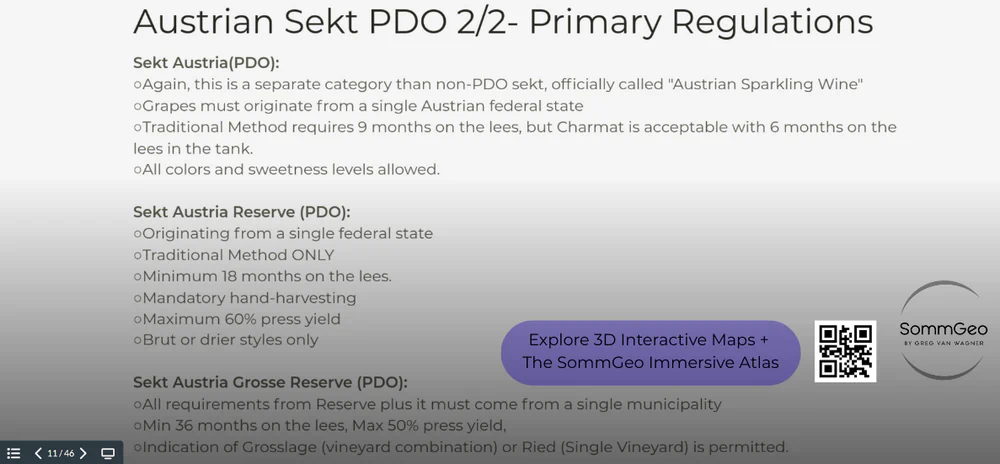
- Austrian Sekt: the three-tier sparkling classification from Klassik to Grosse Reserve
Austrian Wine Law & the DAC System
For a geographic overview of Austria’s wine regions, see the Austria Fast Map. Here, we focus on the classification framework.
The DAC system launched in 2003 with Weinviertel and was completed twenty years later when Thermenregion joined in 2023. It’s an origin-based framework modeled loosely on France’s AOC; each of the 18 DAC regions defines which grape varieties are permitted, what styles are typical, and how wines must be labeled. Most DACs now use a three-tier pyramid: Gebietswein (regional), Ortswein (village), and Riedenwein (single vineyard). Wines that don’t meet their region’s DAC requirements are labeled with the broader federal state name instead, a meaningful distinction on the shelf.
The Wachau operates within the DAC system (from the 2020 vintage onward) but retains its own classification controlled by the Vinea Wachau association since 1984. Steinfeder (light, under 11.5% alcohol), Federspiel (medium-bodied, 11.5–12.5%), and Smaragd (full-bodied, 12.5%+) describe style tiers rather than vineyard hierarchy, though the best Smaragd wines from top Rieds like Kellerberg, Singerriedel, and Achleiten are among the finest dry whites in Austria. Austria’s newest legal development is the Erste Lage (Premier Cru) and Grosse Lage (Grand Cru) vineyard classification, making Austria the only country outside France with a nationwide, legal site-classification system.
A Closer Look
The Wachau & Kremstal
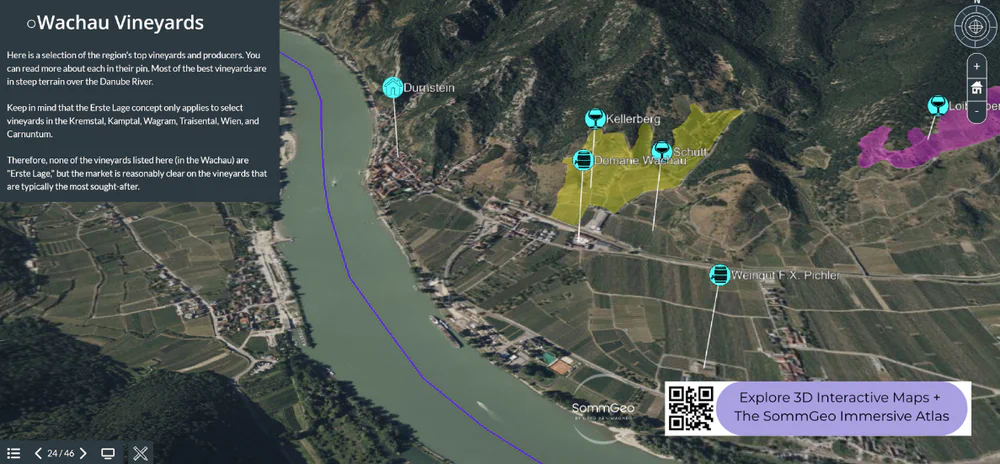
The Wachau’s steep, terraced vineyards along the Danube (primarily gneiss, mica schist, and granite soils) produce Grüner Veltliner and Riesling of extraordinary mineral concentration. The top Rieds (Kellerberg, Singerriedel, Achleiten, Schütt, Loibenberg) are reference sites for both varieties. Neighboring Kremstal, where loess soils dominate the lower slopes, produces a rounder, earlier-accessible style of both grapes, still precise, but with less of the Wachau’s razor-edged structure.
Burgenland Reds
Burgenland is Austria’s red wine heartland. Mittelburgenland DAC is built around Blaufränkisch: medium-bodied, peppery, with firm acidity and aging potential that has drawn comparisons to cool-climate Syrah. Leithaberg DAC spans both whites and reds, with Blaufränkisch from limestone and schist soils producing wines of notable elegance. Neusiedlersee, warmed by the shallow lake, is Zweigelt territory and the home of Austria’s botrytis sweet wines around Rust and Illmitz.
Producers Worth Knowing
F.X. Pichler, Wachau
The most revered name in the Wachau. Now run by Lucas Pichler and his wife Johanna, the estate has shifted from the rich, muscular style that built its reputation in the 1990s toward earlier picking, moderate alcohol (around 13%), and a sharper focus on mineral precision. The Ried Kellerberg Riesling and the Unendlich bottlings are benchmarks: wines that combine stone fruit intensity with a crystalline freshness that’s redefining what Wachau Smaragd can be.
Emmerich Knoll, Wachau
Based in Loiben, Knoll is the traditionalist’s reference for the Wachau. The Ried Schütt Riesling Smaragd is consistently one of Austria’s finest whites: dense, structured, and built for decades of aging. Where F.X. Pichler has moved toward a lighter touch, Knoll maintains a style of generous weight and textural richness that showcases what late-picked Wachau fruit can deliver.
Franz Hirtzberger, Wachau
Hirtzberger farms the Singerriedel (one of the steepest and most dramatic Rieds in the Wachau) along with Honivogl and Rotes Tor. The Singerriedel Riesling Smaragd is the estate’s calling card: concentrated, mineral-driven, and capable of extraordinary longevity. Franz Hirtzberger Jr. maintains the late-picked, textural style, producing wines that are unambiguously powerful yet refined.
Notable Vintages: Austria
Among the standout vintages of the past two decades, 2019 is considered one of the most elegant in recent memory: long hang time, cool autumn nights, and wines marked by minerality, precision, and complexity across both Riesling and Grüner Veltliner. 2017 brought concentration from low yields (spring frost damage) and a warm, dry summer, producing structured wines with excellent aging potential. 2015 was a hot year that produced full-bodied, generous whites with lower acidity, powerful but fast-maturing. 2013 delivered particularly concentrated Grüner Veltliner. 2011 was outstanding for reds, with generous yields and hot weather producing Burgenland’s best Blaufränkisch of the decade.
Conversely, 2016 was a year of rain and hailstorms; the Weinviertel lost 1,000 hectares (2,471 acres) to hail damage alone, and quality was uneven across all regions. 2014 saw rain through much of the growing season, producing lighter wines that required careful selection.
New to the Tours? Learn how to navigate frames, click pins for detailed producer and region profiles, and get the most from your 3D experience.
Tours Guide →Ready to go deeper into Austria? Join 200+ wine organizations already using SommGeo.
Start Your 15-Day Free Trial $5/month billed annually after trial · Cancel anytime