
Spain Wine Tour: Rioja, Priorat, Sherry, Ribera del Duero & Beyond in 3D
From the solera cellars of Jerez to high-altitude Tempranillo on the Meseta. Spain’s wine landscape is being rewritten in real time.
Spain has more vineyard land under vine than any country on earth, and the gap between its bulk production and its fine wine ambitions has never been wider. Rioja and Ribera del Duero remain the established pillars, but the most exciting developments are happening at the edges: Priorat’s new village classification system, the rediscovery of old-vine Garnacha around Madrid, Galicia’s Godello and Mencía rewriting the script on Spanish white and light red wine, and Cava’s ongoing identity crisis. Sherry, meanwhile, remains one of the most complex and undervalued wine styles on the planet. This Tour covers the full country: the traditions, the revolutions, and the producers driving both.
Unlock the Full SommGeo Toolkit
Gain exclusive access to our entire suite of premium features, including interactive Map Makers, immersive 3D Tours, high-resolution classic Maps, and advanced analytical tools.
Start Free TrialInside This Tour
This Tour covers Spain from Galicia to Andalucía, with DO boundaries, producer pins, and classification detail at every stop. Every map frame is fully interactive. Don’t just watch the flythrough. Click, drag, zoom, and rotate the 3D terrain to explore from any angle, then click every pin for the full content.
- Priorat’s new Vi de Vila village classification system
- Sherry production: biological vs. oxidative aging, solera terms, and the Jerez triangle
- High-altitude Tempranillo: Ribera del Duero, Toro, and the Meseta
- Galicia: Godello, Albariño, and Mencía in the Atlantic northwest
- Cava’s fragmentation and the Corpinnat alternative
- Madrid’s Garnacha revival and emerging Central Spain regions
Priorat, Sherry & Cava: Three Systems in Flux
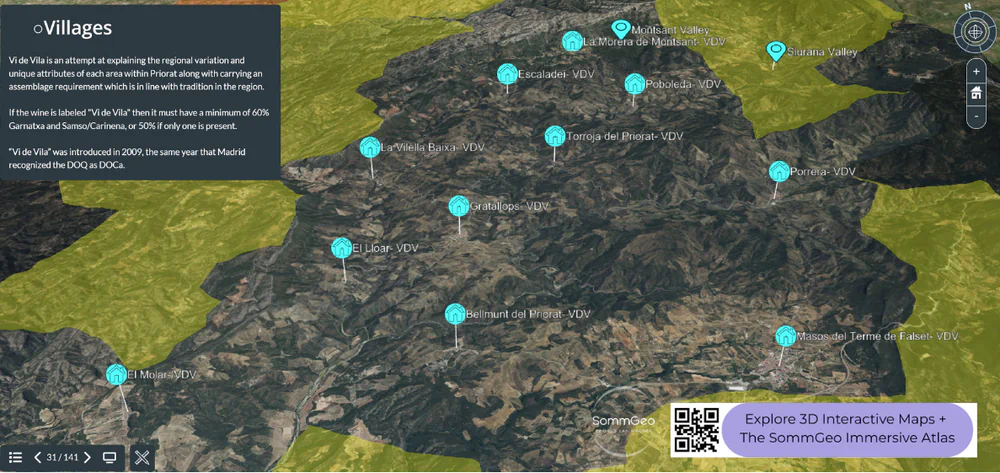
Priorat’s new Vi de Vila (village wine) classification is the most ambitious site-hierarchy project in Spain. Modeled loosely on Burgundy’s approach, it creates a pyramid from DOQ Priorat (regional) through Vi de Vila (village-level, with 12 villages designated) up toward eventual single-vineyard classifications. The wines must come from old vines, low yields, and specific soil types: primarily the llicorella slate that gives Priorat its mineral, concentrated character. It’s still evolving, but it represents a genuine shift toward site-specific identity in a country that has historically classified by aging time rather than vineyard origin.
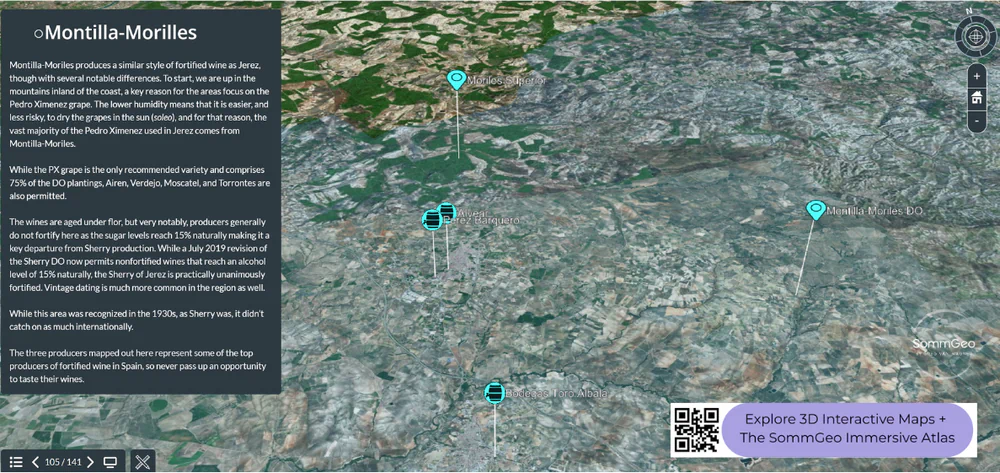
Sherry’s production system is built on two biological processes: flor (a film of yeast that protects wine from oxidation, producing the light, tangy Fino and Manzanilla styles) and oxidative aging (producing the darker, nuttier Amontillado, Oloroso, and Palo Cortado styles). The solera system, fractional blending across multiple vintages, ensures consistency and complexity. Jerez de la Frontera, Sanlúcar de Barrameda (Manzanilla only, where sea air creates a thicker flor), and El Puerto de Santa María form the production triangle.
Cava, meanwhile, is in the middle of an identity crisis. The DO spans a vast geographic area (predominantly Penedès but technically allowing production in parts of Rioja, Aragón, and elsewhere), and the quality range from mass-market to artisanal is enormous. The Corpinnat designation, created in 2018 by a group of top producers who felt Cava’s brand was too diluted, requires organic farming, hand-harvesting, mostly estate fruit, and extended aging. It’s effectively a secession by the quality end of Cava production.
A Closer Look
High-Altitude Tempranillo
Ribera del Duero, at 700–1,000 meters (2,297–3,281 feet) on the Castilian Meseta, produces Spain’s most structured, age-worthy Tempranillo (locally called Tinto Fino or Tinta del País). The extreme diurnal temperature swings (hot days, cold nights) preserve acidity while building concentration and color. Toro, to the west, is even more extreme: old-vine Tinta de Toro (another Tempranillo clone) on sandy soils produces wines of extraordinary power and dark fruit density, often from ungrafted, pre-phylloxera vines.
Galicia: The Atlantic Northwest
Galicia is Spain’s coolest, wettest wine region, and its indigenous white varieties, Albariño in Rías Baixas, Godello in Valdeorras and Bierzo, Treixadura in Ribeiro, produce wines of freshness and aromatic complexity that have nothing in common with the warm-climate Spanish stereotype. Mencía, the red grape of Bierzo and Ribeira Sacra, makes light-to-medium-bodied reds of bright acidity, floral aromatics, and mineral character from steep slate slopes.
Madrid’s Garnacha Revival
The Vinos de Madrid DO, long overlooked, is experiencing a quiet revolution driven by old-vine Garnacha from granitic soils in the Sierra de Gredos foothills. Producers like Comando G, Bernabeleva, and Daniel Landi are making wines of transparency and freshness from high-altitude bush vines: pale, perfumed, and mineral. It’s one of the most exciting emerging scenes in European wine.
Producers Worth Knowing
Vega Sicilia, Ribera del Duero
Spain’s most prestigious wine estate, producing Tempranillo (with small amounts of Cabernet Sauvignon and Merlot) from vineyards along the Duero River since 1864. Único, the flagship, is aged for a decade or more before release, a blend of Tempranillo and Cabernet that combines power with a refinement unmatched in Spanish wine. Valbuena 5°, released younger, is itself among Ribera’s finest wines. The estate also owns Pintia (Toro) and Oremus (Tokaj, Hungary).
Descendientes de J. Palacios, Bierzo
Álvaro Palacios (of Priorat’s L’Ermita fame) and his nephew Ricardo Pérez launched this project in Bierzo to demonstrate that Mencía on old-vine steep slate could produce wines of genuine grandeur. The single-vineyard bottlings (La Faraona, Las Lamas, Moncerbal) are made from tiny, high-altitude parcels farmed biodynamically, and they’ve single-handedly put Bierzo on the international fine wine map. Villa de Corullón, the entry cuvée, is itself exceptional.
Artadi, Rioja / Álava
Juan Carlos López de Lacalle famously withdrew Artadi from the Rioja DOCa in 2015, choosing to label his wines as Vino de Mesa rather than comply with regulations he felt prioritized blending over site expression. The single-vineyard bottlings (Viña El Pisón, La Poza de Ballesteros, Valdeginés) are from old Tempranillo vines in Rioja Alavesa’s Laguardia, and they demonstrate the potential for site-specific Rioja with a precision and purity that the traditional system doesn’t always encourage.
Valdespino, Jerez
Valdespino is one of the oldest Sherry houses (founded 1264) and one of the very few to still ferment entirely in barrel rather than stainless steel. The Inocente Fino, from a single vineyard, Macharnudo Alto, fermented and aged under flor in its own dedicated solera, is the benchmark for how complex and site-specific Fino Sherry can be. The Tío Diego Amontillado and Don Gonzalo Oloroso are equally definitive. Now owned by the Estévez group, quality has remained exceptional.
Gramona, Penedès / Corpinnat
Gramona is one of the founding members of Corpinnat, the breakaway quality designation for top Catalan sparkling wine. The III Lustros (minimum 60 months on lees) and Enoteca (120+ months) bottlings demonstrate that Catalan sparkling wine can achieve a complexity that rivals some Champagne. Gramona’s decision to leave Cava for Corpinnat was a statement that quality-focused producers need a designation that reflects their standards.
Notable Vintages: Spain
Among the standout recent vintages, 2004 is widely considered one of the great modern Ribera del Duero vintages: classical structure and freshness with outstanding aging potential. 2010 was excellent across Rioja and Ribera, producing balanced, precise wines. 2016 delivered very good results in Priorat, with concentration and minerality in balance. 2001 was outstanding in Rioja: elegant, structured wines that are drinking beautifully now. 2019 produced strong results across most of Spain, with freshness despite the warming trend.
On the difficult side, 2013 was cool and late across much of northern Spain, producing uninspiring results in Rioja and Ribera del Duero, though Mediterranean regions like Priorat fared well. 2017 saw devastating spring frosts slash yields by at least 25% across Rioja, and the ongoing drought pushed alcohol, tannin, and extraction to elevated levels; the best wines are concentrated, but selectivity is essential.
New to the Tours? Learn how to navigate frames, click pins for detailed producer and region profiles, and get the most from your 3D experience.
Tours Guide →Ready to go deeper into Spain? Join 200+ wine organizations already using SommGeo.
Start Your 15-Day Free Trial $5/month billed annually after trial · Cancel anytime