
Portugal Wine Regions Map: Interactive Guide
From the terraced schist of the Douro to the volcanic slopes of Madeira. Exploring the geography behind one of Europe’s most underestimated wine countries.
Portugal is a country that punches well above its weight class. Smaller than Indiana, it packs 14 regional wine areas, 31 DOP designations, and over 250 indigenous grape varieties, most of which you won’t find anywhere else on the planet. The Douro Valley alone holds the distinction of being the world’s first formally demarcated wine region (1756), and from there you’ll find everything from the Atlantic-lashed granitic vineyards of Vinho Verde to the sun-baked plains of the Alentejo to the volcanic island terraces of Madeira. The geographic compression is staggering: maritime, continental, Mediterranean, and subtropical climates all exist within a country you can drive across in a few hours. This interactive Portugal wine regions map lets you explore every DOP, sub-region, and geographic influence shaping these wines, and every mapped region includes detailed popup content covering grape varieties, climate and geographic profiles, soil types, wine law, and viticulture, putting a sommelier-level reference guide directly inside the map.
Unlock the Full SommGeo Toolkit
Gain exclusive access to our entire suite of premium features, including interactive Map Makers, immersive 3D Tours, high-resolution classic Maps, and advanced analytical tools.
Start Free TrialWhat You’ll Explore
This interactive portal maps every major Portuguese wine region and DOP designation across the mainland and islands, but the real depth is in what each region reveals. Click on any mapped area and a comprehensive info panel opens with sommelier-level content: indigenous grape varieties, climate and geographic profiles, soil composition, wine law and classification details, and the viticultural specifics that define each region. Whether you’re reading about the schist terraces of the Cima Corgo and their role in premium Port production, the granitic soils driving Vinho Verde’s mineral freshness, or the volcanic basalt giving Madeira’s noble varieties their character, every single region on the map carries this level of built-in intelligence.
- All 14 regional wine areas and 31 DOC/DOP boundaries with filterable layers
- In-depth region profiles for every mapped area: varieties, wine law, soils, and climate
- Lisboa’s historic appellations: Colares, Bucelas, and Carcavelos DOPs
- Madeira island vineyard zones with elevation and aspect data
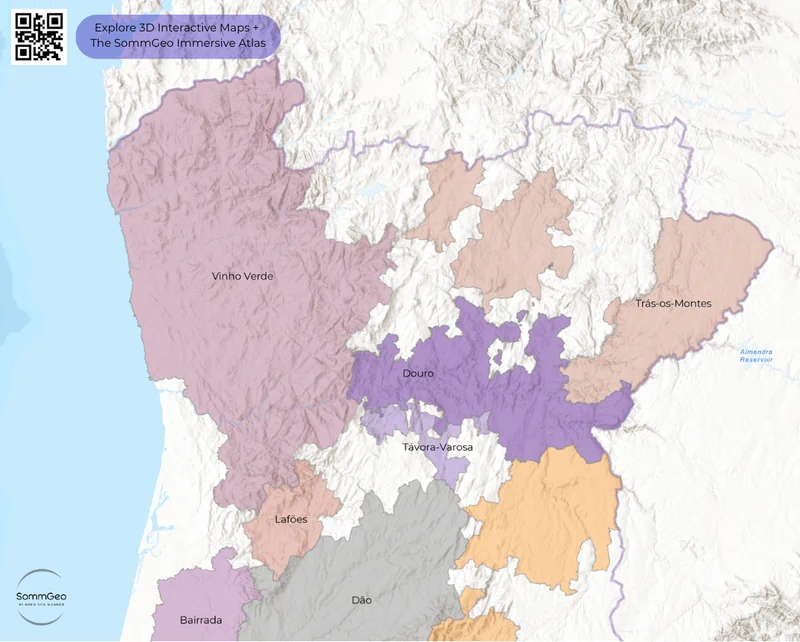
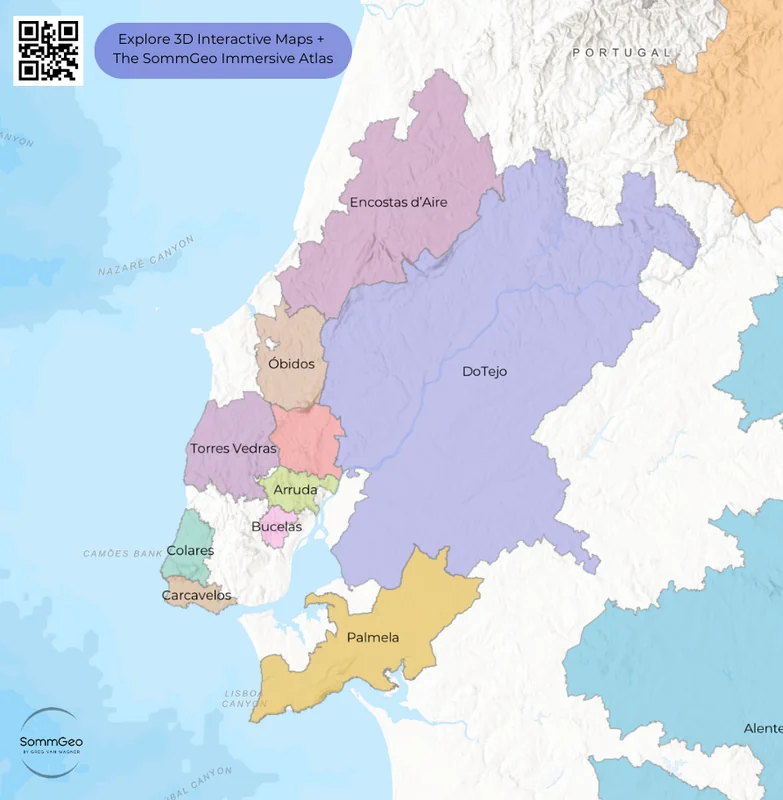
The Great Divide: Northern vs. Southern Portugal
Understanding Portuguese wine starts with a single geographic fact: the north and south are fundamentally different countries when it comes to climate, soil, and wine style. The dividing line runs roughly along the Tagus River (Tejo), and the contrast is dramatic.
Northern Portugal is granitic, Atlantic-influenced, and cool. Rainfall in Vinho Verde can exceed 1,500mm (59.1 in) annually, and the lush green landscape looks nothing like the stereotypical image of sun-baked Iberia. Move inland past the Serra do Marão and the Douro Valley is the opposite extreme: brutally hot summers, cold winters, and steep schist slopes where the river carves a dramatic canyon. The Dão, tucked behind a ring of mountains, produces some of the most elegant reds in the country from granitic sandy soils. Bairrada, closer to the coast, is known for the tannic, age-worthy Baga grape on its distinctive clay-limestone soils.
South of the Tejo, the landscape opens up. The Alentejo is Portugal’s largest wine region by area: rolling plains of cork oak, olive trees, and increasingly modern viticulture under a Mediterranean climate. Temperatures regularly hit 40°C (104°F) in summer, and the wines tend toward ripe, approachable reds from Aragonês (Tempranillo), Trincadeira, and Alicante Bouschet. The Setúbal Peninsula is Moscatel country. And Lisboa, wrapping around the capital, contains some of Portugal’s most historically significant (and most endangered) appellations (Colares, Bucelas, and Carcavelos) where urban sprawl has reduced centuries-old vineyards to a handful of hectares.
Portuguese Wine Law
Portugal’s wine classification system follows the EU framework but carries its own distinct terminology and history. At the top sits DOP (Denominação de Origem Protegida), still commonly referred to by its traditional label DOC (Denominação de Origem Controlada). These are the most strictly regulated wines; production rules govern permitted grape varieties, maximum yields, minimum alcohol levels, and aging requirements. There are 31 DOP designations across the country, from the massive Douro to the tiny Colares.
Below DOP sits IGP (Indicação Geográfica Protegida), traditionally labeled as Vinho Regional (VR). These cover 14 larger regional areas and offer significantly more flexibility; you’ll find international varieties like Syrah and Cabernet Sauvignon here, and some of Portugal’s most creative winemakers deliberately choose the Vinho Regional designation to work outside the constraints of DOP rules. It’s worth noting that an IGP/VR label doesn’t necessarily mean lesser quality; some outstanding wines carry the designation by choice. At the base is simply “Vinho,” table wine with no geographic indication.
One detail that matters for the Douro: Port wine has its own parallel classification system, though not found on labels. Vineyards in the demarcated Douro region are graded from A (the best) down to F based on factors including altitude, soil, orientation, yield, and vine age. The higher the classification, the more the grower is paid for their grapes. It’s one of the most rigorous vineyard quality systems anywhere in the world.
Indigenous Grape Varieties
Portugal has over 250 native grape varieties according to Wines of Portugal. This is the country’s secret weapon. While most of the New World planted Cabernet, Merlot, and Chardonnay, Portugal doubled down on its own grapes, and the result is a wine identity that’s hard to replicate anywhere else.
The headline reds include Touriga Nacional (widely considered Portugal’s finest grape: intensely aromatic, deeply colored, and structured for aging), Touriga Franca (the backbone of many Douro blends and Port), Tinta Roriz (Tempranillo under its Portuguese name), and Trincadeira (versatile and widely planted in the south). Baga, native to Bairrada, is capable of producing tannic, age-worthy wines that some compare to Nebbiolo in their youth. In the Dão, Jaen (known as Mencía in Spain) makes soft, velvety reds.
The whites are equally compelling. Alvarinho dominates Vinho Verde’s finest bottlings and is gaining international recognition. Arinto provides the acid spine for white wines from Lisboa to the Azores. Encruzado, the star of the Dão, produces structured, mineral whites with real aging potential. Fernão Pires is the most widely planted white variety in the country, though rarely the most exciting. And then there are the fortified wine grapes: Sercial, Verdelho, Bual, and Malvasia on Madeira; Touriga Nacional and its field-blend companions in the Douro for Port. Fewer than 15 varieties account for the majority of plantings, which means there’s an enormous reservoir of untapped potential in the remaining 235+ native grapes. Expect to hear more about these in the years ahead.
The Douro Valley & Port Wine
The Douro is the most highly regarded Portuguese wine region. Formally demarcated in 1756 by the Marquis of Pombal (making it the world’s first regulated wine region) the valley is a UNESCO World Heritage landscape of terraced vineyards carved into steep schist slopes along the Douro River. For centuries, this was strictly Port country. The fortified wine was born of necessity (brandy added to stabilize wines for the long sea voyage to England), but the result was something extraordinary: wines of power, sweetness, and complexity that age for decades.
The region divides into three sub-regions. Baixo Corgo, closest to the Atlantic influence of the Serra do Marão, is the coolest and wettest, producing lighter, earlier-maturing styles. Cima Corgo is the heart of premium Port production, where the steep vineyards around Pinhão and São João da Pesqueira yield the most concentrated fruit. Douro Superior, the easternmost and driest zone, is increasingly recognized for serious single-quinta Ports and powerful dry reds.
Nowadays, the Douro’s dry table wines are arguably the bigger story for wine professionals. Producers like Niepoort, Quinta do Crasto, and Quinta do Vale Meão (home of the legendary Barca Velha, first produced in 1952) are making structured, age-worthy reds from field blends of indigenous varieties: Touriga Nacional, Touriga Franca, Tinta Roriz, Tinta Barroca, and Tinto Cão among them. The quality has never been higher, and for the price, Douro reds remain some of Europe’s best values.
Vinho Verde
Vinho Verde is Portugal’s largest appellation, and if you think it’s just cheap, fizzy patio wine, the top bottlings might surprise you. The name loosely means “young wine” (though “green wine” is the direct translation), and while the entry-level blends are designed for easy drinking, the region’s best single-varietal wines (particularly Alvarinho from Monção e Melgaço) compete with top white wines from many appellations in Europe.
The region occupies the northwest corner of Portugal, bounded by the Minho River along the Spanish border and the Douro to the south. Nine sub-regions reflect meaningful differences in site character. Monção e Melgaço stands apart as the only sub-region sheltered from direct Atlantic influence, producing fuller-bodied Alvarinho with minerality and aging potential that would surprise anyone raised on €5 supermarket Vinho Verde. Elsewhere, granitic soils dominate, contributing to the wines’ characteristic freshness and structure. The dominant white varieties (Alvarinho, Loureiro, Arinto (locally called Pedernã), Avesso, Azal, and Trajadura) are almost entirely indigenous, and each brings something different to the glass.
Madeira
Madeira wine is one of the great outliers of the wine world. Produced on a volcanic island nearly 400 kilometers (249 miles) north of the Canary Islands and 520 kilometers (323 miles) west of Morocco, it’s a fortified wine deliberately subjected to heat and oxygen, conditions that would destroy any other wine. The result is something virtually indestructible, with the best vintages capable of aging for a century or more.
The island’s geography is defined by its volcanic basalt soils, extreme topography, and the interplay of altitude and aspect. The four noble white grape varieties (Sercial, Verdelho, Bual, and Malvasia (Malmsey)) each gravitate to specific elevations and sides of the island. Sercial, the driest style, thrives at the highest altitudes (up to 800 meters (2,625 ft)) on the cooler north side, where it barely reaches physiological ripeness. Malvasia, the sweetest, favors the warmer, lower-elevation south coast. Tinta Negra, the workhorse red variety, accounts for roughly 85% of production and is capable of mimicking all four noble styles depending on where it’s planted and how it’s vinified. The rare fifth noble grape, Terrantez, is making a quiet comeback, but remains exceedingly scarce.
New to the Fast Maps? Learn how to search regions, navigate layers, and get the most from your interactive map.
Fast Map Guide →Ready to explore Portugal’s wine regions in full detail? Join 200+ wine organizations already using SommGeo.
Start Your 15-Day Free Trial $5/month billed annually after trial · Cancel anytime