
Chablis Wine Map — Free Download
Seven Grand Crus on one hill, Premier Crus on two riverbanks, and the purest cool-climate Chardonnay in France.
This Chablis wine map covers the northernmost major district of Burgundy, where Chardonnay turns lean, taut, and unmistakably mineral. Chablis sits well north of the Cote d’Or, in the Yonne, closer to the southern edge of Champagne than to Beaune, and that cool, marginal climate is the whole point. Grown on a bed of Kimmeridgian limestone packed with fossilized oyster shells, Chablis is some of the most transparent Chardonnay on earth: high in acid, low in obvious fruit, and built around salinity, tension, and structure rather than weight. The appellation runs in four tiers, from everyday Petit Chablis up to seven Grand Crus that share a single southwest-facing hill above the town. Between them sit the Premier Crus, split across the two banks of the Serein, where aspect does most of the talking. Download the free map below to see how the tiers and climats line up along the river.
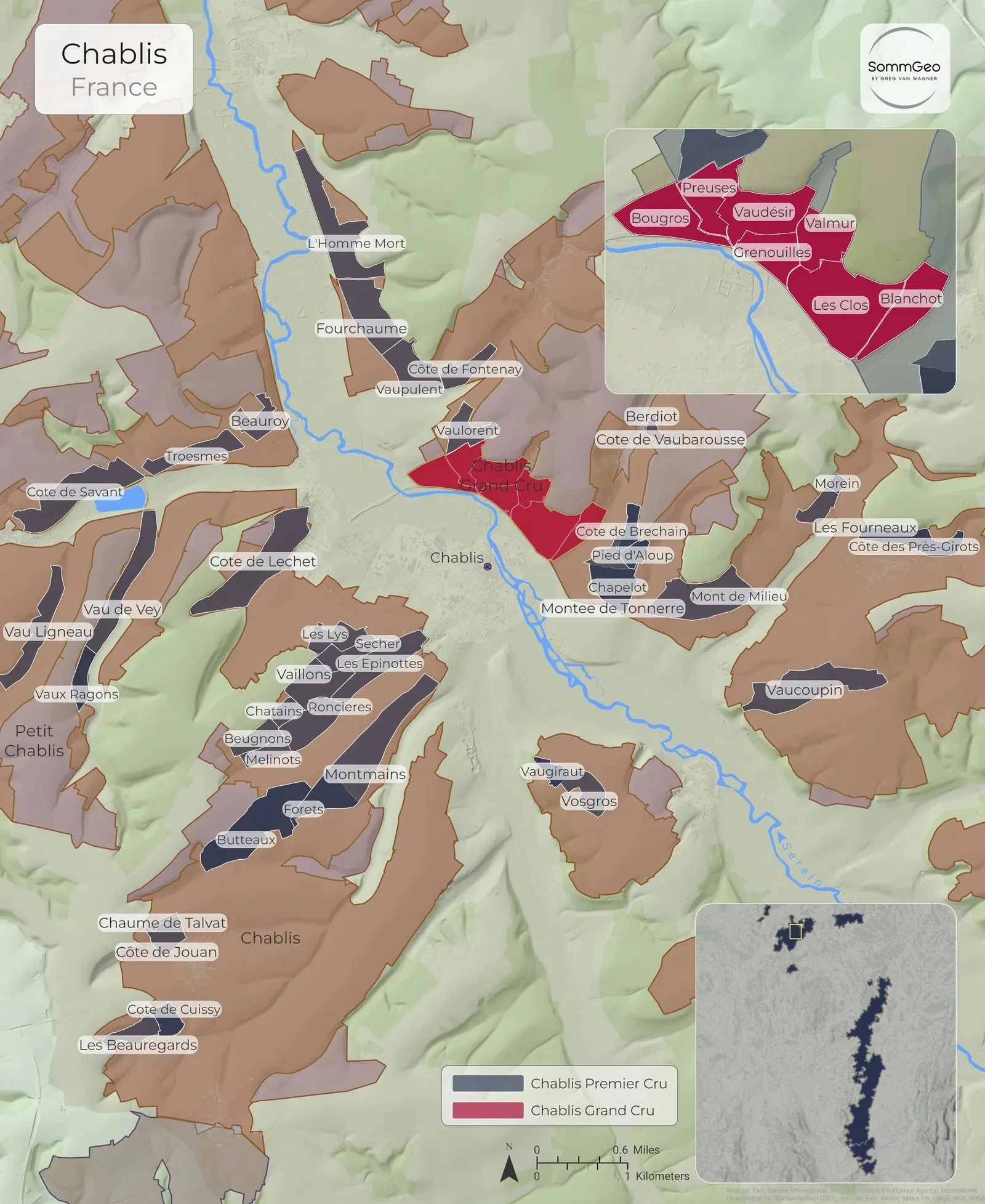
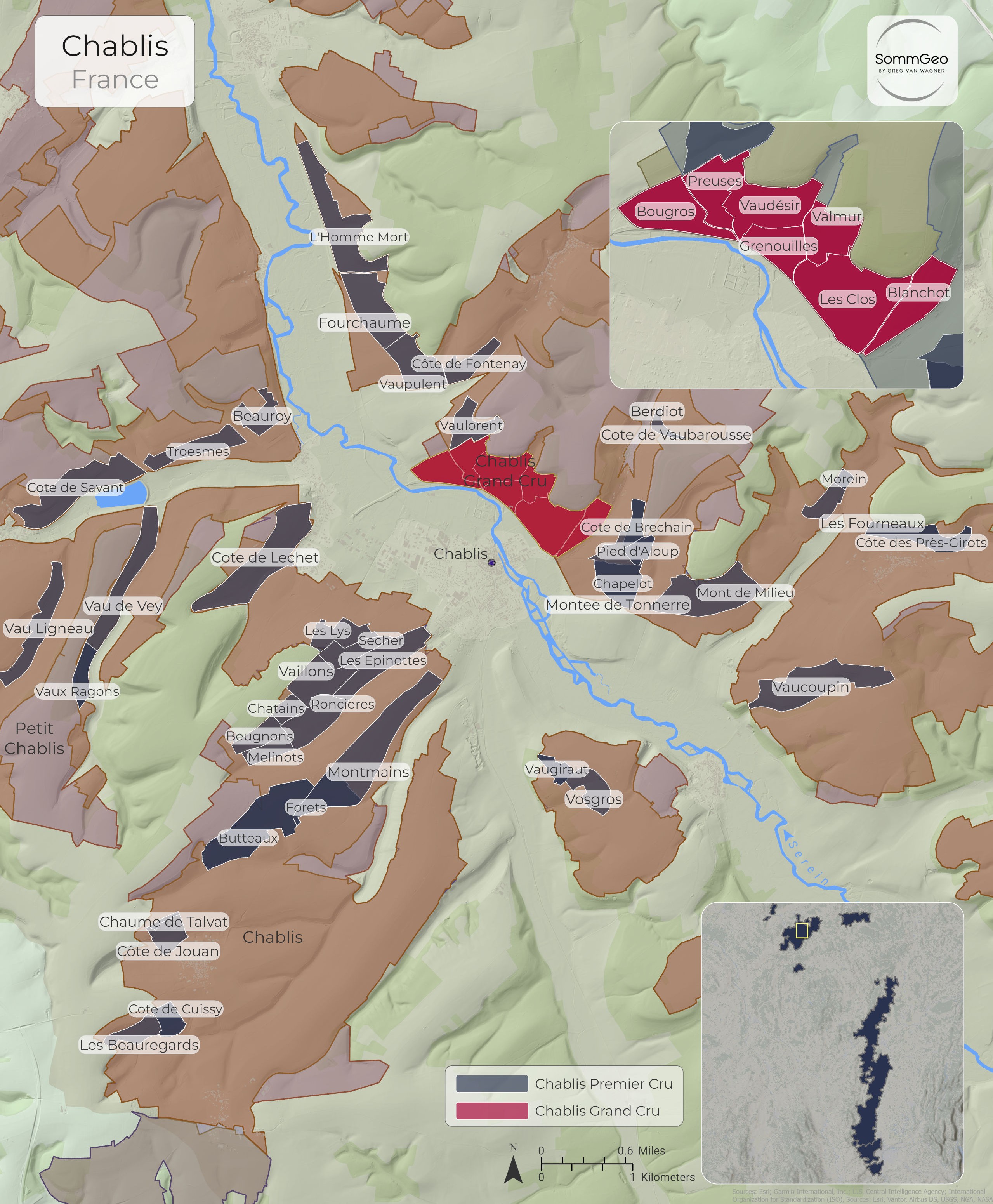
What This Map Covers
This classic map lays out the whole Chablis hierarchy, from the broad Petit Chablis and village zones to the tightly grouped crus along the Serein. You’ll see how all seven Grand Crus share one hill north of the town, how the Premier Crus divide across the two banks of the river, and why aspect and the Kimmeridgian-Portlandian soil line do so much to sort the appellation into tiers.
- The four appellation tiers: Petit Chablis, Chablis, Chablis Premier Cru, and Chablis Grand Cru
- All seven Grand Cru climats on the single hill north of town: Bougros, Les Preuses, Vaudesir, Grenouilles, Valmur, Les Clos, and Blanchot
- The principal Premier Crus on both banks, from Montee de Tonnerre and Fourchaume to Montmains and Vaillons
- The right-bank versus left-bank divide across the Serein that drives much of Chablis’s stylistic range
- The Kimmeridgian slopes that carry the crus versus the Portlandian upper ground of Petit Chablis
- The Serein river corridor and the town of Chablis at the center of the appellation
Geography and Terroir
Chablis is a cool-climate outlier. It lies roughly halfway between the Cote d’Or and Paris, far enough north that fully ripening Chardonnay is never a given, and it is climatically closer to the southern Aube of Champagne than to the rest of Burgundy. That marginal position is exactly what gives Chablis its identity: long, slow ripening locks in high acidity and a chiseled, saline minerality that warmer regions cannot replicate. It also makes the wines among the most site-transparent in France, which is why aspect, slope, and soil matter here as much as anywhere in the world.
The signature soil is Kimmeridgian, a grey marl of limestone and clay studded with tiny fossilized oyster shells laid down in a shallow Jurassic sea around 150 million years ago. Every Grand Cru and the best Premier Crus sit on it, and it is the source of the flinty, oyster-shell salinity that defines serious Chablis. Above the Kimmeridgian, capping the upper slopes and the plateau, lies younger and harder Portlandian limestone, poorer in fossils, and this is the home of most Petit Chablis. The Kimmeridgian-versus-Portlandian line has long been treated as the divide between great Chablis and merely good Chablis.
Aspect and the river do the rest. The Grand Crus and the top right-bank Premier Crus face southwest and catch the warm afternoon sun, producing the ripest, most powerful wines. The left-bank Premier Crus face more to the southeast, ripen a touch later, and lean toward leaner, more mineral expressions. Frost is the constant threat. From March into May, spring frost can wipe out a crop overnight, and Chablis growers fight it with smudge pots and with sprinklers that coat the buds in a protective shell of ice. A single brutal frost in 1945 cut the region to fewer than 500 hectares; the Chablis of today, many times that size, is built on hard-won lessons about where Chardonnay can survive this far north.
The Grand Cru Hill
Chablis concentrates its very best into one place: a single southwest-facing hill on the right bank of the Serein, north-northwest of the town, where all seven Grand Crus sit shoulder to shoulder across roughly 100 hectares (247 acres). From west to east they run Bougros, Les Preuses, Vaudesir, Grenouilles, Valmur, Les Clos, and Blanchot. Les Clos is the largest and the most celebrated, the benchmark for power, depth, and decades-long aging, and a mature Les Clos can take on an almost honeyed, exotic character while keeping its mineral spine. Valmur and Vaudesir bring structure and intensity, Les Preuses catches the most sun and gives generous wines, Grenouilles is the smallest and sits closest to the river, and Blanchot wraps around to a southeast aspect that yields the most delicate, perfumed style of the seven. There is also an unofficial eighth: La Moutonne, a monopole straddling Vaudesir and Les Preuses, long permitted to carry the Grand Cru name on its label. Vincent Dauvissat and Raveneau are the two reference producers here, and their Grand Crus rank among the most sought-after white wines in the world.
Premier Crus: Right Bank and Left Bank
Below the Grand Crus, forty named Premier Cru climats form part of the Chablis AOP, rather than a separate appellation, and they account for much of Chablis’s value and a good deal of its interest. In practice you’ll see only about seventeen names on labels, because the smaller climats are allowed to sell under the name of a larger, better-known neighbor. The most useful way to read them is by riverbank. You’ll often hear Chablis Premier Crus described as right bank or left bank, divided by the Serein, and the key difference between them is aspect.
The Right Bank
The right bank shares the same southwest-facing orientation as the Grand Crus and gets the warm afternoon sun, so its wines are the richest and most powerful Premier Crus in the appellation. Montee de Tonnerre is the standout, sitting just south of the Grand Cru hill and routinely producing wine that rivals it; its sub-climats Chapelot and Pied d’Aloup are names worth knowing. Mont de Milieu and Fourchaume round out the bank, with Fourchaume tending toward a rounder, riper, more open style thanks to its clay-rich soils.
The Left Bank
Across the river, the left-bank Premier Crus face more to the southeast, ripen later, and trade some weight for tension and cut. Montmains, with its sub-climats Butteaux and Foret, and Vaillons are the most prominent, both giving taut, mineral, citrus-driven wines, while Cote de Lechet adds a chalky, austere edge. These are not lesser wines, just leaner ones, and at their best they deliver the salinity and structure Chablis is loved for at a fraction of Cote d’Or prices.
Petit Chablis, Village, and Producers
The two lower tiers fill out the picture. Petit Chablis, grown mostly on the Portlandian upper ground, is the lightest and most immediate, an aperitif style meant for early drinking. Village Chablis is the heart of the appellation by volume, sitting on Kimmeridgian soil and ranging, as ever, from excellent to ordinary depending on the grower. Stainless is classic, though oak can be nuetral at village-level. One camp, led historically by Louis Michel & Fils, works entirely in stainless steel to keep the fruit pure and the minerality untouched; another, including icons like Raveneau and Dauvissat, uses old, large-format barrels to add texture without overt oak flavor. As Chablis producers like to say, they are Chablis, not Meursault. Beyond those names, William Fevre, Christian Moreau, Samuel Billaud, Jean-Paul & Benoit Droin, and the new-wave, organically minded Thomas Pico of Pattes Loup are all worth seeking out, and the large co-op La Chablisienne remains a reliable source across every tier.
Want to explore Chablis and the wider Burgundy region in 3D with interactive layers, elevation data, and appellation boundaries? Join 200+ wine organizations already using SommGeo.
Start Your 15-Day Free Trial $5/month billed annually after trial · Cancel anytimeMap Usage
Free for your own study and tastings. If you share or teach with a map, credit it visibly as Map: SommGeo (sommgeo.com). Commercial use requires a Commercial Embed License. See Map Usage, Credit and Licensing.