
New Zealand Wine Map Maker: Interactive GI & Region Guide
From Marlborough’s Wairau Valley to the schist slopes of Central Otago. Mapping the wine regions of a country that went from obscurity to global relevance in a single generation
New Zealand may be a small wine country by global standards, but its impact is wildly disproportionate to its size. Marlborough Sauvignon Blanc is one of the most commercially successful white wine styles on the planet, a category-defining achievement that put the country on the map and keeps it there. Whether it’s your benchmark is another conversation, but its global reach is undeniable. More interesting to the serious wine professional is what’s happened since: Pinot Noir from Central Otago and Martinborough, Chardonnay from Hawke’s Bay and Gisborne, and Syrah from the northern North Island earning genuine critical attention. The country’s wine regions span from 36 to 45 degrees south latitude (roughly the equivalent of Jerez to Bordeaux flipped upside down) creating a surprising range of growing conditions across two main islands. This New Zealand wine regions Map Maker lets you explore every major GI, prominent subregion, and geographic influence shaping these wines in 2D and 3D. Every mapped region includes detailed popup content covering grape varieties, climate profiles, soil types, and viticulture, a sommelier-level reference built directly into the map.
Unlock the Full SommGeo Toolkit
Gain exclusive access to our entire suite of premium features, including interactive Map Makers, immersive 3D Tours, high-resolution classic Maps, and advanced analytical tools.
Start Free TrialFree to learn from. Credit when you share it.
Studying for an exam or just exploring on your own? It’s all yours, no credit needed. But if a map is going to be seen by others, used to teach, or put to any commercial use, we’d ask that you credit it prominently as Made with SommGeo Map Maker.
Building something bigger? We design licensed and co-branded maps for teams, associations, importers, and producers. Get in touch.
What You’ll Explore
This Map Maker covers New Zealand’s registered Geographical Indication regions along with prominent subregions across both islands, but the real depth is in what each region reveals. Click on any mapped area and a comprehensive info panel opens with sommelier-level content: dominant grape varieties, climate and geographic profiles, soil composition, the viticultural specifics that define each region. Whether you’re reading about Marlborough’s greywacke river gravels and Sauvignon Blanc’s signature intensity, the schist soils driving Central Otago’s Pinot Noir, or the ancient gravels of Gimblett Gravels, every mapped region carries this level of built-in intelligence. A note on subregions: the zones shown represent the most widely recognized and important subregions regardless of their official GI status, and are not intended to be an exhaustive list.
- All major New Zealand GI boundaries across the North and South Islands
- In-depth region profiles for every mapped area: varieties, soils, climate
- 2D and 3D views with multiple basemap options including satellite, topographic, terrain, and streets
- Elevation profile and measurement tools for analyzing vineyard topography
- Solar aspect simulation for understanding sunlight and shadow across vineyard sites
- Full-screen mode for building presentation-ready custom maps


Geography and Climate of New Zealand
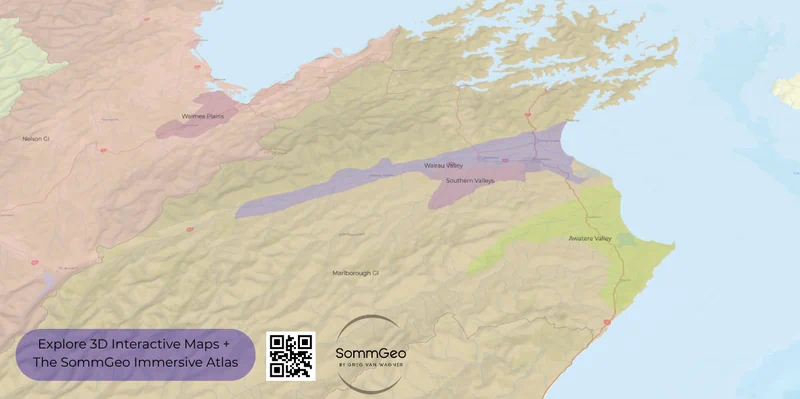
New Zealand’s viticultural character is defined by two things: its maritime climate and its dramatic topography. The country is narrow enough that no vineyard sits more than about 120 kilometers (75 miles) from the coast, which means ocean influence is a constant, moderating temperatures, driving afternoon winds, and keeping humidity in play. But the mountain ranges running through both islands create sharp climate divisions. The North Island’s ranges shelter Hawke’s Bay from prevailing westerlies, giving it the warm, dry conditions that produce New Zealand’s best Bordeaux-style reds and Syrah. On the South Island, the Southern Alps cast an enormous rain shadow over Central Otago, creating the country’s only truly continental climate: hot summers, cold winters, and the kind of extreme diurnal temperature shifts that concentrate flavor in Pinot Noir.
Marlborough, sitting at the northern tip of the South Island, benefits from both high sunshine hours and cool nights funneled through the Wairau and Awatere valleys. This combination of intensity and acidity is precisely what made Marlborough Sauvignon Blanc a global phenomenon, and it’s increasingly what’s driving quality in the region’s Pinot Noir as well. Further south, Canterbury’s Waipara Valley offers limestone-influenced soils that are rare in New Zealand, producing Pinot Noir and Riesling with distinctive mineral drive. The soils across the country range from the free-draining alluvial gravels of Gimblett Gravels, to the schist and greywacke of Central Otago and the clay-over-gravel terraces of Martinborough.
Key Wine Regions
Marlborough
Marlborough is the 800-pound gorilla of New Zealand wine: over 75% of the country’s total vineyard plantings sit here, and it’s the region that built the international reputation of Kiwi Sauvignon Blanc from essentially nothing in the 1980s. The Wairau Valley, the original heartland, produces the riper, more tropical-leaning styles, while the Awatere Valley to the south (technically not a registered GI, but universally recognized as a distinct subregion) delivers leaner, more herbaceous wines with pronounced minerality. Beyond Sauvignon Blanc, Marlborough Pinot Noir has become a serious category: aromatic, red-fruited, with firm structure and real aging potential. Producers like Cloudy Bay, Dog Point, Greywacke, and Fromm are proving that the region has far more depth than its calling card variety suggests.
Central Otago
Central Otago is where New Zealand Pinot Noir reaches its most concentrated and dramatic expression. It’s the world’s southernmost wine region of international commercial note, and the only continental climate zone in the country, which means you get genuine winter cold, scorching summer days, and diurnal temperature swings that can exceed 20°C (68°F). The result is Pinot Noir with density, dark fruit intensity, and a structural backbone that stands apart from the more delicate styles of Martinborough or Marlborough. The subregions matter here: Bannockburn is one of the warmest and most consistent, Gibbston (the highest) delivers more restrained, aromatic wines, and Bendigo and Cromwell offer their own variations on the theme. Felton Road, Burn Cottage, Rippon, and Mt. Difficulty are among the producers setting the standard.
Hawke’s Bay
Hawke’s Bay is New Zealand’s most diverse wine region and its best argument for world-class red wine. The Gimblett Gravels (a 800-hectare area of ancient riverbed soils that absorb and radiate heat) produce the country’s finest Bordeaux-style blends and Syrah. This is warm-climate New Zealand (relatively speaking), and the wines have a generosity and structure that you won’t find elsewhere in the country. Te Mata Estate (whose Coleraine is one of New Zealand’s most iconic reds), Craggy Range, Trinity Hill, and Elephant Hill are among the producers doing the most compelling work. Beyond the gravels, Bridge Pa Triangle adds another layer of site-specific character, and the region’s Chardonnay is increasingly recognized as world-class.
Wairarapa & Martinborough
Martinborough, the most important subregion within Wairarapa, is where New Zealand first proved it could make Pinot Noir that belonged in a global conversation. Sitting on free-draining river terraces in the rain shadow of the Rimutaka Range at the southern end of the North Island, the vineyards here produce Pinot Noir with an elegance, savory complexity, and earthy depth that contrasts sharply with Central Otago’s power. The region is tiny (boutique-scale by definition) and producers like Ata Rangi, Dry River, and Escarpment have long punched above their weight. You’ll also find excellent Pinot Gris and small amounts of Syrah that deserve more attention than they get.
New to the Map Makers? Explore all the tools, tips, and features in our complete walkthrough.
Map Maker Guide →Ready to explore New Zealand’s wine regions in full detail? Join 200+ wine organizations already using SommGeo.
Start Your 15-Day Free Trial $5/month billed annually after trial · Cancel anytimePlease let us know what you think in the form below. Thanks!