
New Zealand Wine Tour: Marlborough, Central Otago, Hawke’s Bay & Beyond in 3D
Two islands, 1,600 kilometers (994 miles) of latitude, and a climate driven entirely by the Tasman Sea. New Zealand’s geography produces wines of intensity.
New Zealand’s wine identity was built on Marlborough Sauvignon Blanc, and that variety still dominates production by a wide margin. But the real story for serious wine professionals is what’s happening everywhere else. Central Otago produces Pinot Noir from schist soils at the edge of viability. Hawke’s Bay’s Gimblett Gravels, an ancient riverbed of deep, free-draining gravel, makes Bordeaux-style reds of genuine structure and complexity. And the North Island’s warmer zones, from Auckland down through Wairarapa, are proving that this country can do far more than one grape. The Tasman Sea is the common thread: its maritime influence moderates temperatures across both islands, keeping summers cool enough for acidity retention and winters mild enough for vine survival even at extreme southern latitudes.
Unlock the Full SommGeo Toolkit
Gain exclusive access to our entire suite of premium features, including interactive Map Makers, immersive 3D Tours, high-resolution classic Maps, and advanced analytical tools.
Start Free TrialInside This Tour
This Tour covers both islands from Northland to Central Otago, with GI boundaries, producer pins, and vineyard-level data at every stop. Every map frame is fully interactive. Don’t just watch the flythrough. Click, drag, zoom, and rotate the 3D terrain to explore from any angle, then click every pin for the full content.
- The Tasman Sea’s role as New Zealand’s defining climatic influence
- Auckland and Northland: the warm northern zone most people overlook
- Hawke’s Bay and the Gimblett Gravels: New Zealand’s Bordeaux-style red wine heartland
- Marlborough sub-regions and why Sauvignon Blanc thrives here
- Central Otago’s Pinot Noir: Bannockburn, Gibbston, Bendigo, and Wanaka
- Producer profiles with vineyard holdings and winemaking philosophy
The Tasman Sea & New Zealand’s Climate Logic
Everything about New Zealand wine starts with the Tasman Sea. The country is narrow enough that no vineyard sits more than 120 kilometers (75 miles) from the coast, and the maritime influence is absolute. Cool ocean breezes moderate summer heat, extend the growing season, and preserve the natural acidity that defines New Zealand wines. But the Tasman’s influence varies dramatically by latitude and topography. On the North Island, Auckland and Northland sit in a subtropical zone where humidity and warmth are the challenges; Syrah, Bordeaux blends, and Chardonnay do best here. Further south, Hawke’s Bay is sheltered by coastal ranges, creating a rain shadow that produces the driest, warmest mesoclimate on the island. On the South Island, the Tasman drives the cool, breezy conditions that make Marlborough’s Sauvignon Blanc possible, while Central Otago’s inland continental position (sheltered from direct maritime influence by the Southern Alps) creates the extreme diurnal temperature swings that Pinot Noir demands.
A Closer Look
Auckland & Northland
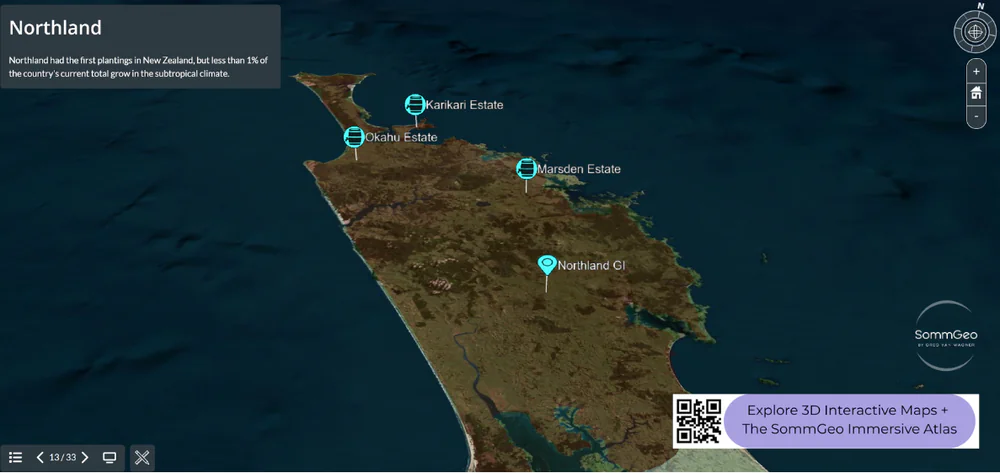
Most people skip straight past New Zealand’s far north, but Auckland (particularly Waiheke Island) and Northland are the country’s original wine regions, and the warmest. Waiheke’s sheltered, north-facing slopes on volcanic and clay soils produce Bordeaux-style reds and Syrah with a ripeness and generosity you won’t find anywhere else in New Zealand. Northland, even warmer and more humid, remains a frontier zone.
Hawke’s Bay & Gimblett Gravels
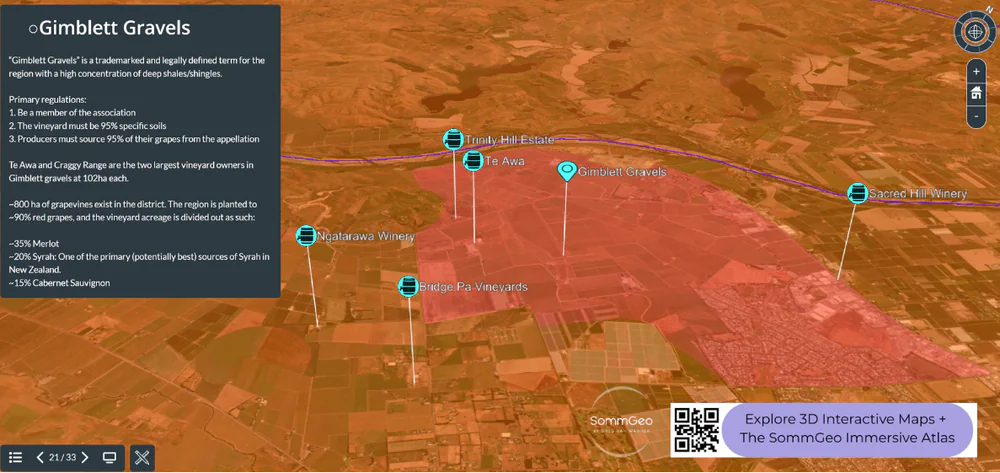
Hawke’s Bay is New Zealand’s most important region for Bordeaux-style reds, and the Gimblett Gravels is its most prestigious site. This 800-hectare area of deep, free-draining river gravels (an old Ngaruroro riverbed) was nearly lost to mining before being recognized as prime vineyard land in the 1980s. The gravels absorb heat during the day and radiate it back at night, creating a warm microclimate that ripens Cabernet Sauvignon, Merlot, and Syrah to full maturity. Beyond Gimblett Gravels, the Bridge Pa Triangle and the cooler, limestone-influenced inland sites are producing increasingly interesting Chardonnay.
South Island Pinot Noir
The South Island is where New Zealand’s Pinot Noir story unfolds. Marlborough (overwhelmingly associated with Sauvignon Blanc) actually produces significant Pinot Noir from its Southern Valleys sub-region, where clay soils and cooler temperatures create a more structured style. Nelson, across the ranges to the west, makes fragrant, lighter-bodied Pinot from clay-over-gravel soils. North Canterbury’s Waipara Valley, on limestone, produces Pinot with elegance. And Central Otago is the headline act: schist soils, extreme diurnal temperature swings (often exceeding 20°C (36°F)), and sub-regions like Bannockburn (one of the warmest, most concentrated), Gibbston (highest, coolest, most structured), Bendigo ( one of the warmest, intensely sunny, ripe), and Wanaka (emerging, higher altitude) each produce meaningfully different expressions of the grape.
Producers Worth Knowing
Craggy Range, Hawke’s Bay & Martinborough
Craggy Range was founded in 1998 by Terry Peabody with a single-vineyard philosophy. The estate sources from distinct sites across two regions: Gimblett Gravels in Hawke’s Bay for Bordeaux-variety reds (Te Kahu and Sophia) and Te Muna Road in Martinborough for Pinot Noir. The Gimblett Gravels wines are built on the district’s free-draining greywacke gravels, while the Te Muna Road vineyard sits on the Wairarapa’s river terraces.
Pyramid Valley, North Canterbury
Founded by Mike and Claudia Weersing, Pyramid Valley was a biodynamic estate on limestone soils in North Canterbury producing single-vineyard Pinot Noir and Chardonnay. The Angel Flower and Earth Smoke bottlings were vineyard-designated Pinots made in small quantities with whole-bunch fermentation and minimal new oak.
Rippon, Central Otago
Rippon sits on the western shores of Lake Wanaka at roughly 300 meters elevation. The estate has been farmed biodynamically under Nick Mills, who studied winemaking in Burgundy. Production includes Pinot Noir, Riesling, and Gamay. The Pinot Noir tends toward a restrained, structured style that contrasts with the riper, more fruit-forward wines common in Central Otago.
Seresin Estate, Marlborough
Founded by filmmaker Michael Seresin in 1992, Seresin is a certified biodynamic estate in Marlborough’s Wairau Valley. In addition to Sauvignon Blanc, the estate produces Chardonnay, Pinot Noir, and Pinot Gris, using whole-bunch fermentation and extended lees contact. The approach prioritizes texture and structure over the bright varietal fruit that characterizes much of Marlborough’s output.
Notable Vintages: New Zealand
Among the standout recent vintages, 2019 was excellent across both islands: balanced, concentrated, and age-worthy in both Pinot Noir and Bordeaux-style reds. 2015 delivered outstanding Central Otago Pinot Noir with structure and freshness in balance. 2013 was a great Hawke’s Bay vintage, producing concentrated Gimblett Gravels reds with firm tannins. 2010 was strong across Marlborough for both Sauvignon Blanc and Pinot Noir. 2018 brought warmth and generosity that particularly favored the South Island’s Pinot Noir regions.
On the difficult side, 2017 was disrupted by Cyclone Cook, with uneven ripening and rain at harvest across the North Island and northern South Island. 2012 was cool and wet for much of the country. 2014 was challenging in Marlborough, with high yields diluting quality in Sauvignon Blanc across the region.
New to the Tours? Learn how to navigate frames, click pins for detailed producer and region profiles, and get the most from your 3D experience.
Tours Guide →Ready to go deeper into New Zealand? Join 200+ wine organizations already using SommGeo.
Start Your 15-Day Free Trial $5/month billed annually after trial · Cancel anytime