
Austria Wine Regions Map: Interactive Guide
From the steep gneiss terraces of the Wachau to the volcanic slopes of Steiermark. Mapping one of Europe’s most precise and geology-driven wine cultures.
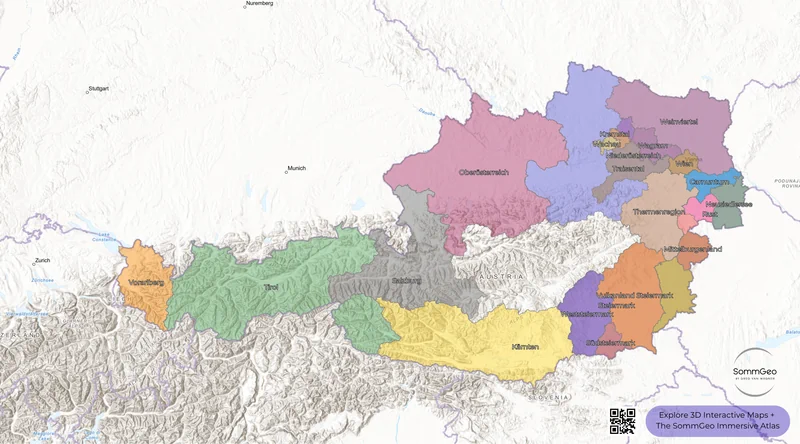
Austria’s wine regions map reads like a geology textbook brought to life in the glass. With roughly 44,000 hectares (108,726 acres) of vineyard, smaller than a single French département, this country produces some of the most site-specific, mineral-driven white wines on the planet, alongside reds from Burgenland that deserve far more international attention than they get. The Danube River is the defining geographic artery, carving through ancient gneiss and depositing loess over millennia, creating the foundation for the world-class Grüner Veltliners and Rieslings of the Wachau, Kamptal, and Kremstal. Further east, the Pannonian plain delivers warmth for serious reds; in Steiermark’s volcanic south, Sauvignon Blanc rivals the best of anywhere. This interactive Austria wine regions map lets you search every DAC appellation and explore the geology, and every mapped region opens a detailed info panel covering permitted grape varieties, classification requirements, climate profiles, soil types, and the viticultural specifics that make each appellation distinct.
Unlock the Full SommGeo Toolkit
Gain exclusive access to our entire suite of premium features, including interactive Map Makers, immersive 3D Tours, high-resolution classic Maps, and advanced analytical tools.
Start Free TrialWhat You’ll Explore
This interactive Fast Map is a fully searchable 2D atlas of Austria’s entire wine appellation system, but the real value is what’s inside every region on the map. Click on any DAC boundary, wine-growing area, or village and a comprehensive info panel opens with sommelier-level content: permitted grape varieties, DAC classification tiers and requirements, soil and geological profiles, climate data, key producers, and the viticultural specifics that define each area. Whether you’re reading about the Wachau’s gneiss terraces and its Smaragd classification, the Pannonian warmth driving Blaufränkisch in Mittelburgenland, or the volcanic soils giving Vulkanland Steiermark’s whites their intensity, every mapped region carries this depth of built-in intelligence.
- All DAC appellations mapped with searchable boundaries
- In-depth region profiles for every mapped area: varieties, classification rules, geology, climate, and producers
- Niederösterreich’s Danube regions: Wachau, Kamptal, Kremstal, Traisental, and Wagram
- Burgenland’s red wine strongholds: Mittelburgenland, Leithaberg, Neusiedlersee, and Eisenberg
- Steiermark’s three DAC zones: Südsteiermark, Vulkanland, and Weststeiermark
- Wien’s urban vineyards and the vast Weinviertel, Austria’s largest specific wine region


Geology & the Danube
If you want to understand Austrian wine, start with the rocks. The country’s viticultural identity sits at a geological crossroads where the ancient Bohemian Massif (the eroded remnant of a mountain range formed over 350 million years ago during the Variscan orogeny) meets the sedimentary basins of the Pannonian plain. That collision zone runs right along the Danube Valley, and it’s the reason you’ll find gneiss, granite, and amphibolite on the steep terraces of the Wachau literally next door to deep loess deposits in the Kamptal and Wagram. The geology isn’t subtle here, and neither is its impact on what ends up in the glass.
The Danube itself is the defining feature. As the river carved its way eastward through the crystalline bedrock of the Bohemian Massif, it created the narrow, steep-sided valley of the Wachau (now a UNESCO World Heritage Site) and deposited loess along its banks for millennia. These wind-blown sediments, accumulated during Ice Age conditions when outwash plains were exposed to persistent easterly winds, form the deep, calcareous soils that Grüner Veltliner thrives on in regions like the Kamptal, Kremstal, and Wagram. Meanwhile, Riesling gravitates to the harder primary rock, the gneiss and granite that force roots deep and produce wines of extraordinary mineral precision.
The steep terraced vineyards along the Danube are among the most dramatic in Europe. In the Wachau, hand-built dry-stone walls climb hundreds of meters above the river, retaining heat during the day and radiating it back overnight, extending the growing season on slopes that would otherwise be too cold for viticulture. These terraces are both an engineering marvel and a viticultural necessity; without them, the gradient is simply too severe for cultivation. The Wachau sits at the convergence of two climate zones (cool, wet Atlantic air from the west meets the warm, dry Pannonian influence from the east) creating the temperature swings that build aromatic complexity and preserve acidity in its best wines.
Further south and east, the geology shifts dramatically. Burgenland, anchored by the shallow Lake Neusiedl, sits squarely on the Pannonian plain with its heavy clay, loess, and gravel soils; the warmth and humidity here are perfect for red grape development and for the noble rot (botrytis) that produces Austria’s legendary sweet wines. And then there’s Steiermark, where extinct volcanoes have deposited basalt, tuff, and mineral-rich sediments that give the region’s Sauvignon Blancs and Weißburgunders their distinctive intensity. Three radically different geological stories, three completely different wine profiles, all within a country you can drive across in four hours.
Wine Law & the DAC System
Austria’s modern wine identity was forged from crisis. The 1985 diethylene glycol scandal (in which some producers were caught adulterating cheap bulk wine to boost sweetness) devastated the industry’s international reputation virtually overnight. The response was transformative: Austria enacted some of the strictest wine laws in Europe and, critically, its producers shifted focus almost entirely toward quality-driven, dry white wines. What looked like an existential catastrophe became a reset button.
The traditional classification, inherited from Germany, uses must weight (measured on the Klosterneuburger Mostwaage, or KMW, scale) to define quality tiers: Wein, Landwein, Qualitätswein, and Prädikatswein (which includes Spätlese, Auslese, Beerenauslese, Eiswein, Ausbruch, Strohwein, and Trockenbeerenauslese). But for dry wines, which are the core of Austria’s modern identity, those sugar-based designations were increasingly seen as inadequate. Enter the DAC system.
Districtus Austriae Controllatus (DAC) was introduced beginning with the 2002 vintage, with Weinviertel becoming the first DAC in 2003 for its peppery Grüner Veltliner. The concept borrows from France’s appellation approach: each DAC defines which grape varieties are typical of a region, along with production standards, and only wines meeting those criteria can carry the region’s name on their label. There are now 18 DAC appellations across Austria. Most operate on a three-tier origin pyramid (Gebietswein (regional wine), Ortswein (village wine), and Riedenwein (single-vineyard wine)) that emphasizes site specificity in a way that would feel familiar to any Burgundy student.
The Wachau, characteristically, went its own way first. The Vinea Wachau association, established in the mid-1980s, created a three-tier classification based on natural alcohol levels: Steinfeder (light, up to 11.5%), Federspiel (medium, 11.5–12.5%), and Smaragd (powerful, minimum 12.5%), named after a feathery grass, the art of falconry, and the emerald-green lizards that sun themselves on the warm terrace walls, respectively. The Wachau eventually joined the DAC system from the 2020 vintage, but those categories remain in use alongside the origin hierarchy. And as of 2023, Austria has approved a nationwide vineyard classification system with Erste Lage (Premier Cru) and Grosse Lage (Grand Cru) designations for the best single-vineyard sites, the first country outside France to formalize such a system at the national level.
Grape Varieties
Grüner Veltliner is the undisputed flagship. Roughly one in three vines in Austria is Grüner Veltliner, around 14,300 hectares (35,336 acres), and the variety produces an almost absurd range of styles: from the light, peppery, easy-drinking Heurigen wines served in Viennese taverns, all the way up to the structured, mineral-driven single-vineyard Smaragd bottlings from the Wachau that age for a decade or more. The signature “Pfefferl” (that characteristic white pepper note) is the calling card, but the best expressions from sites like Kellerberg, Loibenberg, or the Kamptal’s Heiligenstein offer a depth of stone fruit, herbs, and chalky minerality that puts them among Europe’s great white wines.
Riesling accounts for only about 2,000 hectares (4,942 acres) but punches far above its weight. Austrian Riesling is virtually always dry, with a precision and tensile acidity that recalls the Saar at its best but with riper fruit and a fuller body. The finest come from the primary rock sites along the Danube, the gneiss terraces of the Wachau, the volcanic soils of Kamptal’s famous Heiligenstein, and can age for decades, developing the petrol and floral complexity that marks serious Riesling anywhere.
Among reds, Zweigelt is the most planted, a 1922 crossing of Blaufränkisch and St. Laurent created by Fritz Zweigelt at Klosterneuburg, covering roughly 5,900 hectares (14,579 acres). It’s versatile: juicy and fruit-forward at the entry level, structured and complex from top Burgenland sites. But Blaufränkisch is the more serious variety, Austria’s answer to the question of site-expressive reds. In Mittelburgenland (which is dominated by Blaufränkisch) and on the slopes of the Leithaberg, it produces wines with dark fruit, spice, and a savoury, mineral-driven finish. St. Laurent, the other parent of Zweigelt, is rarer and more temperamental but capable of silky, Pinot Noir-like elegance.
Beyond the headliners: Welschriesling is widely planted and ranges from simple to serious, particularly in Burgenland where it forms the backbone of many Beerenauslese and TBA wines. Sauvignon Blanc has found a genuine home in Südsteiermark, producing racy, mineral expressions that compete with the best of the Loire. Wiener Gemischter Satz (a traditional Viennese field blend of multiple white varieties grown, harvested, and vinified together) has its own DAC and is experiencing a well-deserved renaissance. And Roter Veltliner, increasingly championed in the Wagram, offers textural richness unlike anything else in the Austrian portfolio.
Key Wine Regions
Niederösterreich (Lower Austria)
Niederösterreich is Austria’s viticultural heart, over 26,700 hectares (65,977 acres), roughly 60% of the country’s total vineyard area. The five Danube Valley DACs are the crown jewels: the Wachau (steep gneiss terraces, UNESCO-listed, benchmark Riesling and Grüner Veltliner from producers like F.X. Pichler, Hirtzberger, Knoll, and Prager), Kamptal (loess and volcanic soils around Langenlois; Bründlmayer, Schloss Gobelsburg), Kremstal (the geological transition zone between primary rock and loess), Traisental (tiny and exquisite), and Wagram (deep loess and the revival of Roter Veltliner). To the north, the vast Weinviertel (Austria’s largest specific wine region at nearly 14,000 hectares (34,595 acres)) produces the country’s everyday Grüner Veltliner, peppery and fresh. In the southeast, Carnuntum and Thermenregion bring warmer, Pannonian-influenced styles, including serious Zweigelt, Blaufränkisch, and the rare indigenous whites Rotgipfler and Zierfandler.
Burgenland
Burgenland is where Austria gets red. The Pannonian climate (hot summers, mild autumns, and the humidity of Lake Neusiedl) creates conditions that are ideal for full-bodied reds and extraordinary sweet wines. Mittelburgenland is Blaufränkisch country, full stop: deep, heavy clay soils and dedicated producers making structured, age-worthy reds. Leithaberg, on the western shore of the lake, combines both whites (Chardonnay, Pinot Blanc, Grüner Veltliner on limestone and schist) and reds (Blaufränkisch) with a mineral-driven elegance that sets them apart from the broader Burgenland style. Neusiedlersee, on the eastern shore, is Zweigelt territory and the epicenter of Austria’s botrytized wines; the autumn mists rolling off the lake create perfect conditions for noble rot, producing Beerenauslese and Trockenbeerenauslese of remarkable concentration. The Ruster Ausbruch DAC, in the tiny town of Rust, is Austria’s answer to Tokaji, a tradition dating back centuries. In the far south, Eisenberg DAC is a small but serious outpost for Blaufränkisch on iron-rich soils.
Steiermark (Styria)
Steiermark is Austria’s aromatic white wine frontier, roughly 5,100 hectares (12,602 acres) of steep, often brutally demanding vineyards near the Slovenian border. Three DAC zones here tell distinct stories. Südsteiermark is the star, producing Sauvignon Blanc of extraordinary vibrancy alongside Morillon (the local name for Chardonnay) and Gelber Muskateller on sandstone and shale slopes. Vulkanland Steiermark, as the name suggests, sits on extinct volcanic soils (basalt, tuff, and weathered igneous rock) producing spicy Traminer, Welschriesling, and Pinot varieties with a distinctive mineral intensity. Weststeiermark is the smallest and most specialized, devoted almost entirely to Schilcher, a bracingly dry, deep-pink rosé made from the Blauer Wildbacher grape that’s been grown here for centuries. It’s a genuine cult wine in Austria, barely seen outside the region, and absolutely worth seeking out.
Wien (Vienna)
Vienna is the only major capital city in the world with a commercially significant wine industry within its borders, roughly 580 hectares (1,433 acres) of vineyard, much of it on the hillside suburbs overlooking the city. The signature is Wiener Gemischter Satz DAC, a traditional field blend of at least three white varieties planted, harvested, and vinified together from a single vineyard. It’s a living piece of viticultural history that somehow manages to taste completely modern: fresh, complex, and ideal in the Heurigen taverns where it’s served alongside cold cuts and new-season wines. Producers like Wieninger, Mayer am Pfarrplatz, and Cobenzl are elevating the style with single-vineyard expressions that demonstrate real site character.
New to the Fast Maps? Learn how to search regions, navigate layers, and get the most from your interactive map.
Fast Map Guide →Ready to explore Austria’s wine regions in full detail? Join 200+ wine organizations already using SommGeo.
Start Your 15-Day Free Trial $5/month billed annually after trial · Cancel anytime