
Beaujolais Wine Map — Free Download
Ten crus, one grape, and a granite landscape where Gamay shows more range than almost anywhere on earth.
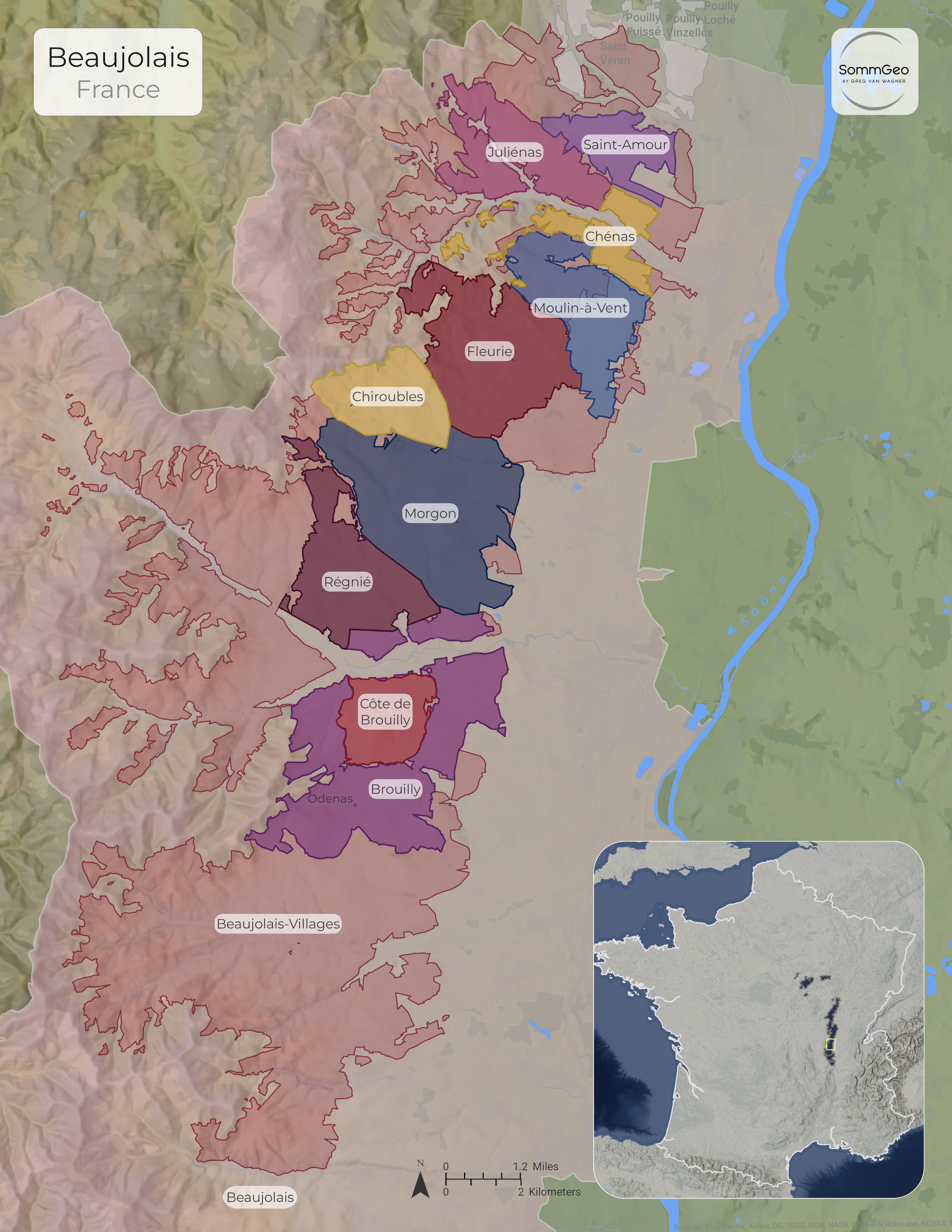
This Beaujolais wine map covers the granite hills running south from the Maconnais toward Lyon, the home of Gamay and the most expressive stretch of country the grape has anywhere. The heart of the region is its northern half, where ten cru appellations sit on a band of granite, blue stone, and steep slopes above the Saone valley. Each cru is its own combination of rock, altitude, and aspect, and the range across them is remarkable for a single variety: fragrant, light-footed wines built for early drinking at one end, and dense, structured bottlings from Moulin-a-Vent and Morgon that take on a Burgundian character after a decade in the cellar at the other. The crus run from Saint-Amour in the north to Cote de Brouilly in the south. Download the free map below to see how they line up across the slope.

What This Map Covers
This classic map gives you the full appellation picture of Beaujolais, with the ten crus laid out across the granite hills of the northern half of the region and the broad Beaujolais and Beaujolais-Villages zones spreading south and west. You’ll see how the crus cluster tightly along the foothills above the Saone valley, why Brouilly and Cote de Brouilly sit apart from the rest around Mont Brouilly, and how Morgon’s celebrated Cote du Py rises in the center of the action.
- All 10 crus: Saint-Amour, Julienas, Chenas, Moulin-a-Vent, Fleurie, Chiroubles, Morgon, Regnie, Brouilly, and Cote de Brouilly
- The two crus built around Mont Brouilly: the large, low-lying Brouilly and the steeper, more concentrated Cote de Brouilly nested inside it
- The granite and blue stone (pierre bleue) of the cru zone in the north versus the golden limestone (pierre doree) country of the south
- The position of Moulin-a-Vent, the only cru named for a landmark rather than a village, and its windmill on the slope
- The Saone River corridor to the east, separating Beaujolais from the Bresse plain and southern Burgundy
- Commune context and the relationship between the crus and the surrounding Beaujolais-Villages appellation
Geography and Terroir
Beaujolais is best understood through its rock, and three soil types define the region. The backbone of the cru zone is granite, decomposed over time into the coarse, pale, fast-draining sand the locals call gore. Granite warms quickly, stresses the vine, and gives Gamay its tension and lift, and it dominates crus like Fleurie, Chiroubles, and Regnie. The second stone is pierre bleue, a hard blue diorite that turns up in pockets across the north and produces the densest, most structured wines in the region. You find it most clearly in Julienas, in the heart of Morgon at the Cote du Py, and across the slopes of Cote de Brouilly. The third is pierre doree, the golden limestone of the south, which lends its name to an entire stretch of countryside, the Pays des Pierres Dorees, below the crus.
That southern limestone country is where most generic Beaujolais and much of Beaujolais-Villages is grown. It has long carried a reputation for volume over quality, but a serious group of growers there now makes honest, characterful wine worth seeking out, and writing off the south is a mistake. Our focus on this map, though, is the ten crus of the north, where granite and pierre bleue combine with altitude and aspect to produce Beaujolais at its most ageworthy and distinct.
Altitude and aspect do the rest. The cru vineyards run roughly between 200 and 500 meters (650 to 1,650 feet), with Chiroubles climbing highest of all, its top vines reaching close to 600 meters (about 1,970 feet). Higher sites hold freshness in warm years, while lower, south-facing slopes ripen Gamay fully and give the sturdier wines. Gamay is naturally vigorous, so the best growers plant densely, prune hard, and work the steepest slopes by hand. The traditional vinification, carbonic or semi-carbonic maceration, emphasizes fruit and perfume, though a growing number of cru producers now work in a more Burgundian, oak-influenced style aimed squarely at the cellar.
The Northern Crus: Structure and Spice
Saint-Amour & Julienas
Saint-Amour is the northernmost cru, straddling the line between Beaujolais granite and the clay-limestone of the southern Maconnais. The name does the marketing, and a fair share of its production predictably moves around Valentine’s Day, but the wines are genuinely good: aromatic, supple, with red fruit and a floral edge. Julienas, just south, is a different animal. Named for Julius Caesar and one of the oldest sites in the region, it produces some of the more structured, spicy, ageworthy wines in Beaujolais. Granite dominates, but Julienas is also one of the clearest homes of pierre bleue in the north, and that blue diorite is a big part of why its wines carry such depth and grip. This is a cru that rewards patience and remains a reliable source of value.
Chenas & Moulin-a-Vent
Chenas is the smallest cru, around 253 hectares (625 acres), named for the oak forests that once covered the hillside before vines replaced them. It has always lived in the shadow of its neighbor, in part because growers on the shared border long had the choice to label their wine as the more lucrative Moulin-a-Vent. What remains is firm, dense, and floral, with notes of wild rose and the structure to age. Moulin-a-Vent is one of the most sought-after crus in Beaujolais, and it has a style all its own. It is the only cru not named after a village, taking its name instead from a 15th-century windmill that still stands on the slope. Grown on pink granite, the wines are firm, deep, and powerfully built, the closest Beaujolais comes to red Burgundy in structure. They are frequently aged in oak and can develop real complexity after ten years or more in the cellar. This is not an easy-drinking style, and it is not trying to be. If you want to show a skeptic that Gamay can be serious and long-lived, an aged Moulin-a-Vent makes the case.
The Heart of the Region: Floral and Powerful
Fleurie & Chiroubles
Fleurie is one of the most loved crus in Beaujolais, and the name suits the wine. Grown on pink granite, Fleurie at its best is perfumed, silky, and elegant, with bright fruit and a finely drawn structure. The cru’s named climats matter here, and sites like La Madone, Poncie, and La Roilette show how much variation a single granite hillside can hold. Yvon Metras and Clos de la Roilette are reference points. Chiroubles sits directly above Fleurie and is the highest of all the crus, its granitic-sand vineyards climbing toward 600 meters (about 1,970 feet). The altitude makes it the lightest and most fragrant of the crus, a wine to drink young and slightly cool. In hot vintages, when lower sites struggle to hold freshness, Chiroubles comes into its own.
Morgon: Cote du Py & Corcelette
Morgon is the second-largest cru and, for many drinkers, the most consistently rewarding. It is best read not as one place but as a set of named climats on different soils, and the contrast between two of them tells the whole story. The Cote du Py is the famous one: a dome of blue diorite and decomposed schist, the local roche pourrie or “rotten rock,” rising to 358 meters (1,175 feet) in the center of the appellation. Its wines are dense, structured, and built to age, with an iron-and-stone minerality that growers describe with their own verb, “morgonner,” the way a Morgon deepens and broods with time. Corcelette, by contrast, sits on sandy decomposed granite. Its wines are lighter on their feet, more floral and perfumed, and more approachable young, without giving up depth. The same producer working both sites, as several of the cru’s best do, will turn out two genuinely different wines. That is the clearest proof that the Py is the headline but not the whole of Morgon.
Morgon is also, in the eyes of many sommeliers today, the cradle of the region’s modern resurgence. It was here that the so-called Gang of Four, Marcel Lapierre, Jean Foillard, Jean-Paul Thevenet, and Guy Breton, working in the spirit of the chemist Jules Chauvet, pushed for low-intervention farming and honest, site-driven Gamay made to age. Their influence reshaped how the region is perceived today.
The South: Regnie and the Brouilly Twins
Regnie
Regnie is the youngest cru, promoted from Beaujolais-Villages only in 1988 after years of lobbying by its growers. Its granitic-sand soils produce bright, perfumed wines built around raspberry and red currant, lighter and more approachable than Morgon or Moulin-a-Vent but a genuine cru in character. It remains one of the better-value names on the list, precisely because it is the least known.
Brouilly & Cote de Brouilly
The two southern crus both sit around Mont Brouilly, the hill that gives them their name, but they could hardly be more different. Brouilly is the largest cru, around 1,300 hectares (3,200 acres), spread across six communes that ring the base of the hill. Its soils are the most varied in the region, and its wines are the archetype of fruity, sappy, easy-drinking Beaujolais, the bistro wine that built the region’s Parisian fame. Cote de Brouilly is the opposite case: a small, steep appellation of about 310 hectares (765 acres) climbing the upper slopes. Here the vines grow largely on pierre bleue, the hard blue diorite, and the wines are denser, more mineral, and more ageworthy than those of Brouilly below. Chateau Thivin is the long-standing benchmark. Side by side, the two crus are the clearest lesson on this map in how slope and stone change everything.
Want to explore Beaujolais and the wider Burgundy region in 3D with interactive layers, elevation data, and appellation boundaries? Join 200+ wine organizations already using SommGeo.
Start Your 15-Day Free Trial $5/month billed annually after trial · Cancel anytimeMap Usage
Free for your own study and tastings. If you share or teach with a map, credit it visibly as Map: SommGeo (sommgeo.com). Commercial use requires a Commercial Embed License. See Map Usage, Credit and Licensing.