
Greece Wine Regions Map: Interactive Guide
From the volcanic caldera of Santorini to the Xinomavro heartland of Macedonia. The birthplace of European wine culture, mapped.
Greece is where European wine began. That’s not poetic license; it’s archaeological fact. Evidence of winemaking on Greek soil dates back 6,500 years, and as Greek civilization expanded across the Mediterranean, it carried Vitis vinifera with it to Italy, southern France, and Spain. But for all that history, Greece remains one of the most misunderstood wine countries on the planet. Forget the retsina stereotypes. Modern Greece is a country of over 300 indigenous grape varieties (around 90% of Greece’s vineyard area is planted to indigenous Greek varieties) spread across roughly 64,000 hectares (158,147 acres) of vines, 33 PDO appellations, and more than 120 PGIs. The landscape is 70–80% mountains, and altitude is the secret weapon that makes high-acid, structured wines possible in a Mediterranean climate. This interactive Greece wine regions map lets you explore every PDO, every island, and the geographic forces that make Greek wine unlike anything else in Europe, and every mapped region includes detailed popup content covering indigenous grape varieties, climate and geographic data, soil types, classification details, and key producers, putting a complete wine reference directly inside the map.
Unlock the Full SommGeo Toolkit
Gain exclusive access to our entire suite of premium features, including interactive Map Makers, immersive 3D Tours, high-resolution classic Maps, and advanced analytical tools.
Start Free TrialWhat You’ll Explore
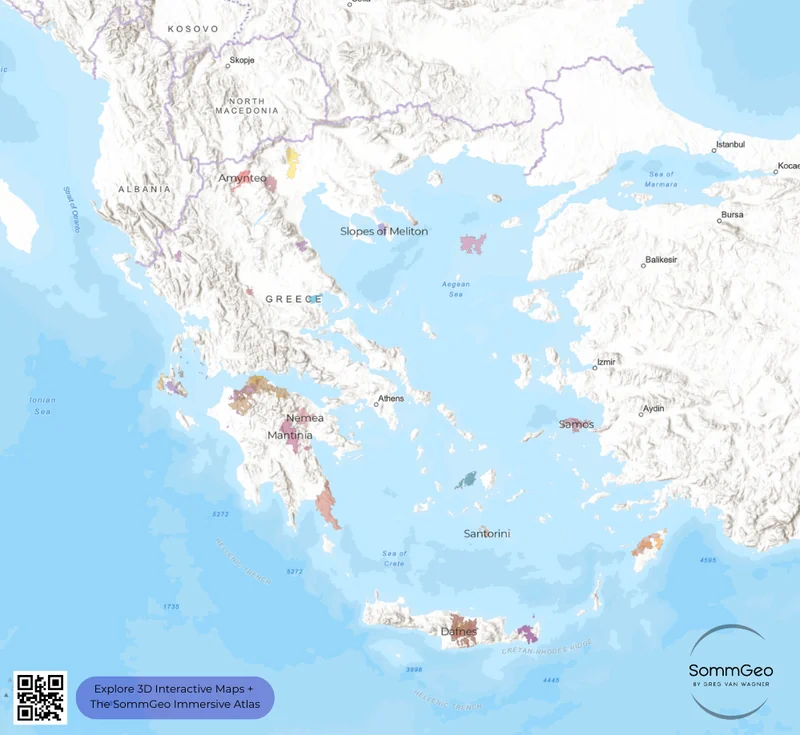
This interactive portal maps every major Greek wine region, PDO appellation, and island wine zone, but the real treasure is in the detail. Click on any mapped region and a comprehensive info panel opens with sommelier-level content: indigenous grape varieties, climate and geographic profiles, soil composition, classification specifics, and what makes each appellation distinct. Whether you’re reading about Santorini’s volcanic ash soils and its basket-trained Assyrtiko, the Xinomavro clones driving Naoussa’s age-worthy reds, or the limestone slopes of Nemea, every single region on the map carries this depth of built-in intelligence.
- All 33 PDO appellations and major PGI zones with searchable sidebar
- In-depth region profiles for every mapped area: indigenous varieties, soils, climate, and classification details
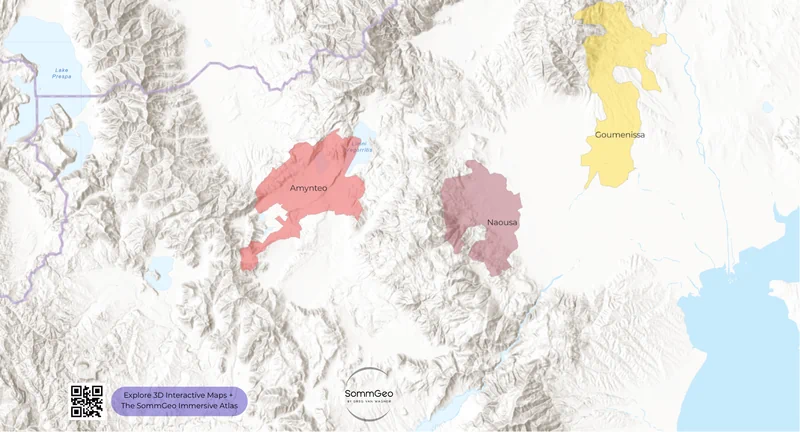
- Macedonia’s flagship reds: Naoussa, Amynteo, Goumenissa, and Rapsani PDOs
- Peloponnese wine regions including Nemea, Mantinia, and Patras
- Aegean island appellations: Santorini, Samos, Rhodes, Crete, and Paros
- Maritime influence from three seas (Aegean, Ionian, and Mediterranean) shaping coastal and island climates

Geography and the Greek Vineyard
The single most important thing to understand about Greek wine geography is this: Greece is essentially a collection of mountains surrounded by sea. Roughly 70–80% of the country is mountainous terrain, and no point in Greece is more than about 100 kilometers (62 miles) from the coast. These two facts explain everything about how Greek wine tastes.
In a country sitting between 34°N and 42°N latitude (roughly the same span as Morocco to southern Italy) you’d expect uniformly hot conditions and flabby, overripe wines. Instead, Greece produces some of the most high-acid, mineral-driven whites and structured, age-worthy reds in the Mediterranean. The reason is altitude. Greek winemakers have been planting vineyards on mountain slopes for millennia, not out of romantic tradition but out of necessity. Higher elevations mean wider diurnal temperature shifts; hot days ripen the fruit, cool nights preserve acidity. Mantinia, in the Peloponnese, sits at over 650 meters (2,132 ft) and produces Moschofilero with the kind of crisp aromatics you’d associate with northern Europe. Amynteo, in Macedonia, sits high enough to support ski resorts in winter.
Then there’s the maritime influence. The Aegean to the east, the Ionian to the west, and the Mediterranean to the south all moderate temperatures and drive the meltemia winds that are both a curse and a blessing across the islands. On Santorini, those winds necessitated the invention of the kouloura vine-training system. On Crete, the northern-facing vineyard slopes of Peza and Archanes are protected from scorching African winds by mountain ridges. On the mainland, the interaction between maritime air and mountain barriers creates the rain shadow effects and föhn winds that give Macedonia its surprisingly continental character. The soils are equally diverse: limestone across much of the Peloponnese, granite in parts of Macedonia, volcanic basalt and pumice on Santorini, and ancient schist on several Aegean islands.
A 6,500-Year Wine Heritage
Greece holds the earliest evidence of grape wine production in Europe, with archaeological finds dating back to around 4500 BCE. The ancient Greeks didn’t just make wine; they built an entire civilization around it. Dionysus was a central figure in Greek religion, and wine was integral to symposia, religious rituals, and trade. As Greek colonies spread across the Mediterranean from the 8th century BCE onward, they brought viticulture with them, planting the ancestral vineyards of what would become Italy, southern France, and Spain’s wine regions.
The medieval period brought Venetian trade dominance, and the port of Monemvasia on the Peloponnese became a major hub for exporting sweet Aegean wines to northern Europe, giving rise to the generic term “Malmsey” (a corruption of Monemvasia) that would later attach itself to Madeira’s sweetest style. Ottoman rule from the 15th to mid-19th century devastated the wine industry, as Islamic prohibition meant viticulture survived mainly on the islands and in monastery settings. It wasn’t until after independence in 1830 that Greece began rebuilding, and the modern appellation system didn’t arrive until 1971, when Naoussa became the country’s first officially designated PDO wine region.
The real revolution came in the 1980s and 1990s, when a generation of Greek winemakers trained in France and Australia returned home, invested in modern equipment, and, critically, doubled down on indigenous grape varieties rather than chasing international ones. This decision defines Greek wine today. Around 300 indigenous varieties are cultivated, and roughly 90% of the national vineyard is planted to native grapes. The major whites include Assyrtiko (Santorini’s volcanic star), Malagousia (rescued from near-extinction in the 1970s by Vangelis Gerovassiliou), Moschofilero (the aromatic Peloponnesian specialty), Roditis, and Savatiano. The reds are led by Xinomavro (the “sour black” of Macedonia, often compared to Nebbiolo), Agiorgitiko (the “Blood of Hercules” from Nemea), Mavrotragano (Santorini’s rare red), Mavrodaphne (the fortified specialty of Patras and Cephalonia), and Liatiko (Crete’s ancient variety). Most of these grapes exist nowhere else in the world in meaningful quantities, which makes Greek wine one of the few genuinely distinctive wine cultures on earth.
Key Wine Regions
Naoussa: Macedonia’s Flagship
If Xinomavro is the grape that puts Greece on the fine wine map, Naoussa is the place that proves it. Established as Greece’s first PDO in 1971, this appellation covers roughly 700 hectares (1,730 acres) across nine villages on the southeastern slopes of Mount Vermion (2,052 meters, 6732 ft) ) in the Macedonia region. The vineyards sit between 150 and 350 meters (492-1,148 ft) elevation, but the climate here is far more continental than you’d expect from a Greek wine region: cold, snowy winters and warm summers moderated by cool, damp winds drawn in from the Aegean coast. Mount Vermion’s ski resorts are just uphill from the vineyards.
PDO Naoussa permits only one grape: Xinomavro, 100%. The name translates as “sour black,” which tells you something about the variety’s personality: high acid, aggressive tannins in youth, moderate color that fades to garnet early, and a complex aromatic profile of sun-dried tomato, olive, dark cherry, and baking spices. The comparison to Nebbiolo is irresistible and not entirely wrong: both are high-acid, high-tannin, pale-colored reds with extraordinary aging potential from limestone-rich foothills. Until DNA analysis disproved it, some experts genuinely believed they might be related.
Naoussa’s nine villages (Trilofos, Fitia, Yianakohori, Stranzta, Ramnista, Pola Nera, and others) sit on a patchwork of sand, limestone, loam, and clay soils that produce meaningfully different expressions. Discussions about formalizing “crus” within Naoussa are ongoing, though nothing is legislated yet. Key producers include Kir-Yianni (founded by Yiannis Boutaris, whose family’s plantings in the late 1960s essentially revived the region), Thymiopoulos (biodynamic and natural-leaning producer gaining excitement), Dalamara, Château Pegasus, and the Vaeni cooperative, which produces over half of Naoussa’s total output.
Santorini: Volcanic Viticulture at Its Most Extreme
Santorini is, without question, one of the most singular wine regions on the planet. A volcanic island in the southern Cyclades, it was reshaped by a catastrophic eruption around 1630 BCE that created the dramatic caldera visible today and deposited the layers of volcanic ash, pumice, and solidified lava that form its distinctive “aspa” soil. There is essentially zero clay, zero organic matter, and zero water-holding capacity in this ground. The vines survive entirely on morning sea mist that condenses on the volcanic rock overnight, and they’ve been doing so, uninterrupted, for at least 3,500 years.
Today roughly 1,200 hectares (2,965 acres) remain under vine (down from nearly 4,800 in the 1950s, lost to the construction boom that tourism demands). The vines are ungrafted; phylloxera never reached the island because the louse can’t survive in sandy, volcanic soil. Some rootstocks are estimated to be several hundred years old, as the basket-shaped kouloura training system allows growers to cut the vine at the base when it stops producing (around 75 years) and wait for a new shoot to emerge from the ancient root. This process has been repeated five or six times over the centuries on the oldest plants.
Assyrtiko dominates, comprising around 70% of plantings and at least 85% of PDO Santorini wines (blended with small amounts of Athiri and Aidani). What makes Assyrtiko remarkable is its ability to maintain razor-sharp acidity even at high sugar levels and full ripeness, a rare trait in Mediterranean whites. The volcanic soil gives the wines a saline minerality and steely structure that’s unmistakable. Yields are brutally low: averages of 10–15 hectoliters (396 gallons) per hectare are common, and some years dip below 10. The PDO also encompasses Nykteri (a richer, oak-aged dry style whose name means “working the night,” a reference to traditional nighttime harvesting) and Vinsanto, a sun-dried-grape dessert wine of extraordinary concentration that has been made here since antiquity. Key producers include Domaine Sigalas, Estate Argyros, Gaia (whose Thalassitis is many drinkers’ introduction to the island), Hatzidakis, Boutari (Santorini’s first private winery, established in 1989), and the Santo cooperative.
Nemea: The Peloponnese Red
Nemea is Greece’s largest PDO zone for red wines, covering 2,500 to 3,000 hectares (7,413 acres) across 17 villages in the northeastern Peloponnese. Like Naoussa, it was established in 1971, and like Naoussa, it permits a single grape: Agiorgitiko, 100%. But where Xinomavro is all structure and austerity, Agiorgitiko is approachability and fruit. The grape, nicknamed the “Blood of Hercules” after the myth of the Nemean lion) produces wines with deep ruby color, soft tannins, red fruit character, and a velvety texture that’s consumer-friendly from the start.
The key to Nemea is altitude. The appellation spans from 200 to 850 meters (656-2788 ft) elevation, and the wines change dramatically across that range. Low-altitude vineyards (200–400 meters (656–1,312 ft)) produce riper, sometimes flabbier wines that can lack acidity. The sweet spot sits between 450 and 650 meters (1,476–2,133 ft), where limestone and gravel soils combine with cooler temperatures and greater diurnal range to produce structured, balanced reds with genuine aging potential. The high-altitude plateau of Asprokampos, above 700 meters (2,297 ft), yields lighter, more aromatic expressions that can make excellent rosé. Producers like Gaia Wines, Domaine Skouras, Palivou Estate, and the Nemea cooperative have helped transform the appellation from bulk production to quality-focused winemaking over the past three decades.
Macedonia’s Other Stars: Amynteo, Goumenissa & Rapsani
Naoussa isn’t the only Xinomavro story in northern Greece. Amynteo, situated on the western side of Mount Vermion at elevations above 600 meters (1,969 ft) near Lake Vegoritis, is one of Greece’s coolest wine zones. It’s the only Greek PDO that permits rosé and sparkling wine production from Xinomavro, and the high altitude gives the wines a leaner, more aromatic profile. Alpha Estate has been the leading force here, with over 200 hectares (494 acres) of sustainably farmed vineyards. Goumenissa PDO blends Xinomavro with the softer Negoska grape, producing more approachable reds with earlier drinkability. And Rapsani, on the lower slopes of Mount Olympus in Thessaly, represents the southernmost expression of Xinomavro, blended here with Krassato and Stavroto, the warmer climate rounds out the variety’s edges into something altogether more generous.
The Islands: Crete, Samos & the Ionian
Greece’s island wine stories extend far beyond Santorini. Crete, the largest island is home to ancient varieties like Liatiko and Vidiano that are attracting serious attention from quality-minded producers. Samos, just off the Turkish coast, has been famous for its Muscat wines for centuries: sweet, fortified vin doux naturels from Muscat à Petits Grains grown on terraced vineyards up to 800 meters (2,625 ft). And in the Ionian Sea, Cephalonia produces Robola of Kefalonia PDO: crisp, mineral whites from limestone soils at elevations up to 800 meters (2,625 ft), alongside the rare Mavrodaphne of Cephalonia, a sweet fortified wine of real distinction. Rhodes, Paros, and Lemnos round out the island PDOs, each with distinctive local varieties and microclimates that reward exploration on the map.
New to the Fast Maps? Learn how to search regions, navigate layers, and get the most from your interactive map.
Fast Map Guide →Ready to explore Greece’s wine regions in full detail? Join 200+ wine organizations already using SommGeo.
Start Your 15-Day Free Trial $5/month billed annually after trial · Cancel anytime