
Jura, Savoie & Switzerland Wine Tour: Alpine Wines in 3D
Vin Jaune under voile, sparkling Cerdon, steep Alpine Chasselas. The most distinctive and least understood wines in francophone Europe.
These three regions share a geography (the western Alps and their foothills) and a philosophy (indigenous varieties, site-driven character, total indifference to international trends), but each produces wines that are genuinely unlike anything else. The Jura’s oxidative traditions (Vin Jaune aged under a film of yeast, Macvin, Crémant) have no real equivalent anywhere in the world. Savoie’s steep, glacier-carved valleys produce whites of crystalline freshness from varieties like Jacquère and Altesse that barely register outside the region. And Switzerland, despite being one of Europe’s oldest wine-producing countries, remains almost invisible internationally because the Swiss drink virtually everything they make. This Tour covers all three, with detailed stops at the key appellations, winemaking techniques, and producers defining each region.
Inside This Tour
This Tour covers the Jura, Savoie, Bugey, and the major Swiss wine cantons, with appellation boundaries, producer pins, and winemaking detail at every stop. Every map frame is fully interactive: don’t just watch the flythrough. Click, drag, zoom, and rotate the 3D terrain to explore the landscape from any angle. The pins contain detailed profiles you won’t find in the satellite view alone.
- Jura appellations: Arbois, Château-Chalon, L’Étoile, Côtes du Jura, and Crémant du Jura
- Vin Jaune production and the voile aging process
- Bugey Cerdon: the méthode ancestrale sparkling that’s hard to find and harder to forget
- Savoie’s crus: Apremont, Jongieux, Chignin-Bergeron, and more
- Swiss wine regions: Valais, Vaud, Geneva, Neuchatel, Ticino, and Graubunden
- Producer profiles with vineyard holdings and winemaking philosophy

Vin Jaune, Cerdon & the Grape Varieties
Vin Jaune is one of the most singular wines in the world. Made exclusively from Savagnin, it ages for a minimum of six years and three months in partially filled barrels under a film of yeast called voile, similar to the flor in Sherry, but thinner. The result is an intensely nutty, oxidative wine with curry spice, walnut, and a piercing acidity that makes it virtually indestructible. It’s bottled in the distinctive 62-centiliter clavelin, sized to represent what remains of a liter after six years of evaporation (the “angels’ share”). Château-Chalon is the most prestigious appellation for Vin Jaune, though excellent examples come from Arbois and L’Étoile as well.
The Jura’s other key varieties include Poulsard (light, translucent reds with earthy, spicy character), Trousseau (darker, more structured reds), and Chardonnay (often called Melon d’Arbois locally, producing both oxidative and ouillé (topped-up) styles). Crémant du Jura, predominantly from Chardonnay, is increasingly recognized as one of France’s best sparkling values.
Bugey Cerdon, technically in the Ain département between the Jura and Savoie, deserves special mention. This méthode ancestrale sparkling (made from Gamay and Poulsard, bottled before the primary fermentation finishes, with no dosage) is a low-alcohol, off-dry, reddish-fizzy wine that sounds frivolous and tastes extraordinary. It’s one of France’s most undervalued wines.
Savoie’s signature white varieties are Jacquère (the workhorse, producing light, mineral whites in Apremont and Abymes from vineyards planted on glacial scree), Altesse (locally called Roussette, producing richer, more aromatic whites with aging potential), and Bergeron (the local name for Roussanne, used in Chignin-Bergeron, one of Savoie’s most serious whites). Mondeuse is Savoie’s indigenous red: peppery, structured, and increasingly taken seriously as a variety capable of making wines that age.
Switzerland’s dominant white variety is Chasselas (known as Fendant in the Valais) a grape that produces exceptionally subtle, terroir-transparent wines. Critics dismiss it as neutral; defenders argue that’s precisely the point. In the steep terraced vineyards of Lavaux above Lake Geneva (a UNESCO World Heritage site), Chasselas achieves a mineral complexity and textural weight that justifies the reverence the Swiss have for it. The Valais also grows significant Pinot Noir and Gamay (often blended as Dôle), along with indigenous rarities like Petite Arvine, Amigne, Cornalin, and Humagne Rouge.
A Closer Look
The Jura
The Jura’s vineyards occupy a narrow strip of west-facing slopes between the Bresse plain and the Jura Mountains, on limestone and blue-grey marl soils. Arbois is the largest sub-appellation, producing the full range of Jura styles. Château-Chalon, the smallest, is exclusively Vin Jaune and sits on a dramatic plateau of blue marl at around 400 meters (1,312 feet). L’Étoile, named for star-shaped fossil crinoids in its soil, is white wine only: Chardonnay and Savagnin, still and sparkling.
Savoie
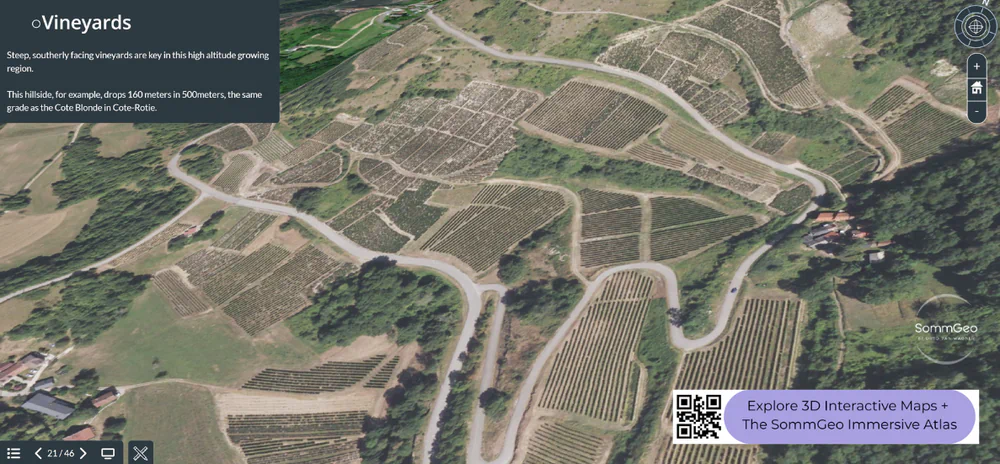
Savoie’s vineyards are scattered across the western Alps, clustered around lakes and valleys that provide crucial reflected light and thermal moderation. The best crus (Apremont, Abymes, Chignin, Arbin) each have distinct soil types ranging from glacial deposits to schist. Elevations reach 500 meters (1,640 feet) in places, and the continental-alpine climate produces wines of marked freshness and relatively low alcohol.
Switzerland
The Valais (the upper Rhône Valley) is the largest and most diverse canton, with terraced vineyards on steep south-facing slopes at elevations up to 1,100 meters (3,609 feet). Vaud, particularly the Lavaux district, produces Switzerland’s most celebrated Chasselas. Geneva and Neuchâtel round out the French-speaking regions, while the Ticino in the Italian-speaking south focuses on Merlot. Three Lakes (Neuchâtel, Biel, Murten) and the German-speaking cantons contribute Pinot Noir and Müller-Thurgau.
Producers Worth Knowing
Jean Bourdy, Arlay, Jura
One of the oldest wine estates in France, with records going back to the 16th century and a cellar containing vintages from the 1700s. Jean Bourdy produces the full spectrum of Jura wines (Vin Jaune, Macvin, Château-Chalon, and still reds and whites) in a style that prioritizes tradition and longevity. The Château-Chalon bottlings are benchmark: deeply oxidative, powerfully concentrated, and capable of aging for a century.
Stéphane Tissot, Arbois, Jura
Tissot has done more than perhaps any other producer to modernize the Jura’s image without abandoning its identity. The estate is biodynamic, the range is enormous (spanning ouillé Chardonnay, oxidative Savagnin, Crémant, Poulsard, Trousseau, and Vin Jaune), and every wine reflects its specific parcel. Tissot demonstrates that the Jura can be both avant-garde and deeply traditional: serious wines that appeal to natural wine enthusiasts and classicists alike.
Patrick Bottex, Bugey Cerdon
Bottex is the reference producer for Bugey Cerdon and the reason the appellation has any international profile at all. His La Cueille bottling (Gamay and Poulsard, méthode ancestrale, low alcohol, no dosage) is one of the most joyful wines made in France. Production is small, demand outstrips supply, and there’s essentially no substitute for what Bottex makes from his steep, south-facing vineyards above the Ain River.
Louis Bovard, Lavaux, Vaud, Switzerland
The Bovard family has farmed terraced Chasselas vineyards in Lavaux since 1552. The estate’s Dézaley and Épesses bottlings (from two of Lavaux’s most prestigious crus on impossibly steep slopes above Lake Geneva) are the strongest argument for Chasselas as a serious wine grape. These are wines of subtle mineral complexity, textural depth, and a saline finish that reflects centuries of winemaking on ancient soils. If you’ve dismissed Chasselas, Bovard will change your mind.
Notable Vintages: Jura, Savoie & Switzerland
Among the standout recent vintages, 2018 was excellent across all three regions: warm, concentrated, with enough freshness to maintain balance in the Alpine wines. 2019 produced generous, ripe Jura wines and very good Swiss Chasselas. 2015 delivered warm, rich results that favored red varieties: Trousseau, Mondeuse, and Pinot Noir all performed well. 2020 brought excellent concentration across Switzerland’s Valais, with outstanding Petite Arvine.
On the difficult side, 2017 saw severe frost across the Jura, devastating yields and producing a tiny vintage. 2013 was cool and late, with thin reds and variable whites. 2012 was uneven in Savoie, with hail damage reducing quality in several crus.
New to the Tours? Learn how to navigate frames, click pins for detailed producer and region profiles, and get the most from your 3D experience.
Tours Guide →Enjoyed this free demo? Unlock the full SommGeo toolkit: 24 more 3D Tours, interactive Map Makers, Fast Maps, and classic wine maps across every major region.
Start Your 15-Day Free Trial $5/month billed annually after trial · Cancel anytime