
Spain Wine Regions Map: Interactive Guide
From the high-altitude vineyards of the Meseta Central to the albariza soils of Jerez. Navigating the most widely planted wine country by area on earth.
Spain has more land under vine than any other country in the world, over 900,000 hectares (2,223,945 acres) spread across all 17 autonomous communities, from the rain-soaked Atlantic coast of Galicia to the sun-blasted plains of Andalucía. And yet, despite being the third-largest wine producer globally (behind Italy and France), Spanish wine still flies under the radar for many consumers. That’s a mistake. With over 400 indigenous grape varieties, two DOCa-designated regions (the highest classification in Spanish wine law), more than 70 DOs, and a classification system that includes single-estate Vinos de Pago, Spain offers a depth and diversity of wine that rivals its more famous neighbors. This interactive Spain wine regions map lets you explore every DO, DOCa, Vino de Pago, and geographic influence shaping these wines, and every mapped region includes detailed popup content covering grape varieties, classification rules, climate and soil profiles, viticulture, and history, putting a sommelier-level reference guide directly inside the map.
What You’ll Explore
This interactive portal maps every major Spanish wine region, DO, and DOCa across the peninsula and islands, but the real depth is in what each region reveals. Click on any mapped appellation and a comprehensive info panel opens with sommelier-level content: permitted grape varieties, classification rules, climate and geographic profiles, soil composition, wine law, and the viticultural specifics that define each DO. Whether you’re reading about Rioja’s limestone and clay soils across its three sub-zones, the llicorella slate driving Priorat’s concentrated reds, or the albariza chalk that defines Sherry’s finest vineyards, every single region on the map carries this level of built-in intelligence.
- All 70+ DO regions and both DOCa designations (Rioja and Priorat)
- In-depth appellation profiles for every mapped area: varieties, classification, soils, climate, and history
- The Meseta Central and its role as Spain’s vast, high-altitude viticultural heartland
- Sherry triangle: Jerez de la Frontera, Sanlúcar de Barrameda, and El Puerto de Santa María
- Vino de Pago single-estate designations and Vino de la Tierra boundaries

Three Spains: Climate, Elevation, and Geography
Spain’s viticultural diversity is driven by one fundamental reality: this is a country of extreme geographic contrasts, and understanding them is the key to understanding its wines. You can usefully think of Spain as three distinct climate zones, each producing radically different wine styles.
The Atlantic Northwest
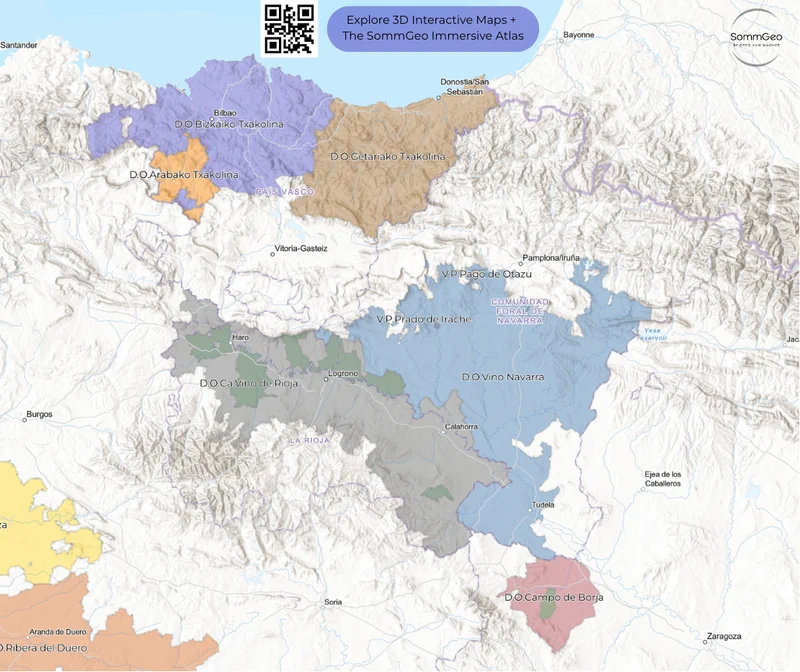
Galicia and the Cantabrian coast are Spain’s green, wet corner, more in common with northern Portugal or Brittany than with the Spain of popular imagination. Rainfall regularly exceeds 1,500mm (59.1 in), and the cool maritime climate produces aromatic, high-acid whites that have nothing in common with the warm, sun-baked reds most people associate with Spanish wine. Rías Baixas is the star here, producing crisp, saline Albariño that’s become one of Europe’s most fashionable white wines. Ribeira Sacra, further inland along dramatic river gorges, is gaining recognition for Mencía-based reds grown on impossibly steep terraced slopes. The Basque Country’s Txakolí (a bone-dry, slightly spritzy white) rounds out a region that’s essentially Atlantic Europe with Spanish passports.
The Central Plateau (Meseta Central)
The Meseta is Spain’s vast interior, a high-altitude plateau sitting between 600 and 800 meters (1,969–2,625 ft) above sea level, with extreme continental climate: brutally hot summers, bitterly cold winters, and diurnal temperature shifts that can exceed 20°C (68°F). Castilla-La Mancha alone accounts for over 430,000 hectares (1,062,552 acres) of vineyard, nearly half of Spain’s total and the largest wine-producing region in the world by area. Much of this is bulk wine from Airén (one of, if not the world’s most widely planted white grapes), but the Meseta also harbors serious wine regions. Ribera del Duero, at 800+ meters (2,625+ ft), produces some of Spain’s most structured and age-worthy Tempranillo (locally called Tinto Fino). Toro, just to the west, makes powerfully concentrated reds from old-vine Tinta de Toro on sandy soils that survived phylloxera. Rueda has emerged as Spain’s premier source of crisp, aromatic Verdejo. The altitude is the Meseta’s secret weapon; those cold nights preserve acidity in ways that the daytime heat alone would never suggest.
The Mediterranean South and East
From Andalucía through Murcia, Valencia, and up the Catalan coast, the Mediterranean influence takes over. The south is Sherry country; the chalky albariza soils around Jerez produce one of the world’s most singular and undervalued wines. The Levante coast (Jumilla, Yecla, Alicante) is Monastrell territory: thick-skinned, sun-loving grapes that produce deeply colored, fruit-forward reds at often remarkable value. Catalonia encompasses everything from the sparkling Cava heartland of Penedès to the schist-and-slate drama of Priorat, where old-vine Garnacha and Cariñena produce some of the most intense (and expensive) wines in Spain. And the Canary Islands, while technically off the coast of Africa, produce some exciting wines right now: ungrafted vines on volcanic soils making wines with unique identity.
Spanish Wine Law: The Peculiarities
Spain’s wine classification system is one of the most layered in Europe, and it rewards attention. The hierarchy sits under the EU’s DOP (Denominación de Origen Protegida) umbrella, but Spain subdivides it into four distinct tiers (plus an IGP level below) creating a pyramid that’s both more specific and more confusing than its French or Italian equivalents.
At the top sit two categories that coexist somewhat awkwardly. DOCa (Denominación de Origen Calificada) is the highest appellation-level classification, requiring at least ten years of prior DO status, strict bottling-within-the-region rules, and grape prices that must exceed the national DO average. Only two regions hold this status: Rioja (awarded 1991) and Priorat (2003, using the Catalan spelling DOQ). Alongside DOCa sits Vino de Pago (VP), introduced in 2003 for individual estates whose wines fall outside (or are *supposed to* transcend) the DO system. These are single-estate classifications, not regional ones, and they require unique soil and microclimate characteristics that distinguish the property from its surroundings. There are currently around 20 Vinos de Pago, concentrated heavily in Castilla-La Mancha. The concept is not unlike a one-property Grand Cru, though its execution has been controversial; not all autonomous communities have ratified the legislation, and Rioja has notably refused to participate.
Below these sit the roughly 70 DO (Denominación de Origen) regions, the backbone of Spanish wine classification, each governed by a consejo regulador that dictates permitted varieties, yields, and winemaking practices. VC (Vino de Calidad con Indicación Geográfica) functions as a stepping stone to DO status; regions must spend at least five years at VC level before they can apply for promotion. And VT (Vino de la Tierra), the IGP equivalent, covers larger regional areas with more flexible rules. As with Portugal’s Vinho Regional, some exceptional producers deliberately choose VT to work outside DO constraints.
One more layer that matters: Spain’s national aging classifications. Joven, Crianza, Reserva, and Gran Reserva designate minimum aging periods in both barrel and bottle. A red Reserva, for instance, requires at least 36 months of total aging with a minimum of 12 months in oak. A Gran Reserva demands 60 months with at least 18 in barrel. These are minimum standards; individual DOs can (and do) impose stricter requirements.
Indigenous Grape Varieties
Spain has over 400 native grape varieties, though the reality on the ground is less diverse than that number suggests; roughly 88% of production comes from just 20 varieties. Still, what Spain lacks in varietal exploration it makes up for in the sheer quality of its best indigenous grapes, several of which rank among the finest in the world.
Tempranillo is the undisputed king: Spain’s most planted red variety and the backbone of Rioja, Ribera del Duero, Toro (as Tinta de Toro), and Valdepeñas (as Cencibel). It’s a grape of remarkable adaptability, producing everything from fresh, early-drinking joven styles to deeply structured Gran Reservas built for decades of aging. Garnacha (Grenache) thrives across the northeast, reaching its pinnacle in old-vine plantings in Priorat, Calatayud, and the Campo de Borja. Monastrell (Mourvèdre) dominates the Mediterranean southeast. Mencía, native to Bierzo and Ribeira Sacra, is one of Spain’s most exciting emerging reds: floral, medium-bodied, and irresistibly drinkable. And Bobal, long dismissed as a bulk grape in Utiel-Requena, is being rehabilitated by a new generation of producers.
The whites are equally compelling. Albariño in Rías Baixas needs no introduction. Verdejo in Rueda has become Spain’s answer to crisp, aromatic white wine. Godello, native to Valdeorras and Bierzo, produces textured, mineral whites with real complexity. And Palomino, in the right hands and the right soils around Jerez, produces one of the most intellectually rewarding wines on the planet.
Rioja
Rioja is where most people’s relationship with Spanish wine begins, and for good reason. It’s the country’s most famous wine region, the first to receive DOCa status (1991), and home to a winemaking tradition that stretches back centuries, though the modern Rioja style owes much to French winemakers who crossed the Pyrenees during the phylloxera crisis of the 1860s, bringing with them the 225-liter oak barrica that defines the region’s approach to aging.
The denomination spans nearly 66,000 hectares (163,089 acres) across three autonomous communities (La Rioja, the Basque Country, and Navarra) and divides into three sub-zones with distinct characters. Rioja Alta, on the western end, combines Atlantic and continental influences at elevations around 500 meters (1,640 ft), it produces the most classically structured, age-worthy reds. Rioja Alavesa, in the Basque province of Álava, sits on chalky-clay soils and tends toward more aromatic, medium-bodied styles. Rioja Oriental (formerly Rioja Baja), the warmest and driest sub-zone in the east, produces riper, fuller wines, historically used as blending components, though increasingly bottled on their own.
Tempranillo dominates (over 80% of plantings), but Garnacha, Graciano, and Mazuelo (Cariñena) play important supporting roles. The region’s recent embrace of single-vineyard bottlings and a new “Viñedos Singulares” classification marks a significant shift away from the traditional house-style blending model toward site-specific expression. It’s an evolution, not a revolution, but it’s changing what Rioja means for the next generation.
Priorat
Priorat is the other DOCa, and it could hardly be more different from Rioja. Where Rioja is a vast, established denomination with centuries of commercial history, Priorat is a tiny, dramatic landscape of steep terraced vineyards on llicorella (schist and slate) soils, revived from near-abandonment in the late 1980s by a small group of pioneering winemakers. Álvaro Palacios, René Barbier, and their collaborators essentially rebuilt a forgotten wine region from scratch, and within a generation Priorat was producing some of the most sought-after (and expensive) wines in Spain.
The region sits in the rugged hills of inland Catalonia, southwest of Barcelona, where old-vine Garnacha and Cariñena cling to impossibly steep slopes of dark, mineral-rich llicorella. Yields are naturally tiny (the poor soils and old vines see to that) and the wines are intensely concentrated, with a mineral-driven complexity that distinguishes them from virtually anything else in Spain. L’Ermita, Clos Mogador, and Clos Erasmus command prices that rival top Burgundy. The adjoining DO Montsant, which surrounds Priorat on three sides, offers similar geology at a fraction of the price and is increasingly worth attention.
Sherry
Sherry is, without qualification, one of the most undervalued great wines in the world. Produced exclusively within the “Sherry triangle” (Jerez de la Frontera, Sanlúcar de Barrameda, and El Puerto de Santa María) from the Palomino grape grown primarily on the brilliant white albariza soil (chalk-rich marl with up to 80% calcium carbonate), it’s a wine of extraordinary complexity produced through the solera fractional-blending system and biological aging under a layer of flor yeast.
The range of styles is vast. Fino and Manzanilla (the latter exclusively from Sanlúcar) are bone-dry, intensely saline, and aged entirely under flor, among the most food-friendly wines on the planet. Amontillado begins under flor but continues with oxidative aging, gaining amber color and nutty depth. Oloroso is aged entirely oxidatively, developing rich, complex, walnut-and-toffee character. Palo Cortado, the rarest style, combines the aromatics of an Amontillado with the body of an Oloroso. And Pedro Ximénez (PX), made from sun-dried grapes, produces intensely sweet wines that can be almost syrupy in their concentration. The tragedy of Sherry is that it remains dramatically underpriced relative to its quality and the complexity of its production; a bottle of aged Amontillado at €15 offers more intellectual depth than many wines multiple times the price.
Cava
Cava is Spain’s traditional-method sparkling wine, and it occupies a peculiar position in the Spanish wine landscape. Unlike virtually every other DO, Cava is not tied to a single geographic region; it’s a multi-regional denomination that spans 160+ municipalities across seven autonomous communities, though the overwhelming majority (95%+) comes from Catalonia, specifically the Penedès region around Sant Sadurní d’Anoia.
The traditional grape trio is Macabeo, Xarel·lo, and Parellada, all indigenous Catalan varieties. Macabeo brings floral aromatics, Xarel·lo provides structure and earthiness (and is increasingly bottled as an impressive still wine), and Parellada adds delicacy and citrus freshness. Chardonnay and Pinot Noir are also permitted and increasingly used. In 2017, the Cava Consejo Regulador introduced a significant quality reform, creating the “Cava de Paraje Calificado” designation for single-vineyard sparkling wines with a minimum 36 months on lees, a clear attempt to differentiate premium Cava from the high-volume, entry-level production that has historically defined (and diluted) the category’s reputation. It’s a move in the right direction. At its best, aged Cava from producers like Gramona, Recaredo, and Raventós i Blanc offers remarkable complexity for the price. That said, all of these producers have left the DO Cava and no longer use the term. For a deeper exploration of how Catalonian producers are reshaping the region’s identity, including those abandoning the DO designation in favor of innovative new classifications, explore the Catalonia section of the SommGeo Spain Tour to discover emerging trends and producer strategies.
New to the Fast Maps? Learn how to search regions, navigate layers, and get the most from your interactive map.
Fast Map Guide →Ready to explore Spain’s wine regions in full detail? Join 200+ wine organizations already using SommGeo.
Start Your 15-Day Free Trial $5/month billed annually after trial · Cancel anytime