
Germany Wine Regions Map: Interactive Guide to German Wine Classifications
13 Anbaugebiete, roughly 2,600 Einzellagen, three overlapping classification systems, and the most misunderstood wine country on the planet. Finally visualized.
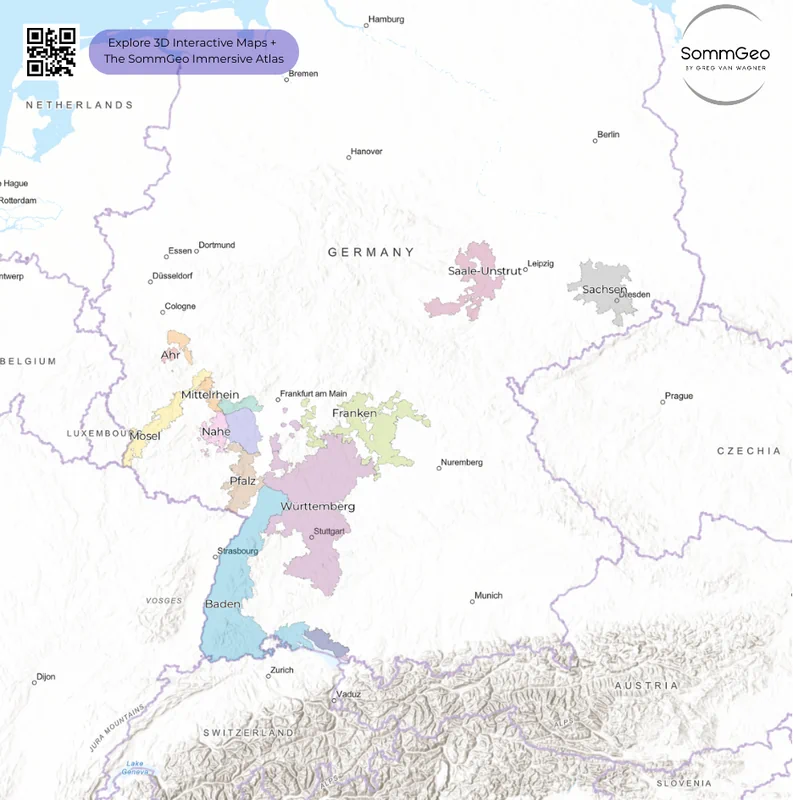
Here’s the paradox of German wine: it produces some of the most profound, age-worthy, and geographically expressive wines anywhere in the world, and yet its classification system has spent the better part of sixty years actively confusing the people trying to buy them. This Germany wine regions map covers all 13 Anbaugebiete (major wine-growing regions), from the vertiginous slate slopes of the Mosel to the sun-drenched Pfalz, from the prestigious Rheingau to the emerging eastern regions of Sachsen and Saale-Unstrut. With approximately 103,000 hectares (254,518 acres) of vineyard planted to over 130 permitted grape varieties, Germany sits at the cool-climate frontier of viticulture, and its wines (particularly Riesling) reward the kind of geographic study that makes an interactive map essential rather than optional. Every mapped region includes detailed popup content covering grape varieties, classification systems, soil profiles, climate data, and key producers, a sommelier-level reference built directly into the map.
Unlock the Full SommGeo Toolkit
Gain exclusive access to our entire suite of premium features, including interactive Map Makers, immersive 3D Tours, high-resolution classic Maps, and advanced analytical tools.
Start Free TrialWhat You’ll Explore
This interactive Fast Map puts Germany’s 13 Anbaugebiete at your fingertips, but the real depth is in what each region reveals when you click it. Every mapped area opens a comprehensive info panel with sommelier-level content: dominant grape varieties, classification hierarchies (Prädikat, VDP, and regional systems), soil and geological profiles, climate data, key producers, and the geographic specifics that define each region’s wines. Whether you’re reading about the Devonian slate driving Mosel Riesling’s mineral character, the loess deposits shaping Rheinhessen’s best sites, or the Buntsandstein soils of the Pfalz, every single region carries this depth of built-in intelligence. The searchable sidebar lets you look up any region, district, or vineyard site and jump directly to it.
- All 13 Anbaugebiete with regional boundaries and geographic context
- In-depth region profiles for every mapped area: varieties, classification rules, geology, climate, and producers
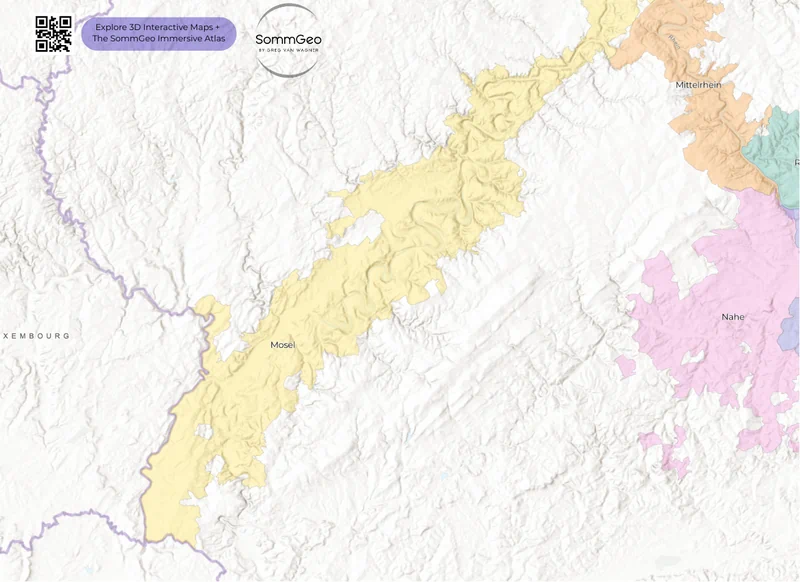
- The Mosel’s steep slate slopes and its Saar and Ruwer tributaries
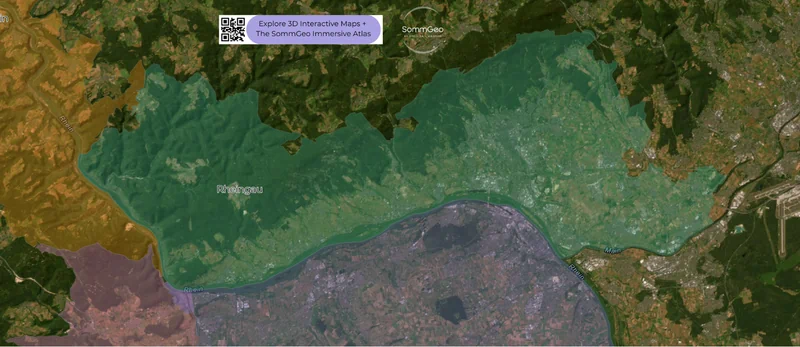
- Rheingau’s south-facing Rhine embankment from Wiesbaden to Lorch
- The Pfalz: the world’s largest Riesling-growing region by area
- Rheinhessen, Germany’s largest Anbaugebiet at roughly 27,000 hectares (66,718 acres)
German Wine Law: A History of Competing Systems
Understanding German wine means understanding that you’re dealing with not one classification system but effectively three, all operating simultaneously. If that sounds unnecessarily complicated, you’re not wrong, and neither are the German winemakers who’ve spent decades trying to fix it. But the history of how Germany got here tells you a lot about why the wines taste the way they do.
The Early Regulations (1892–1970)
Germany first began officially regulating wine production with the Wine Laws of 1892, primarily to address the uncontrolled use of chaptalization, adding sugar to unfermented grape must to increase alcohol content. Left unchecked, this practice was producing thin, acidic wines that damaged the reputation of German wine at a time when top Rieslings from the Mosel and Rheingau were among the most expensive wines in the world, commanding prices on par with the finest Bordeaux. Prior to the major reform of 1971, German wine labels were detailed and information-rich. Estates used terms like feine (fine) and feinste (finest), listed cask numbers, and indicated specific picking dates. Individual vineyard sites were small and precisely defined, and top producers drew on 19th-century Prussian tax maps that classified vineyards by quality, a system that bore striking parallels to what Burgundy had done with its cru designations.
The 1971 Wine Law: Ripeness over Place
The German Wine Law of 1971 changed everything, and not entirely for the better. Driven partly by the need to harmonize with European Economic Community regulations, the new law established a classification system based almost entirely on grape ripeness, measured in degrees Oechsle (sugar content at harvest). The logic made a certain sense in a marginal climate: riper grapes generally meant better wines. The law created three ascending tiers: Tafelwein (table wine), Qualitätswein bestimmter Anbaugebiete (QbA, quality wine from a designated region), and Qualitätswein mit Prädikat (QmP, quality wine with distinction), with the Prädikat tier subdivided into six levels of increasing ripeness: Kabinett, Spätlese, Auslese, Beerenauslese (BA), Eiswein, and Trockenbeerenauslese (TBA).
The problem was what the law did to vineyard designations. In its zeal to simplify labels, the 1971 law consolidated thousands of small, historically distinct vineyard parcels into larger units. Tiny, high-quality sites were absorbed into expansive Großlagen (collective vineyards) that shared a name but had little else in common. The most notorious example: the Piesporter Goldtröpfchen, a genuinely great Einzellage, became virtually indistinguishable on the label from Piesporter Michelsberg, a Großlage encompassing a vast area of mediocre vineyard land. Consumers had no way to tell the difference. The result was predictable: a race to the bottom in quality, the proliferation of cheap, semi-sweet bulk wine, and the slow erosion of German wine’s international reputation.
The VDP: Germany’s Quality Growers Strike Back
Enter the VDP (Verband Deutscher Prädikatsweingüter), the Association of German Prädikat Wine Estates. Founded in 1910 as the Verband Deutscher Naturweinversteigerer (the Association of German Natural Wine Auctioneers) it originally united estates that refused to chaptalize their wines. By the time the 1971 law threatened to drag German wine quality into a collective ditch, the VDP was uniquely positioned to push back.
After the 1971 reforms stripped the term “natural wine” from legal use, the association nearly dissolved. In a dramatic vote, Peter von Weymarn convinced the remaining 75 members to reinvent rather than disband. The organization rebranded as the VDP, adopted stricter membership requirements, and, critically, began developing its own vineyard classification system that the national law refused to provide. In 1994, VDP members committed to abandoning Großlage designations entirely. By 2012, the VDP had formalized a four-tier pyramid modeled explicitly on Burgundy’s approach: VDP.Gutswein (estate wine), VDP.Ortswein (village wine), VDP.Erste Lage (Premier Cru equivalent), and VDP.Grosse Lage (Grand Cru equivalent), with VDP.Grosses Gewächs (GG) designating the top dry wines from Grosse Lage vineyards. The classifications drew on those same 19th-century Prussian tax maps that the 1971 law had effectively discarded.
Today, the VDP counts approximately 200 member estates, a tiny fraction of Germany’s roughly 16,000 winegrowers, cultivating about 5% of the vineyard area, yet they account for over 8% of total wine turnover. Members include many of the country’s most respected names: Egon Müller-Scharzhof, JJ Prüm, Dr. Loosen, Fritz Haag, Keller, and Wittmann among them. The eagle emblem on the bottle capsule remains one of the most reliable quality indicators in German wine.
The 2021 Wine Law: Terroir Finally Gets Its Due
Passed by the Bundestag on November 26, 2020 and coming into force on January 27, 2021, the most significant reform of German wine law since 1971 established a core principle: “the smaller the origin, the higher the quality.” For the first time, German law officially shifted from ripeness-based classification to a terroir-based hierarchy that mirrors (and was clearly influenced by) the VDP’s model. Under the new framework, Qualitätswein is subdivided into four narrowing tiers of geographic origin: Anbaugebiet (wine-growing region), Region (which formally replaces the old Bereich and Großlage designations as the district-level tier), Ort (village), and Lage (vineyard site).
Within the Lage tier, the law goes further, establishing three ascending quality levels for single-vineyard wines, terms pioneered by the VDP and the Rheingauer Weinbauverband that the federal Wine Ordinance now codifies with specific minimum requirements applicable to all producers regardless of association membership. At the base level, all Einzellage (single vineyard) wines may be produced from one or more grape varieties as specified by the regional protection associations, and grapes must be ripened to at least Kabinett quality; these wines may not be sold before March 1 of the year following harvest, and the name of the single vineyard must always appear on the label together with the name of the village or district. Above that, Erstes Gewächs (First Growth) applies exclusively to white and red wines made from a single grape variety that matches the regional profile; grapes must be selectively harvested at yields not exceeding 60 hl/ha on flat land or 70 hl/ha on steep slopes, with a natural minimum potential alcohol of at least 11%; the wine must be vinified dry, indicate the vintage on the label, and may only be sold from March 1 of the following year, with regional protection associations empowered to prescribe additional sensory testing. At the summit, Grosses Gewächs (Great Growth) demands the strictest standards: exclusively single-variety white or red wines matching the regional profile, with mandatory hand-harvesting, yields capped at 50 hl/ha, natural minimum potential alcohol of at least 12%, mandatory dry vinification, and compulsory sensory evaluation by an examination committee; white wines may not be sold before September 1 of the year following the vintage, and red wines not before June 1 of the second year after harvest. For both Erstes Gewächs and Grosses Gewächs, the regional protection associations determine which grape varieties and sensory characteristics match the regional profile, and may impose requirements stricter than the federal minimums. Associations that already use these terms (such as the VDP) may continue to do so provided they meet the minimum requirements of the Wine Ordinance.
The existing Prädikat designations (Kabinett through Trockenbeerenauslese) survive, but with a crucial clarification that was long overdue: Kabinett, Spätlese, and Auslese wines are now required to contain a minimum level of residual sugar, with sweetness corridors determined by the regional wine associations. If you want those wines in a dry style, you simply make them as Qualitätswein (or Grosses Gewächs) instead. No more guessing whether a Spätlese is sweet or dry. The old Großlage and Bereich designations are also reformed under the new “Region” tier; wines from these collective or district-level areas must now be labeled with the prefix “Region” (e.g., “Region Michelsberg” rather than the deceptive “Piesporter Michelsberg”) and can no longer use a village name unless at least 85% of the grapes originate from that village, making it finally possible to distinguish them from genuine single-vineyard wines on the shelf.
The catch? Implementation is staggered. For Grosses Gewächs and Erstes Gewächs, the new federal requirements have applied since the 2023 vintage; wines could still be labeled under the old rules through 2022 and marketed until remaining stock was sold. For all other PDO (g.U.) wines, the transition period extends through the 2025 vintage, with the new geographic hierarchy becoming fully mandatory from the 2026 harvest onward. This means students and professionals currently need to understand all three systems: the 1971 framework, the VDP classification, and the 2021 reform, simultaneously. Welcome to German wine.
The Prädikat System & Essential German Wine Terms
Even with the new terroir-based hierarchy, the Prädikat system remains central to understanding German wine, particularly for the off-dry and sweet styles that are among the country’s most distinctive contributions to world viticulture. Each Prädikat level is defined by minimum must weight (sugar content in the grape juice at harvest), measured in degrees Oechsle. The levels in ascending order:
Kabinett: The lightest Prädikat, traditionally producing wines of delicacy and modest alcohol (often 7–9% ABV). In the Mosel, Kabinett Riesling is arguably the most food-versatile wine style in existence: low alcohol, vibrant acidity, and just enough residual sugar to create tension without heaviness. Under the 2021 law, Kabinett must now contain residual sweetness.
Spätlese: Literally “late harvest.” Riper grapes producing wines with more body and intensity than Kabinett. Historically, the discovery of Spätlese is credited to the Rheingau, where in 1775 the courier carrying the official permission to begin harvest at Schloss Johannisberg arrived late, and the resulting wine from overripe grapes was exceptional. Like Kabinett, now officially a residual-sugar style under the 2021 law.
Auslese: “Select harvest.” Made from individually selected bunches of very ripe grapes, often with some botrytis (noble rot) influence. Auslese wines can range from medium-sweet to lusciously sweet and are capable of aging for decades.
Beerenauslese (BA): “Berry select harvest.” Made from individually selected, overripe, botrytis-affected berries. Intensely sweet, viscous, and rare, produced only in exceptional vintages when conditions permit widespread noble rot.
Trockenbeerenauslese (TBA): The summit. Made from individually selected, shriveled, botrytis-desiccated berries that have essentially become raisins on the vine. TBA is one of the most concentrated and expensive sweet wines in the world, with extraordinary aging potential measured in generations rather than decades.
Eiswein: Made from grapes naturally frozen on the vine, typically harvested at temperatures of -7°C (19°F) or below. The freezing concentrates sugars and acids while leaving water behind as ice. Increasingly rare as climate change makes the required sustained freezing temperatures less reliable.
Beyond the Prädikat designations, a few other terms are essential. Trocken means dry (up to 4 g/l residual sugar, or up to 9 g/l if total acidity is no more than 2 g/l lower than the residual sugar). Halbtrocken or feinherb means off-dry. Einzellage is a single vineyard site; there are approximately 2,600 registered across Germany. Großlage is the collective vineyard designation now being replaced by the “Region” prefix under the 2021 reform. And Grosses Gewächs (GG) (originally a VDP designation, now codified in federal law) marks the highest tier of dry single-vineyard wine, widely regarded as Germany’s finest dry Rieslings and Pinot Noirs.
Key Wine Regions
Mosel
The Mosel is, without debate, the most iconic German wine region. Stretching along the serpentine Mosel River and its tributaries the Saar and Ruwer (the region was officially called Mosel-Saar-Ruwer until 2007), it encompasses roughly 8,500 hectares (21,004 acres) dominated overwhelmingly by Riesling: 91% white grape plantings, with Riesling accounting for the vast majority. The defining feature is steepness. The Mosel boasts more steep-slope vineyard area (sites with 30% gradient or greater) than any other wine region on earth, roughly 3,400 hectares (8,402 acres) of near-vertical viticulture where all work must be done by hand.
The soils here are primarily Devonian slate (blue, grey, and red) which retains heat during the day and radiates it back to the vines at night, helping grapes achieve ripeness at latitudes where they otherwise wouldn’t. The river itself acts as a heat reflector and moderator. The best sites (Wehlener Sonnenuhr, Ürziger Würzgarten, Bernkasteler Doctor, Scharzhofberger on the Saar) produce Rieslings of crystalline purity, piercing acidity, and extraordinary longevity. Producers like Egon Müller, JJ Prüm, Fritz Haag, Dr. Loosen, and Van Volxem set the global standard for the grape.
Rheingau
The Rheingau is where German wine history was written. This compact, 3,200-hectare region runs along the north bank of the Rhine from Wiesbaden to Lorch, where the river takes a dramatic east-to-west turn that gives vineyards their prized south-facing exposure. Riesling dominates at around 76% of plantings, the highest proportion of any German region. The region claims several foundational moments in wine history: the documented discovery of Spätlese at Schloss Johannisberg in 1775 and some of the earliest recorded botrytis-affected sweet wines. The Rheingau also houses some of Germany’s most historically important estates: Schloss Johannisberg, Schloss Vollrads, and Kloster Eberbach, the 12th-century Cistercian monastery that became one of medieval Europe’s most important wine producers.
Nowadays, the Rheingau’s best dry Rieslings (from sites like Rüdesheimer Berg Schlossberg, Rauenthaler Baiken, and Hochheimer Kirchenstück) deliver a broader, more powerful style than the Mosel’s filigree, with deeper fruit and richer body while retaining the racy acidity that defines German Riesling.
Pfalz (Palatinate)
The Pfalz is Germany’s second-largest Anbaugebiet at approximately 23,000 hectares (56,834 acres), and the world’s largest Riesling-growing region by vineyard area. Protected by the Haardt Mountains to the west (the northern extension of the Vosges), it enjoys some of Germany’s warmest and sunniest conditions. The region divides into the Mittelhaardt in the north, where Riesling dominates on limestone and sandstone soils, and the Südliche Weinstraße to the south, where Burgundian varieties (Spätburgunder, Grauburgunder, Weissburgunder) increasingly share the spotlight. VDP members like Dr. Bürklin-Wolf, Reichsrat von Buhl, and Von Winning produce world-class dry Rieslings from Grand Cru sites along the Deutsche Weinstraße, Germany’s oldest wine route.
Rheinhessen
Rheinhessen is Germany’s largest wine region by area, roughly 27,000 hectares (66,718 acres) in a valley of rolling hills between Mainz, Worms, and Bingen. For decades it was synonymous with bulk wine (this is where Liebfraumilch largely originated). That reputation is long outdated. A new generation of growers, concentrated especially around the villages of Westhofen, Flörsheim-Dalsheim, and Nierstein, has transformed Rheinhessen into one of Germany’s most exciting regions. Producers like Keller and Wittmann are making dry Rieslings from sites like Morstein, Kirchspiel, and Brunnenhäuschen that rank among Germany’s finest. The soils are remarkably diverse: limestone, loess, red sandstone, and clay, contributing to wines of surprising complexity and depth.
Other Notable Regions
Beyond the big four, several smaller regions deserve attention. Nahe (4,250 hectares (10,502 acres)) sits at a geological crossroads where diverse soil types produce Rieslings of remarkable versatility; estates like Dönnhoff and Emrich-Schönleber prove it. Franken (Franconia), along the Main River, is Silvaner country; the grape reaches its fullest expression here, bottled in the distinctive flat-sided Bocksbeutel. Baden, Germany’s warmest and southernmost region, stretches 400 kilometers (249 miles) along the Rhine opposite Alsace and specializes in Burgundian varieties; Spätburgunder (Pinot Noir) finds its most powerful German expressions here. Ahr, one of Germany’s smallest regions at just 530 hectares (1,310 acres), defies its northern latitude by producing extraordinary Pinot Noir from steep slate slopes. And in the east, Sachsen and Saale-Unstrut (recognized as Anbaugebiete only after reunification in 1990) represent the northern frontier of German viticulture, producing crisp whites from sites with viticultural histories dating back to the 10th and 12th centuries.
New to the Fast Maps? Learn how to search regions, navigate layers, and get the most from your interactive map.
Fast Map Guide →Ready to explore Germany’s wine regions in full detail? Join 200+ wine organizations already using SommGeo.
Start Your 15-Day Free Trial $5/month billed annually after trial · Cancel anytime