
Note: For this demo, only Niederösterreich and Wien have interactive features attached.
For many, it is the Wachau’s prominent producers and iconic vineyards that come to mind at mention of Austrian wine. The overall quality of these wines is unparalleled, setting the bar for what Grüner Veltliner and Riesling can achieve. This westernmost region of Lower Austria has long enjoyed accolades for its wine, with recognition for its distinctive qualities as early as 830 CE, when it began its golden age under Carolingian rule.
Archaeological evidence traces the origins of Austrian winemaking to the Wachau. Monks fastidiously documented observations about the region’s soils, mesoclimates, and grapes. When secularization took place in 1790, vineyards were turned over to private landowners, and holdings became more fragmented over time. Because the small parcels were difficult to monetize, in the 1930s, Coop Dürnstein (now Domäne Wachau) was formed. This cooperative has remained central to the region and now claims a third of its vineyard land and over 250 of its growers. Only in more recent years have grapes replaced orchard fruit as the primary crop, as prices for the latter plummeted in the 1950s.
The Wachau extends for roughly 32 kilometers between the Benedictine monasteries of Melk and Göttweig in Krems. Its viticultural area is smaller, stretching about 20 kilometers from the western village of Spitz to Mautern in the east. The region’s boundaries have shifted significantly over time. For centuries , the Wachau referred only to the area from Spitz to Weissenkirchen; Dürnstein, Loiben, and Mautern were added later. Even into the 1960s, there was little delineation of Danubian winegrowing regions in general. Many were centered around towns and named accordingly. This became problematic from a marketing standpoint, and heated debates rose about how to divide. Some went so far as to argue for splitting the Wachau into two regions, using the Danube as the partition between north and south, with all winemaking villages to the north referred to as Wachau. Others, like Franz Hirtzberger Sr., reasoned that neighboring vineyards in Stein, Krems, and Senftenberg should be included as part of the Wachau for their environmental similarities. This suggestion caused much discontent among vignerons in the rest of Kremstal as well as Kamptal and Traisental, eventually leading to the boundaries as they are today.
Wachau is a relatively recent addition to the DAC system. As with other DACs that joined since 2018, the Wachau introduced a three-tier hierarchical system for its wines. All grapes, regardless of level, must be hand-harvested. At the base of the system are regional wines called Gebietsweine. These are the most inclusive, allowing 17 grapes including Gemischter Satz blends; they can be presented as monovarietal wines or blends and often represent a youthful, crisp style. The mid-tier, called Ortswein, must be produced in a recognized village (there are 23), with a more focused selection of permissible grapes including Grüner Veltliner, Riesling, Pinot Gris, Weissburgunder, Neuburger, Chardonnay, Sauvignon Blanc, Muskateller, and Traminer. The top wines are known as Riedenwein, or single-vineyard wines, and can only be made from Grüner Veltliner and Riesling grown in 1 of 157 exceptional named vineyards. Though more complex and sometimes reflective of botrytis character, Ortswein and Riedenwein are not to have any noticeable aromatic oak influence. Wachau producers may also still adhere to the rules set by the Vinea Wachau, a regional protection association formed in 1983, and classify their wines using the stylistic categories of Steinfeder, Federspiel, and Smaragd in addition to, or instead of, applying DAC on the label. Where Vinea Wachau necessarily implies dry styles, with specific minimum alcohol and must weight parameters, DAC is less defined. With so many permitted varieties, there is potential for confusion with DAC labeling, making a strong case for Vinea Wachau’s relevance despite this new schematic.
Wachau
Vinea Wachau
The Vinea Wachau Nobilis Districtus was formed in 1983 by four producers: primarily Wilhelm Schwengler (then general manager for Coop Dürnstein) and Josepf Jamek, with the support of Franz Hirtzberger and Franz Prager. This association had a commitment to “quality, origin, and purity.” First and foremost, member wineries were to produce and sell wines exclusively from the Wachau, an effort to protect the region and counter the practices of other wineries, like the nearby Dinstlgut Loiben Coop, that were bottling wine with grapes from elsewhere (often the Weinviertel). The group also offered means of communicating ripeness levels more clearly on labels.
Three categories were created and trademarked in 1984 to replace the German system in place at the time and classify Vinea Wachau wines according to weight and natural alcohol level achieved. The lightest style is Steinfeder, named for the long wispy grasses that can be found near vineyards. Typically fermented in stainless steel, Steinfeder wines are fruity and youthful, with a maximum of 11.5% alcohol and must weight of at least 15 degrees KMW. Federspiel, a name that references bait used to lure falcons to the falconer’s glove, replaced Kabinett wines. These wines have more pronounced varietal character yet still possess a youthful, fruit-driven style, as they too are commonly fermented in stainless steel. Federspiel requires alcohol levels between 11.5 and 12.5% and a minimum must weight of 17 degrees KMW. The final category, known as Smaragd and named for the sun-bathing lizards often found on stones throughout the region, was not introduced until 1986 and replaced dry wines of Spätlese ripeness. These wines come from the warmest and, arguably, best sites and tend to be long lived, powerful, and concentrated. Grapes for Smaragd are last to be harvested and may show signs of botrytis, with more honeyed and mushroom-like aromas, also resulting in a deeper golden hue in the glass. While the wines must reach a minimum of 12.5% ABV (with a minimum must weight of 18.2 degrees KMW), many can achieve over 14% alcohol in warm years.
Vinea Wachau currently has about 200 members, controlling roughly 90% of production in the Wachau. Their driving principles are reflected in the Codex Vinea Wachau, though today the group focuses on advocating for its farming values rather than its prohibitions. Some of these tenets include hand-harvesting, using only natural sugars for fermentation, and refraining from artificial concentration techniques, additions, and fractionation methods.
The Wachau has roughly 1,350 hectares—only 3% of Austria’s vineyard land—planted across its 20-kilometer length. Over 600 producers grow grapes in the quaint villages of Spitz, Joching, Weissenkirchen, Dürnstein, and Loiben on the north bank of the Danube, and the town of Mautern on the south. Grüner Veltliner claims just over half of plantings with nearly 800 hectares; Riesling accounts for about 200. Most of Austria’s other grapes can be found here as well, but in tiny amounts—often less than one hectare. Vineyards are generally planted on the north side of the bank, as there are less-optimal expositions and access to sunlight on the south side, with the exception of a few notable sites. Unique parcels are carefully outlined, with over 150 rieden and more than 900 unofficial subzones.
The Wachau is a UNESCO World Heritage Site. Nearly three million square meters of hand-built granite walls mark steeply terraced vineyards, primarily on the northern bank, facing south. Despite the financial burden of maintaining these walls, their effect is both aesthetic and functional—they help preserve the humus that sits atop the bedrock, hold in heat and moisture, and contribute to vineyards’ individual microclimates and sense of terroir.
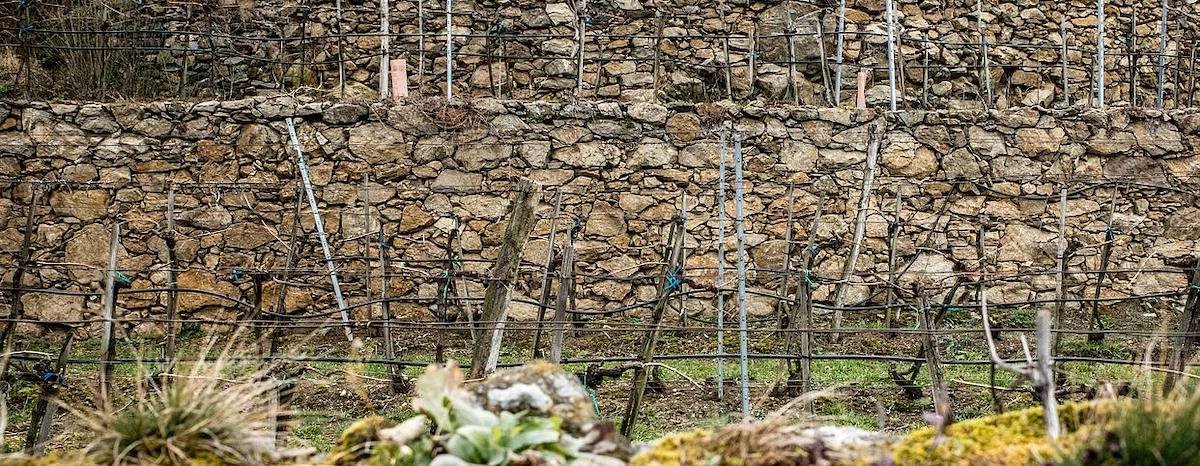 Wachau’s stone walls (Photo credit: Vinea Wachau)
One of the driest of the Danubian regions, the Wachau often receives under 500 millimeters of rain annually. It is also more affected than other regions in Lower Austria by the pre-Alpine Atlantic winds from the west. Still, warmth from the Pannonian Plain stretches as far as the eastern section of the Wachau, with a particularly notable impact in Loiben. Cool, northern winds are essential at night to help wines develop tension despite a long ripening season, high sugar development, and elevated potential alcohol.
The Wachau is considerably hillier than neighboring Danubian regions. This provides a range of exposures and elevation differentials, resulting in myriad mesoclimates despite the relatively small growing area. Slopes in the Wachau rise as high as 600 meters, though many of the best are around 400 meters, with an average 30-degree gradient (some vineyards in Spitz are as steep as 70 degrees). This makes the Wachau a poor subject for Lenz Moser’s training system, as mechanized farming is nearly impossible. For every 150 meters or so in elevation gain, another degree (Celsius) drops for average yearly temperature, making conditions close to the river remarkably different from those toward the top. Volcanic soils, which inform much of the Wachau’s geology, have a propensity to drain quickly and hold heat. Historically, these factors, combined with an already dry climate in the peak of summer, would stunt the vine’s growth, leading to less-ripe expressions in the warmest vintages. Irrigation was authorized in 1983 and, though strictly regulated, is common in warmer years. As a result, quality has improved dramatically.
Cellar techniques are varied in the Wachau. Most winemakers destem their fruit and use a pneumatic press upon reception. Temperature-controlled fermentations in stainless steel are popular, but some prefer the texture achieved with ambient yeasts, no temperature control, and neutral barrels, including Weingut Emmerich Knoll. Nearby forests supply the wood for locally crafted Stockinger barrels, a favorite in the Wachau. Some producers employ a little skin contact, others opt for extended lees aging, and various vessels can be used for fermentation and aging. Most winemakers actively avoid malolactic fermentation. Botrytis is infrequent and seldom welcome, leading to severe sorting when present. New oak is rarely used, nor is it allowed for those who are seeking to achieve wine of Ortswein, Riedenwein, or Vinea Wachau status.
Spitz, the village furthest west, sits at the base of the well-known Tausendeimerberg Vineyard, which yields delicate, easy-drinking wines. Just below, the steeply terraced rieden of Singerriedel and Hochrain contain sandier loam over gneiss, and both are excellent sites for Riesling. Further west, in the tributary valley of Spitzer Graben, some of the most celebrated rieden sit within high-reaching hillsides with notable amounts of slate and schist. This valley funnels air from the Weinviertel through to the Danube. Set apart from the river, it is the coolest region and experiences the latest harvest, sometimes extending into December. Even then, fruit expression is more austere than in other regions in the Wachau. Rieslings can be exceptional, with tension and a leaner frame, particularly those coming from the southwest-facing, slate-driven sites of Bruck (which sits at 500 meters), Schön, and Kalkofen. Donabaum, Högl, Veyder-Malberg, and Muthenthaler are the major players here.
The areas of Joching and Wösendorf have deeper paragneiss soils, and both begin to catch the loess sediments blowing in from the Alps. Ried Hochrain is one example. Downriver, Weissenkirchen yields wines with a more balanced expression overall—more generous in fruit on the palate than those from the west but a bit more focused than some of the opulent styles from further east. Rieden Achleiten and Klaus to its north are two of the most well-known sites. The west-facing Achleiten extends from about 200 to 400 meters, and soils go from mica schist to Gföhl gneiss, which characterizes Klaus soils as well. Prager and Rudi Pichler offer bottlings from Achleiten, and the site’s Grüner Veltliner and Riesling are known to carry a kind of petrichor minerality referred to locally as stinkerl.
Moving further east, in Dürnstein, wines offer more weight on the palate. Ried Kellerberg, home to one of the oldest parcels (Schmidl’s Küss den Pfennig), is among the most revered sites, with sandy loess soils over crystalline gneiss and slate. Across the river in Rossatz to the south, weightier styles are typical.
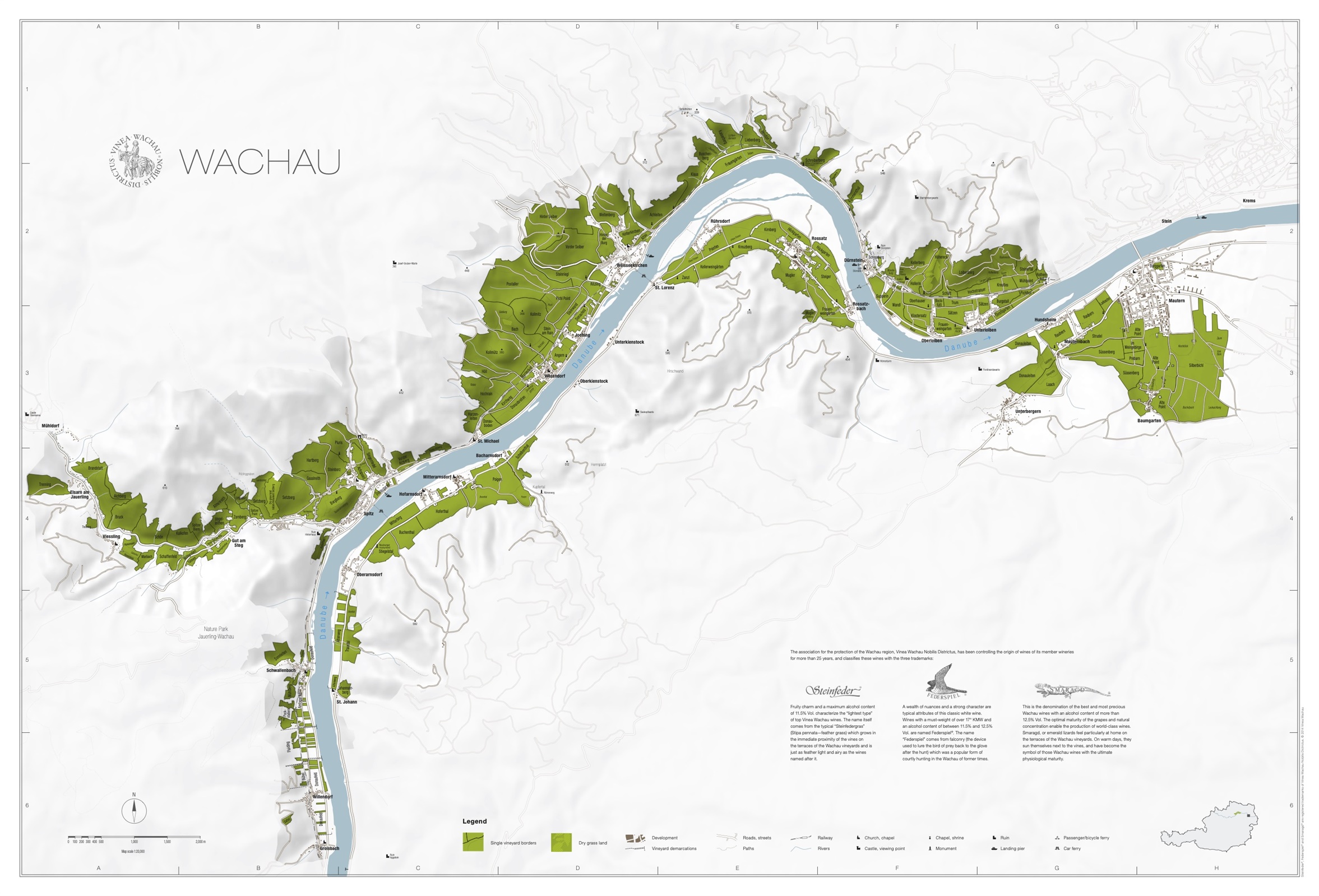 Rieden of Wachau; click to enlarge and zoom in (Credit: Vinea Wachau)
As the Danube dips south then north again, a sheltered swell in between defines the Schütt, one of the first named vineyards (1379), shared by Dürnstein and Loiben. This site is largely noted for its deep loess soils, and although it is lower in elevation, a small crevasse allows cool air to enter in the evenings. Some of the most powerful wines come from Loibenberg, a huge south-facing hill to the north of the village that offers a wide range of expressions, as the soils, elevation, and producers vary. Knoll, Dömaine Wachau, and Alzinger are among those making wine from this heralded site.
Furthest east and slightly south, on the other side of the river, Mautern is quite flat, with sandy and gravely soils. It is thought that this is where viticulture began for Austria in the ried Im Weingebirge, documented back to 470 CE. It is also home to the country’s oldest winery, Nikolaihof, owned by the Saahs family since 1894 and famous for its biodynamic practices. Vom Stein, a parcel in the ried Silberbichl, holds some of the oldest vines in the Wachau.
Kremstal
In the heart of the Danube River Valley, Kremstal is a bit more exposed and open to the Pannonian Plain’s warm air current, though more protected than the Wachau from cooler northerly winds. Riper styles come from this region, which is also capable of producing full-bodied reds. With around 500 millimeters annually, Kremstal receives more rainfall than the Wachau; in the stretch that leads to Senftenberg in the Krems River Valley, it can be as high as 720 millimeters. This, along with less wind, means that botrytis is more common as well. Kremstal can be divided into three distinct areas: the region around and north of Krems, villages to the east and northeast en route to Kamptal, and those south of the Danube that border Traisental.
Krems is an old town that serves as the cultural center of Lower Austria. It retains a medieval character, with narrow windy roads and old churches. Krems is home to many museums, such as the Kunstmeile Krems Stein, and three universities, including Wein und Obstbauschule, an important enology school second only to Bundesamt für Wein- und Obstbau in Klosterneuburg. Also near Krems is the Göttweig Abbey, built in 1072, which reflects viticulture’s monastic origins here.
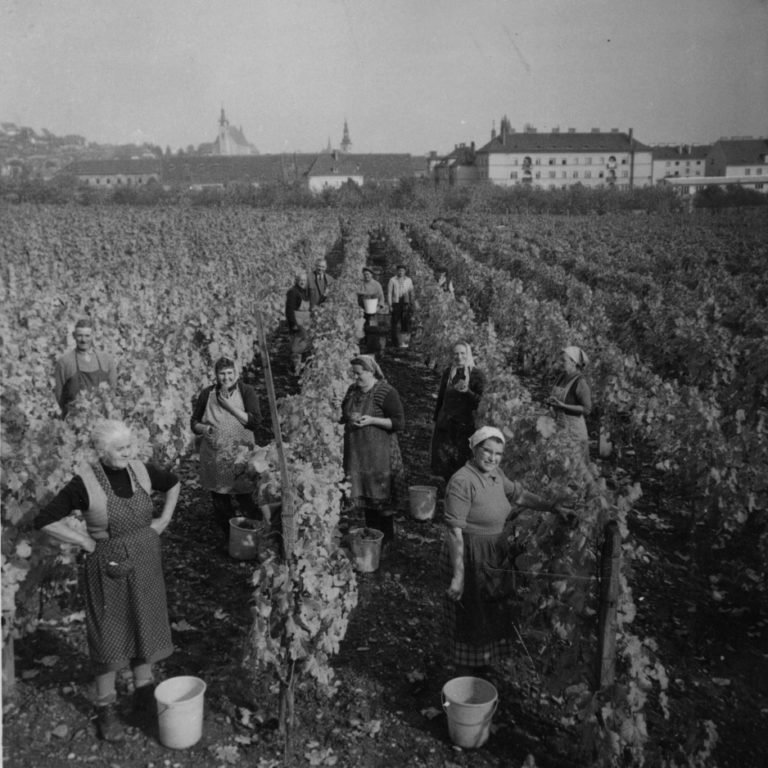 Harvest at Salomon Undhof in the 1960s (Photo credit: Weingut Salomon Undhof)
Centered around the twin towns of Stein and Krems, the vineyards have the same primary soils and high terraces as the Wachau. Grüner Veltliner and Riesling are again the focus, but the wines have a softness compared to their neighbors from the west, with exotic spice and a ripe, yellow-fruited character. A handful of producers still grow vines on the borders of Wachau and Kremstal. One example is the Pfaffenberg Vineyard. Salomon Undhof, a highly respected family estate since 1792, is one of the holders of this parcel and also farms two other acclaimed sites in Stein: Hund and Kögl (known for its pure glimmerschiefer, or “mica slate,” soils). Traveling north along the Krems River, bluff-like mounds of loess buffer a seven-mile stretch of windy roads on the way to Senftenberg. Here, Nigl and Proidl work well-known sites including Hochäcker and Pellingen.
To the east and northeast are the winemaking communities of Strazing, Rohrendorf, and Gedersdorf. Deep swaths of water-retaining loess make this area ideal for Grüner Veltliner, which accounts for 55% of Kremstal’s land under vine. The warmer, flatter vineyards to the south, from the village of Furth to the edges of Traisental, offer a mixture of water-retentive gravels, sand, and loess, allowing a wide variety of grapes to thrive. Zweigelt accounts for even more hectarage than Riesling in Kremstal, with 12.9% to Riesling’s 10.5%. Malat is among the more reputable producers in the area.
The Kremstal DAC, achieved in 2007, allows only wines made from Grüner Veltliner and Riesling. Basic Kremstal DAC with no vineyard mention must have a minimum of 12% alcohol and show no oak influence or botrytis; these wines are occasionally referred to informally as klassik. With mention of a vineyard, Kremstal DAC must meet 12.5% alcohol. Reserve DAC wines must have 13% minimum alcohol, cannot exceed nine grams per liter of residual sugar, and allow oak and botrytis character. Any wines that fall outside these requirements are labeled Niederösterreich. The terms klassik and reserve are no longer used widely. Most of the well-known growers have abandoned them altogether (particularly klassik) in preference for distinctions outlined by the Österreichische Traditionsweingüter, an association that identifies distinctive sites and quality levels throughout participating regions in Lower Austria. Wines can be labeled Gebietswein (regional wine), Ortswein (village wine) and Lagenwein (single vineyard), much like labeling in the DACs established after 2018.
Kamptal
Many believe that the wines of Kamptal rival those of the Wachau. Kamptal is home to some of the most revered Riesling sites in Austria and also offers world-class Grüner Veltliner, a wide range of complex reds, and premium Sekt. Despite its relatively small size, Kamptal follows only Weinviertel and Neusiedlersee in production volume. Much of the viticultural activity is centered around Langenlois, though the neighboring towns of Zöbing, Gobelsburg, Kammern, and Lengenfeld are significant as well.
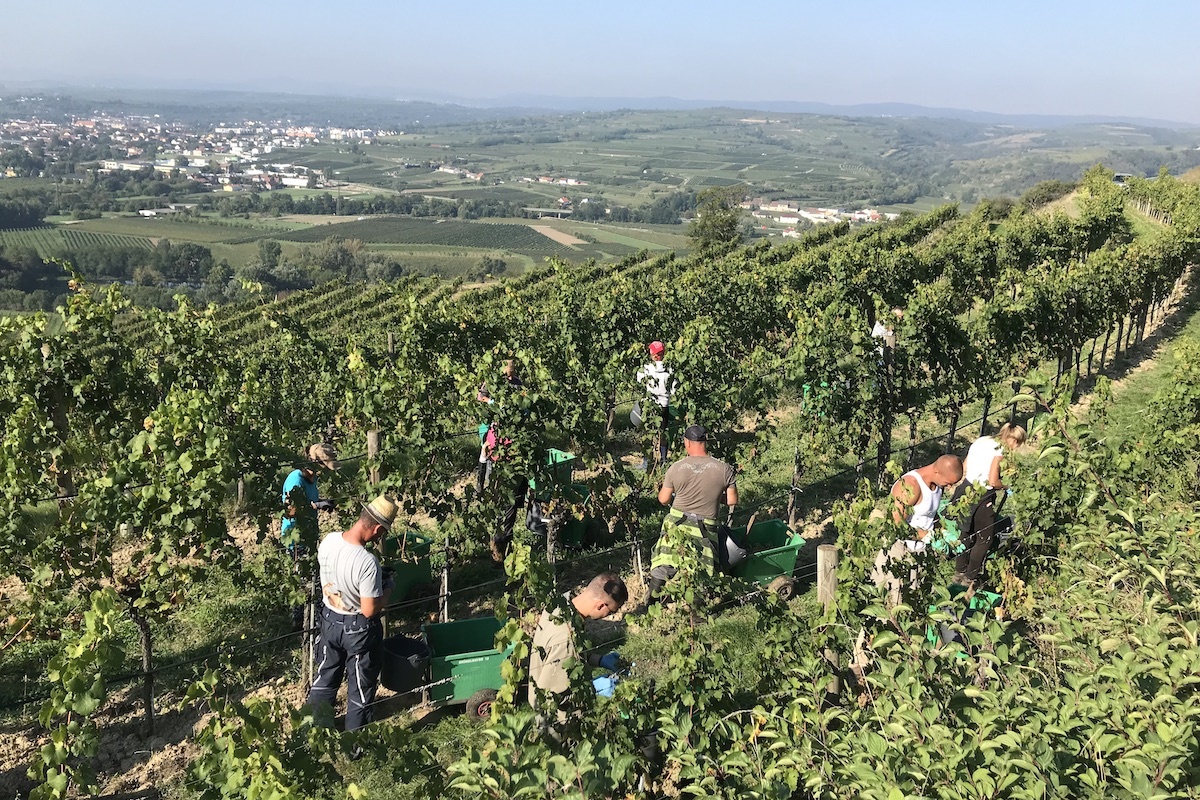 Harvest at Heiligenstein Brundylmayer (Photo credit: Andreas Wickhoff, Weingut Bründlmayer)
While Kamptal shares many of the geological and climatic aspects of Kremstal, it differs in a few important ways. For one, it is less humid and, as a result, doesn’t experience as much botrytis. (When it does, some producers experiment with sweet wines that can have racier acidity than those from Burgenland.) Kamptal is also slightly cooler at night, influenced less by the Danube and more by the Kamp tributary, which passes through its center, as well as the cool nightly winds coming in from the Waldviertel (Forest Quarter) to the west. The region is slightly warmer than the Wachau, particularly in the east near Kammern, and some Reserve offerings can achieve higher alcohol levels and denser styles. Overall, however, the wines offer more freshness than those from the Wachau or Kremstal.
The Kamp River created a gorge-like valley within the Bohemian Massif, which largely defines Kamptal. While there is more loess, unique rock formations and conglomerate soils typify some of Kamptal’s higher-reaching sites, which near 350 meters. In the warmer, lower-elevation sites, gravels, sands, and clays are more common—an ideal combination for red grapes. In Langenlois specifically, Gföhl gneiss and slate are overlaid with sand, clay, and cambisol (brown earth at an early stage of soil formation); throughout the Kamptal Valley, gravel deposits make for crystalline formations in the hillsides, with more loams and clays in the lowlands.
Österreichische Traditionsweingüter
In 1992, a handful of producers throughout Kamptal and Kremstal formed Österreichische Traditionsweingüter (ÖTW), an association dedicated to identifying vineyard sites for their quality and distinctiveness, much like Germany’s VDP system. Factors such as soil structure, precipitation, wind patterns, mesoclimate, and elevation are considered. The inaugural 2010 classification revealed 53 named ÖTW erste lage, or first growth sites; as of 2025, there are 120. As with DAC wines, only the authorized grapes may be used, and the wines must be dry. Since its formation, the organization has grown and now includes the Wagram, Wien, Carnuntum, Thermenregion, and Traisental. These regions base theirs on a three-tier pyramid, where basic regional wines, or Gebietswein, are at the bottom (for example, Kamptal); followed by village wines, or Ortswein (Langenlois); and single-vineyard wines, or Riedenwein, at the top (Heiligenstein). ÖTW members can utilize the erste lage logo on the label for bottles classified as Riedenwein. The grosse lage designation (approved but not yet utilized) will define iconic single vineyards. As of 2023, there are 90 ÖTW member wineries.
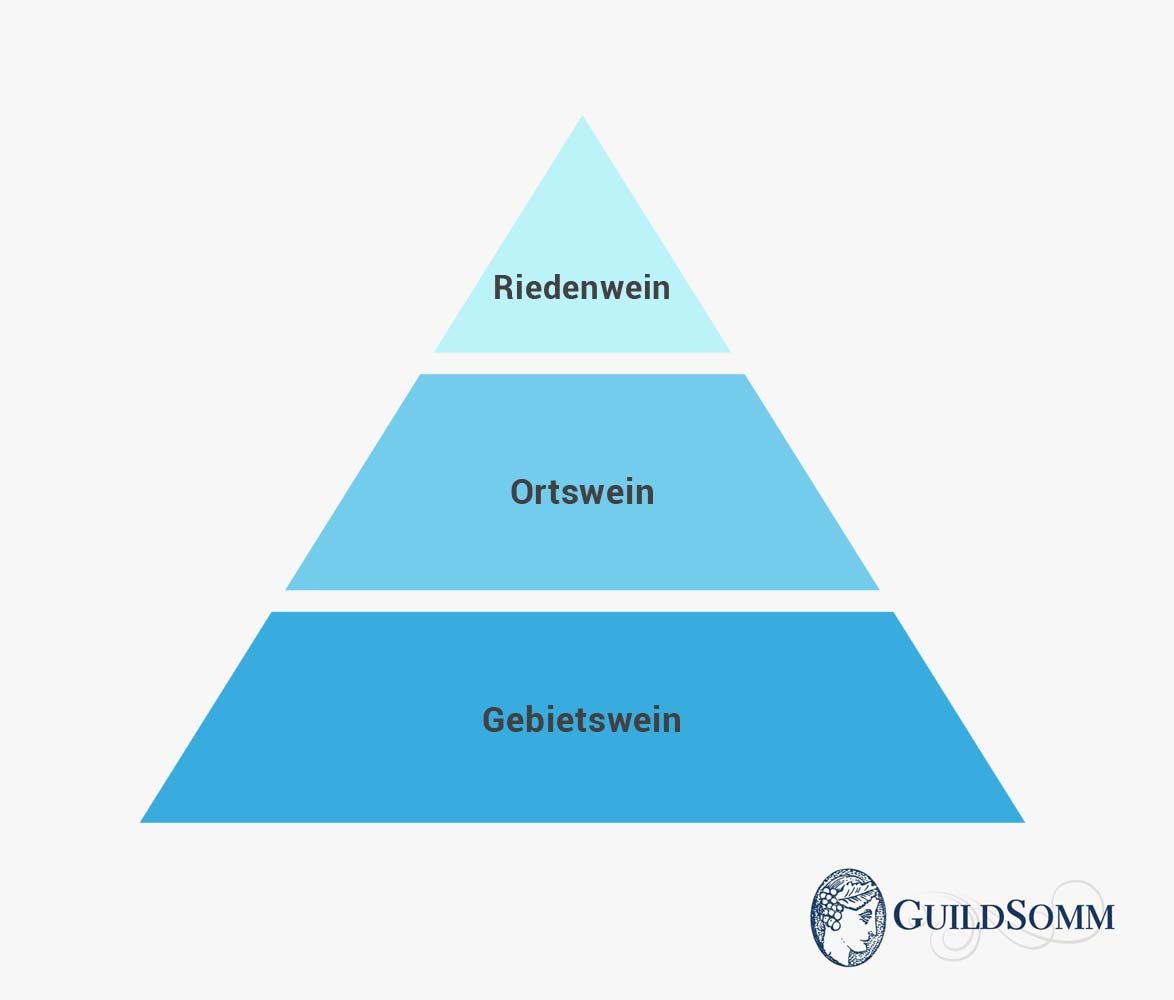 The three-tiered pyramid of ÖTW
One of the most remarkable and treasured geologic formations in Kamptal, and home to an important vineyard, is the Heiligenstein. Located near the village of Zöbing, this massive rock is composed of 270 million-year-old Permian desert sandstone—a type of sandstone with volcanic conglomerates not found in any other vineyard in the country. It is regarded as one of the most special vineyards for Riesling in Austria. Rising 345 meters in elevation, its terraced, 36-hectare vineyard faces south and west. Among the producers with vines here are Bründlmayer, Schloss Gobelsburg, and Hirsch.
There are many famed rieden throughout Kamptal, including Gaisberg, Loiserberg (a cooler, elevated vineyard at over 400 meters in altitude), and Lamm, an excellent site for Grüner Veltliner. Some of these rieden are further recognized as Österreichische Traditionsweingüter-designated erste lage sites.
Kamptal became a DAC in 2008. Basic DAC wines must have a minimum of 11.5% alcohol by volume. Wines may only come from Grüner Veltliner, Riesling, Chardonnay, Weissburgunder, or Grauburgundergrapes. While these two varieties reflect 60% of the hectarage (Grüner claiming most of this at 50%), there is still a substantial amount of wine in Kamptal bottled as Niederösterreich, though some of this percentage is presumably Niederösterreich g.U. Sekt.
Traisental
The sizeable Traisental region has relatively little area—only 815 hectares—under vine. It is peppered with historic villages that harbor heurigen, local taverns that traditionally serve fresh, recently released young wines from nearby growers. It is also home to St. Pölten, the capital of Lower Austria, in the south. One of the few regions growing in size, it serves as a hub for eager young vignerons to explore new grapes and styles—though the DAC, achieved in 2006, only allows for Grüner Veltliner and Riesling. Neumeyer, a prominent grower in Traisental, was a key figure in advocating for this region’s recognition as distinct from the umbrella Donauland designation it was under until 1995.
Traisental is tucked within the Mostviertel region south of the Danube and Kremstal, separated from the Wachau by the Dunkelsteinerwald, an extension of the Bohemian Massif, in the west. The vines are mostly clustered in the north, closer to the Danube but primarily alongside the left bank of the Traisen River, where active limestone and conglomerate soils are unique to this region. Terraced vineyards sit on east-facing slopes that reach as high as 400 meters in elevation, offering cooler conditions. Loess with conglomerate soils dominates Traisental, particularly on the right bank, and Grüner Veltliner is the leading grape with 475 hectares under vine. Grüner Veltliner from Traisental balances decadence and spice with distinctive structure and verve on the palate. The region receives more rain than its neighbors but benefits from a constant breeze that comes in from the forest. Vines are often trained high to avoid rot and counter frost. Reichersdorf and Inzersdorf are important winemaking villages.
Wagram
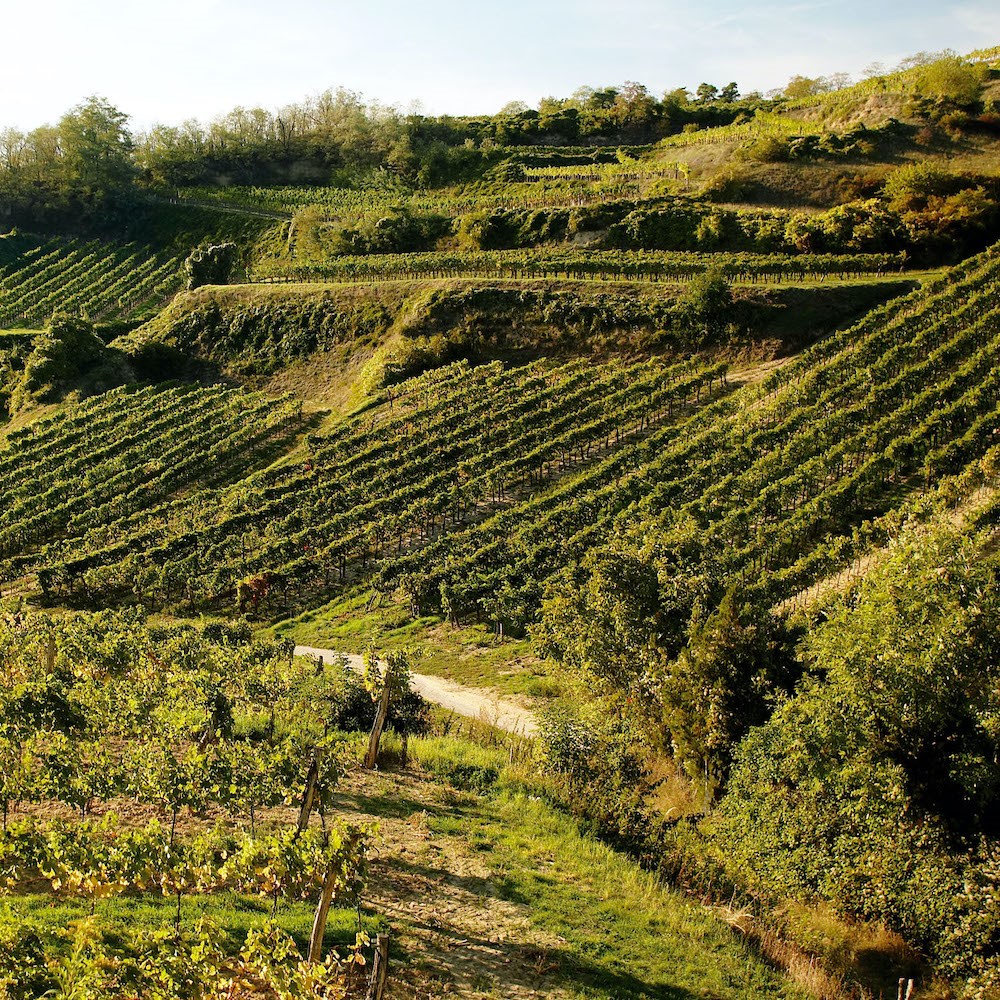 The vineyards of Wagram (Photo credit: ÖTW)
Wagram sits on the eastern edge of the Danubian regions, nearest to Vienna. Until 2007, it was known as Donauland and included Traisental; since then, each has gained its own boundaries. Wagram extends on both sides of the Danube. The vast majority of grapegrowing occurs on the north shore, and quite far from the river itself. Here, a ridge about 40 meters high lines the northern end of a grand plateau that was an ancient shoreline nearly 150 million years ago, when much of Central Europe was beneath the Paratethys Sea. The Ice Age brought layers of cakey loess, a significant component of the soils today, extending as deep as 20 meters atop primordial sea fossils. With steady southern exposure, Grüner Veltliner thrives, often yielding full-bodied, spicy wines with an identifiable creamy texture. Roter Veltliner and ageworthy Eiswein from Grossriedenthal are standouts as well. Other noteworthy villages include Feuersbrunn, Fels, and Kirchberg.
There are a few hundred hectares planted to the south, including around the 900-year-old Klosterneuburg Monastery, just outside of Vienna. The monastery’s wine institute, established in 1860, was formative for most of Austria’s leading winemakers in the late 19th and much of the 20th century. Vines are planted on mixed soils that include flysch rocks, a kind of layered shale embedded with greywacke-sandstone.
Wagram has long resided in the shadow of its more prominent western neighbors, but, much like Traisental, it is beginning to receive more respect for its rise in quality and overall value. Wagram was elevated to DAC status in 2022. A handful of dedicated and curious vignerons have reenergized the region in recent decades. Anton Bauer is experimenting with concrete eggs for his old vine Weissburgunder, Ecker-Eckhof ages reserve wines in acacia barrels, and Josef Fritz has made a name for his Roter Veltliners, the best from 60-year-old vineyards and aged in large casks. Trials with extended lees aging are also common, including with Bernhard Ott, who is among the most revered winemakers and a pioneer of biodynamic practices in Wagram.
Weinviertel
The Weinviertel offers open spaces, generous hilltop vistas, and quaint villages. In terms of winemaking, however, it was historically considered the land of bulk production and mediocre quality. Throughout recent centuries, this was an agricultural community that primarily focused on polyculture, with grapes one of many crops and the Gemischter Satz blend a utilitarian product. But by the mid-1980s, the Weinviertel, like so many regions throughout Austria, was rethinking quality, identity, and reputation. Led by individuals like Roman Pfaffl, a younger generation began to see the potential of the Weinviertel, which is home to more than 4,500 hectares of vines over 30 years of age. A commitment to quality was made more official when the Weinviertel became the first wine region to apply for and receive DAC status in 2002. That same year, 15 wineries formed the Premium Weingüter Weinviertel, an association dedicated to lifting the region’s reputation across several grapes and styles. Today, Grüner Veltliner comprises nearly half of the vines in the Weinviertel, and it is the only variety that qualifies for DAC consideration—despite ongoing debate.
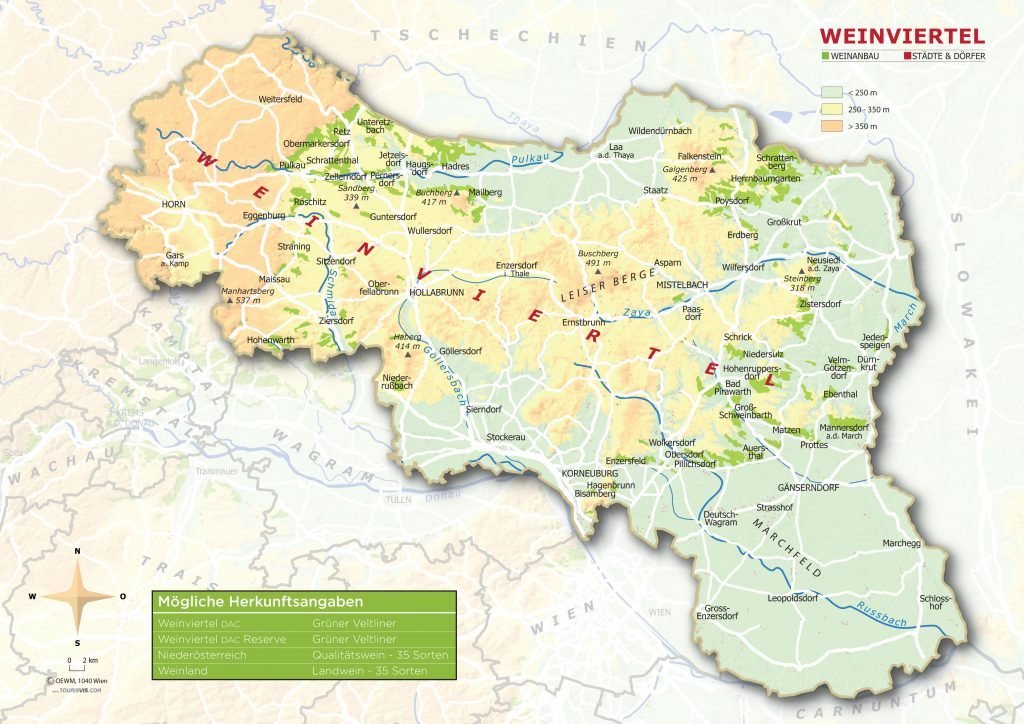 The Weinviertel; click to enlarge and zoom in (Credit: AWMB)
The Weinviertel extends 80 kilometers east to west and claims nearly half of the vines planted in all of Lower Austria. It is bordered by the Danube River to the south, the Czech Republic to the north, and Slovakia to the east. The region’s western frontier sees some of the primary granitic soils of its more prestigious neighbors, allowing for more structured Riesling. In and around the northwest area of the Pulkau Valley, there are some notable red winemaking villages, such as Haugsdorf and Jetzelsdorf; red wine is also produced further east in the warm town of Mailberg. Grüner Veltliner and Weissburgunder are successful in the loess-and-granite soils around Röschitz. To the south, Hohenwarth, on the Wagram border, has chalkier soils. Here, exceptional whites from Grüner Veltliner, Weissburgunder, and Roter Veltliner have been celebrated since the 1960s for their intensity and complexity.
The eastern half of the Weinviertel can be roughly divided into north and south in considering its wines. The northern stretches, centered around Poysdorf and Falkenstein, experience more wind and produce fresh, vibrant whites as well as fine examples of Sekt. Further south and closer to Vienna, the Pannonian Plain dictates warmer, softer expressions. The stretch from Korneuburg to Wolkersdorf, otherwise referred to as the flysch zone, yields very powerful, spicy styles of Grüner and Weissburgunder.
Throughout much of the late 18th century and into the 19th, Carnuntum enjoyed a quiet but respectable grapegrowing tradition. Yet its position on the borderlands of Slovakia and then Hungary’s Burgenland made it a popular crossroads for troops. By the end of World War II, Carnuntum had diminished in reputation. In response, a cooperative was established in the east, near Prellenkirchen, to process many of the region’s grapes. It wasn’t until the 1990s that Carnuntum’s potential, especially for red grapes, would be acknowledged again. In 1992, 25 producers formed the Rubin Carnuntum Wine Producers association and spelled out standards for high-quality Zweigelt—a grape that still dominates today, at over a quarter of the region’s vines. The Rubin designation falls within but goes beyond DAC regulations (received in 2019), mandating 100% Zweigelt, a minimum must weight of 18 degrees KMW (about 12.5% alcohol by volume), and a minimum of six months in wood. This group still exists and today has about 40 members.
Carnuntum
Carnuntum is the only region in Lower Austria where red grapes lead, at nearly 55%, with Zweigelt and Blaufränkisch on top. But the region grows nearly all of Austria’s grapes, including impressive examples from French varieties like Pinot Noir, Chardonnay, Cabernet Sauvignon, and Merlot. If bottled monovarietally, DAC white wines must be 100% Chardonnay, Grüner Veltliner, or Weissburgunder; in a blend, two-thirds of these varieties must be present, along with other Qualitätswein grapes. Primary red varieties for DAC wines are Zweigelt and Blaufränkisch, and the same rules apply for red blends.
There are three regions that can be considered in Carnuntum: the Leitha Mountains, Arbesthal Hills, and Hundsheimer Mountains. Some of the freshest wines come from the Leitha Mountains, where limestone-accented vineyards are protected by forests from the warm winds coming up from the Pannonian Plain. The isolated and steep sandy hillsides of Stixneusiedl are the source of much of the activity in the region. Most production comes from the Arbesthal Hills, roughly in the heart of the region around the villages of Göttlesbrunn and Höflein, where Gerhard Markowitsch, Walter Glatzer, and the Artner family have been pioneers. Warm, western-facing vineyards on deep, loamy soils and gravel are foundational for the area’s red wines, the best coming from hilltop sites cooled by winds from the Danube that offset the warmth from the south. In the east, particularly around Prellenkirchen and Spitzerberg, there is a renewed sense of enthusiasm, with leaders like Muhr-van der Niepoort and Johannes Trapl offering prime examples of elegant Blaufränkisch.
Thermenregion
Thermenregion has enjoyed a long winemaking tradition, but the Cistercian monks are primarily responsible for establishing its reputation in the Middle Ages. In the 15th century, sweet styles from the village of Gumpoldskirchen grew in popularity, going on to rival those of Rust and Tokaj through the 19th century. Thermenregion is widely recognized for its many heurigen, which attract the Viennese and tourists but have made it difficult for the region to progress in terms of quality. The tide is starting to turn, however, and Thermenregion is attracting accolades for its aspirational wines and inspiring excitement among young winemakers.
In 2023, the region was granted the DAC designation. The DAC features a three-tiered system of Gebietswein, Ortswein, and Riedenwein. At the Gebietswein level, producers are allowed to feature Rotgipfler, Zierfandler, Pinot Blanc, Pinot Gris, Chardonnay, Neuburger, Pinot Noir, St. Laurent, Blauer Portugieser, and Zweigelt as blends, monovarietal wines, or Gemischter Satz. At the Ortswein or village level, producers can use Gebietswein varieties except for Blauer Portugieser as blends or varietal bottlings hailing from the villages of Gumpoldskirchen, Wiener Neustadt, Perchtodsdorf, Bad Vöslau, and Tattendorf. Also at the Ortswein level, producers are permitted to make sweet wines from Auslese to Trockenbeerenauslese. Lastly at the Riedenwein (single-vineyard) level, the DAC focuses on Rotgipfler, Zierfandler, Pinot Blanc, Chardonnay, Pinot Noir, and St. Laurent. The first wines within the structure will be released in 2024.
Heurigen
The heuriger is an Austrian institution, thought to date back to Charlemagne’s days, but it was only legalized in 1784, when Emperor Joseph II defined it as “an inn which the proprietor can only serve wine and food of his own production,” according to Stephen Brooks. Heurige, meaning “this year,” refers to young wines. Heurigen—the establishments—offer up wines from the current vintage, or occasionally the last (alten), alongside local cuisine such as traditional huerigenplatte (cheese and charcuterie), schinkenfleckerl (pasta and ham casserole), or fleischlaberl (burgers) in a modest, communal setting. While there are heurigen across Austria, a rich tradition is particularly evident in Vienna, Traisental, and Styria. It was not always customary to serve food; often, visitors would bring their own to enjoy with the wine. Yet by the late 1970s, heurigen began to offer a simple menu of cold dishes. This is still the most traditional setup, though some have procured licenses to offer warm food and others are essentially modified restaurants serving a range of wines—defeating the original intent. The authentic experience still exists, even if it is harder to find. Historically, heurigen kept inconsistent hours throughout the day and year, indicating that they were open with a pine branch or gathering of fir branches above the doorway. This is one reason why heurigen are also known as buschenschänke (buschen means “bunches”), a more common name throughout Burgenland and Styria.
As Thermenregion sits over a fault line, bubbling hot springs can be found around the villages of Baden and Bad Vöslau. The region can be divided into two growing areas, with Baden as the dividing line between north and south. There are over 42 different winegrowing areas, though the greatest activity is centered around Gumpoldskirchen to the north and Tattendorf in the south. On the easternmost stretches of the Alps in the north, the vineyards of the Anninger Hills reach as high as 450 meters, clinging to marine limestone fossils over 19 million years old atop brown loamy soils. These well-protected hills face east and south, receiving ample sunshine and producing the best wines mid-slope. The northern wineries are prized for their Rotgipfler and Zierfandler. Both grapes have an affinity for desirable botrytis and can achieve high levels of sugar and extract, but where Rotgipfler has an expansive palate and dense, tropical fruit, Zierfandler tends toward more balance, with pointed acidity and focused yellow fruit. It is not uncommon for dry versions, such as those from Johanneshof Reinisch, to experience some skin contact and extended aging in neutral wood.
Though it appears flat as compared to the north, southern Thermenregion sits upon a plateau of gravelly, alluvial material, fully open to Pannonian warmth. Though less celebrated than the Anninger Hills, the southerly vineyards are nonetheless finding renewed attention for their Pinot Noir and St. Laurent. The best reserve reds tend to see new oak aging regimens. In 2003, a group of eight wineries established the Burgundermacher association—less a rule making establishment and more an outlet to exchange ideas and methods for achieving higher quality with Weissburgunder, Pinot Noir, and St. Laurent.
Wien
No capital city is so intimate with wine as Vienna. . . . Vineyards still hold their ground
right up to the tramlines within the heart of the residential districts and surge up the side
of the surrounding hills in the Vienna woods.
– “The World Atlas of Wine”
Winemaking within the city walls of Vienna (Wien in German) predates the Romans. Yet after the Turkish siege in 1683, grapegrowing was pushed beyond the walls and toward city limits—a fortunate shift, as the soils and climate there would prove to be more suitable for viticulture. Following a period of diminished sales after the city’s reorganization, Emperor Joseph II reinvigorated the local heurigen tradition, encouraging wineries to open up their doors. Wien is now recognized for its active, if not sometimes overly touristy, heurigen culture.
While some winemaking occurs south of the city in the warm areas of Mauer and Oberlaa, most of Vienna’s grapegrowing is to the north, on both sides of the Danube. The river is a critical moderating feature for vineyards subject to extreme frost in the spring and persistent heat from the Pannonian-Hungarian Plain in the summer. Wine from the Danube’s left bank is largely from the Bisamberg, a hill reaching about 350 meters in elevation and composed of well-drained flysch soils. This hill supplies winemakers in the surrounding villages of Jedlersdorf, Strebersdorf, and Stammersdorf with both white and red grapes. Across the river, fossil-laden limestone characterizes the soils in the 19th district and on the Nussberg hill, widely considered the most prominent area for quality grapegrowing. Nussberg accounts for about 200 hectares with south and southeast exposure, ranging from 175 to 360 meters in elevation. The best rieden are found mid-slope and include prized erste lagen such as Ulm, Rosengartel, and Preussen. Old Gemischter Satz sites are among the most sought-after vineyards in Vienna. Other noteworthy villages in the 19th are Nussdorf, Grinzing, Neustift am Walde, and Heiligenstadt.
In 2006, a group of six winemakers from across Vienna came together to form WienWein, with a mission to raise quality standards and showcase the region’s potential. Their effort culminated in obtaining DAC status in 2013, with a sole focus on Gemischter Satz. Fritz Wieninger has long been recognized for his transformative role in Vienna and was one of the first to demonstrate the potential for Gemischter Satz. Viennese crop reports document a three-fold rise in the category between 2009 and 2016, from 53 to 179 hectares. Wiener Gemischter Satz DAC requires a minimum of three white varieties; no single grape can exceed 50% of the blend, nor can one grape represent less than 10% if only three varieties are used. Those without a vineyard designation must be under 12.5% alcohol and made in the trocken style. Those with a stated ried on the label must be above 12.5% and are not required to be trocken.