
Chile Wine Tour: Maipo, Casablanca, Maule & Beyond in 3D
4,300 kilometers (2,672 miles) of Pacific coastline, Andean altitude, and one of the most dramatic geographic reshufflings in New World wine.
Chile’s wine identity has changed more in the past twenty years than in the previous two centuries. For most of its modern history, the country’s reputation was built on reliable, affordable Cabernet Sauvignon from the warm Central Valley: Maipo, Colchagua, Rapel, where irrigation and sunshine produced consistent, fruit-forward reds at scale. That era isn’t over, but it’s no longer the whole story. The interest in cool-climate coastal valleys like Casablanca and San Antonio in the 1980s and 1990s opened up entirely new possibilities for Chardonnay, Sauvignon Blanc, and Pinot Noir. And more recently, a new generation of producers has pushed south into Maule, Itata, and Bío Bío, reviving old-vine País and Cinsault, farming on granite rather than irrigated clay, and making wines that have nothing in common with the industrial Chilean paradigm. This Tour covers the full north-to-south sweep, from the desert vineyards of Atacama to the rainy frontier of the south.
Unlock the Full SommGeo Toolkit
Gain exclusive access to our entire suite of premium features, including interactive Map Makers, immersive 3D Tours, high-resolution classic Maps, and advanced analytical tools.
Start Free TrialInside This Tour
This Tour flies the full length of Chilean wine country, from the Atacama Desert at 27°S to the frontier regions south of Bío Bío. Producer pins, DO boundaries, and vineyard-level data at every stop. Every map frame is fully interactive. Don’t just watch the flythrough. Click, drag, zoom, and rotate the 3D terrain to explore from any angle, then click every pin for the full content.
- Maipo Valley and its historical role as Chile’s premier Cabernet region
- Casablanca and San Antonio: the coastal valleys that redefined Chilean white wine
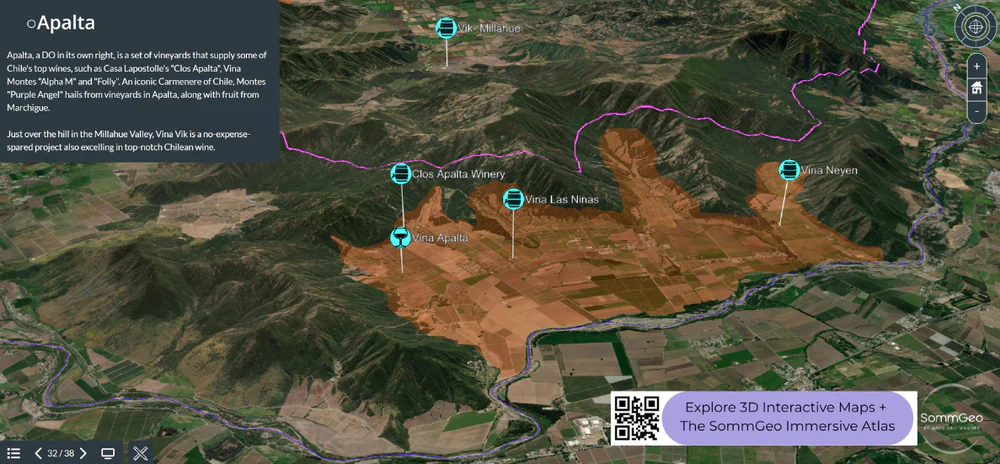
- Colchagua’s Apalta: one of Chile’s most celebrated red wine sites
- Maule, Itata, and the old-vine movement rewriting Chile’s identity
- Atacama’s extreme desert vineyards: Huasco and Copiapó at the northern frontier
- Producer profiles spanning the traditional establishment to the new wave

Chile’s Geographic Logic
Chile’s viticultural geography reads on two axes. North to south, the country stretches over 1,300 kilometers (808 miles) of vineyard land, from the near-desert conditions of Atacama to the rain-soaked frontier of the Sur. East to west, every valley is shaped by the same tug of war: the Andes providing altitude and dramatic diurnal temperature swings on one side, and the Pacific (specifically the cold Humboldt Current) driving fog and cooling winds into any valley that opens to the coast on the other. The flat valley floors between those influences are warmer, drier, and the source of most of Chile’s volume production.
Chile’s DO system classifies regions from north to south (Atacama, Coquimbo, Aconcagua, Central Valley, and the Sur) and further subdivides them by east-west position: Costa (coastal), Entre Cordilleras (between the ranges), and Andes. This three-dimensional grid: latitude, altitude, and coastal proximity, is the key to reading Chilean wine geography.
A Closer Look
Maipo Valley
Maipo is where Chilean quality wine began. Surrounding Santiago, it has been the country’s most important Cabernet Sauvignon region since the 19th century, when French-trained winemakers planted cuttings on its warm, well-drained alluvial soils. Alto Maipo (the upper eastern reaches, rising toward the Andes foothills) produces the most structured, mineral-driven Cabernets: Puente Alto is the specific sub-region behind Almaviva, Concha y Toro’s Don Melchor, and other benchmark wines.
Casablanca & San Antonio
Before Casablanca was planted in the mid-1980s, nobody believed Chile could produce serious cool-climate wine. Pablo Morandé’s gamble on this foggy, Humboldt-cooled valley between Santiago and Valparaíso proved everyone wrong. Casablanca’s Sauvignon Blanc and Chardonnay brought a freshness and aromatic precision that didn’t exist in Chilean wine before. San Antonio (including its sub-region Leyda) pushed even closer to the Pacific, producing Pinot Noir, Chardonnay, and Syrah with freshness from vineyards that can be hit by ocean fog until midday. Together, these two valleys fundamentally changed what Chile meant on the world stage.
Maule & the Southern Movement
Maule is where the most exciting changes in Chilean wine are happening right now. The region has always been Chile’s largest planted area, but historically its production went into bulk blends. What’s changed is a new generation recognizing that Maule’s old-vine País and Cinsault, some planted over a century ago on granite and volcanic soils, dry-farmed without irrigation, are assets, not relics. Producers like Clos des Fous, Bouchon, and MOVI (Movimiento de Viñateros Independientes) are making wines of freshness, tension, and site character from vineyards that cost a fraction of what you’d pay in Maipo or Colchagua. Itata and Bío Bío, even further south, are following the same trajectory: wetter, cooler, wilder, and producing some of Chile’s most distinctive wines.
Producers Worth Knowing
Viña Errázuriz, Aconcagua Valley
Founded in 1870 by Maximiano Errázuriz in the Aconcagua Valley, north of Santiago, warmer than Maipo, Errázuriz has been central to Chilean wine’s evolution for over 150 years. The estate pioneered cool-climate planting in Chile’s coastal zones (their Aconcagua Costa vineyards produce some of the country’s best Pinot Noir and Chardonnay) while maintaining serious Cabernet and Syrah from the warmer inland sites. The Don Maximiano Founder’s Reserve, first produced in 1983, remains one of Chile’s benchmark Bordeaux-style reds. Eduardo Chadwick, the current chairman, famously organized the 2004 Berlin Tasting where Chilean wines were blind-tasted against top Bordeaux and Tuscany, and won.
Clos des Fous, Multiple Regions
Founded in 2008 by Pedro Parra (one of the world’s leading terroir consultants), François Massoc, Paco Leyton, and Albert Cussen, Clos des Fous was born from frustration with the perception that Chilean wine was industrial and standardized. The project sources from vineyards across Malleco, Guarilihue, Alto Cachapoal, and Aconcagua Costa, deliberately seeking out extreme sites with stony soils where vines struggle. The wines are made with minimal intervention at their winery in Cauquenes, Maule: native yeast, cement fermentation, no corrections. It’s the clearest expression of the new Chilean philosophy: tension over power, site over variety, farming over winemaking.
Viña Almaviva, Puente Alto, Maipo
Almaviva is the joint venture between Concha y Toro and Baron Philippe de Rothschild (Mouton Rothschild), launched in 1997. The vineyards sit in Puente Alto at the base of the Andes, on well-drained alluvial soils with significant stone content, the same general area that produces Don Melchor. Almaviva is a Bordeaux-style blend, predominantly Cabernet Sauvignon, made with the kind of precision and investment that reflects both partners’ ambitions.
Notable Vintages: Chile
Among the standout recent vintages, 2015 is widely considered excellent: concentrated, balanced, and age-worthy across the Central Valley and Colchagua. 2014 produced excellent cool-climate results, particularly in Casablanca and San Antonio, with fresh acidity and aromatic purity. 2017 was outstanding in Maipo, with Cabernets showing classical structure and mineral depth. 2019 was strong across the board, with freshness and concentration in balance from coast to Andes.
Conversely, 2016 brought heavy El Niño rains and a warm, compressed harvest; some wines lack definition
New to the Tours? Learn how to navigate frames, click pins for detailed producer and region profiles, and get the most from your 3D experience.
Tours Guide →Ready to go deeper into Chile? Join 200+ wine organizations already using SommGeo.
Start Your 15-Day Free Trial $5/month billed annually after trial · Cancel anytime