
Bordeaux Wine Tour: Appellations, Soils & Classifications in 3D
Gravel, clay, limestone, and the classification systems built on top of them. Bordeaux is where terroir meets hierarchy in its most layered form.
Bordeaux needs no introduction, but it does reward a closer look at what actually separates one appellation from the next. The differences between a Pauillac and a Saint-Julien, or between the gravel banks of Pessac-Léognan and the clay plateau of Pomerol, aren’t abstract; they show up in the glass as structure, weight, and aging trajectory. This Tour walks through the major appellations with a focus on soils and how they shape wine style, the classification systems that codified (and sometimes froze) Bordeaux’s hierarchy, and the producers who continue to define their corners of the region. Pessac-Léognan, in particular, deserves more attention than it typically gets; it’s the birthplace of claret and the only appellation to produce both classified reds and whites at the highest level.
Unlock the Full SommGeo Toolkit
Gain exclusive access to our entire suite of premium features, including interactive Map Makers, immersive 3D Tours, high-resolution classic Maps, and advanced analytical tools.
Start Free TrialInside This Tour
This Tour covers Bordeaux’s major appellations across the Left Bank, Right Bank, and Graves, with detailed pins on classification tiers, soil types, and château profiles. Every map frame is fully interactive. Don’t just watch the flythrough. Click, drag, zoom, and rotate the 3D terrain to explore from any angle, then click every pin for the full content.
- Appellation-by-appellation soil comparison: Pauillac gravel vs. Saint-Julien gravel vs. Pomerol clay
- The 1855 Médoc Classification, Graves Classification, and Saint-Émilion Classification explained
- Pessac-Léognan: why the birthplace of claret deserves more attention than it gets
- Producer profiles: Léoville Las Cases, Pichon Baron, Pichon Lalande, Ausone, Clinet, and more
- Right Bank terroir: limestone plateau of Saint-Émilion vs. the clay and iron of Pomerol
- Bordeaux wine history from the 18th century through phylloxera and the modern era
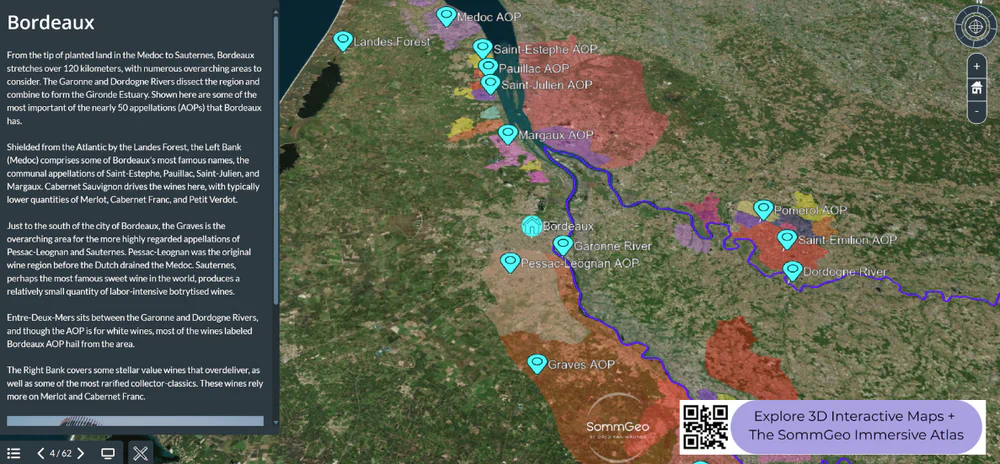

Soils & Appellation Character
For a geographic overview of France’s wine regions, see the France Fast Map. Here, we focus on what makes each Bordeaux appellation taste the way it does.
The Left Bank’s identity is gravel: deep beds of Quaternary-period pebbles, sitting on a clay-sand base. But the composition varies meaningfully. Pauillac’s gravel mounds produce the most powerful, structured Cabernet Sauvignon in Bordeaux: dense, tannic, cassis-driven wines built for decades. Saint-Julien, just south, shares the gravel profile but tends toward a slightly finer grain, producing wines that balance Pauillac’s power with notable elegance and consistency (it has the highest proportion of classified growths per hectare of any Médoc commune). Margaux’s gravel is thinner and more fragmented, yielding wines of perfume and suppleness rather than sheer weight. Saint-Estèphe, the northernmost, has more clay mixed into its gravel, giving wines their characteristic firmness and occasional rusticity.
Pessac‑Léognan sits on some of Bordeaux’s most famous gravel terraces (thick beds of quartz‑ and flint‑rich ‘graves’ over sand and clay) forming a distinct geological island just south of the city. It’s the only major Bordeaux appellation where classified estates produce both reds and whites at the top level (the 1953/1959 Graves Classification covered 16 châteaux, all within Pessac-Léognan). Across the Gironde, Pomerol’s famous clay plateau, laced with iron-rich deposits known as crasse de fer, produces Merlot-dominant wines of extraordinary richness and texture, but with remarkable concentration. Saint-Émilion splits between its limestone plateau and côtes (where Ausone and Pavie sit) and its gravel-sand soils closer to Pomerol (Cheval Blanc and Figeac territory).
Bordeaux Blanc & Sweet Wines
Bordeaux’s white wines are easy to overlook in a region dominated by red, but the best are genuinely world-class, and the sweet wines of Sauternes and Barsac represent one of the most extraordinary expressions of botrytis anywhere on earth.
Dry whites are led by Pessac-Léognan, where classified estates like Haut-Brion and La Mission Haut-Brion produce barrel-fermented blends of Sauvignon Blanc and Sémillon with the weight and aging potential to rival top white Burgundy. Domaine de Chevalier, Smith Haut Lafitte, and Pape Clément also produce whites of real distinction. The style is textural, often waxy, with citrus, stone fruit, and a smoky minerality that develops beautifully over a decade or more.
Sauternes and Barsac, tucked into the southern Graves where the cold waters of the Ciron meet the warmer Garonne, are the source of Bordeaux’s legendary sweet wines. The confluence creates autumn morning mists that encourage Botrytis cinerea (noble rot) to develop on Sémillon, Sauvignon Blanc, and Muscadelle. The resulting wines are intensely concentrated, with flavors of apricot, honey, saffron, and marmalade, balanced by a spine of acidity that gives the best examples extraordinary longevity. Château d’Yquem, the only Premier Cru Supérieur in the 1855 Classification, remains the benchmark. Barsac, which sits on flatter limestone terrain and may label its wines as either Barsac or Sauternes, tends toward a slightly fresher, more delicate style. Climens and Coutet are the leading Barsac estates, both classified as Premiers Crus.
The commercial reality is that Sauternes has struggled for decades; production costs are enormous, demand is limited, and prices have not kept pace with quality. Some producers have pivoted toward dry white production or reduced their sweet wine volumes. But the wines themselves, when given the attention they deserve, remain among the most profound in all of Bordeaux.
Producers Worth Knowing
Château Léoville Las Cases, Saint-Julien
The undisputed reference for Saint-Julien and one of the most commonly cited “Super Second” in Bordeaux. The Grand Enclos (the walled vineyard parcel that abuts Château Latour) produces wines of First Growth intensity at Second Growth pricing (a gap that narrows with every vintage). The style is precise, structured, and deeply concentrated, with a mineral backbone that gives it more in common with its Pauillac neighbor than with the rest of Saint-Julien.
Pichon Baron & Pichon Lalande, Pauillac
Two estates, one origin. The original Pichon Longueville property was split in 1850 when Baron Joseph divided it among his children: his two sons received what became Pichon Baron (with the château), and his three daughters received the larger vineyard parcel that became Pichon Lalande (Comtesse de Lalande). Both are classified Second Growths and sit directly across the road from each other in Pauillac. The styles diverged over time; Pichon Baron is the more powerful and structured of the two, while Pichon Lalande has traditionally carried a higher proportion of Merlot, producing a more supple, aromatic expression of Pauillac. Baron is now owned by AXA Millésimes; Lalande by the Rouzaud family (Louis Roederer).
Château Ausone, Saint-Émilion
Premier Grand Cru Classé A until its withdrawal from the Saint-Émilion classification in 2022. Ausone occupies one of the most dramatic vineyard sites on the Right Bank: steep limestone côtes with south-facing exposure, producing wines of extraordinary mineral tension from roughly equal parts Cabernet Franc and Merlot. The production is tiny (fewer than 2,000 cases), the prices are astronomical, and the wines are among the most age-worthy in all of Bordeaux.
Château Clinet, Pomerol
Located on the central Pomerol plateau near the appellation’s best clay-gravel soils. Clinet produces a Merlot-dominant blend (typically 85%+) that showcases Pomerol’s signature combination of power and silk: dark fruit, truffle, and iron minerality wrapped in velvety tannins. Under the Laborde family’s ownership since 1998, the estate has steadily climbed in quality and now sits comfortably among Pomerol’s top tier.
Notable Vintages: Bordeaux
Among the standout vintages of the past two decades, 2010 combined power with classical structure: firm tannins, excellent acidity, and extraordinary concentration that rewards patience. 2015 delivered generous, ripe wines with broad appeal and excellent balance across both banks. 2016 brought freshness and precision after the warmth of 2015, producing wines with remarkable purity and fine-grained tannins; some consider it the finest recent vintage for the Left Bank. 2005 offered dark-fruited intensity and firm structure built for long aging. 2009, rich and approachable from the start, remains a crowd favorite with opulent fruit and supple tannins.
For tough years, 2013 was cool and uneven, producing lighter wines that required careful selection, far better on the Right Bank than the Left. 2011 brought early-season heat followed by a wet, cool summer, yielding variable results. 2012, while not a disaster, was inconsistent, better in Pomerol and Saint-Émilion than across the Médoc.
New to the Tours? Learn how to navigate frames, click pins for detailed producer and region profiles, and get the most from your 3D experience.
Tours Guide →Ready to go deeper into Bordeaux? Join 200+ wine organizations already using SommGeo.
Start Your 15-Day Free Trial $5/month billed annually after trial · Cancel anytime