
Italy Wine Regions Map: Interactive Guide
From the Nebbiolo hills of Piedmont to the volcanic slopes of Etna. Navigating the world’s most diverse wine country.
Italy is, by any measure, the most complex wine country on earth. Every single one of its 20 administrative regions produces wine. There are 78 DOCG appellations, over 330 DOCs, more than 120 IGTs, and somewhere north of 500 indigenous grape varieties in commercial production, a number that dwarfs every other country on the planet. In 2024, Italy reclaimed its position as the world’s largest wine producer at nearly 44 million hectoliters from 728,000 hectares (1,798,924 acres) of vineyards. And yet, for all that volume, the best Italian wines remain some of the most site-specific, terroir-driven bottles you’ll find anywhere. From the Nebbiolo-draped slopes of Barolo to the Sangiovese heartland of Montalcino, from Franciacorta’s metodo classico sparklers to the explosive reds of Mount Etna, this interactive Italy wine regions map lets you explore the full scope of a country where geography, grape, and tradition intersect in ways no other wine nation can match. Every mapped region includes detailed popup content covering grape varieties, classification hierarchies, climate and soil profiles, and viticultural specifics, a sommelier-level reference built directly into the map.
Unlock the Full SommGeo Toolkit
Gain exclusive access to our entire suite of premium features, including interactive Map Makers, immersive 3D Tours, high-resolution classic Maps, and advanced analytical tools.
Start Free TrialWhat You’ll Explore
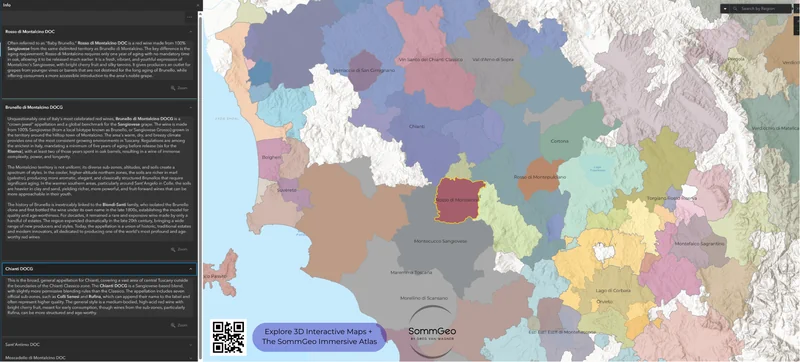
This interactive portal maps Italy’s full appellation hierarchy across all 20 wine-producing regions, but the real depth is in what each region reveals. Click on any mapped appellation and a comprehensive info panel opens with sommelier-level content: permitted grape varieties, DOCG and DOC classification requirements, soil and geological profiles, climate data, key producers, and the viticultural specifics that define each area. Whether you’re reading about the calcareous marl driving Barolo’s complexity, the galestro soils of Chianti Classico, or the volcanic terraces shaping Etna’s explosive reds, every single mapped region carries this level of built-in intelligence.
- All DOCG and 330+ DOC appellations with searchable sidebar navigation
- In-depth appellation profiles for every mapped area: varieties, classification rules, geology, climate, and more
- Piedmont’s Langhe hills: Barolo, Barbaresco, and surrounding Nebbiolo zones
- Tuscany’s Sangiovese heartland: Brunello di Montalcino, Chianti Classico, Vino Nobile
- Southern Italy and the islands: Campania, Puglia, Sicily’s Etna, Sardinia
- Topographic relief showing how the Alps and Apennine spine shape climate from north to south


Italian Wine Law: The Classification System
Italy’s wine classification system is both its greatest strength and its most frequent source of confusion. Modeled on the French AOC system, the structure was introduced in 1963 with the creation of DOC (Denominazione di Origine Controllata), a framework regulating permitted grape varieties, yields, aging requirements, alcohol levels, and production zones. The first DOCs included Vernaccia di San Gimignano and Frascati. By the late 1970s, however, critics argued the DOC designation had been given too liberally, diluting its meaning.
The response was DOCG (Denominazione di Origine Controllata e Garantita), introduced in 1980 as the pinnacle of the pyramid. The original DOCGs were Brunello di Montalcino, Vino Nobile di Montepulciano, and Barolo (all approved by presidential decree in July 1980) followed by Barbaresco three months later. A wine must hold DOC status for at least ten years before it can be promoted to DOCG, and every DOCG wine must pass a government tasting panel before being bottled with a numbered seal. Today there are 78 DOCGs, concentrated heavily in Piedmont, Tuscany, and the Veneto.
Then there’s IGT (Indicazione Geografica Tipica), created in 1992 to solve a uniquely Italian problem: some of the country’s most acclaimed wines (the so-called “Super Tuscans”) couldn\’t qualify for DOC or DOCG because they used unauthorized grape varieties or winemaking methods. Tignanello, Sassicaia, Ornellaia: these were labeled as humble Vino da Tavola (table wine) despite selling for hundreds of dollars. IGT gave them a classification that acknowledged geographic origin without the rigid varietal and production restrictions of DOC/DOCG. Since the 2008 EU reform, DOC and DOCG are both classified under the broader DOP (Protected Designation of Origin), while IGT falls under IGP (Protected Geographical Indication), though the traditional Italian terms remain in common use.
You’ll also encounter important label terms: Classico denotes wines from the historic heart of an appellation (Chianti Classico, Valpolicella Classico), Superiore indicates higher minimum alcohol and usually stricter yield limits, and Riserva signals extended aging beyond the standard minimum for the denomination.
Geography: The North-South Divide
Italy stretches from roughly 36°N at the southern tip of Sicily to 47°N in the Alps, an 11-degree span of latitude that, combined with the country’s mountainous topography, produces one of the widest ranges of viticultural climates on earth. The Alps form a barrier across the north, protecting the Po Valley and the Piedmontese hills from the worst of continental Europe’s cold air. The Apennines run like a spine down the center of the peninsula, creating distinct eastern and western flanks with different rainfall patterns, sun exposure, and maritime influence.
Northern Italy is where you’ll find the country’s most structured, age-worthy wines. Piedmont’s continental climate (foggy autumns, cold winters, warm but not scorching summers) gives Nebbiolo the long, slow ripening season it needs to develop its signature tannins and aromatics. Lombardy’s Franciacorta benefits from the moderating influence of Lake Iseo and cool Alpine air. The northeast (Alto Adige, Trentino, Friuli Venezia Giulia) sits at the crossroads of Italian and Germanic winemaking traditions, producing some of Europe’s most precise, mineral-driven whites from varieties like Pinot Grigio, Gewürztraminer, and Friulano at elevations that can exceed 1,000 meters (3,280 ft).
Central Italy is Sangiovese country. Tuscany dominates the conversation (Chianti, Brunello, Vino Nobile, Bolgheri) but Umbria (Sagrantino di Montefalco), Le Marche (Verdicchio, Montepulciano d’Abruzzo across the border in Abruzzo), and Lazio each contribute distinctive expressions. The Mediterranean climate here is moderated by altitude in the hills and by maritime breezes along the Tyrrhenian coast.
Southern Italy and the islands are where things get hot, and increasingly interesting. Campania (Taurasi from Aglianico, Fiano di Avellino, Greco di Tufo), Puglia (Primitivo, Negroamaro), Calabria, Basilicata, Sicily, and Sardinia represent Italy’s most dynamic frontier. Mount Etna, an active volcano rising to 3,357 meters (11,013 ft) on Sicily’s east coast, has become one of the most exciting wine regions in the world over the past two decades, producing ethereal reds from the indigenous Nerello Mascalese grown on ancient lava flows at elevations above 700 meters (2,296 ft). Three seas (the Adriatic to the east, the Tyrrhenian to the west, and the Mediterranean/Ionian to the south) moderate temperatures and create the breezes that make high-quality viticulture possible even at southern latitudes.
Indigenous Grape Varieties
Italy’s grape diversity is staggering. The Ministry of Agriculture has documented over 500 indigenous varieties in commercial production, with some estimates putting the total number of identified native cultivars above 2,000. No other country comes close. Roughly 75% of Italy’s national vineyard is planted to just 80 native varieties, but the long tail of rare, hyper-local grapes is what makes the Italian wine landscape endlessly interesting.
The headline reds are Sangiovese (the backbone of Chianti, Brunello di Montalcino, and Vino Nobile), Nebbiolo (Barolo, Barbaresco, and the broader Langhe), Aglianico (Taurasi in Campania, Aglianico del Vulture in Basilicata), Barbera (Piedmont’s workhorse), Primitivo (Puglia), Nero d’Avola (Sicily), and Nerello Mascalese (Etna). Among the whites, Trebbiano remains the most planted (though not the most interesting), while Garganega (Soave), Verdicchio (Le Marche), Fiano (Campania), Greco (Campania), Arneis (Piedmont), Cortese (Gavi), and Glera (Prosecco) represent the breadth of what Italy’s white grapes can do. And then there are the obscurities (Timorasso, Pelaverga, Coda di Volpe, Carricante, Grillo, Catarratto, Sagrantino) that reward the adventurous drinker and make some of the most interesting whites.
Key Wine Regions
Barolo & Barbaresco: Piedmont’s Nebbiolo Kings
Barolo and Barbaresco are two of the greatest wine appellations in the world. Both sit in the Langhe hills of Piedmont, both are made from 100% Nebbiolo, and both produce wines of extraordinary complexity, structure, and longevity. Yet they are meaningfully different. Barolo, the larger appellation, encompasses 11 comuni (villages, including the famous names of La Morra, Barolo, Castiglione Falletto, Serralunga d’Alba, and Monforte d’Alba) spread across roughly 2,100 hectares (5,189 acres) of vineyard. The wines must age a minimum of 38 months (18 in oak), with Riserva requiring 62 months. They tend toward power, concentration, and tannic grip in youth, with the capacity to age for decades.
Barbaresco, just northeast, is smaller (roughly 800 hectares (1,977 acres) across four comuni), sits at slightly lower elevations, and produces wines that are often described as more elegant and approachable in youth, though the best are every bit as age-worthy as top Barolo. Minimum aging is 26 months (9 in oak), with 50 months for Riserva. The soils across both appellations are predominantly calcareous marl; the Tortonian soils of La Morra and Barolo tend toward sand and clay, producing more perfumed, earlier-drinking wines, while the Helvetian marls of Serralunga and Monforte d’Alba are harder and more compact, yielding wines of greater structure and longevity.
Producers like Giacomo Conterno, Bruno Giacosa, Bartolo Mascarello, Gaja, Vietti, Produttori del Barbaresco, and Roagna have made these appellations benchmarks of fine wine. The ongoing MGA (Menzioni Geografiche Aggiuntive) system (officially recognizing individual vineyard sites) has added a new layer of specificity that makes the interactive map particularly useful for understanding how geography translates into the glass.
Brunello di Montalcino: Sangiovese at Its Peak
If Barolo is the undisputed king of Nebbiolo, Brunello di Montalcino holds that title for Sangiovese. Located south of Siena in Tuscany, the appellation covers roughly 3,500 hectares (8,649 acres) of vineyard on and around the hill town of Montalcino. The wines are 100% Sangiovese (locally called Brunello), and the aging requirements are among Italy’s most demanding: a minimum of five years from harvest before release, including two years in oak, with Riserva requiring six years total.
Montalcino sits at 564 meters (1,850ft) elevation, and the vineyards radiate outward from the town across a remarkable diversity of exposures, altitudes, and soil types. The north slope tends to be cooler and later-ripening, producing more structured, aromatic wines. The south and southwest slopes are warmer, yielding riper, more approachable styles. The southeast, particularly the area around Castelnuovo dell’Abate, benefits from the cooling influence of the nearby Orcia River valley. While the topic of officially designating subzones remains complicated by local politics (apologies to those who’ve tried), there is no question that different sectors of the hill produce meaningfully different wines.
Brunello was one of the original three Italian DOCGs in 1980, and producers like Biondi-Santi (whose family essentially created the modern wine in the mid-19th century), Soldera, Il Poggione, Salvioni, Fuligni, and Canalicchio di Sopra continue to demonstrate why Sangiovese from this singular hill deserves its place among the world’s greatest reds.
Franciacorta: Italy’s Méthode Champenoise
Franciacorta is Italy’s answer to Champagne, and it’s a serious one. Located in Lombardy on the glacial moraine hills south of Lake Iseo, this was the first Italian DOCG to mandate metodo classico production (secondary fermentation in the bottle), earning its DOCG in 1995. The region covers roughly 3,000 hectares (7,413 acres) across 19 municipalities, with over 120 producers making approximately 17 to 19 million bottles annually. The numbers are a fraction of Champagne’s output, but the quality at the top is genuinely high.
The permitted grapes are Chardonnay (the dominant variety at around 80% of plantings), Pinot Nero, Pinot Bianco, and Erbamat, a rare local variety recently admitted to the blend to add acidity as a hedge against climate change. The aging requirements exceed Champagne’s minimums: 18 months on lees for non-vintage, 30 months for Millesimato (vintage), and a full 60 months for Riserva. Satèn, a style unique to Franciacorta, is a blanc de blancs produced at lower pressure (generally ~4.5 atmospheres versus the standard 6), resulting in a creamier, silkier mousse that’s become the appellation’s calling card. The microclimate (cool Alpine air meeting the thermal moderation of Lake Iseo, on mineral-rich glacial soils) gives the wines a freshness and finesse that distinguishes them clearly from both Champagne and Prosecco.
Chianti Classico & the Super Tuscans
No discussion of Italian wine is complete without Chianti Classico and the Super Tuscan phenomenon. Chianti Classico, the historic heart of the larger Chianti DOCG, lies between Florence and Siena on rolling hills of galestro (friable clay-limestone) and alberese (hard limestone) soils. The wines must be at least 80% Sangiovese, with the remainder drawn from approved red varieties. In modern times, the quality has never been higher; the Gran Selezione tier (introduced in 2014) represents single-vineyard or estate-level expressions meant to compete with Italy’s finest.
The Super Tuscan movement, born in the late 1960s and 1970s, was a direct rebellion against what ambitious producers saw as outdated DOC regulations. Winemakers like Mario Incisa della Rocchetta (Sassicaia), Piero Antinori (Tignanello, Solaia), and Lodovico Antinori (Ornellaia) began blending Cabernet Sauvignon, Merlot, and Cabernet Franc (either alone or with Sangiovese) in French oak barriques. These wines couldn’t qualify for Chianti DOCG, so they were labeled as humble Vino da Tavola. The market didn’t care about the label; the wines became some of Italy’s most collected bottles, and the creation of the Bolgheri DOC (and eventually Bolgheri Sassicaia DOC, a single-wine appellation) brought them back into the fold.
Southern Italy & the Volcanic Frontier
Southern Italy’s wine revolution is one of the great stories in contemporary wine. Campania leads the charge with three white DOCGs (Fiano di Avellino, Greco di Tufo, and the lesser-known Aversa) and Taurasi DOCG, where the Aglianico grape produces deeply tannic, age-worthy reds often called the “Barolo of the South.” Puglia, Italy’s largest wine-producing region by volume, has moved beyond bulk production, with Primitivo di Manduria and Negroamaro-based Salice Salentino earning serious attention.
But the real excitement is on Mount Etna. This active volcano on Sicily’s east coast has attracted a wave of investment from some of Italy’s most ambitious producers (Andrea Franchetti, the Benanti family, Tenuta delle Terre Nere, and more recently, marquee names from Tuscany and Piedmont). Etna DOC wines (reds from Nerello Mascalese, whites from Carricante) are grown on ancient lava flows at elevations often exceeding 700 meters (2,296 ft). The result is wines of extraordinary elegance, transparency, and volcanic minerality, with a Burgundian sense of place. The contrade (individual vineyard districts) of Etna are rapidly being recognized and mapped, making this one of the most dynamic regions to explore on the interactive portal.
Ready to explore Italy’s wine regions in full detail? Join 200+ wine organizations already using SommGeo.
Start Your 15-Day Free Trial $5/month billed annually after trial · Cancel anytime